

Editorial transparency. Floralens publishes this site and appears in the ranking. The test applies the same grid to every candidate; each verdict cites public sources (UK App Store, Google Play UK, RHS, Plantlife, Numerama, INRAE, specialist press).
Our ranking at a glance
| Rank | App | Best for | Annual price | Rating | Languages |
|---|---|---|---|---|---|
| 1 | Floralensour app | Identification + diagnosis, no account, offline | $34.99 | 39 | |
| 2 | PlantNet | The best free option, backed by CIRAD | Free | 41 | |
| 3 | PictureThis | The largest review base, but heavy tracking | $39.99 | 28 | |
| 4 | Seek by iNaturalist | For families: free, safe, playful | Free | 30 | |
| 5 | Flora Incognita | The highest peer-reviewed accuracy (98.8%) | Free | 35 | |
| 6 | PlantSnap | Largest claimed catalogue (600,000 species) | $21.99 – $59.99 | 17 | |
| 7 | Google Lens | Quick ID without installing a dedicated app | Free | 100 | |
| 8 | Planta | Swedish identification paired with a care planner | $17.99 – $47.99 | 12 | |
| 9 | Plant Parent | Identification + diagnosis, by Glority (same publisher as PictureThis) | $29.99 | 15 | |
| 10 | PlantIn | Recognition topped up by paid human botanists | $29.99 – $39.99 | 19 | |
| 11 | Greg | English-language ID with pot and light measurement | $19.99 – $39.99 | 1 | |
| 12 | Plantum | ex-NatureID, AIBY identification at a highly variable price | $39.99 | 9 |
How to judge the accuracy of an identification app
Three things genuinely matter in the quality of a photo recognition.
The quality of the image you provide. PlantNet's official demonstration on YouTube 1 makes the point well: reliable identification often needs several organs visible, and a single leaf shot rarely separates two neighbouring species.
The size and nature of the catalogue. PlantNet claims around 20,000 species oriented towards wild flora 2. PictureThis and Floralens reach 400,000 species with broader coverage including houseplants and cultivars. PlantSnap pushes to 600,000. A large catalogue increases coverage but also the risk of false positives on closely related plants.
The displayed confidence score. An app that hands you a single peremptory name is more dangerous than one that offers three hypotheses ranked by probability. PlantNet and Floralens show a confidence score; Google Lens and some consumer apps settle for the top result alone.
For UK wildflowers specifically, Plantlife, the British conservation charity, recommends PlantNet, Seek and a small handful of others, and notes that letting an app narrow its search to a regional flora helps rule out non-British lookalikes 3. The RHS, for its part, now bundles its own ID tool into the RHS Grow app, alongside two centuries of horticultural advice 4.
Ready to take care of your plants?
Identify, diagnose, learn. Everything your plants need.
Top 12 identification apps tested

Floralens
Identify AND diagnose, with no mandatory account or tracking
- Annual price
- $34.99 (7-day free trial)
- Free version
- 4 free IDs, no sign-up
- Languages
- 39
- App Store rating
- 4,7 ★
- 66-symptom diagnostic engine (Dr. Flora)
- Offline queue for scans plus access to saved plant and garden info
- No mandatory account, no cookies, no data selling
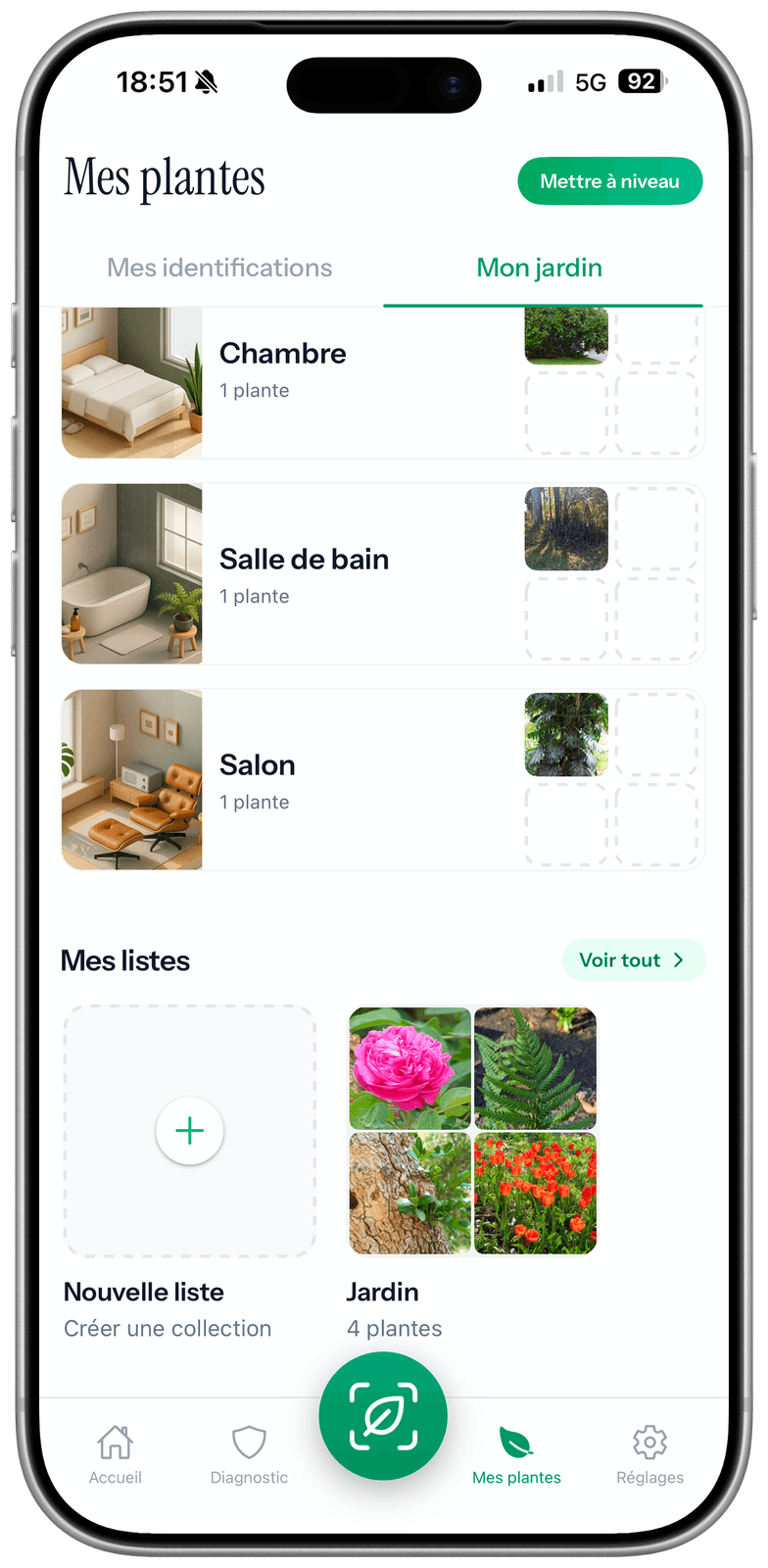
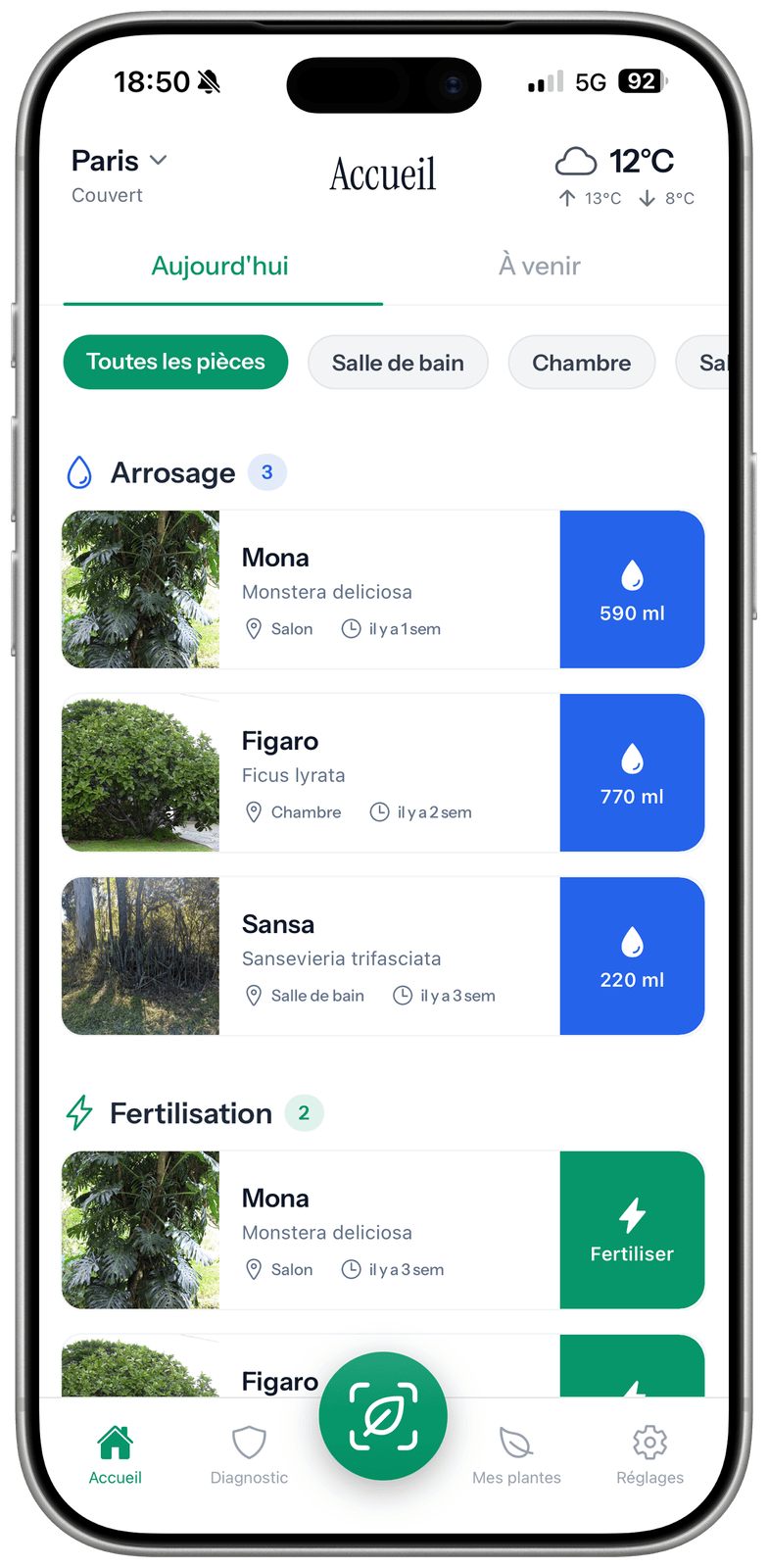
The photo returns the species name with a confidence score and alternative hypotheses when the scan hesitates. Each species page details origin, toxicity to dogs, cats and children, hardiness zones, soil pH, exposure, humidity and growth rate. The encyclopaedia references around 400,000 known species (indoor, outdoor, wild flora) and is navigable by family, genus and species so you can explore related plants without going back through a photo. Once recognised, a plant is saved to a room (living room, balcony, office) and the watering reminders adjust to pot, exposure, season and hemisphere: not the same cadence for a south-facing ficus and a bathroom pothos.
Beyond identification, Dr. Flora cross-references 66 symptoms (yellowing, spots, pests, etiolation) with their likely causes and a treatment plan. Two editorial choices set the app apart: no mandatory account, with photos that stay on the device unless you explicitly ask otherwise; and broad language coverage with 39 languages, against 5 to 30 for its direct rivals. Published in France by Chapalu Studio, it offers four free identifications with no sign-up before a clear annual subscription.
Between the images, the detailed descriptions for each species and all the knowledge to manage your plants better, I find it the most complete app of all the ones I have tested.
I used to manage to kill even a fake plant, and I have finally got a grip on this monstera that kept putting out one yellow leaf after another. In a single photo everything was detected: the pot, the spot, the light, and I had recommendations straight away.
I am a complete beginner with plants, and Floralens helps me enormously day to day. The app is simple to use, recognises plants quickly and gives clear, easy-to-understand advice.
Floralens combines photo identification, the Dr. Flora diagnosis across 66 symptoms and a context-aware care plan (pot, exposure, season, hemisphere). 39 languages, no mandatory account, a clear annual subscription after four free identifications.

PlantNet
Free botanical identification, backed by French public research
- Annual price
- Free
- Free version
- Unlimited, 100% free
- Languages
- 41
- App Store rating
- 4,6 ★
- Completely free on the App Store
- About 20,000 recognizable species listed on the App Store page
- Community-reviewed observations contribute to biodiversity research
PlantNet rates 4.7/5 on the UK App Store 2. The app is 100% free, with no advertising or in-app purchases, and supported by CIRAD in France along with several public research institutes.
Plantlife, the British wildflower charity, lists PlantNet among its recommended identification tools and highlights its citizen-science backbone 3. The strength of the project lies in its participatory science: every observation helps enrich the global scientific database on plant biodiversity. Experienced users validate other people's identifications, which pushes reliability upwards on wild plants. For UK records, PlantNet's regional-flora filter helps rule out non-British lookalikes.
Two limits to know. The catalogue favours wild flora over houseplants and horticultural cultivars, which makes it less effective on a cultivated rubber plant or pothos. And the app includes neither disease diagnosis nor care reminders: it is an identification tool, not a growing companion.
The app identifies a vast range of plants quickly and accurately, and it also provides detailed information on each species.
Thank you for this quality app. The recognition is not 100% reliable, which is normal, but impressive enough all the same, with several suggestions when there is doubt.
Brilliant for wildflowers, but I wish it covered indoor plants and cultivars better; it struggles with anything that is not native flora.
PlantNet remains the reference for identifying a plant free of charge. The project is run by CIRAD and several research institutes, with a deliberately citizen-science logic.

PictureThis
The widest user and cultivar base, if you accept the tracking
- Annual price
- $39.99 (offer-dependent)
- Free version
- Free trial
- Languages
- 28
- App Store rating
- 4,8 ★
- 1M+ App Store ratings
- 400,000+ species and 98% accuracy claimed by the developer
- Disease diagnosis, pet warnings, light meter, and expert consultation
PictureThis shows more than 1.6 million reviews worldwide and a high average rating on the UK App Store 5. The listing claims 400,000 species recognised with 98% accuracy, plus disease diagnosis, a light meter, watering reminders and expert consultations.
The official privacy label indicates that the app uses tracking data (purchases, identifiers, usage data) across third-party apps and websites, and links to your identity: contact details, user content, search history, identifiers and diagnostics. It is one of the heaviest profiles in the ranking, to be set against PlantNet, which essentially collects location and photos for its scientific project.
The publisher, Glority Global Group Ltd., also releases Plant Parent; the two apps share their recognition architecture.
It is paid, and you always hesitate before spending a non-trivial yearly sum on an app, because there are plenty of free ones in the same vein. But after testing them, this one stands out clearly for its speed and above all its accuracy.
My plants are healthy, but a few marks make me want to check. The app just tells me they are fine, and that is all. It is not as sharp as the advert suggests. Given the price of the subscription, I expected better, especially as a beginner.
Several of my plants got frosted outside and are now in a bad way. The photo diagnosis always ends with the same conclusion: it is fine. Yet the plant is nearly dead. This app just lists care information you can find free on other sites.
PictureThis adds up more than a million reviews and 400,000 claimed species. The trade-off is one of the heaviest privacy labels in the ranking.

Seek by iNaturalist
For children and families: free, safe, no data collection
- Annual price
- Free
- Free version
- Unlimited, 100% free
- Languages
- 30
- App Store rating
- 4,8 ★
- Completely free — no ads, no in-app purchases
- Best-in-class privacy (no data collected)
- Gamification with badges and challenges
Seek is the consumer app from iNaturalist, the US citizen-science project. It recognises plants, animals, fungi and insects, which makes it a broader naturalist discovery tool than a purely botanical identifier. Plantlife lists it among its recommended UK wildflower apps 3.
The technical choices are radical: no account required, no data collected, on-device identification (photos never leave the device). The gamification, in the form of badges and challenges, is designed for children. This stance makes it particularly suited to family and school use.
Limits: Seek includes no care features (no watering reminders, no diagnosis), its 80,000-species catalogue is narrower than PictureThis or Floralens, and accuracy drops on rare or hybrid species.
Works a treat for identifying plants, paired with Google to cross-check the information. I particularly like having a history of the species observed.
The answers are increasingly off the mark. It confuses bird species and gives different answers on each attempt, ones that are clearly wrong. A shame, it used to work very well, but for a while now you cannot rely on it.
Wish it covered more of the rarer garden cultivars; great for wildlife, thinner on horticulture.
Seek by iNaturalist is the ideal choice for discovering nature as a family. No account, no collection, simple gamification. Limit: no care features, and a narrower catalogue.

Flora Incognita
The highest accuracy attested by the scientific literature
- Annual price
- Free
- Free version
- Unlimited, 100% free
- Languages
- 35
- App Store rating
- 4,8 ★
- Highest peer-reviewed accuracy (98.8%)
- Completely free — no ads, no subscription
- 35 languages supported
Flora Incognita comes out of a university research project led by TU Ilmenau and the Max Planck Institute in Germany 6. Its claimed accuracy, unlike that of most commercial apps, is documented by scientific publications, with a rate of 98.8% on European flora.
The app is entirely free, with no advertising and no in-app purchases, and stores encrypted data in Germany under GDPR. Language coverage is broad (35 languages) and the species pages are rich, with toxicity information.
Three reservations explain its fifth place. The app is centred on European wild flora, poorly suited to houseplants. It offers no care features: no diagnosis, no reminders, no journal. And identification needs a connection: the offline mode only serves to capture a photo for later identification.
An app that is genuinely useful if you take an interest in the plants you come across along the way.
Works really well even for trees. You can refine with photos of different parts when there is any doubt.
It ought to catalogue medicinal plants, rare plants, and indoor and outdoor plants too.
Flora Incognita is a German academic project (TU Ilmenau) with a peer-reviewed accuracy of 98.8%. Ideal for European wild flora, far less so for houseplants.

PlantSnap
Largest claimed catalogue (600,000 species) and a big community
- Annual price
- $21.99 – $59.99
- Free version
- Free download
- Languages
- 17
- App Store rating
- 4,6 ★
- 600,000+ plant types claimed on the App Store
- Large community with 50M+ users claimed by the developer
- Care advice and disease-diagnosis features are now highlighted in store copy
PlantSnap claims 600,000 species and more than 50 million cumulative users. The app has evolved towards a broader proposition than simple identification, with a community layer, growing tips and more recent diagnosis features.
The privacy label indicates tracking across apps and websites, plus extensive collection (purchases, location, contact details, photos, identifiers, usage data, diagnostics). It is one of the heaviest profiles in the ranking.
Public pricing varies across monthly, annual and lifetime offers, which complicates direct comparison with fixed-price rivals such as Floralens or Greg.
Just discovered it, and I am a fan. One photo and there you go, you know which flower or plant it is.
It struggles a little to recognise certain species, but by digging deeper into the results given you always end up identifying the plant you were after. I really appreciate this app.
Watch out for the adverts that block the app. It is a shame and it stops you using the thing.
PlantSnap claims the biggest catalogue on the market and a large community, but carries heavy tracking and pricing that varies by region.
Google Lens
Quick identification, no install, already on Android
- Annual price
- Free
- Free version
- Unlimited, 100% free
- Languages
- 100
- App Store rating
- 4,7 ★
- Completely free, built into Android
- Good accuracy for common species (92.6%)
- 100+ languages (as part of Google)
Google Lens is not a plant app: it is a general-purpose visual search engine able to identify objects, text, animals and, incidentally, plants. Accuracy hovers around 92.6% on common species according to Google, but drops significantly on blurry photos or rare species.
Advantages: already available on Android with no separate install, free, multilingual. Drawbacks: no structured botanical page (it points you to web results), no diagnosis, no reminders, and the image sent passes through Google's servers with the associated data collection.
The tool stays useful as a complement, for an immediate, improvised identification, but it replaces neither PlantNet (citizen science) nor Floralens (botanical tracking and care).
Google Lens does the job for a quick identification, but it remains a general visual search engine. For rare plants, hybrids or botanical tracking, a dedicated app will go further.

Planta
Identification paired with a real care planner, a Swedish signature
- Annual price
- $17.99 – $47.99
- Free version
- Free download
- Languages
- 12
- App Store rating
- 4,8 ★
- App Store Editors' Choice
- Smart care schedules, light meter, and Dr. Planta diagnosis
- Plant journal and progress tracking
Planta shows 4.7/5 on the UK App Store with a claimed library of 5 million users and 25 million plants 7. Photo identification is built into the app's main use: recognise a plant in the shop to add it straight to the watering calendar.
Recognition is solid on common houseplants and horticultural cultivars. The strength of the product plays out more on the suite, the light meter, the personalised watering reminders, the journal, than on raw scan accuracy.
Two nuances. Language coverage stands at 12 languages on iOS, against 30 to 41 for the citizen-science tools (Seek, PlantNet, Flora Incognita). And the App Store privacy label mentions advertising tracking with identifiers, precise location and photos linked to your identity, a heavier profile than the scientific references in the ranking.
I told myself I needed help so as not to end up a houseplant serial killer. Since I discovered Planta, it has been a miracle. My flat is turning into a little jungle, to my great delight. I warmly recommend this app.
I have used Planta premium for a year. It is a good tool for BEGINNERS. The catalogue is thorough, there are plenty of explanations and the reminders are useful. Once you are experienced, you hit limits. The customisation of reminder frequencies is not deep enough to stay interesting.
I thought the app was great. I have used it for months. But I have only just noticed that the watering does not update. On my plant's page, watering says in 29 days, while if I look at the same plant via search it says 11 days. My watering schedule is wrong.
Planta identifies plants but its true value plays out in the care calendar and the built-in light meter. The privacy label is heavier than with the citizen-science tools.

Plant Parent
Photo identification + diagnosis, the hidden sibling of PictureThis
- Annual price
- $29.99
- Free version
- Essai 7 jours, puis paywa…
- Languages
- 15
- App Store rating
- 4,7 ★
- Scanner fiable, y compris sur plantes sauvages et exotiques
- Rappels d'arrosage personnalisés par espèce et saison
- Diagnostic des maladies (jaunissement, taches, dessèchement)
Plant Parent shows 4.4/5 on 107,000 Google Play UK reviews 8. The scanner is solid on common species and on more exotic plants alike, and the species page includes a diagnosis of visible symptoms.
The point no British roundup spells out explicitly: Plant Parent is published by Glority Global Group Ltd., exactly the same Asian studio that releases PictureThis (and now PlantAI). The three apps share their recognition architecture and a typical commercial model, a 7-day trial then a paywall. For the user, recommending "Plant Parent or PictureThis" amounts to offering two brands of the same engine.
Honestly I love this app: simple, practical, super reliable (even for wild plants whose species you want to know). It is really top notch. One improvement: being able to update a plant's state. For instance I had one that used to be ill but I cannot edit its state again.
After a 7-day trial, you move to more than 30 pounds a year. I thought it was a free app. Correction after your message: you can indeed use it free and get plant-care advice. I admit the scanner is even rather strong at recognising plants.
The app works well, but you are better off watching free tutorials than installing this one, which will charge you an annual fee with no warning (no notification, just a charge on my account). As a student, this mistake cost me dearly. I would not recommend it unless you can afford it.
Plant Parent recognises plants with an engine identical to PictureThis: both apps come out of the same Glority Global studio. Choosing one over the other amounts to choosing the same technology under a different brand.

PlantIn
Photo identification topped up by paid human botanists
- Annual price
- $29.99 – $39.99
- Free version
- Free trial
- Languages
- 19
- App Store rating
- 4,6 ★
- Google Play currently claims 24,000+ species and 40M+ users
- Plant diagnosis, light meter, care reminders, and history journal
- Paid botanist help for more detailed support
PlantIn shows 4.6/5 on more than 300,000 cumulative App Store reviews 9 and claims 24,000 species on Google Play. The app recognises houseplants, flowers, trees and even fungi from a photo.
The differentiator: when the recognition hesitates, you can pay for a consultation with a human botanist. That is rare on this market and useful when the scan returns two competing hypotheses, for instance on Monstera cultivars or orchid hybrids.
Two nuances weigh on the identification ranking. Public pricing varies considerably across markets and offers, which complicates direct comparison. And the App Store privacy label mentions advertising tracking as well as several categories of identity-linked data, in the same vein as PictureThis.
Top class, genuinely helps me track my plants and keep them healthy.
Can help, but it does not give a real treatment beyond the basics.
The reminders are useful, but there is plenty to fix; the water calculation for outdoor plants is non-existent and annoying because you get useless reminders. Paying an extra fee for a botanical opinion when the app cannot even recognise the plant, and I already have a subscription: a first free consultation would be the bare minimum.
PlantIn identifies plants from photos and opens paid access to human botanists for disputed cases. That is its distinctive argument when automatic recognition hesitates.

Greg
English-language identification, pot and window-distance measurement
- Annual price
- $19.99 – $39.99
- Free version
- Free download; premium un…
- Languages
- 1
- App Store rating
- 4,6 ★
- Active community forum and social feed
- Plant identification on both iOS and Android
- Precision watering guidance is a core premium feature
Greg shows 4.6/5 on about 660 UK App Store reviews 10. Photo identification is paired with an unusual measurement system, PlantVision, which combines species recognition, pot size and distance to the nearest window. The idea: cross those three variables to propose a watering calendar more accurate than a simple weekly reminder.
As a US-built app, Greg leans on its troubleshooting community, one of the most active on the market, with answers in a few minutes on the in-app forums. The serious functions sit behind the subscription: watering accuracy, reminders and light measurement need the premium plan.
The PlantVision measurement is a clever touch and the community answers questions fast. Just a shame the genuinely useful features sit behind the subscription.
With this app you can know when to water five of your plants! And if you pay the subscription you can have a reminder for all of your plants. Plenty of apps do it for free. Greg seems to think the only care a plant needs is to water it once in a while. No option for mist, fertilizing. Don't bother.
Greg offers a PlantVision feature that scans the plant, measures the pot and the distance to the window. The app remains English-only on the interface and the value unlocks on the premium side.

Plantum
Large-catalogue AIBY identification, but opaque pricing
- Annual price
- $39.99
- Free version
- 1 free ID, then paywall
- Languages
- 9
- App Store rating
- 4,6 ★
- Sometimes available at very low promo prices
- 40,000+ recognizable natural objects claimed on public listings
- Disease diagnosis feature
Plantum shows 4.5/5 on 7,700 UK App Store reviews 11 and claims 40,000 natural objects recognisable plus 14 million users. The NatureID to Plantum rebrand came with a broader repositioning: ID, Plant Doctor, Light Meter, Water Calculator, Weather Tracking, Holiday Mode.
The point users repeat is the pricing. Several reviews flag a hidden subscription that adds up fast over a year if you do not turn renewal off in time. That is many times the price of the fixed-rate references in this ranking, for catalogue coverage that does not pull decisively ahead.
On identification itself, the scanner holds its own on common houseplants. The friction is commercial rather than technical: the weekly billing cadence and the upsell to expert advice catch users out, and the App Store reviews never miss it.
Quick and accurate on the houseplants I tried it on, and the light meter is a nice extra.
The subscription is not clearly flagged, and the weekly price is far too high. Given how useful this app could be for a very wide audience, dividing the price by four or five would multiply your subscribers.
I wanted to test the app before subscribing. The only way to test it was to subscribe with a free trial. I cancelled ten minutes later because I scanned several plants and was told they were ill and that I needed to see an expert, and that is not included in the subscription.
Plantum (ex-NatureID) claims 40,000 recognisable objects and 14 million users. The scanner is competent, but the pricing trajectory frustrates users.
Which app for which use?
Who is it for?
The curious rambler
A wild plant spotted on a walk, a wish to learn its name and its cycle.
Free, backed by CIRAD, optimised for wild flora. Every observation feeds a scientific project.
Who is it for?
The family with children
Discovering nature through play, with no account, no advertising, no data collection.
No account, on-device identification, suitable gamification, covers plants, animals, fungi and insects.
Who is it for?
The houseplant enthusiast
Identify a precise cultivar, track the health of a Monstera or a Calathea over time.
A 400,000-species catalogue including cultivars, disease diagnosis and care tracking in the same app.
Who is it for?
The serious naturalist
Documented accuracy, scientific data, fine European flora.
Peer-reviewed accuracy of 98.8%, a German academic project, encrypted data under GDPR.
Who is it for?
The rushed Android user
Immediate identification, with no extra app to install.
Already available on Android, free, multilingual. Acceptable for common species, to be topped up afterwards.
Who is it for?
The connected collector
Thirty plants, a need for a visual inventory and an active social base.
The widest review and cultivar base, a very active community. Provided you accept a heavy privacy label.
What we learned testing these twelve apps
First finding: raw accuracy is no longer the right choice criterion. On common species (pothos, monstera, ficus, basil), most of the twelve candidates clear 90% accuracy. The gaps open up on rare species, hybrids and horticultural cultivars, where Floralens and PictureThis (a 400,000-species catalogue) pull ahead of PlantNet (20,000 species oriented towards wild flora).
Second finding: the market is more concentrated than it looks. Of the twelve tested, three come out of the same Glority Global studio (PictureThis, Plant Parent, and the more recent arrival of PlantAI), and AIBY releases Plantum (ex-NatureID) along with Plant Guru. A ranking that cites "PictureThis or Plant Parent or PlantAI" as three options amounts to recommending the same engine three times under three different brands.
Third finding: privacy has clearly split apart. On one side, PlantNet, Seek and Flora Incognita practise minimal collection tied to their scientific mission. On the other, PictureThis, Plant Parent, PlantSnap, Plantum, Greg, Planta and Google Lens run advertising tracking across third-party apps and websites. Floralens occupies a third position: neither a citizen-science project nor an advertising player, but a commercial app that has chosen not to collect what it does not need.
Fourth finding: offline mode remains rare. Of the twelve tested, only Floralens offers a genuine full offline mode with a local database. This criterion seems minor until the day you find yourself in a basement garden centre, in a wood with no signal, or simply in a flat with poor coverage. As INRAE notes 12, diagnosis apps remain support tools, and a one-off outage can block a simple identification.
Frequently asked questions
What is the best free app to identify a plant?
PlantNet, backed by France's CIRAD, remains the best entirely free, ad-free option for identifying a plant, and Plantlife lists it among its recommended UK wildflower tools 3. For European wild flora with the highest scientifically documented accuracy, Flora Incognita (a German academic project, 98.8% peer-reviewed) is an equally free alternative. Seek by iNaturalist covers more broadly (plants, animals, fungi) and stays ideal for families.
PlantNet or PictureThis: which is more accurate?
The direct comparison is misleading because the two apps aim at different targets. PlantNet is optimised for wild flora with around 20,000 scientifically validated species. PictureThis claims 400,000 species including horticultural cultivars and houseplants. On a wild plant, PlantNet matches or beats PictureThis. On an orchid cultivar or a Monstera cross, PictureThis and Floralens (an equivalent catalogue) pull ahead. The difference plays out more on the catalogue than on the algorithm.
How does plant identification by photo work?
Most apps use a neural network trained on hundreds of thousands of images annotated by botanists. The photo you send is compared to the learned representations and the app returns a list of candidates ranked by probability. Accuracy depends on three factors: photo quality (visible organ, sharpness, light), the coverage of the training catalogue, and the ranking algorithm. PlantNet's official demonstration 1 illustrates the key role of several visible organs (leaves, flowers, fruit) in making the result reliable.
Can an identification app get it wrong?
Yes, and on rare species or imperfect photos it is the rule rather than the exception. INRAE notes 12 that diagnosis apps are an aid to identification, not an automatic certainty. Good practice means checking the confidence score the app shows (PlantNet and Floralens offer one), cross-checking the result against several sources, and seeking a human opinion (a botanist, the Reddit community r/whatsthisplant, or an app with expert consultation such as PlantIn) when doubt persists.
Do you need a different app to identify and to care for plants?
Not necessarily. Floralens, PictureThis, Plant Parent and PlantIn combine the two functions. PlantNet, Seek, Flora Incognita and Google Lens stay purely identification-focused. The choice depends on your workflow. If you occasionally identify a wild plant on a walk, a free identification app is enough. If you want to track ten houseplants over time, a combined app is more practical. Our plant care app comparison covers this second case.
Going further
This article focuses on identification. To go beyond the name and into disease diagnosis and the care plan, our plant care app comparison covers a different set of candidates, with a ranking adjusted accordingly (Planta, Plant Parent and Floralens ahead, rather than PlantNet).
And if you are starting out with houseplants, the selection of 15 easy houseplants limits false starts, whichever app you choose.