
Nordmann fir (Abies nordmanniana, )
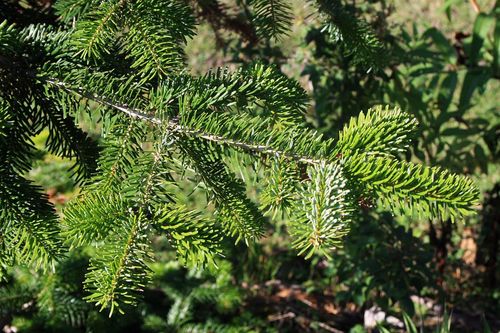

The Nordmann fir (Abies nordmanniana) is a large evergreen conifer native to northern Türkiye and the western Caucasus. Its dark, non-prickly and long-lasting foliage explains its use as both an ornamental tree and a Christmas tree.
Read moreNordmann fir and Caucasian fir
Pinus nordmanniana, Picea nordmanniana and Pinus abies var. nordmanniana


© photo
(c) Franz Xaver, some rights reserved (CC BY-SA) · cc-by-sa
Wikimedia Commons · CC BY-SA or Public Domain
Wikipedia · CC BY-SA
Taken Jul 5, 2022 by Joan Francesc (cc-by-sa)
Taken Aug 15, 2009 by Photoflora - Jean-Luc TASSET (©)
Taken Jul 9, 2021 by Renaud Brochiero (cc-by-sa)
Taken Jul 3, 2022 by Tristan Jaton-Maria (cc-by-sa)
Taken Nov 30, 2021 by Im Batzen (cc-by-sa)
© copyright of the Board of Trustees of the Royal Botanic Gardens, Kew.




Global distribution
Native from northern Türkiye to the western Caucasus, and introduced in several European countries and southern New Zealand.
- Native3
- Introduced1
- Türkiye
- North Caucasus
- Transcaucasia
- Central and northern Europe
Hexagons: regions where the plant occurs. Green dots: native range.1
Identity
The Nordmann fir (Abies nordmanniana (Steven) Spach, 1841), also called Caucasian fir, is an accepted species in the Pinaceae. Its publication under this name dates to 1841, while the basionym Pinus nordmanniana Steven, 1838 records its first description. 12
The scientific name honors Alexander von Nordmann, a naturalist associated with the tree's discovery in the Caucasus in 1836. 5 The vernacular name therefore does not indicate Scandinavian origin, despite the species' prominence in European Christmas-tree production. In French, its recorded names are sapin de Nordmann, sapin du Caucase and sapin de Crimée. 6
Identification
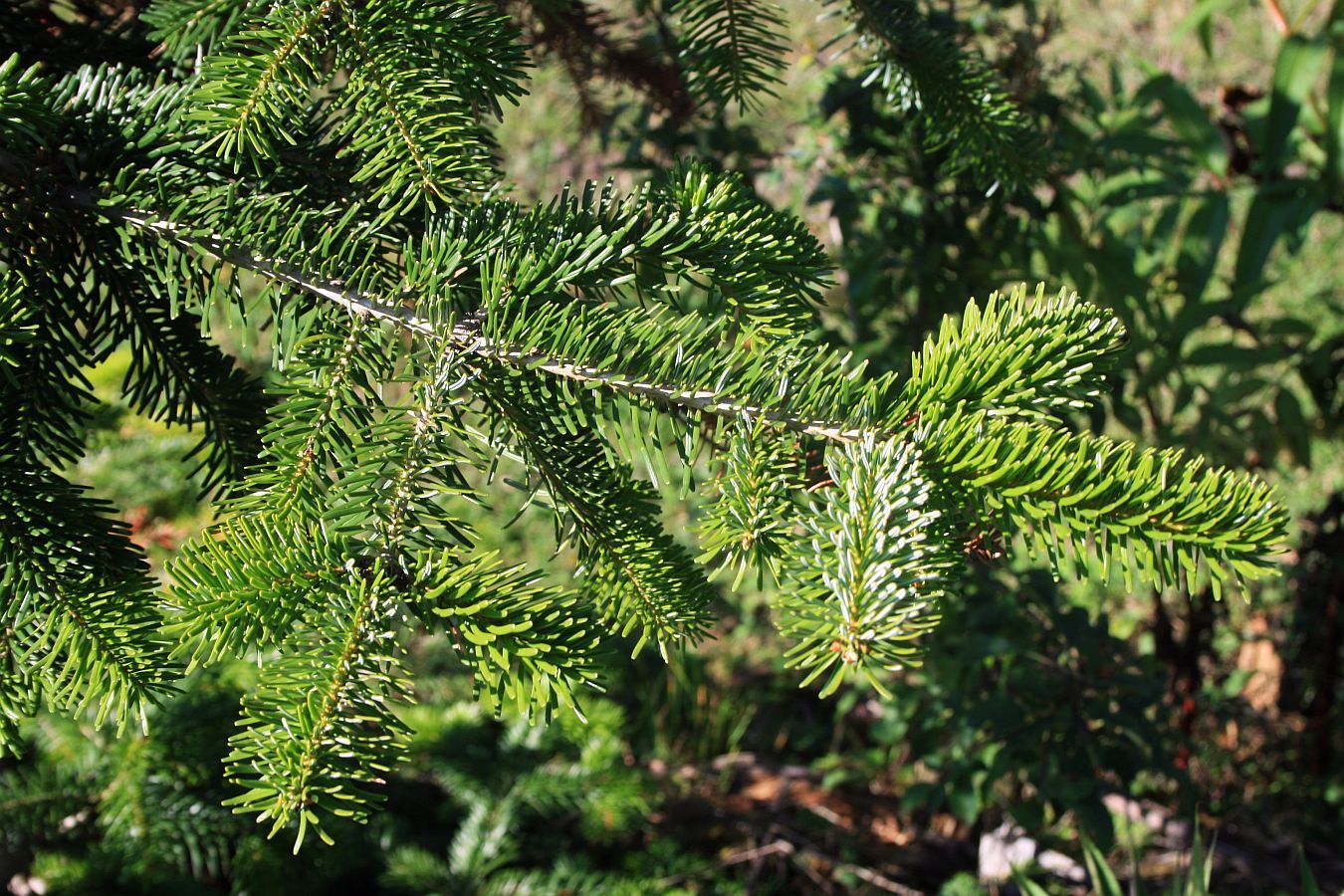
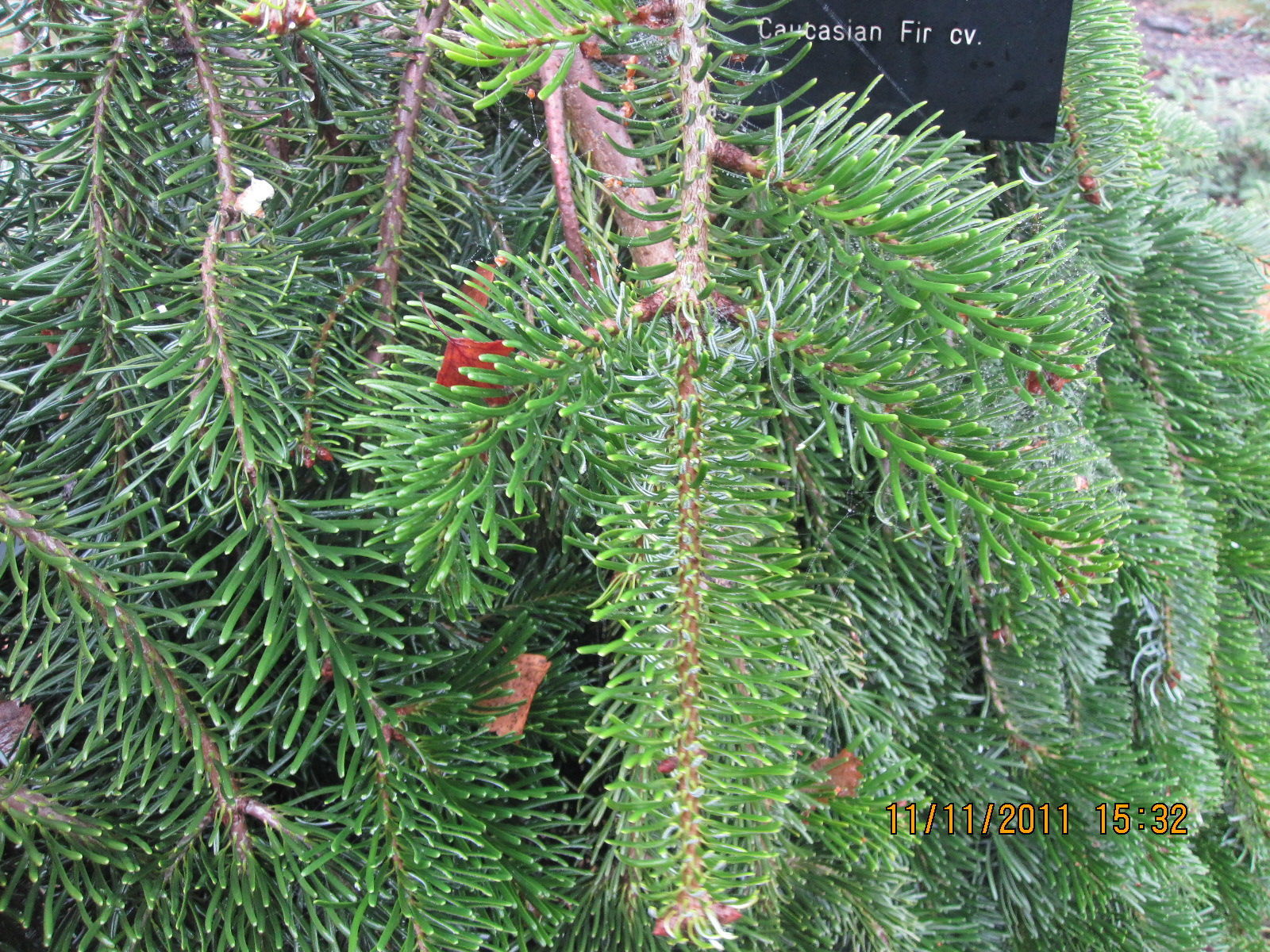
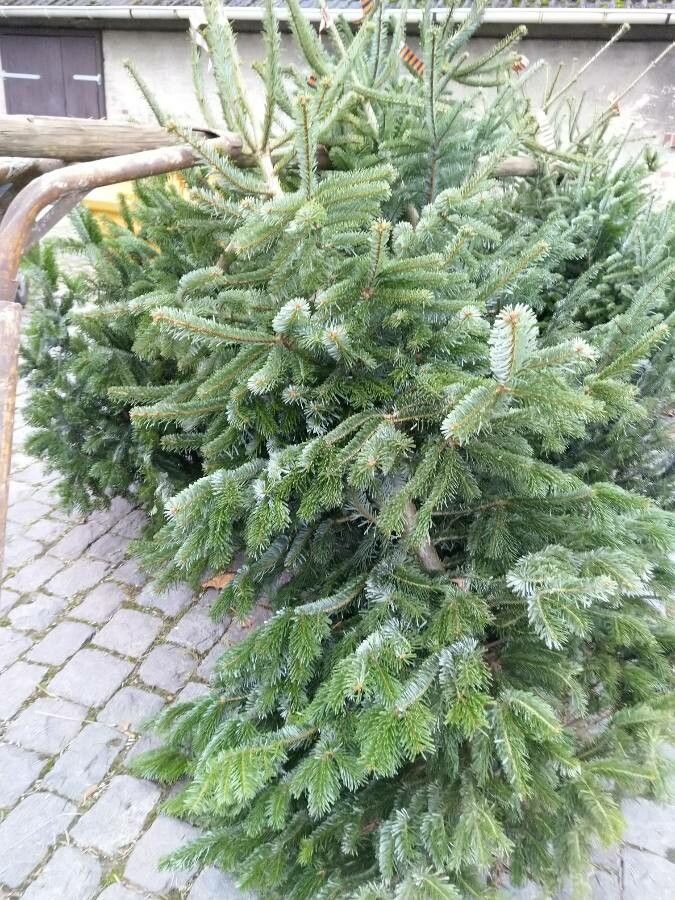
The best twig character is the foliage: needles are flat, leathery, glossy and non-prickly, with two conspicuous white stomatal bands beneath. Their tips are usually rounded and often notched. They point forward and cover much of the upper twig rather than leaving a clear groove. 85
Young bark is smooth and gray-brown, with resin blisters, while buds have little or no resin. Female cones begin green or reddish, turn brown, remain upright on the branches, and reach about 15 cm (6 in). As in other firs, their scales break apart on the tree to release seed; an intact cone on the ground more often suggests a spruce or pine. 35
Useful taxonomy
The species belongs to Pinales, Pinaceae and Abies. Three homotypic synonyms are recorded: Picea nordmanniana (Steven) Loudon, Pinus abies var. nordmanniana (Steven) F.Muell., and Pinus nordmanniana Steven. 1 These changes of genus explain older catalog names without creating three different species.
The accepted infraspecific taxa are the nominal subspecies and Abies nordmanniana subsp. equi-trojani (Asch. & Sint. ex Boiss.) Coode & Cullen, native to northwestern Türkiye. 15 Species rank is the sound everyday identification unless provenance or subspecies characters are established.
Habitat and range
The native range extends from northern Türkiye to the western Caucasus, including Türkiye, Transcaucasia and the North Caucasus within the temperate biome. 1 Montane stands occur at roughly 900–2,200 m (3,000–7,200 ft) in areas receiving more than 1,000 mm (39 in) of annual rain. This background helps explain why the tree favors steady moisture and struggles with hot, dry summers. 5
The species has also been introduced into numerous European countries and southern New Zealand. 1 Occurrence outside the Caucasus does not by itself prove a natural population. Documented provenances are maintained in plantations, arboreta and trials in France and Denmark, alongside protected stands in Türkiye. 7
Life cycle, cultivation and reproduction
Nordmann fir is an evergreen conifer. It does not flower in the angiosperm sense, but produces male and female cones. Upright female cones bear scales that disarticulate at maturity and release winged seeds. 5 The typical species is propagated horticulturally from seed. 3
Its seed has an intermediate storage category marked with a question mark, signaling uncertainty, and weak dormancy. Storage requires controlled moisture and temperature; this applies to forestry seed lots and does not guarantee germination from seed collected under a tree. 9 Seed propagation maintains provenance diversity tracked through conservation units and ex situ trials. 7
Allow permanent space: horticultural dimensions reach 30 m (98 ft) or more with a 4–8 m (13–26 ft) spread and 20–50 years to maturity. Another account gives 12–18 m (39–59 ft) in North American cultivation, but about 61 m (200 ft) in the wild. 35 These values describe different settings and should not be merged into one universal size.
The best-documented garden conditions are cool, fertile, well-drained acidic to neutral soil and sun; partial shade is also tolerated. 35 Hot dry summers, urban pollution and persistent waterlogging are poor fits. Regular pruning is unnecessary because the conical crown develops naturally. 35
Uses and risks
Its most visible use is as a Christmas tree. Its dark green needles fall very slowly after cutting, unlike those of Norway spruce. 4 It is also used as an ornamental, as a screen, and for paper and construction. 5
The global conservation assessment is Least Concern (LC). 101 This global category does not remove the need to conserve genetic diversity in Caucasian populations. 7
Toxicity specific to Nordmann fir remains unknown in cats, dogs, horses, children, adults and other animals, without implying that it is safe. Christmas trees of all species are generally considered to have low toxicity for pets; stand water should still be covered because bacteria or fertilizer may cause nausea, diarrhea or stomach upset. This general precaution cannot establish a toxicity level for Abies nordmanniana. 11
Varieties, look-alikes and related plants
Nordmann fir is most often confused with silver fir and, at a distance, Norway spruce. Against spruce, look for flat needles without woody pegs and upright cones that disintegrate on the tree. Against silver fir, Nordmann foliage is denser, tougher and swept forward across the upper twig. 8
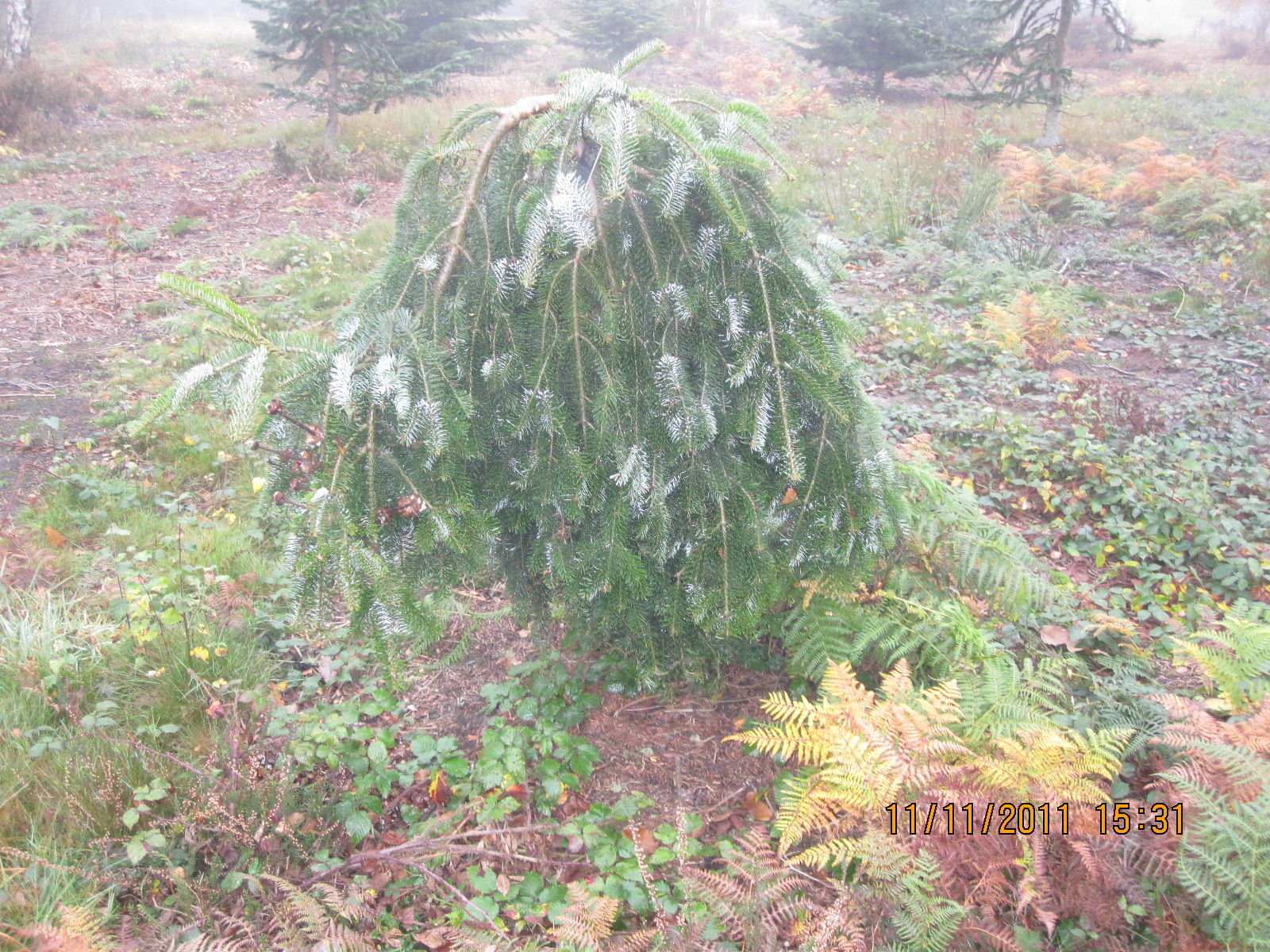
‘Golden Spreader’ is a low-growing selection with yellow needles, but it does not represent the form or color of the species. 5 Check the mature size of any named cultivar before purchase: the species dimensions of 12 to more than 30 m (39 to more than 98 ft) do not automatically apply to dwarf forms. The recognized subspecies are botanical taxa, not cultivars. 1
Main sources
- Kew, Plants of the World Online, Abies nordmanniana
- International Plant Names Index, Abies nordmanniana
- Royal Horticultural Society, Abies nordmanniana
- Royal Horticultural Society, Christmas trees: types and care
- NC State Extension, Abies nordmanniana
- INPN, ZNIEFF inventory 210020071, TAXREF table, page 54
- EUFORGEN, Abies nordmanniana
- Forest Research, Conifers in the British Isles
- Forest Research, seed storage: Abies nordmanniana
- IUCN Red List, Abies nordmanniana
- ASPCA, precautions for Christmas trees and animals
Frequently asked questions
How do you identify a Nordmann fir?
Its flat, glossy, non-prickly needles have two white bands underneath and largely cover the upper side of the twig. Its cylindrical cones remain upright.
How tall does a Nordmann fir grow?
A horticultural specimen can reach 30 m (98 ft) or more. In North American cultivation, trees more often reach 12–18 m (39–59 ft), while wild trees can reach about 61 m (200 ft).
Where should a Nordmann fir be planted?
It suits a spacious site with cool but well-drained, acidic to neutral soil and protection from hot, dry summers. Horticultural spread reaches 4–8 m (13–26 ft).
Why is Nordmann fir used as a Christmas tree?
Its dark green foliage is non-prickly, and its needles drop slowly after cutting, two desirable qualities indoors during the holidays.
Is Nordmann fir toxic?
Toxicity specific to Nordmann fir remains unknown in cats, dogs, horses, children, adults and other animals, without implying that it is safe. General Christmas-tree precautions do not establish a toxicity level for this species.
If you are unsure about a plant’s toxicity, ask a botanist or veterinarian for advice.