
Garlic (Allium sativum)
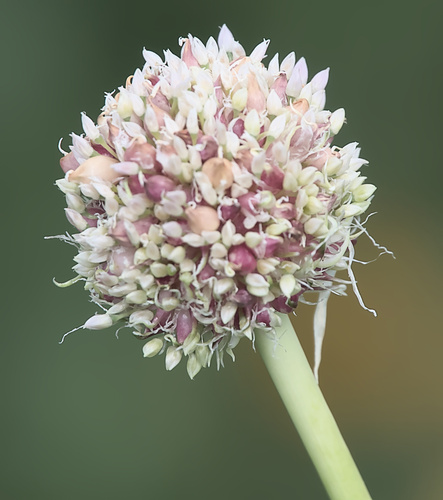
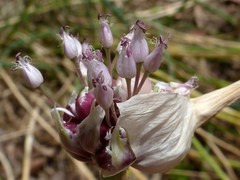

Garlic (Allium sativum) is a perennial vegetable in the Amaryllidaceae family, native to Central Asia. Its bulb consists of strongly flavored, aromatic cloves and ranks among the oldest culinary seasonings. Although edible and valued by humans, garlic is toxic to cats, dogs and horses.
Read moreGarlic, Cultivated garlic and Common garlic


© photo
(c) willem9, some rights reserved (CC BY-NC), uploaded by willem9 · cc-by-nc
Юрий Данилевский (Yuriy Danilevsky) · cc-by
Wikimedia Commons · CC BY-SA or Public Domain
Taken Jul 16, 2022 by Alexander Baransky (cc-by-sa)
Taken Aug 26, 2016 by Tela Botanica − Liliane ROUBAUDI (cc-by-sa)
Taken Dec 30, 2020 by Alves Léo (cc-by-sa)
© copyright of the Board of Trustees of the Royal Botanic Gardens, Kew.




Identity
Garlic (Allium sativum L., 1753), also called cultivated garlic or common garlic, is a perennial vegetable in the Amaryllidaceae family and Allioideae subfamily. Among the oldest cultivated seasoning plants, it is recognized around the world by the strong smell and flavor of its bulb. 1 4
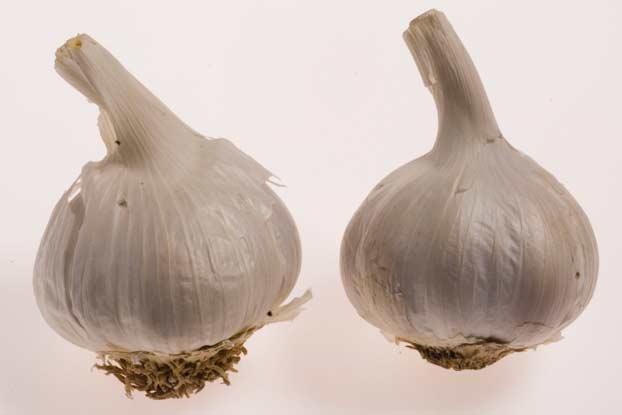
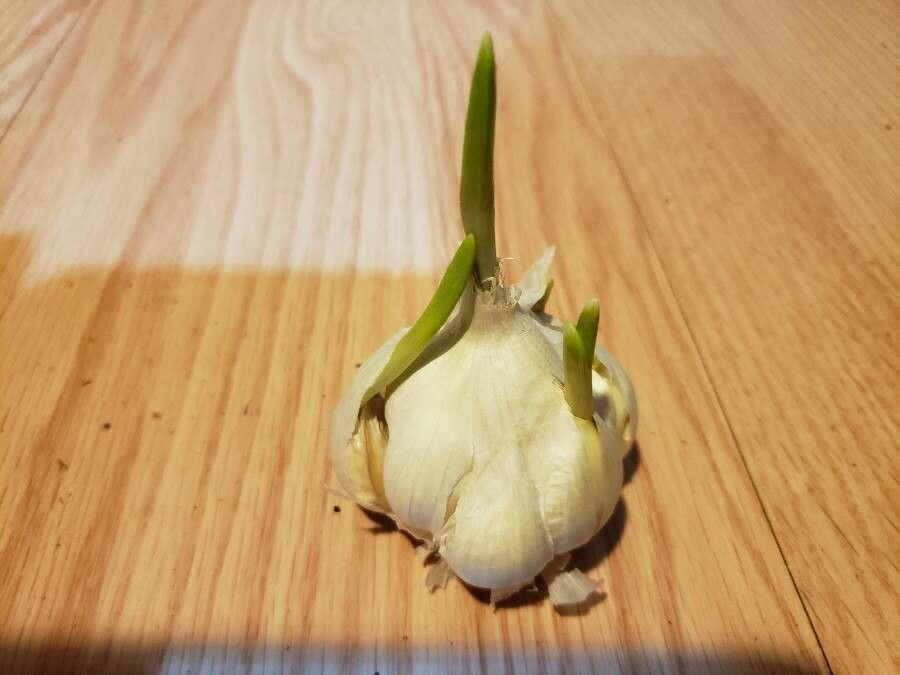
A head of garlic consists of several cloves packed around a central axis and wrapped in papery skins. These individual cloves contain sulfur compounds responsible for the characteristic flavor. They make garlic a staple seasoning in many culinary traditions, whether used whole, chopped or crushed. 4 6
Recognition
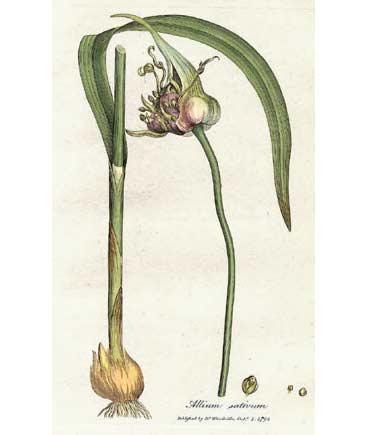
Flat, strap-shaped leaves rise from a bulbous herb usually 30–60 cm (12–24 in) tall, occasionally reaching 1 m (3 ft) when a flower stalk develops. The grayish green leaves sheath one another at their bases and form a fan above a false stem made from those overlapping leaf sheaths. 6 3
The most dependable clue is the smell: cut or crushed leaves and bulbs release the sulfurous aroma typical of Allium. Below ground, the bulb separates into cloves. This divided structure distinguishes garlic from an onion, whose bulb forms one continuous unit rather than a cluster of separate cloves. 3 5
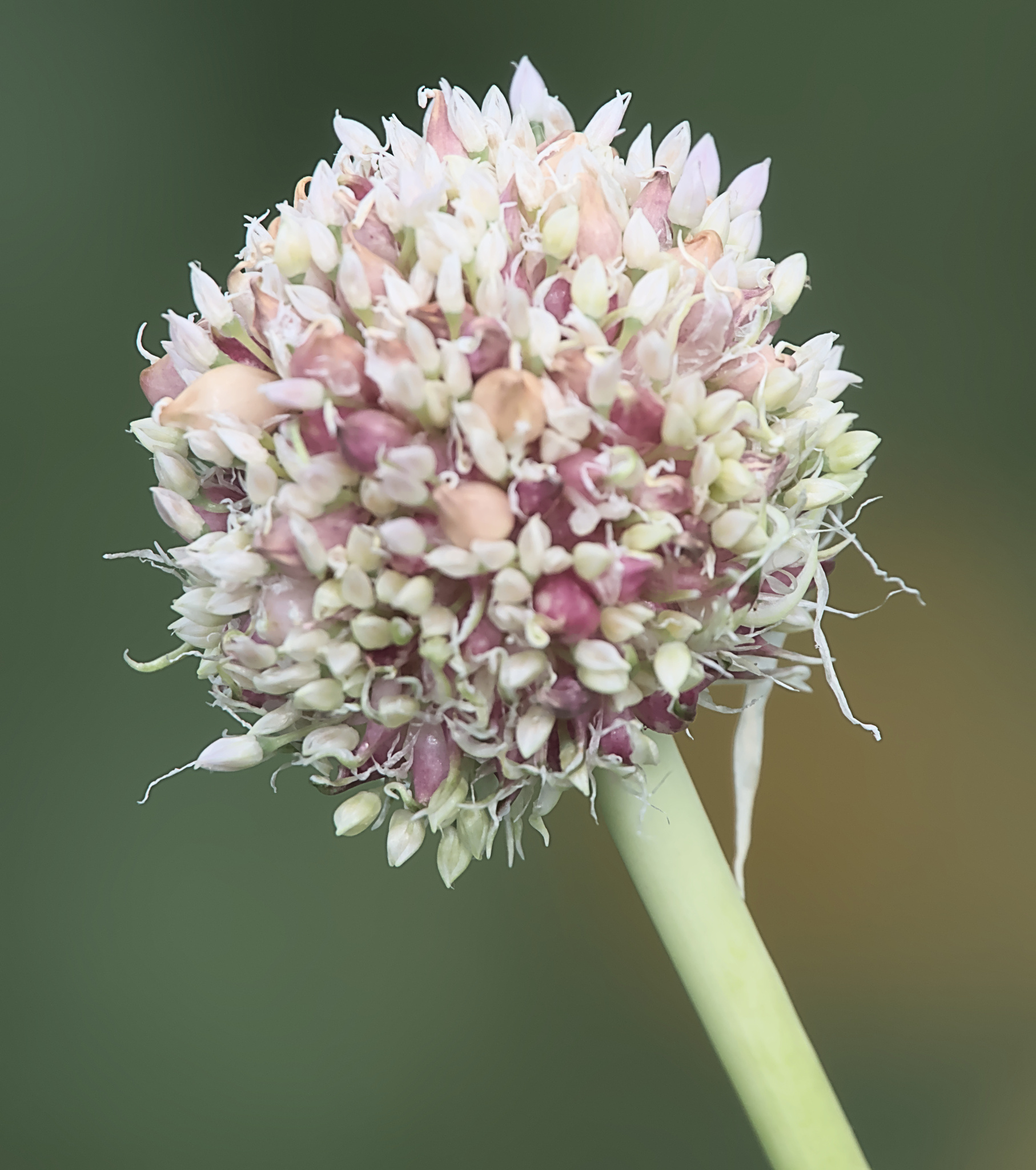
When present, the flower stalk ends in an umbel, enclosed while young by a pointed spathe. In many cultivars, tiny white to pinkish flowers share this cluster with aerial bulbils. The flowers often remain sterile, leaving the cloves as the plant's main means of reproduction. 4 7
Useful taxonomy
Linnaeus described garlic as Allium sativum in 1753. Within the large genus Allium, several older names now treated as synonyms still appear in botanical and horticultural writing. The principal historical names include:
- Allium longicuspis Regel, a historical synonym;
- Allium controversum Schrad. ex Willd., a historical synonym;
- Allium ophioscorodon Link, a historical synonym;
- Allium pekinense Prokh., a historical synonym;
- Porrum sativum (L.) Rchb., a historical synonym.
For many years, Allium longicuspis was proposed as the wild ancestor of cultivated garlic. The accepted scientific name, Allium sativum, remains the stable reference. Labels such as hardneck and softneck garlic refer to horticultural types, rather than separate botanical species. Keeping these two naming systems distinct helps when comparing seed catalogs with botanical records. 1 7
Habitat and range
Central Asia and northeastern Iran form garlic's region of origin, including mountain foothills where related wild species still grow. Garlic itself is now scarcely found growing spontaneously and is chiefly known as a cultivated plant, spread by people since antiquity. Its present cultivation range is therefore much larger than its original range. 1 4
Adaptation to temperate climates includes a need for winter chilling to develop cloves well, which explains the common practice of fall planting. Garlic favors full sun and loose, fertile, well-drained soil with a near-neutral pH. Heavy, waterlogged ground encourages bulb rot, so the condition of the soil matters as much as the planting season. 2 6
Cultivation spans every continent, from small home vegetable plots to large agricultural production areas. France has several regions renowned for garlic, some with protected geographical indications. These regional traditions belong to the history of the crop, while its everyday culinary use extends far beyond any one country. 7 4
Life cycle and reproduction
A garden crop generally takes eight to nine months from planting to harvest. Cloves planted in fall or late winter root, pass through the cold season and put on leaves in spring. The bulb swells as summer approaches. Harvest usually falls in summer, when the foliage yellows and begins to fall over; exact timing depends on local conditions. 2 6
Vegetative propagation accounts for almost all production: a clove separated from a head grows into a complete new plant. Hardneck cultivars produce a stalk bearing bulbils. Those bulbils can also propagate garlic, although they need one or two additional growing seasons to produce a normal-sized bulb. 4 5
Seed reproduction plays only a small role because most cultivated garlic flowers sparingly or produces sterile flowers. Dependence on cloves means that varieties are maintained chiefly as clonal lines, passed from one harvest to the next. The planting material is thus part of the preceding crop rather than a fresh batch of seed. 5 3
Uses and risks
Cooking is garlic's main use. Raw or cooked cloves flavor a wide range of dishes, and young shoots harvested before the bulb forms are also eaten as green garlic. The plant additionally has a long history in traditional herbal medicine, centered on its sulfur-containing compounds. That history is distinct from its ordinary role as a seasoning. 4 5
For people, garlic is edible and safe in normal food use. The safety picture differs for domestic animals: the ASPCA lists Allium sativum as toxic to cats, dogs and horses. Thiosulfates and other organosulfur compounds in Allium can destroy their red blood cells, causing hemolytic anemia with weakness, dark urine and digestive upset. Keep fresh or powdered garlic, peelings and food scraps away from these animals. 8 4
Varieties, look-alikes and related plants
Two major horticultural groups dominate cultivation. Hardneck garlic produces a rigid flower stalk, tolerates cold well and forms heads with large, evenly arranged cloves. Softneck garlic lacks a true flower stalk, stores longer and can be braided. Alongside white and purple garlic, pink-skinned types are also valued for their keeping quality. 2 6
Most possible confusion involves other members of the genus:
- Allium cepa, onion, has a single bulb without separate cloves;
- Allium porrum, leek, has wider leaves and no distinct bulb;
- Allium schoenoprasum, chives, is much finer and forms dense tufts;
- Allium ursinum, wild garlic, grows wild and has broad leaves.
Their shared sulfurous smell makes the relationship easy to recognize. A bulb divided into cloves together with flat leaves provides the most useful combination of features for confirming Allium sativum. Neither the smell alone nor a general resemblance to an onion replaces examining that characteristic bulb structure. 3 7
Main sources
- Plants of the World Online / Kew, Allium sativum L.
- Royal Horticultural Society, Garlic - grow your own
- Missouri Botanical Garden, Allium sativum
- Encyclopaedia Britannica, garlic
- Plants For A Future, Allium sativum
- North Carolina State Extension, Allium sativum
- Tela Botanica, Allium sativum L.
- ASPCA, Garlic (Allium sativum) toxicity entry
If you are unsure about a plant’s toxicity, ask a botanist or veterinarian for advice.