
Pecan (Carya illinoinensis, )
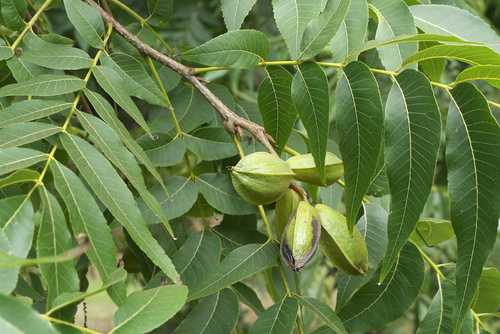
Pecan (Carya illinoinensis) is a large deciduous tree in the Juglandaceae family, native to the south-central United States and northeastern Mexico. Widely cultivated for its thin-shelled nuts, it has long compound leaves, fissured bark and a fruit husk that splits into four sections at maturity.
Read morePecan and Sweet pecan

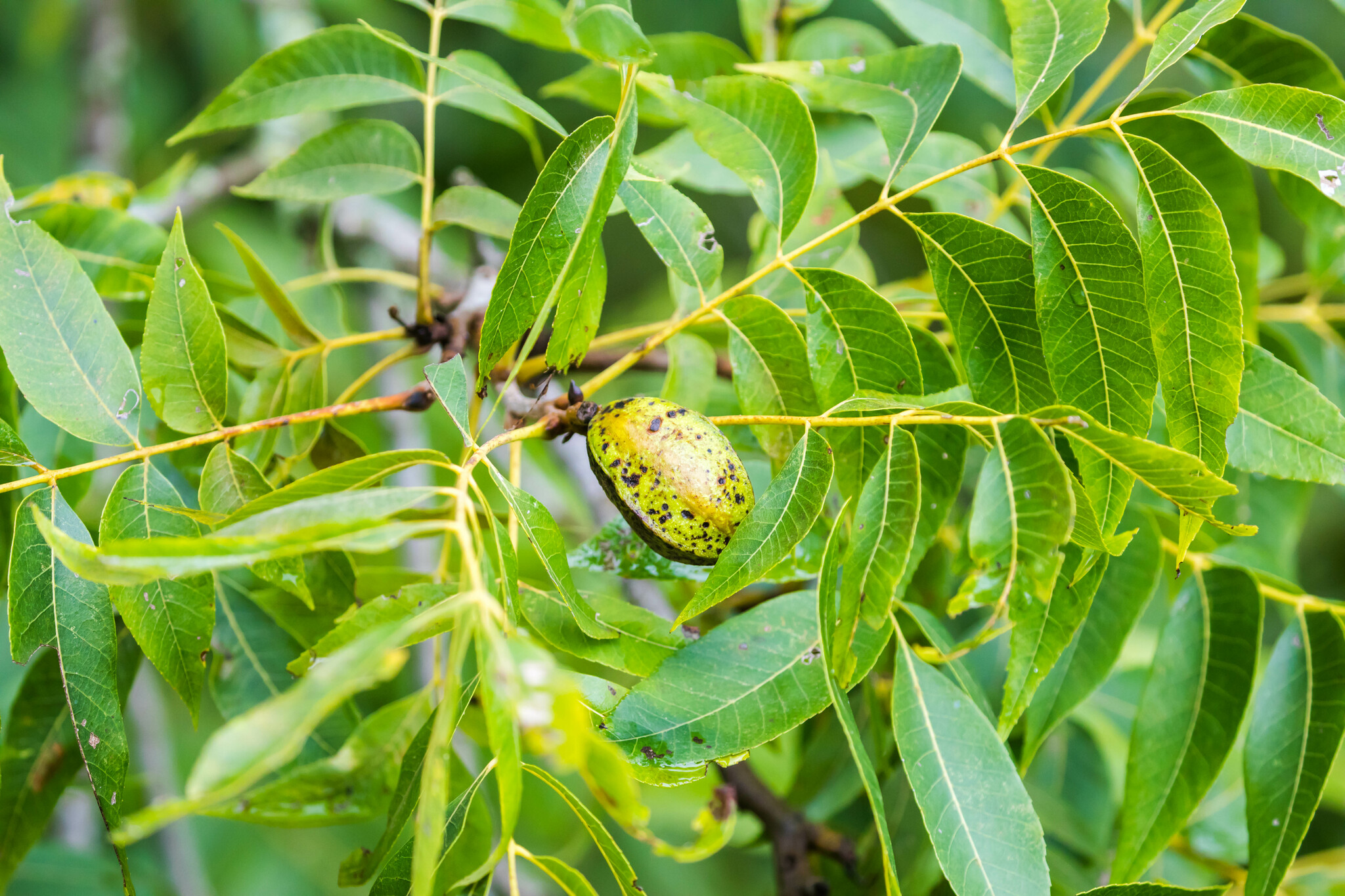
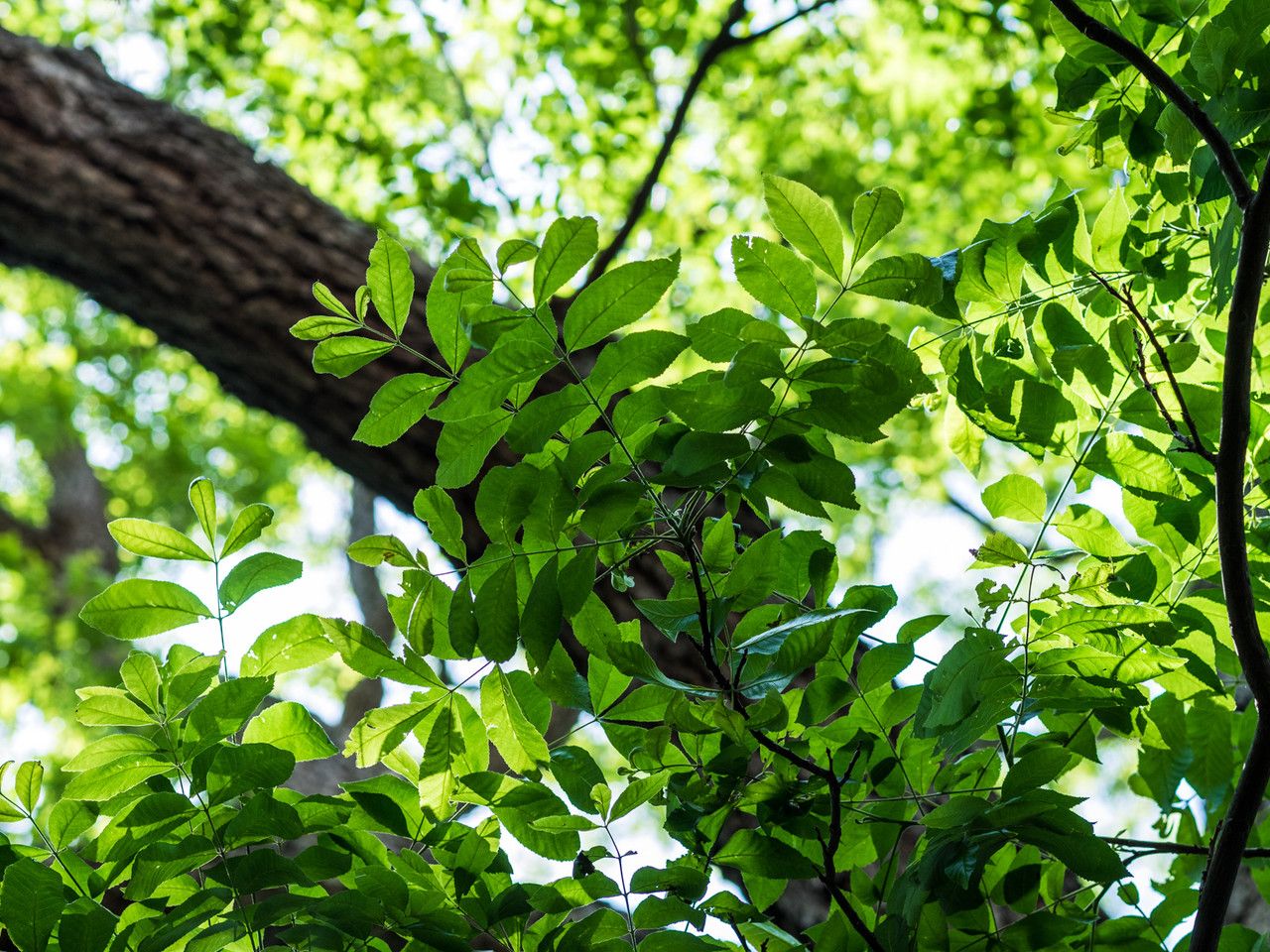
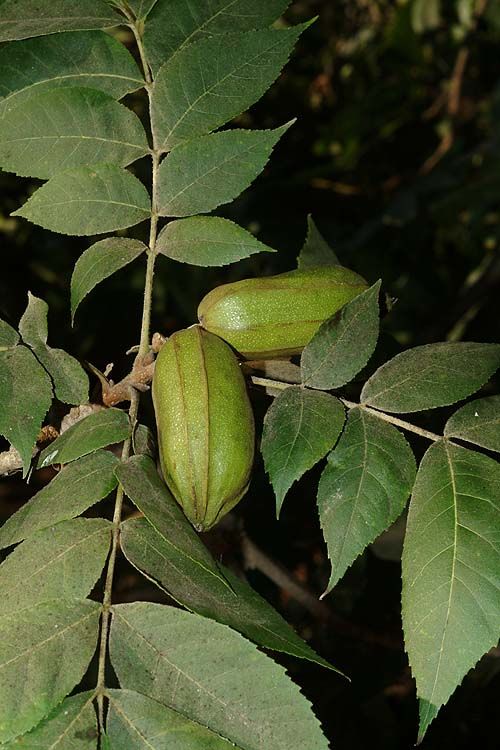

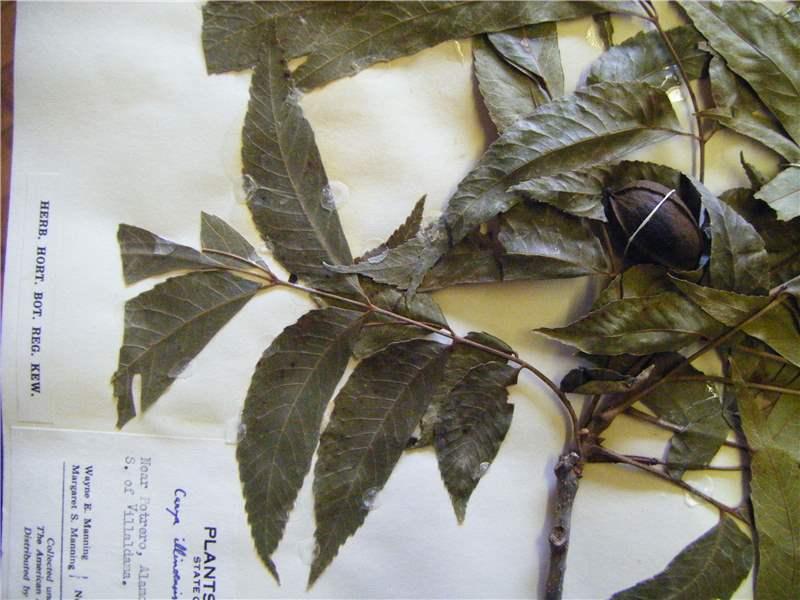
© photo
(c) Tony Rodd, some rights reserved (CC BY-NC-SA) · cc-by-nc-sa
Kristi Zoebelein · cc0
Melissa McMasters · cc-by
Taken May 28, 2014 by Tela Botanica − Denis NESPOULOUS (cc-by-sa)
© copyright of the Board of Trustees of the Royal Botanic Gardens, Kew.


Global distribution
The native range of Carya illinoinensis extends across the south-central United States, along the Mississippi Valley from southern Iowa and Illinois to Texas and western Kentucky, and into northeastern Mexico, from Coahuila to Jalisco and Veracruz. Commercial cultivation began around 1880 and has since spread far beyond this native range.
Identity
Pecan (Carya illinoinensis (Wangenh.) K.Koch, 1869), also called sweet pecan, is a large deciduous tree in the Juglandaceae family. It reaches 20–40 m (66–131 ft) at maturity. Friedrich von Wangenheim first described the species in 1787 as Juglans illinoinensis. Karl Koch transferred it to Carya in 1869, establishing the scientific name accepted today. 1
The word pecan derives from an Algonquian term used regionally for hickory nuts or walnuts with shells that required a stone to crack. English uses pecan for both the tree and its fruit, whereas French distinguishes the tree, pacanier, from the nut, pacane. 7
Roughly twenty hickory species belong to Carya, chiefly in North America and eastern Asia. Carya illinoinensis is the largest member of the genus and by far the most widely cultivated for its nuts. 8
Recognition
A mature pecan commonly stands 20–40 m (66–131 ft) tall, spreading 12–23 m (39–75 ft) across. Very old trunks can exceed 1 m (3.3 ft) in diameter. Gray to light brown bark develops fairly regular rectangular fissures with age, a useful winter feature when the tree is bare. 2 3
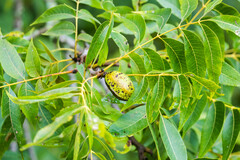
Alternate, pinnately compound leaves carry 9–17 leaflets, including a terminal leaflet, along a total leaf length of 30–70 cm (12–28 in). The leaflets are lance-shaped with toothed margins. Green summer foliage turns yellow in fall before dropping. 2
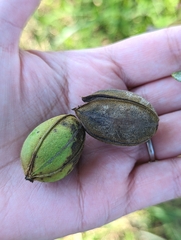
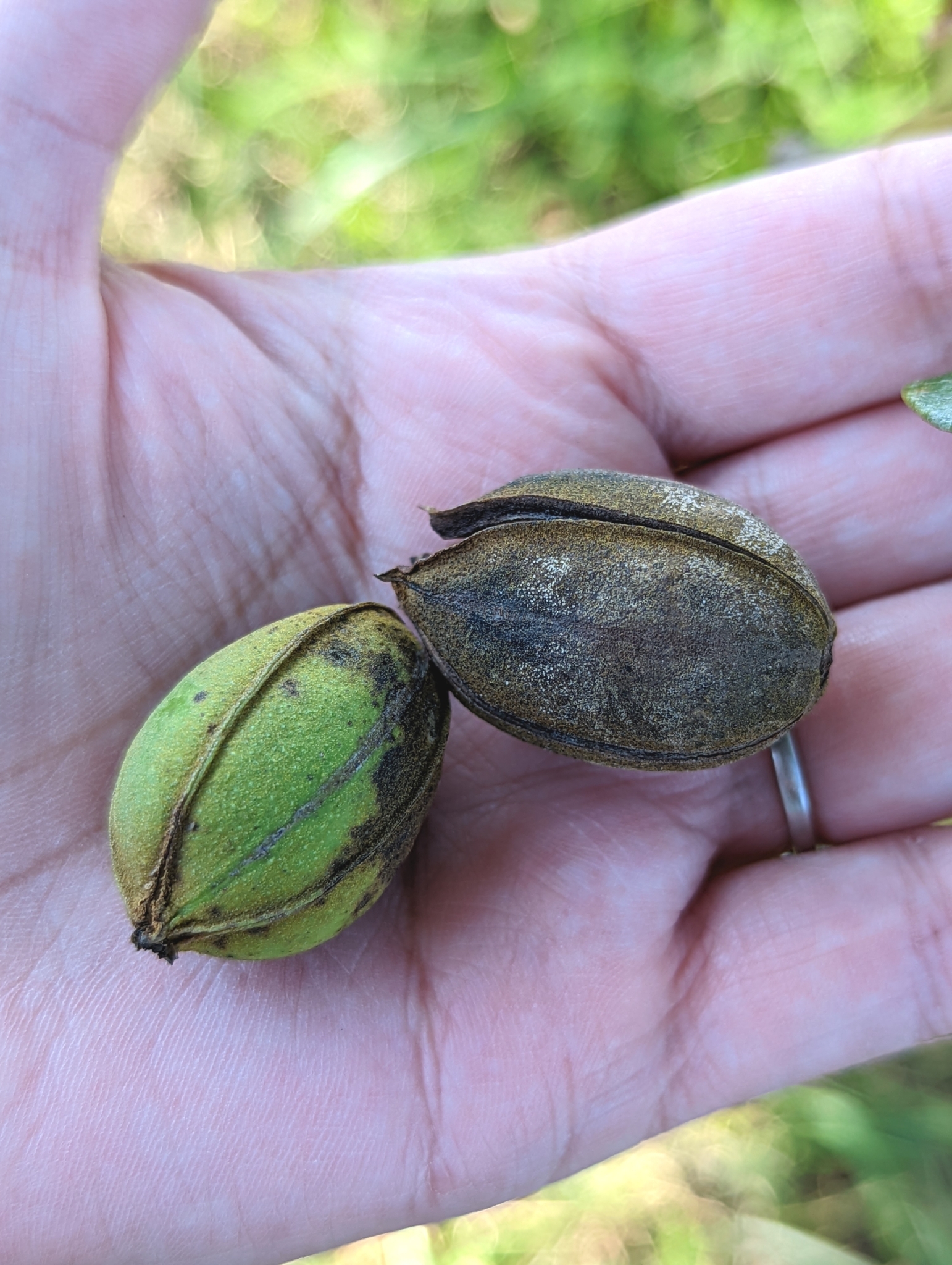
An outer fleshy husk changes from green to brown and splits into four sections at maturity, releasing an oblong, pointed nut 3–6 cm (1.2–2.4 in) long. Its thin shell encloses a sweet, wrinkled kernel. That shell, much thinner than in other hickories, helps distinguish pecan in a mixed stand. 3
Useful taxonomy
Wangenheim first described the taxon as Juglans illinoinensis in 1787. Several names circulated before Koch established the accepted combination in 1869. Historical synonyms include:
- Juglans illinoinensis Wangenh., original name (basionym), 1787
- Juglans pecan Marshall, historical synonym, 1785
- Carya pecan (Marshall) Nutt., historical synonym, 1842
- Carya oliviformis (F.Michx.) Nutt., historical synonym, 1818
- Hicorius pecan (Marshall) Britton, historical synonym, 1888
Older books and nursery catalogs may still use these synonyms. The accepted scientific name, Carya illinoinensis, provides the stable reference when identifying a tree or checking nursery stock, so that a historical label is not mistaken for a different species. 1 8
Habitat and range
South-central North America contains the native range, from the Mississippi Valley to Texas and western Kentucky, continuing into northeastern Mexico from Coahuila to Jalisco and Veracruz. Pecan grows in riverbank woodland, rooted in deep alluvial soils on floodplains. 1 7
Nut filling requires long, hot summers. Where summer is too cool or too short, the harvest may contain empty shells or poorly filled kernels. Commercial cultivation, which began only around 1880, has spread far beyond the native range. Mexico and the United States are major producers, together accounting for much of the world crop. 2
The International Union for Conservation of Nature assesses Carya illinoinensis as Least Concern. Its extensive native range and worldwide cultivation limit the risk of the species disappearing. 5
Life cycle and reproduction
Pecan bears male and female flowers separately on the same tree, making it monoecious. Male flowers form long hanging catkins; female flowers occur in small spikes. Wind carries pollen during spring, corresponding to April and May in the native Northern Hemisphere range. 3
Flower timing differs between cultivars through dichogamy. Type I, or protandrous, cultivars release pollen before their own female flowers become receptive. Type II, or protogynous, cultivars do the reverse. Two cultivars with complementary flowering types therefore cross-pollinate much more effectively than an isolated tree. 3
A seed-grown pecan generally needs 8–10 years for its first substantial harvest, and longer to reach full production, depending on climate. A tree grafted with a selected cultivar begins bearing earlier. Its taproot grows deep from a young age, however, making later transplanting risky. 3 4
Uses and risks
Raw or roasted pecans are eaten directly and used in baking, especially pecan pie, a traditional dish of the southern United States. Fat-rich kernels also yield edible oil. The hard, figured timber serves in cabinetmaking and as fuel for smoking meat. 4
No species-specific toxicity is documented for people or domestic animals. As with other nuts, moldy or rancid pecans should be discarded. Mold can produce mycotoxins, a hazard associated with storage rather than an intrinsic toxic property of the pecan tree. 4
Pecan has been the official state tree of Texas since 1919, and the pecan became its official state nut in 1982; four other U.S. states have since made comparable symbolic choices. 6
Varieties, look-alikes and related plants
Dozens of grafted cultivars have followed the beginnings of commercial cultivation. Stuart, selected in the 19th century, remains a widely grown historical cultivar in the southeastern United States. Desirable is a commercial standard despite susceptibility to scab in humid climates. Pawnee and Kanza, selected for earlier ripening and better cold tolerance, suit areas beyond the traditional growing region. 2
Compared with shagbark hickory (Carya ovata) or bitternut hickory (Carya cordiformis), pecan has a much thinner shell and a pointed, oblong nut 3–6 cm (1.2–2.4 in) long. Its relatives have rounder fruits with thicker shells. True walnuts, Juglans, instead have wrinkled, more spherical shells. They share the Juglandaceae family with pecan but belong to a different genus. 3
Main sources
- Plants of the World Online / Kew, Carya illinoinensis (Wangenh.) K.Koch
- NC State Extension, Carya illinoinensis (Pecan)
- Missouri Botanical Garden, Carya illinoinensis
- Plants For A Future, Carya illinoinensis
- IUCN Red List of Threatened Species, Carya illinoinensis assessment
- Texas State Library and Archives Commission, Texas State Symbols (pecan)
- USDA PLANTS Database, Carya illinoinensis profile (CAIL2)
- GBIF Backbone Taxonomy, Carya illinoinensis
Frequently asked questions
Is pecan a walnut tree?
Not in the strict botanical sense. Carya illinoinensis belongs to Carya, a genus related to Juglans, the true walnuts, within Juglandaceae. The French name meaning pecan walnut reflects a horticultural association rather than membership in the walnut genus.
Why is my pecan tree not producing nuts?
The most frequent cause is a lack of cross-pollination. An isolated cultivar often sheds pollen too early or too late for its own female flowers. A second cultivar with a complementary flowering type improves pollination.
Are pecans poisonous to dogs or cats?
No toxicity specific to this species is documented. As with any nut, discard moldy or rancid pecans because molds can produce mycotoxins.
How long does a pecan tree take to bear nuts?
A seedling generally takes eight to ten years to produce its first substantial crop, and longer to reach full production. A tree grafted with a selected cultivar bears earlier.
Can a mature pecan tree be transplanted?
It is difficult. The taproot grows deep while the tree is still young and is easily damaged during lifting. Nurseries therefore recommend planting a young tree directly in its permanent position.
Is pecan invasive?
No invasive behavior is documented in the cited references, despite widespread cultivation outside its native range. The International Union for Conservation of Nature assesses the species as Least Concern.
How does pecan differ from other hickories?
Carya illinoinensis has a much thinner nut shell than shagbark or bitternut hickory. Its nut is oblong with a distinctly pointed tip, rather than nearly spherical.
If you are unsure about a plant’s toxicity, ask a botanist or veterinarian for advice.