
Yellow nutsedge (Cyperus esculentus, )
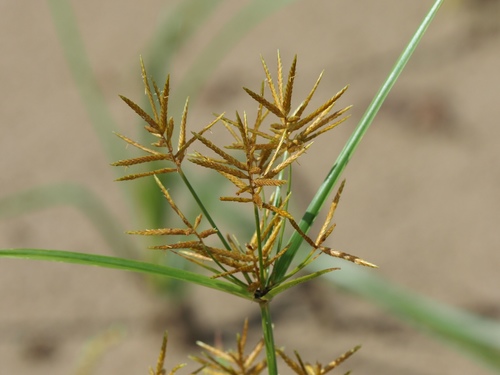
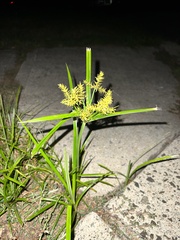
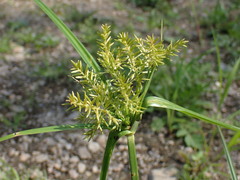
Yellow nutsedge (Cyperus esculentus) is a small perennial sedge in the Cyperaceae, recognizable by its triangular stems and tiny sweet tubers, known as tiger nuts or chufa. Native to the temperate and tropical Old World, it now occurs on almost every continent, both as a Spanish food crop and as a persistent weed of gardens and row crops.
Read moreYellow nutsedge, tiger nut and Chufa




© photo
(c) Cin-Ty Lee, some rights reserved (CC BY-NC), uploaded by Cin-Ty Lee · cc-by-nc
Ryan · cc0
Milan Chytrý · cc-by
Taken Jan 1, 1970 by Photoflora - L'Abbé COSTE (©)
Taken Oct 15, 2011 by Photoflora - Benoit BOCK (©)
Taken Jun 13, 2020 by buisan jose (cc-by-sa)
Taken Sep 20, 2021 by Uebel Matt (cc-by-sa)
© copyright of the Board of Trustees of the Royal Botanic Gardens, Kew.


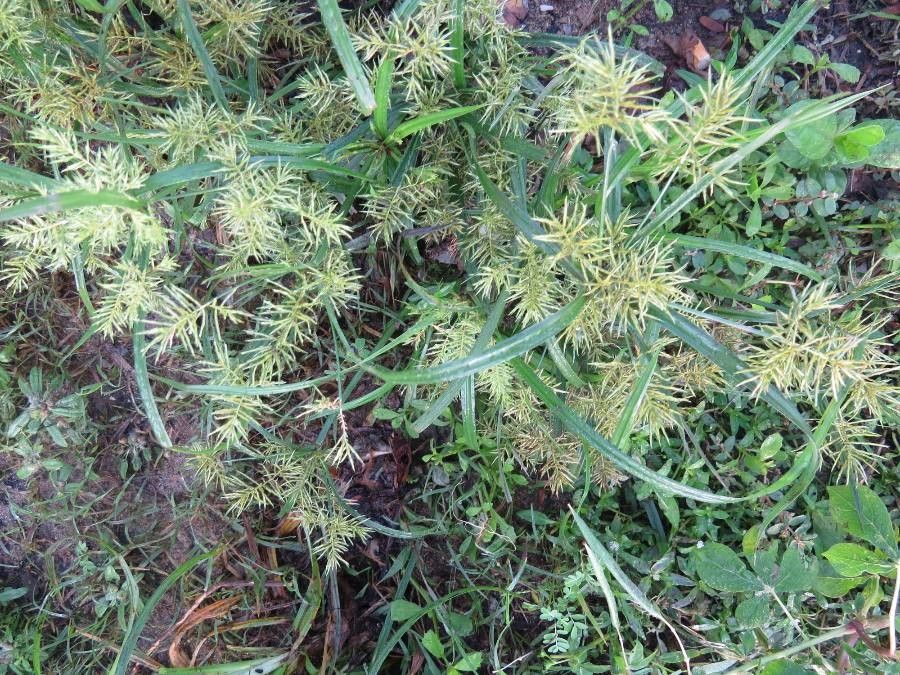


Global distribution
Cyperus esculentus is native to the temperate and tropical Old World, from the Mediterranean basin to Africa, Madagascar, the Middle East and the Indian subcontinent. Cultivation and accidental transport have spread it to almost every continent. It is classified as a noxious weed in several US states and as invasive in parts of Europe.
- Native4
- Introduced1
- Invasive4
- Mainland France
- Egypt
- India
- Madagascar
- Ghana
- Switzerland
- United States (California)
- Mexico
- Australia
Hexagons: regions where the plant occurs. Green dots: native range.1
Identity
Yellow nutsedge (Cyperus esculentus L., 1753), also called tiger nut or chufa, has triangular stems, a characteristic of the Cyperaceae absent from true grasses. This small perennial sedge has contrasting roles: it is cultivated in Spain for sweet tubers, yet ranks elsewhere among the most persistent weeds of gardens and row crops. 2 3
Its many common names reflect different uses. French technical names include souchet tubéreux and souchet sucré; chufa is the Spanish name associated with the cultivated form, while yellow nutsedge and tiger nut are used in English. The German Erdmandel derives from the older term Erdnuss. It does not refer to the true peanut, a botanically unrelated member of the Fabaceae. 4
Recognition
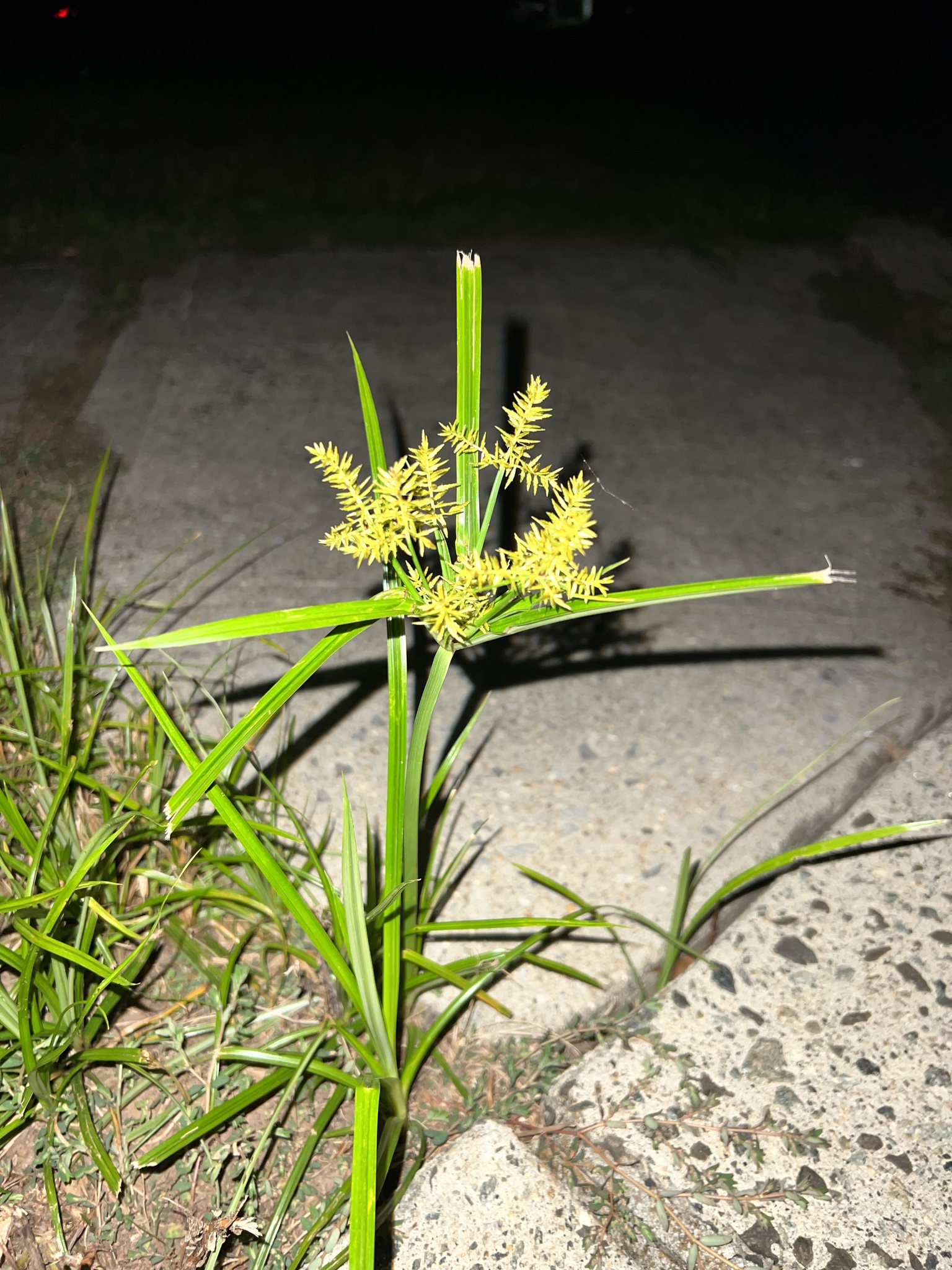
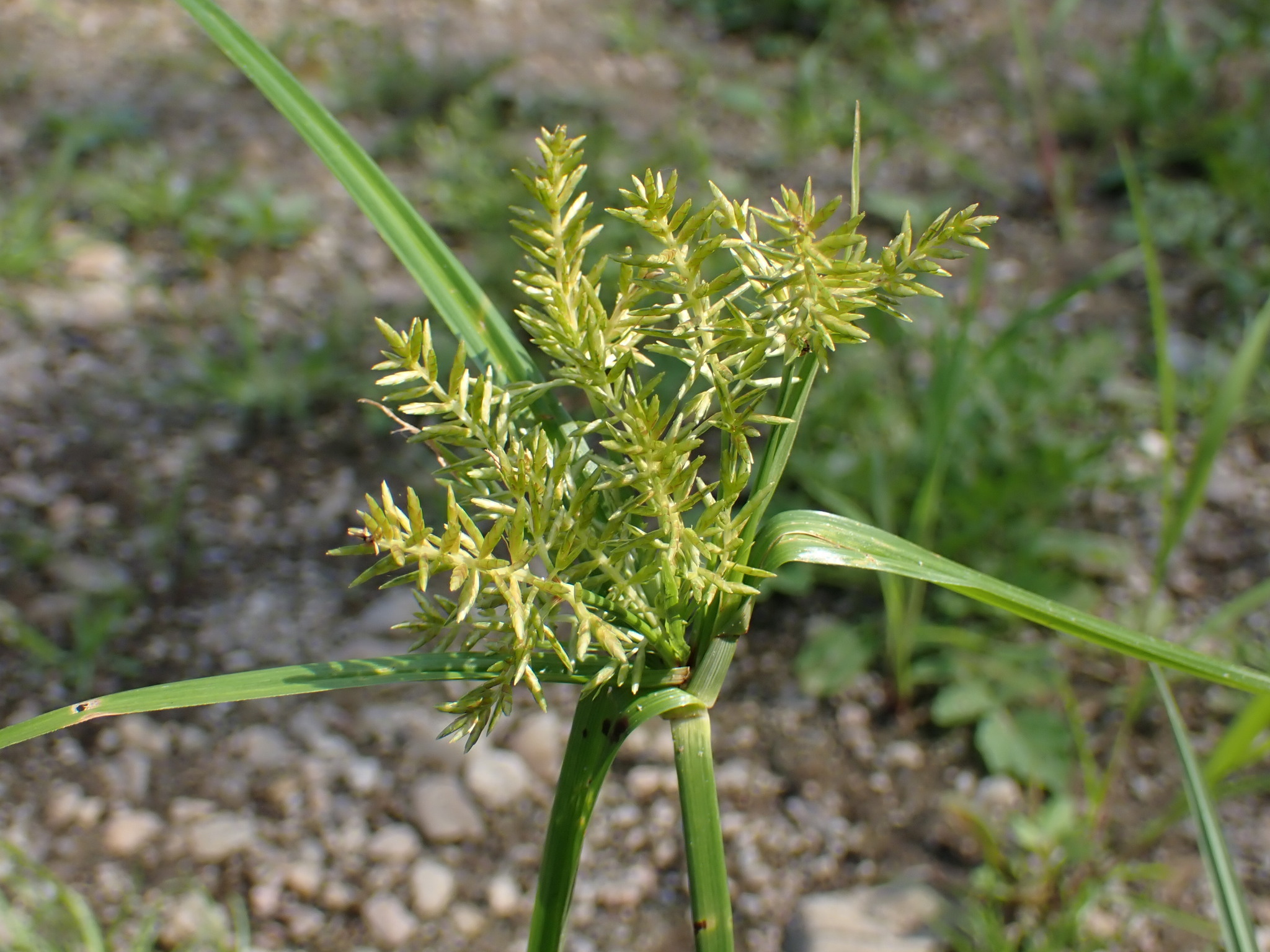
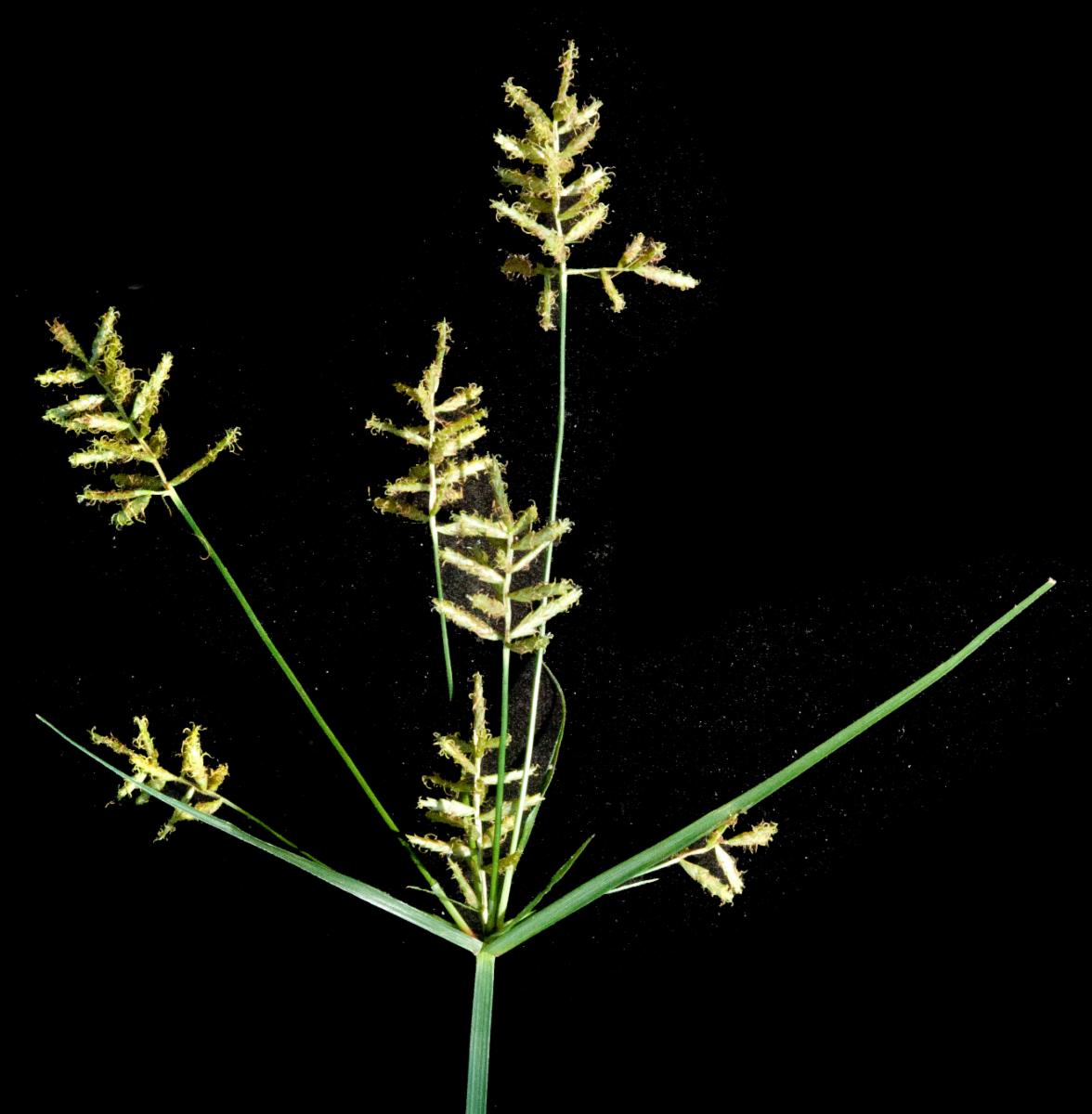
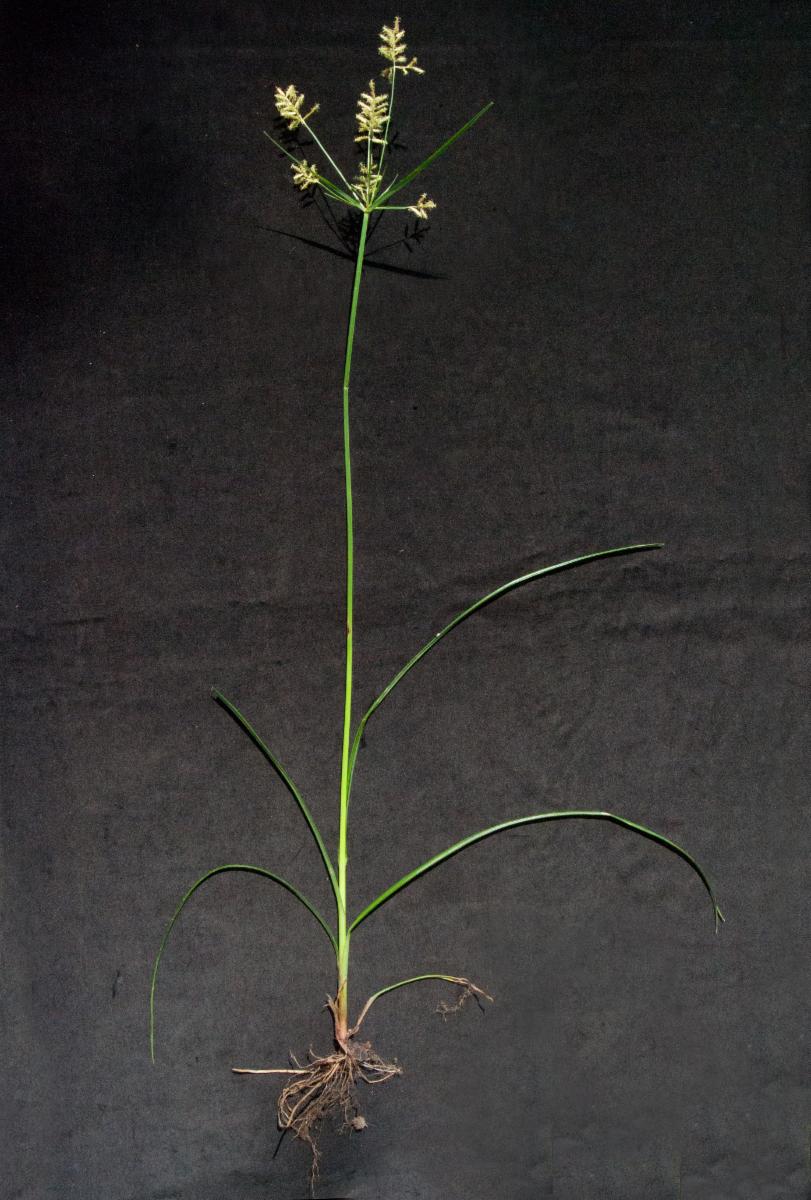
An upright stem with a triangular cross-section is the first identifying feature of Cyperus esculentus, characteristic of the Cyperaceae rather than true grasses. Narrow, glossy, light green leaves 5–10 mm (0.2–0.4 in) wide form a basal clump. Stems rise 25–90 cm (10–35 in), depending on climate and soil conditions. 2 3
Small yellow spikelets form a terminal umbel, with leaflike bracts set at right angles to one another. Underground rhizomes bear tiny, scaly, egg-shaped tubers 0.3–2.5 cm (0.1–1 in) across. Their color changes from yellowish brown to blackish as they mature. A single plant can produce hundreds, sometimes thousands, in one growing season. 3 6
Useful taxonomy
In 1753, Linnaeus described this sedge in Species Plantarum, the starting point for modern botanical nomenclature. Cyperus contains several hundred sedge species worldwide within the Cyperaceae. Historical varieties and forms have circulated under separate names now treated as synonyms:
- Cyperus aureus K.Richt., a historical synonym
- Cyperus phymatodes (Muhl.) Kük., another former name
- Cyperus sativus Boeckeler, now placed in synonymy
- Cyperus macrostachyus Boeckeler, a former botanical name
- Cyperus leptostachyus Boeckeler, also treated as a synonym
The accepted name Cyperus esculentus remains the reliable reference. It should not be confused with purple nutsedge, Cyperus rotundus, a related species even more troublesome in tropical agriculture. Shared common names and similar grassy clumps can obscure the distinction. 1 3
Habitat and range
The native range covers the temperate and tropical Old World: the Mediterranean basin, Africa, Madagascar, the Middle East and the Indian subcontinent. Yellow nutsedge favors sunny, moist soil, from flooded rice fields to regularly watered lawns and row crops. 3 2
Deliberate cultivation of chufa and accidental movement of tubers on farm machinery have spread it to almost every continent. Yellow nutsedge is classified as a noxious weed in several US states, including California, and is invasive in parts of Europe, notably Switzerland. There it colonizes vegetable plots, gardens and lawns. These are regional classifications, rather than a single status applying everywhere. 6 2
Persistence comes from the underground architecture. Rhizomes connect many tubers, sometimes buried more than 50 cm (20 in) deep. Roots break readily when pulled by hand. One forgotten tuber can regenerate a whole clump, and an established colony can spread more than 1 m (3.3 ft) in a year. 2 7
Life cycle and reproduction
Tubers, rather than seed, chiefly support this perennial's annual regrowth. Flowering requires full sun and sufficient summer warmth; shade and cool temperatures prevent it. A clump can therefore remain vegetative for years without producing spikelets, even while the underground plant survives and spreads. 3 5
Vegetative reproduction greatly outweighs sexual reproduction in Cyperus esculentus. Each sprouting tuber develops rhizomes that produce new tubers in chains. This repeated underground cycle explains the speed of colonization much more than windborne seed does. A clump's visible shoots reveal only part of the established plant. 2 3
For the food crop, chufa is planted on ridged soil in spring and harvested in late fall or early winter, after six to eight months of maturation. These seasons describe the traditional northern growing cycle rather than universal calendar months. Tubers then dry in the sun for several weeks before consumption or sale. 3
Uses and risks
Food use has a long history. Wild tubers from Wadi Kubbaniya in Egypt date to about 16,000 BCE, and predynastic Egyptian tombs contained boiled or roasted tubers. In Spain, Chufa de Valencia has been used since the 13th century to make horchata de chufa, a traditional sweet, milk-like drink. 3 2
Tubers are eaten raw, cooked, roasted or ground into flour. They yield an oil comparable to olive oil and have been considered as an oil crop for biodiesel. Their sweet, lightly nutty flavor distinguishes them from bitter Cyperus rotundus. No toxicity is documented for people or domestic animals. 5 6
Yellow nutsedge poses no health hazard. Its main challenge is agricultural: it is among the hardest weeds to control, able to penetrate mulch or sheeting and resist many nonselective herbicides. Removing young shoots early and repeating the operation throughout the season restricts its spread more effectively than a single chemical treatment. 7 6
Varieties, look-alikes and related plants
There are no ornamental cultivars of note; the principal named form is Chufa de Valencia, an agricultural selection with large, sweet tubers protected by a designation of origin. Most other diversity encountered in trade corresponds to older botanical varieties now placed in synonymy. 1
The closest look-alike is purple nutsedge, Cyperus rotundus. It has purple spikelets and chains of tubers, rather than a single terminal tuber. A grassy habit also invites confusion with true grasses; the triangular stem provides the certain distinction. In either comparison, lifting a plant resolves the doubt: the egg-shaped tuber of Cyperus esculentus, 0.3–2.5 cm (0.1–1 in) across, sits alone at a rhizome tip, unlike the chain of tubers in Cyperus rotundus. 3 6
Main sources
Frequently asked questions
Is yellow nutsedge poisonous?
No toxicity is documented for people or domestic animals. Its tubers have been eaten since antiquity, notably as tiger nuts and in horchata de chufa.
Why is yellow nutsedge so difficult to remove?
Its rhizomes connect many deeply buried tubers. Roots break easily during pulling, and a single tuber left behind can regenerate the entire clump.
How can I distinguish yellow nutsedge from purple nutsedge?
Cyperus esculentus has yellow spikelets and a single tuber with a sweet, nutty flavor. Cyperus rotundus, purple nutsedge, has purple spikelets, chains of tubers and a bitter taste.
What is Chufa de Valencia?
It is the cultivated Spanish form of Cyperus esculentus, known since the 13th century. Its tubers are used to make horchata de chufa, a traditional sweet drink.
Can yellow nutsedge grow in a pot?
Yes, provided the container is closed so that rhizomes cannot escape. In open ground, the species quickly colonizes moist, sunny soil.
Does yellow nutsedge occur in France?
Yes. It belongs to the native Mediterranean flora and occurs both in southern France and as a weed of watered gardens and row crops.
How can I identify yellow nutsedge without flowers?
Its upright, triangular stem, a characteristic of the Cyperaceae, is the most reliable feature even when spikelets or tubers are not visible.
If you are unsure about a plant’s toxicity, ask a botanist or veterinarian for advice.