
Caper spurge (Euphorbia lathyris, )
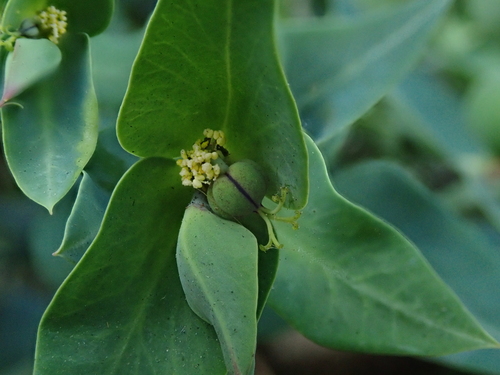
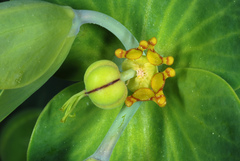

Caper spurge (Euphorbia lathyris L., 1753) is a biennial in the Euphorbiaceae native to Central Asia and Pakistan, now widely naturalized in Europe and North America. Its stiff outline, opposite leaves arranged crosswise and highly irritating white sap make it distinctive, but hazardous to handle without precautions.
Read moreCaper spurge, Moleplant and Gopher plant
Allow a few hours of direct sun per day, preferably morning or evening.
Full sun; tolerates light partial shade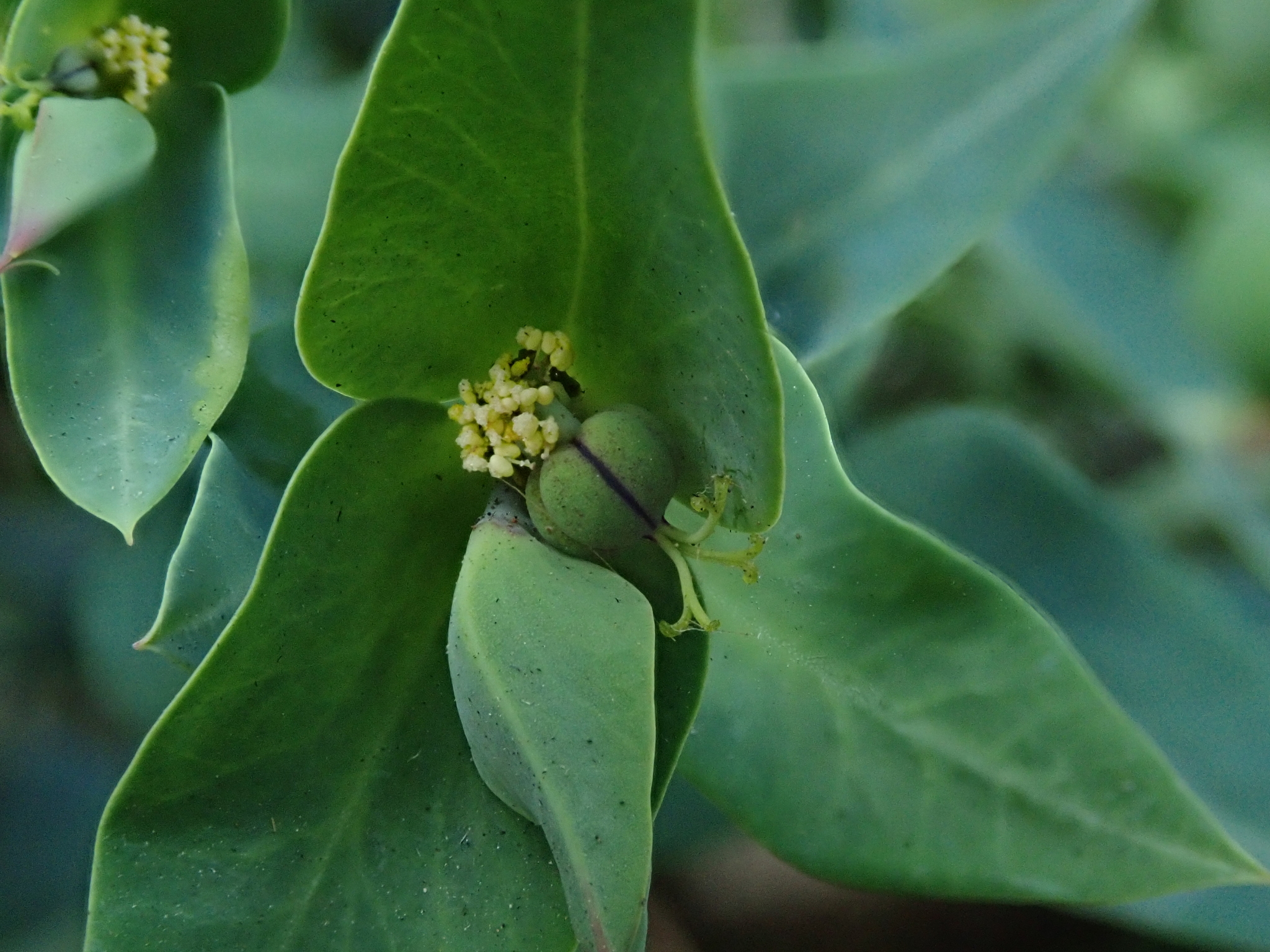


© photo
Daniel Cahen · cc-by
Douglas Goldman · cc-by-nc
Wikimedia Commons · CC BY-SA or Public Domain
Taken Apr 21, 2021 by victoria green (cc-by-sa)
Taken May 21, 2022 by Renaud Brochiero (cc-by-sa)
Taken Apr 26, 2020 by Christine Schuster (cc-by-sa)
Taken Jan 15, 2022 by cscoq (cc-by-sa)
Taken Feb 12, 2022 by antonio (cc-by-sa)
© copyright of the Board of Trustees of the Royal Botanic Gardens, Kew.




Global distribution
Euphorbia lathyris is native only to Central Asia and Pakistan, from western China to Kyrgyzstan. It has long been cultivated and naturalized in Mediterranean Europe, including France, and in North America, where several states monitor its potential invasiveness.
- Native1
- Introduced4
- Central Asia and Pakistan
- Mainland France
- Mediterranean Europe
- United States
- Australia
Hexagons: regions where the plant occurs. Green dots: native range.1
Identity
Caper spurge (Euphorbia lathyris L., 1753), also called moleplant or gopher plant, is a biennial in the genus Euphorbia, family Euphorbiaceae. Plants of the World Online accepts the species name published by Linnaeus in 1753. 1
An old French name, épurge, recalls the former use of its sap and seeds as a powerful purgative, a medicinal practice now abandoned because of the plant's toxicity. The English name caper spurge refers to its three-seeded capsules, once soaked at length in salt water and then vinegar to imitate capers, despite the poisoning risk. 2
Recognition
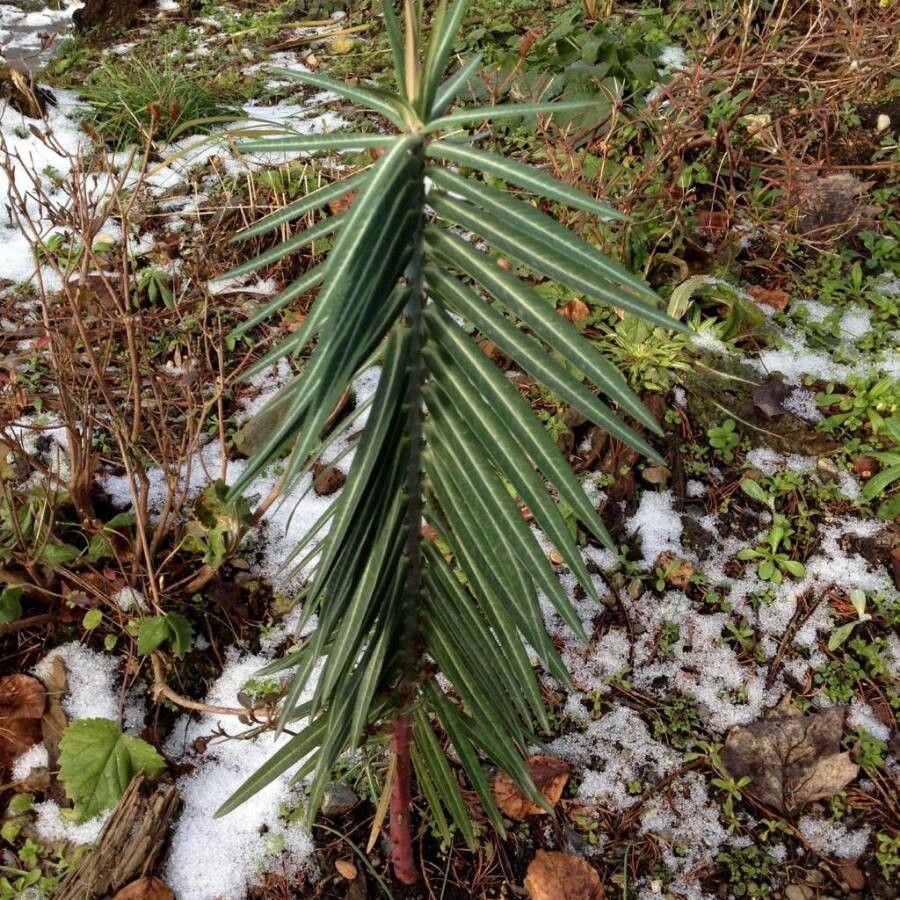
An upright, stiff stem reaches 60 cm–1.50 m (2–5 ft), depending on soil and climate, and remains unbranched below the inflorescence. Unusually rigid for a spurge of this size, it stands without a stake even in a windy garden. 3 4
Crosswise leaves provide the most reliable distinction from native European spurges, many of which have alternate foliage. The stalkless, blue-green, lance-shaped leaves grow in opposite pairs, each rotated 90° from the pair below. A terminal umbel of yellow-green cyathia, each 3–5 mm (0.12–0.20 in) across, appears from late spring into summer. 3
Pollination produces a three-lobed capsule, resembling a caper fruit as it ripens, before it bursts and ejects its seeds. Damage to any stem or leaf immediately releases milky white sap, a warning against prolonged contact. The sap deters most herbivores, while pollinating flies can approach the cyathia unharmed. 2 4
Useful taxonomy
The accepted botanical name, Euphorbia lathyris L., dates to Linnaeus's original publication in 1753. The species belongs to Euphorbiaceae and the large genus Euphorbia, whose several thousand species often contain irritating latex. 1
Older floras sometimes mention Euphorbia lathyris var. minor Hook. & Arn., a minor variety without recognized horticultural standing today. The species name remains the stable reference. A defining feature of Euphorbia is the cyathium, a condensed inflorescence resembling one flower but actually containing several reduced flowers around a central female flower. 1
Habitat and range
Central Asia and Pakistan form the plant's native range, extending from western China to Kyrgyzstan. There it grows in open woodland on nonacid soils with a pH of 6–7.5. 1 2
French regional references record a long-established introduction, variously described as fifty to a hundred years old, without documented invasive behavior. The INPN records the species under its French name, euphorbe épurge, across most regions of France. 6
Garden introductions to North America have naturalized in about twenty states, from inland areas to the coast. Tolerance of winter temperatures down to -15 °C (5 °F) and summer heat to 35 °C (95 °F), within USDA zones 5–9, helps explain that spread. California's Cal-IPC assigns it Watch status, a monitoring category less strict than a ban. Water, agricultural machinery and garden waste can transport the seeds. 5
Life cycle and reproduction
A biennial, monocarpic life cycle ends with the plant's death after fruiting. Brown oval seeds, 4–5 mm (0.16–0.20 in) long, germinate in two to three weeks when soil reaches 20 °C (68 °F). A low rosette forms in the first year, survives winter and sends up a stiff flowering stem the following spring. 4
Flowering falls mainly in May–June in northern temperate climates. Yellow-green cyathia form a terminal umbel with two or four rays. The plant is monoecious, bearing separate male and female flowers on the same individual, and flies provide pollination. 2
Ripe capsules burst mechanically, throwing their three seeds several meters from the parent. This ballistic dispersal is more effective than wind dispersal for the species and explains how dense colonies quickly develop in gardens when stems are not cut before seed release. 4
Uses and risks
The white sap contains irritating diterpene esters that cause redness, blisters and sometimes photosensitive reactions on contact. These effects persist even in material dried for several days. Repeated contact is a documented skin concern, making gloves necessary for any handling, including pruning. Aphids and powdery mildew are comparatively minor problems and do not call for routine treatment. 2
Every part is toxic if swallowed by cats, dogs, horses or children. Signs include mouth and digestive irritation, salivation and vomiting, with symptoms documented as more severe than those of other common spurges. 7
Former use as a purgative and worm remedy has been abandoned because the gap between an active dose and a toxic one is too narrow. Seeds contain oil amounting to as much as 48% of their weight and have attracted biofuel research instead. In 1977, chemist Melvin Calvin was already studying the triterpene-rich latex as a potential fuel source. 2 8
Some gardeners plant it around vegetable plots for its supposed ability to repel moles and voles. Horticultural sources describe this old belief as unproven. An isolated plant, in particular, cannot repel an established mole colony; only a dense border approaches the traditional planting practice described by gardeners. 4
Varieties, look-alikes and related plants
No true horticultural cultivar is recognized for Euphorbia lathyris. It remains a semiwild plant without ornamental selection, unlike garden spurges such as Euphorbia characias. 3
Other latex-bearing spurges found in France are more useful comparisons. Euphorbia peplus is much smaller and has alternate leaves rather than crosswise pairs. Euphorbia helioscopia has bright yellow umbel-like flower heads and rounded leaves. Against either species, the crossed leaf arrangement is quicker to check than stem height or cyathium color.
Despite its English name, caper spurge has no botanical relationship to the caper bush (Capparis spinosa). Only the shape of the capsule justifies the comparison, never a claim of safe food use.
Main sources
- Plants of the World Online / Kew, Euphorbia lathyris L.
- Plants For A Future, Euphorbia lathyris
- Royal Horticultural Society, Euphorbia lathyris (caper spurge)
- NC State Extension Gardener Plant Toolbox, Euphorbia lathyris
- California Invasive Plant Council, Euphorbia lathyris profile
- INPN / MNHN, Euphorbia lathyris L., 1753 - caper spurge
- ASPCA, Euphorbia toxicity entry
- ScienceDirect / Fuel journal, biodiesel from crude Euphorbia lathyris oil
Frequently asked questions
Is caper spurge toxic?
Yes. Its white sap contains irritating diterpene esters, and all parts are toxic if eaten by cats, dogs, horses or children.
Does caper spurge really repel moles?
The belief is longstanding, but current horticultural sources describe it as scientifically unproven. It cannot replace an effective control method.
Can caper spurge seeds be eaten like capers?
Historically they were soaked for a long time in salt water and then vinegar, but this use is now discouraged because the plant is documented as toxic.
How can I identify caper spurge outdoors?
The most reliable feature is its opposite leaves, which turn through 90° from one node to the next, forming a regular cross along a stiff stem.
Where does caper spurge come from?
Its native range is limited to Central Asia and Pakistan. It was introduced long ago to Europe, including France, and more recently to North America.
Is caper spurge invasive?
In California, Cal-IPC places it on its Watch list rather than treating it as a regulated species. In France, invasive behavior has not been documented despite its long presence.
How should I handle caper spurge?
Wear gloves and eye protection when pruning or removing it. Rinse skin or eyes thoroughly if sap makes contact, and keep the plant away from children and animals.
If you are unsure about a plant’s toxicity, ask a botanist or veterinarian for advice.