
Chinese parasol tree (Firmiana simplex, )
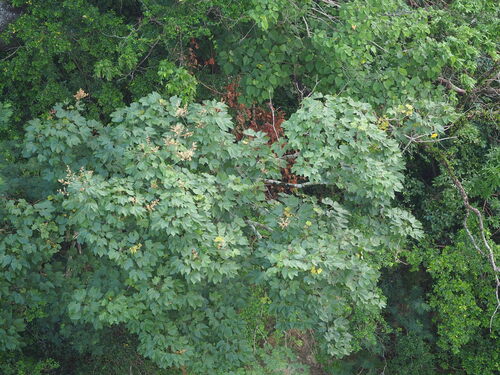
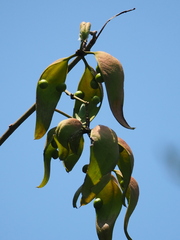
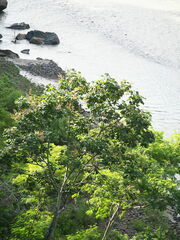
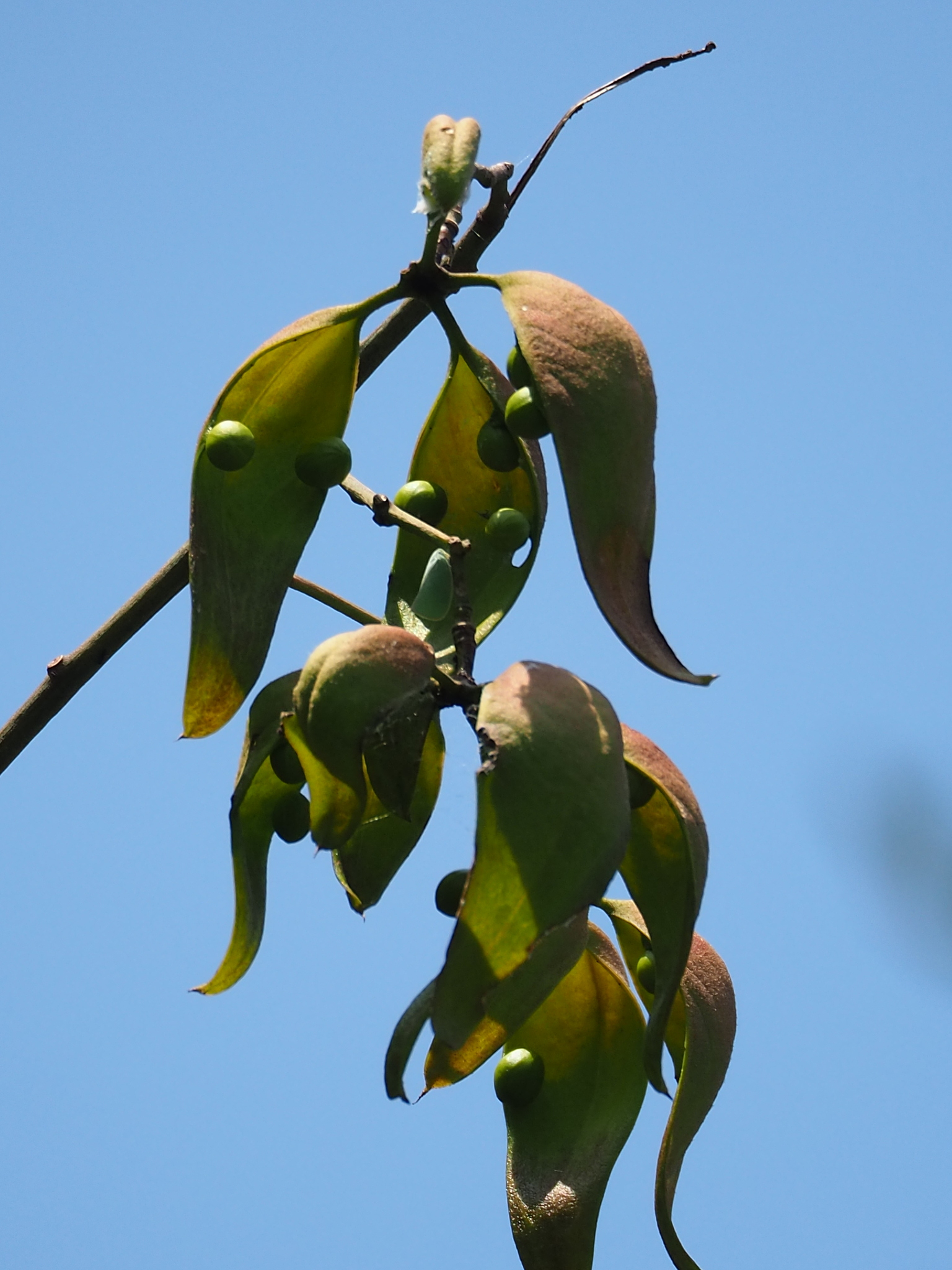
Chinese parasol tree (Firmiana simplex), or wutong, is a deciduous Malvaceae tree native to central and southern China, Taiwan, the Ryukyu Islands and Vietnam. Its smooth green bark persists for several years, while large, palmately lobed leaves resemble open parasols. Unusual capsules open well before maturity, exposing seeds along the edge of each valve.
Read moreChinese parasol tree, wutong, phoenix tree and varnish tree
Allow a few hours of direct sun per day, preferably morning or evening.
Full sun to light partial shade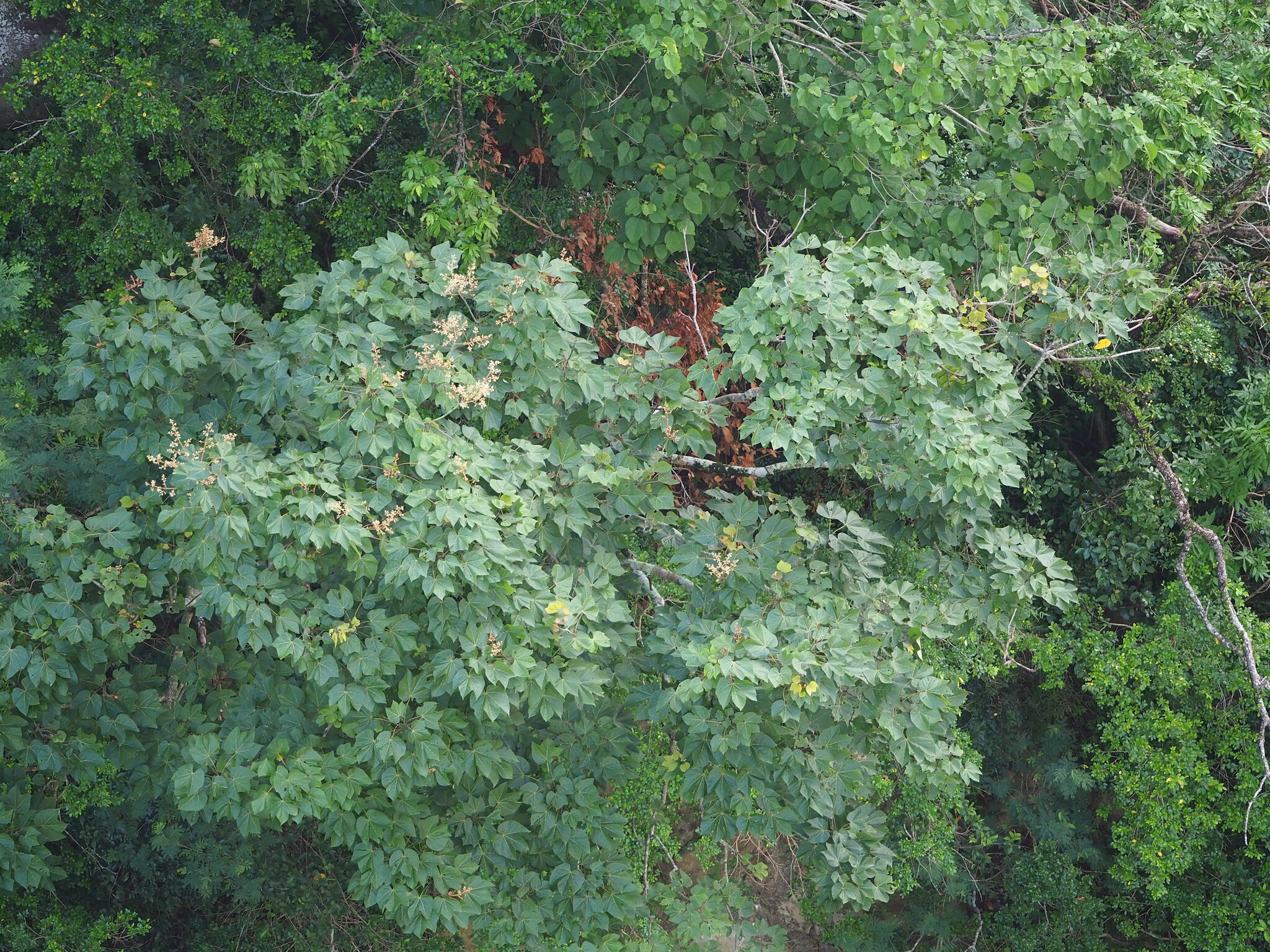



© photo
葉子 · cc0
Taken Sep 15, 2003 by Photoflora - Jean-Luc TASSET (©)
Taken Jul 28, 2019 by cimadevilla susy (cc-by-sa)
Taken Apr 28, 2017 by Dieter Albrecht (cc-by-sa)
Taken May 7, 2022 by Tristan Jaton-Maria (cc-by-sa)
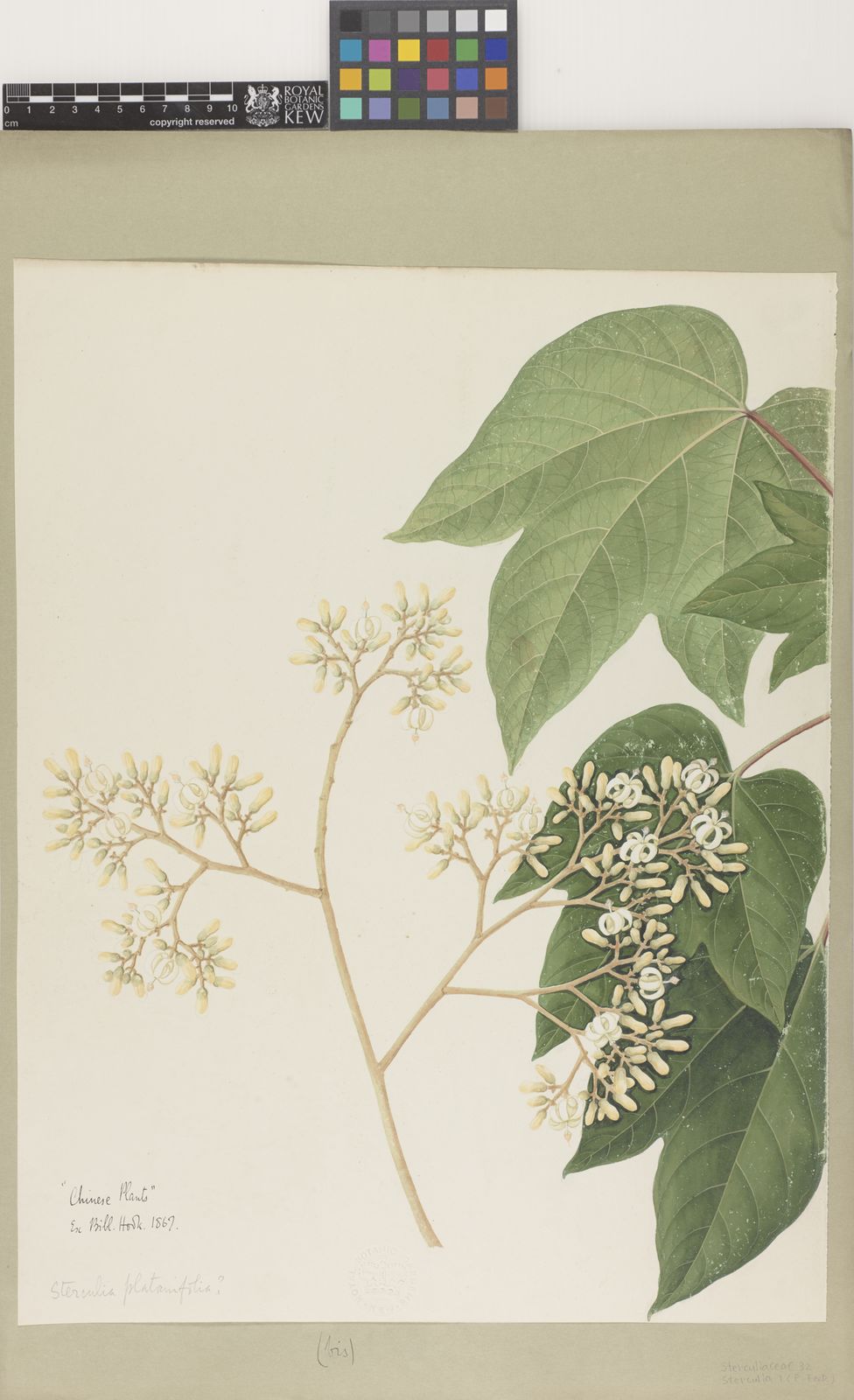
© copyright of the Board of Trustees of the Royal Botanic Gardens, Kew.




Global distribution
Firmiana simplex is native from southeastern Bangladesh to central and southern China and Vietnam, and from southern Japan to Taiwan. Introduced to the United States in the 1850s as an ornamental, it has naturalized and behaves invasively in warmer regions. In France it remains chiefly a botanical-garden specimen.
- Native4
- Invasive1
- China
- Taiwan
- Japan
- Vietnam
- United States
Hexagons: regions where the plant occurs. Green dots: native range.1
Identity
Chinese parasol tree (Firmiana simplex (L.) W.Wight, 1909), also called wutong, is a deciduous tree in the Malvaceae. It was formerly placed in Sterculiaceae, now absorbed into the broader mallow family. Linnaeus first described it as Hibiscus simplex in 1763; William Franklin Wight transferred it to Firmiana in 1909. 1 7
The genus commemorates Karl Joseph von Firmian, Austrian governor of Lombardy and an eighteenth-century patron of science. In China, the tree's name is wutong (梧桐). A traditional saying holds that the phoenix perches only on this tree, an association with nobility and welcome that recurs in classical poetry. English names also include phoenix tree and varnish tree. 8 9
Recognition
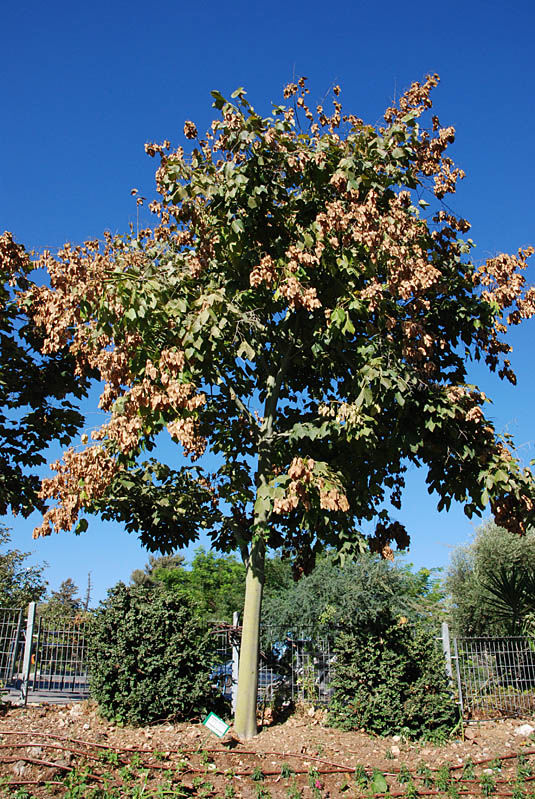
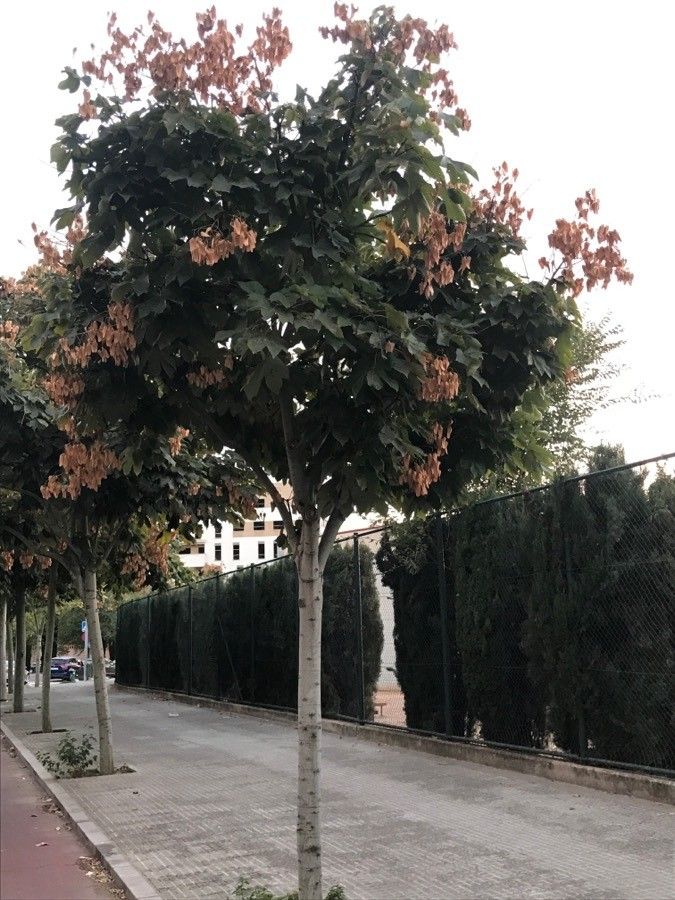
Smooth green bark is the clearest distinction from paulownia and catalpa, two trees with similarly broad leaves. The photosynthetic bark remains green for several years on the trunk and young branches before becoming gray. A rounded crown usually develops above a single trunk, reaching 9–16 m (30–52 ft) at maturity. 2 7
Alternate, deciduous leaves are palmately divided into three or five lobes and can reach 30 cm (12 in) across. Their outline resembles an open parasol, giving the tree its common name. The upper surface is bright green, the lower surface paler and slightly downy. 2 7
Flowering in early to midsummer, June–July in northern temperate climates, produces small, star-shaped yellow-green flowers in large upright terminal panicles. Fragrance varies with humidity, sometimes lemony and sometimes resembling chocolate. This scent differs from that of paulownia or catalpa and supplies another recognition feature. 2 7
Useful taxonomy
Several botanical names preceded the present nomenclature. Older literature may use:
- Hibiscus simplex L., the basionym published in 1763;
- Sterculia platanifolia L.f.;
- Firmiana platanifolia (L.f.) Marsili;
- Sterculia firmiana J.F.Gmel.;
- Firmiana chinensis Medik. ex Steud.;
- Firmiana simplex var. glabra Hatus..
The name glabra describes a hairless-leaved form and still occurs in some Asian catalogs. POWO treats it as a synonym of the species rather than a separately accepted variety. The accepted name remains Firmiana simplex. 1
About twenty species from Asia and the Pacific make up Firmiana. Formerly placed in Sterculiaceae, the genus now belongs to Sterculioideae, a subfamily of Malvaceae in its broad sense. Chinese parasol tree is by far the most widely cultivated ornamental member; most of its relatives remain chiefly within their Asian native ranges. 1 8
Habitat and range
The native range extends from southeastern Bangladesh through central and southern China to Vietnam, and from southern Japan to Taiwan. In that range, sunny lowland roadsides and woodland edges are characteristic sites. This native occurrence differs from its later use as an ornamental tree elsewhere. 1 3
Introduced to the United States as an ornamental in the 1850s, the tree has since spread beyond cultivation. Grown as an ornamental since then, the tree has naturalized in the southeastern and southwestern parts of the country. It behaves as an invasive weed in warmer regions. Florida's state plant atlas records it as nonnative. IUCN assesses it as Least Concern globally, a conservation category that does not describe its invasive behavior outside the native range. 2 7 4 5
In France, Chinese parasol tree remains mainly a collection specimen in botanical gardens and city parks, including those in Paris, Lyon, Nantes and Bordeaux. Naturalization comparable with that in the United States has not been reported there to date. This is a statement about France, rather than a prediction for every climate where it is planted. 6
Life cycle and reproduction
The fruit behaves unusually for a tree grown in temperate gardens. Soon after pollination, the five carpels split open before maturity, flattening into green, leaf-like valves. Seeds remain exposed along their edges, so the fruit resembles small paired oval leaves edged with round seeds. 8 9
Wind and watercourses carry the seeds, which have no particular dormancy requirement. Fresh seed sown in a light surface layer germinates in warmth; stored seed takes about two months when sown in local spring. Seedlings are less cold-tolerant than established trees, helping explain spring planting in temperate climates. 3 6
Early growth is rapid, and a tree can develop its adult outline in roughly fifteen years under good conditions. Vigor and abundant viable seed allow it to establish readily on riverbanks or disturbed ground outside its native range, where an open site can quickly acquire seedlings. 7
Uses and risks
Ornamental planting is the dominant use. Green bark and large leaves attract attention from spring onward, followed by summer flowers and decorative open capsules into late summer. The capsules are sometimes collected for dried arrangements. In China, the fine-grained wood is traditionally valued for soundboards in the guqin and guzheng, two stringed instruments. 2 7
The oil-rich seeds are eaten roasted, a documented but relatively minor food use. Traditional medicine attributes anti-inflammatory and expectorant uses to the seeds, employs root decoctions for swelling, and uses leaf lotions externally for boils and hemorrhoids. These are ethnobotanical reports rather than clinically validated treatments. 3
Plants For A Future reports no known hazards for this plant. That statement is not a veterinary safety assessment for cats, dogs or horses and does not replace veterinary advice after substantial ingestion. 3
Varieties, look-alikes and related plants
Broad leaves can lead to confusion with two other Asian ornamental trees also grown in France. Paulownia (Paulownia tomentosa) has opposite, downy leaves and early purple flowers appearing before them. Catalpa (Catalpa bignonioides) has leaves in whorls of three, white summer flowers and slender pod-like fruits. Neither has the smooth green bark characteristic of Chinese parasol tree, the most useful distinction outside flowering. 2
At varietal level, Firmiana simplex var. glabra was described separately for leaves lacking the usual slight down on their lower surface. POWO treats that name as a synonym. No stabilized horticultural cultivar is documented for the species, in contrast with more extensively selected genera such as Monstera or Acer. A botanical varietal name and a named garden cultivar therefore represent different kinds of labels. 1
Main sources
- Plants of the World Online / Kew, Firmiana simplex (L.) W.Wight
- Missouri Botanical Garden Plant Finder, Firmiana simplex
- Plants For A Future, Firmiana simplex
- Atlas of Florida Plants, Firmiana simplex
- IUCN Red List, Firmiana simplex assessment
- Wikipedia FR, Firmiana simplex
- Wikipedia EN, Firmiana simplex
- Wikipedia EN, Firmiana (genus)
- Wikipedia ZH, 梧桐 (Firmiana simplex)
Frequently asked questions
Is Chinese parasol tree invasive?
It is invasive in warm parts of the southern United States, where it has naturalized following its introduction in the 1850s and reseeds readily along watercourses. In France it remains mainly a collection tree, without comparable naturalization reported to date.
Why does Chinese parasol tree have green bark?
Smooth green bark persists for several years on the trunk and young branches before turning gray with age. It is the most useful identification feature outside flowering, including comparisons with paulownia and catalpa.
Is the fruit of Chinese parasol tree edible?
The oil-rich seeds are eaten roasted, a documented but minor use. The fruit itself is especially notable for opening well before maturity, exposing bare seeds along the margin of each valve.
What connects this tree with the Chinese phoenix?
A classical Chinese saying holds that the phoenix, or fenghuang, perches only on wutong. This association made the tree a symbol of nobility and a favorable welcome, prominent in classical poetry and imperial imagery.
How can I distinguish Chinese parasol tree from paulownia or catalpa?
Its smooth green trunk bark often settles the comparison, since neither paulownia nor catalpa has that feature. Flowers provide another distinction: yellow-green summer flowers here, early purple flowers in paulownia and white summer flowers in catalpa.
Is Chinese parasol tree toxic to pets?
Plants For A Future reports no known hazards. This is not a veterinary safety assessment for cats, dogs or horses, and does not replace veterinary advice after substantial ingestion.
Where does the name Firmiana come from?
The genus honors Karl Joseph von Firmian, the Austrian governor of Lombardy and an eighteenth-century patron of science. The epithet simplex refers to the simple leaf, in contrast to other species in the genus.
If you are unsure about a plant’s toxicity, ask a botanist or veterinarian for advice.