
Golden bells (Forsythia, )
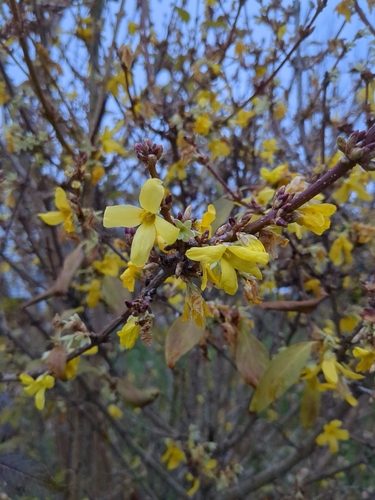
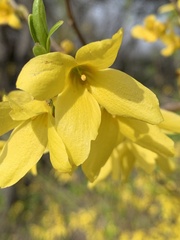

Forsythia is a genus of deciduous shrubs in the Oleaceae, mostly of Asian origin, known for yellow flowers on bare branches in early spring. Common garden plants include Forsythia × intermedia, a hedge hybrid. The genus includes several species and cultivars suited to informal hedges, cut branches and pruning after flowering.
Read moreGolden bells


© photo
littlespacecase · cc0
Jay Pruett · cc-by-nc
Wikimedia Commons · CC BY-SA or Public Domain
© copyright of the Board of Trustees of the Royal Botanic Gardens, Kew.


Identity
Forsythia (Forsythia Vahl) is a genus in the Oleaceae, the family of lilac, jasmine and olive. POWO, WFO and IPNI recognize it at genus level. The familiar hedge hybrid Forsythia × intermedia belongs within this broader group. 1 2 3
Bare branches covered in yellow flowers make forsythia one of the most recognizable shrubs of early spring. Its clear, strong yellow announces the new season before the leaves emerge. Golden bells is another established name for these shrubs. 8 4
Several species and hybrids share the common name forsythia. One of the most widely planted choices for informal hedges is Forsythia × intermedia, a hybrid of F. suspensa and F. viridissima. 5 4
NC State describes forsythias as easy perennial deciduous shrubs that can grow in average soil and urban settings. This resilience helps explain their presence in older gardens, street hedges and beds that receive little watering. 6 4
Recognition
Upright or arching branches give this fast-growing deciduous shrub its shape. Yellow flowers appear on the previous year’s wood before the foliage, often in March and April in temperate Northern Hemisphere gardens. The gap between flowers and leaves is its simplest identifying feature. 5 8
Bell-shaped flowers have four lobes and occur singly or in small clusters along the branches. Opposite, simple, toothed leaves become visible after flowering; the bare flowering stems create the striking spring display. 5 7
Pruning strongly affects the outline. An informal hedge retains flexible flowering branches, while a tightly clipped forsythia becomes a green mass that flowers mainly on its outer surface. This difference explains many disappointing displays. 4 8
Branches can root by layering when they touch the ground. This habit does not make forsythia an invasive plant in France, but it does mean that an aging shrub takes up more space unless it is thinned. 6 4
Useful taxonomy
Botanically, Forsythia names the genus. The common hedge hybrid Forsythia × intermedia is only one member of that group, so its characteristics should not be taken to describe every forsythia. 8 1
Eastern Asia is home to several species in this predominantly Asian genus. Garden plants are often hybrids or cultivars selected for height, habit, intensity of yellow and suitability for hedges. 7 4
Different selections require different amounts of space. Forsythia × intermedia can become tall and broad, whereas low cultivars such as Gold Tide fit small gardens and banks more readily. 4 5
Knowing the common hybrid helps when choosing cultivars, but the name Forsythia covers the wider range of species and garden forms sold under the same everyday name. 8 6
Cultivation
Growing forsythia is straightforward when its basic needs are met. It flowers best in full sun, tolerates light partial shade, accepts many drained soils and copes with urban conditions. Established shrubs need little watering. 4 5
Prune after flowering to protect the next display. The following spring’s buds form on the wood produced afterward, so late pruning in summer or fall removes some of those future flowers. 4 5
Rejuvenate a clump by removing a few old stems at the base just after flowering, rather than clipping the whole shrub into a ball. This retains young flowering branches and a more natural outline. 4 8
More drastic renovation can cut the shrub back low, but sacrifices the immediate display and should be an occasional recovery measure. In a mixed hedge, combine removal of old wood with light shortening while retaining young arching branches. 6 4
A large container can support forsythia for a few years, though the shrub expresses its habit better in open ground. A cramped pot brings frequent watering, restricted roots and pruning to keep growth within bounds. 4 6
Uses
Informal hedges, the backs of borders, banks and specimen plantings all suit forsythia. Flowering branches last well in a vase and can be forced indoors in late winter, bringing the spring display forward. 4 5
Daffodils, mahonias, flowering currants, spireas and country hedge shrubs make useful companions. A few blocks of yellow can announce spring without overwhelming the subtler colors elsewhere in the garden. 8 4
Vigor is an advantage in large spaces and a constraint in small ones. Choose a cultivar that fits the available room instead of severely pruning an oversized selection for years. 4 5
Dark evergreens provide a clear backdrop for the yellow flowers. Yellow bulbs strengthen the sunny effect, while soft pink or white flowers soften the intensity as the spring display develops. 8 6
Precautions and limitations
NC State lists Forsythia × intermedia as non-toxic to dogs, cats and horses. For the genus as a whole, a low-risk description remains appropriate, with the simple precaution of avoiding ingestion of ornamental plant material. 5 1
The main difficulties concern cultivation: pruning at the wrong time, excessive size, or reduced flowering caused by dense shade or late frost on buds. Forsythia needs relatively little care, but timing matters. 4 8
Use Forsythia for the whole genus and F. × intermedia for its major hedge hybrid. This distinction also leaves room for the other species and cultivars with related but differing garden habits. 8 2
Main sources
- Plants of the World Online / Kew, Forsythia
- World Flora Online, Forsythia
- International Plant Names Index, Forsythia
- Royal Horticultural Society, how to grow forsythia
- NC State Extension, Forsythia × intermedia
- NC State Extension, Forsythia genus
- Wikipedia EN, Forsythia
- Floralens, selection of yellow flowers
If you are unsure about a plant’s toxicity, ask a botanist or veterinarian for advice.