
hawkweed (Hieracium, )
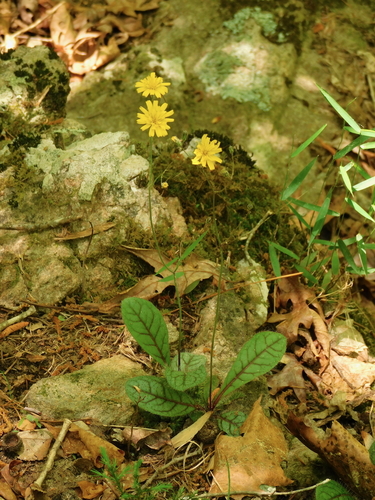
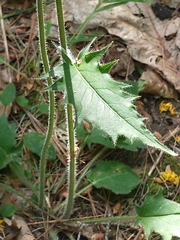

Hawkweed (Hieracium) is a genus in the Asteraceae whose yellow wildflowers resemble dandelions and other daisy relatives. Its many closely related forms make identification difficult; leaves, hairs, stems and habitat help distinguish them. The genus includes Hieracium umbellatum.
Read morehawkweed


© photo
Michael J. Papay · cc-by
Tom Norton · cc-by
Oscar C. González Martínez · cc-by-sa
© copyright of the Board of Trustees of the Royal Botanic Gardens, Kew.
Identity
hawkweed (Hieracium L.) is a genus in the Asteraceae. POWO, WFO and IPNI confirm this botanical rank: the name covers a group of species rather than a single yellow wildflower. 1 2 3
Among yellow wildflowers, hawkweed offers an exercise in identification. Seen from a distance, it resembles other yellow members of the daisy family. Leaves, stems and flower heads provide the additional characters needed to move beyond that first impression. 8 4
The English name hawkweed covers a broad and complicated group. Some classifications place part of the former hawkweed group in Pilosella, while others adopt a wider treatment. Working at genus level avoids promising a species identification from a yellow flower alone. 4 5
That difficulty is part of learning to recognize wild plants. Hawkweed demonstrates why a genus name can be an honest answer when a photograph or its context does not reveal enough distinguishing characters. A less precise name can still convey useful botanical information. 8 4
Recognition
Hawkweeds generally bear yellow flower heads composed entirely of strap-shaped ray florets, like many other Cichorieae. Stems and leaves may release white latex. Basal leaves, hairs, leaf teeth, bracts and achenes become decisive when attempting a more detailed identification. 5 4
A flower head alone can look like a small dandelion, hawksbeard, sow-thistle or another yellow meadow flower. To photograph a hawkweed usefully, include the leaf rosette, the entire stem, the underside of the flower head and the surrounding habitat. Each view supplies information missing from a close-up of the open florets. 8 4
Several species are hairy, sometimes with glandular hairs, and their leaves vary in how strongly toothed they are. These characters can be difficult to assess in a smartphone photograph. 5 One example within the genus, Hieracium murorum, is a hawkweed native to Europe. 7
Plant texture is a useful clue. Simple, star-shaped and glandular hairs, the presence or absence of stem leaves, and the shape of the involucre, the ring of bracts beneath the head, provide more information than a photograph taken from directly above the flower head. 4 5
Useful taxonomy
Hieracium is a notoriously difficult genus. Thousands of names have been published, and many lineages reproduce by apomixis, producing seeds genetically very close to the parent plant. This biology maintains numerous local microforms, making the boundaries between named entities unusually complicated. 5 6
Go Botany also notes that the group's taxonomy continues to change. Depending on the flora, species may be transferred to Pilosella or treated within a different framework. Such changes do not prevent the use of a genus name for general identification, but they call for caution at species level. 4 1
Hieracium spp. refers to several species within the genus. Hieracium umbellatum and H. murorum are separate species names. Identifying either requires comparison of the specimen's characters, rather than inferring a species from the broader genus name. 8 2
This caution benefits anyone learning identification. False precision creates an illusion of knowledge; a clearly explained genus supplies real characters to check in the field. It gives a reason to take further photographs and compare the specimen with a regional flora before settling on a species name. 8 4
Habitat and management
Hawkweeds occur in remarkably varied habitats: nutrient-poor grassland, banks, meadows, woodland edges, rocky ground, mountains and waste ground, depending on the species. Many cope better with poor soils than with heavily fertilized lawns. The setting therefore matters as much as the general color of the flowers. 5 4
In gardens, hawkweeds are seldom grown as conventional border perennials. They are more often encountered as spontaneous plants, meadow flowers, subjects for botanical observation or plants of banks. Mowing too early removes the flower heads and seeds that would otherwise help with identification. 8
Some hawkweeds can become troublesome outside their native ranges or in vulnerable pasture, particularly where they have been introduced. Assess the plant in its local setting first: it is a wild plant to identify, rather than one to propagate indiscriminately. The same genus can include plants with very different local significance. 5 1
A single hawkweed in a garden lawn does not necessarily require intervention. The decision depends on the intended use of the space: a closely maintained lawn, a wildflower meadow, a dry bank or a botanical survey. A plant that is unwanted in one setting can be of interest in another. 8 5
Uses
The main use is educational. For someone learning to distinguish yellow flowers, Hieracium encourages attention to leaves, stems, hairs, latex, bracts and habitat. Alongside dandelion, coltsfoot, arnica, buttercup and ragwort, it offers a useful step toward more careful wildflower identification. 8 4
In natural grassland, these small Asteraceae also contribute to the patchwork of resources available to insects. They may lack the dramatic appearance of a large garden perennial, but their open flower heads add variety at times when dry banks can offer relatively few different flowering plants. 5
Hawkweed is chiefly useful for careful observation, rather than large-scale gathering or medicinal use without an appropriate framework. 8 Geographical context matters too: Hieracium murorum, native to Europe, is naturalized in some colder parts of North America. 7
Precautions and limitations
Hieracium contains many species that can be difficult to identify. 1 5 Recognizing the genus is not enough to recommend eating it: do not consume an unidentified wild plant or offer it as food or livestock feed.
Identification is the greatest limitation. Hawkweeds are a specialist group; an identification app or general botanical account can often reach the genus, while a species determination requires detailed characters, a regional flora and sometimes a botanist's opinion. Accepting that limit is part of a sound identification. 4 5
Hieracium covers a group of hawkweeds whose resemblance to other yellow flowers makes careful observation especially useful. The genus name provides an initial identification; a finer determination depends on leaves, hairs, bracts and habitat. 8 2
Detailed hawkweed identification requires expert knowledge: a methodical approach, botanical vocabulary and comparison of distinguishing characters. The difficulty lies in separating closely related species, well beyond what a quick glance at flower color can establish. 4 5
Main sources
If you are unsure about a plant’s toxicity, ask a botanist or veterinarian for advice.