
Common jasmine (Jasminum officinale, )
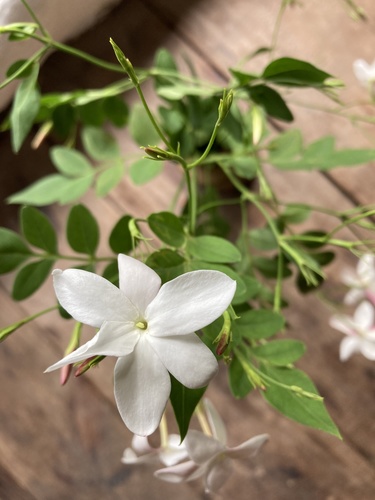

Common jasmine (Jasminum officinale L.) is a flexible, fragrant climber in the Oleaceae, grown for white flowers and a light framework of stems. It flowers more reliably on a bright trellis than in a dark corner. Horticultural sources describe it as nontoxic to dogs and cats, although ordinary care around plant ingestion remains appropriate.
Read moreCommon jasmine, poet’s jasmine and true jasmine



© photo
(c) trala, some rights reserved (CC BY-NC) · cc-by-nc
Wikimedia Commons · CC BY-SA or Public Domain
Taken Jul 17, 2021 by Joan Francesc (cc-by-sa)
Taken Apr 28, 2022 by mohammad fazel dehkordi (cc-by-sa)
Taken May 4, 2021 by Jacques Zuber (cc-by-sa)
Taken Jan 10, 2022 by Fabrice Rubio (cc-by-sa)
© copyright of the Board of Trustees of the Royal Botanic Gardens, Kew.




Identity
Fragrance and flexible stems make common jasmine (Jasminum officinale L.) a familiar climber in the Oleaceae. White flowers bring height and a light texture to a railing or trellis. Its other established English names include poet’s jasmine and true jasmine. 1 2 8
NC State describes a perennial vine that can be evergreen to semi-evergreen depending on climate. It gives a broad origin extending from Turkey through Iran and northern India to central China. Foliage persistence therefore needs to be understood in relation to growing conditions. 5
A balcony or bright trellis suits its role better than a shaded indoor corner. Flowering and fragrance depend on enough light, together with stems guided onto an appropriate support. A climbing plant needs both the opportunity to grow and room for its flowers to be enjoyed. 8 5
“Jasmine” is a shared common name, not a guarantee of botanical identity. Trachelospermum jasminoides is often called star jasmine, while several true Jasminum species also resemble one another. The binomial Jasminum officinale distinguishes this species from those similarly named plants. 5 4
Recognition
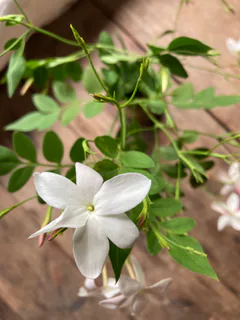
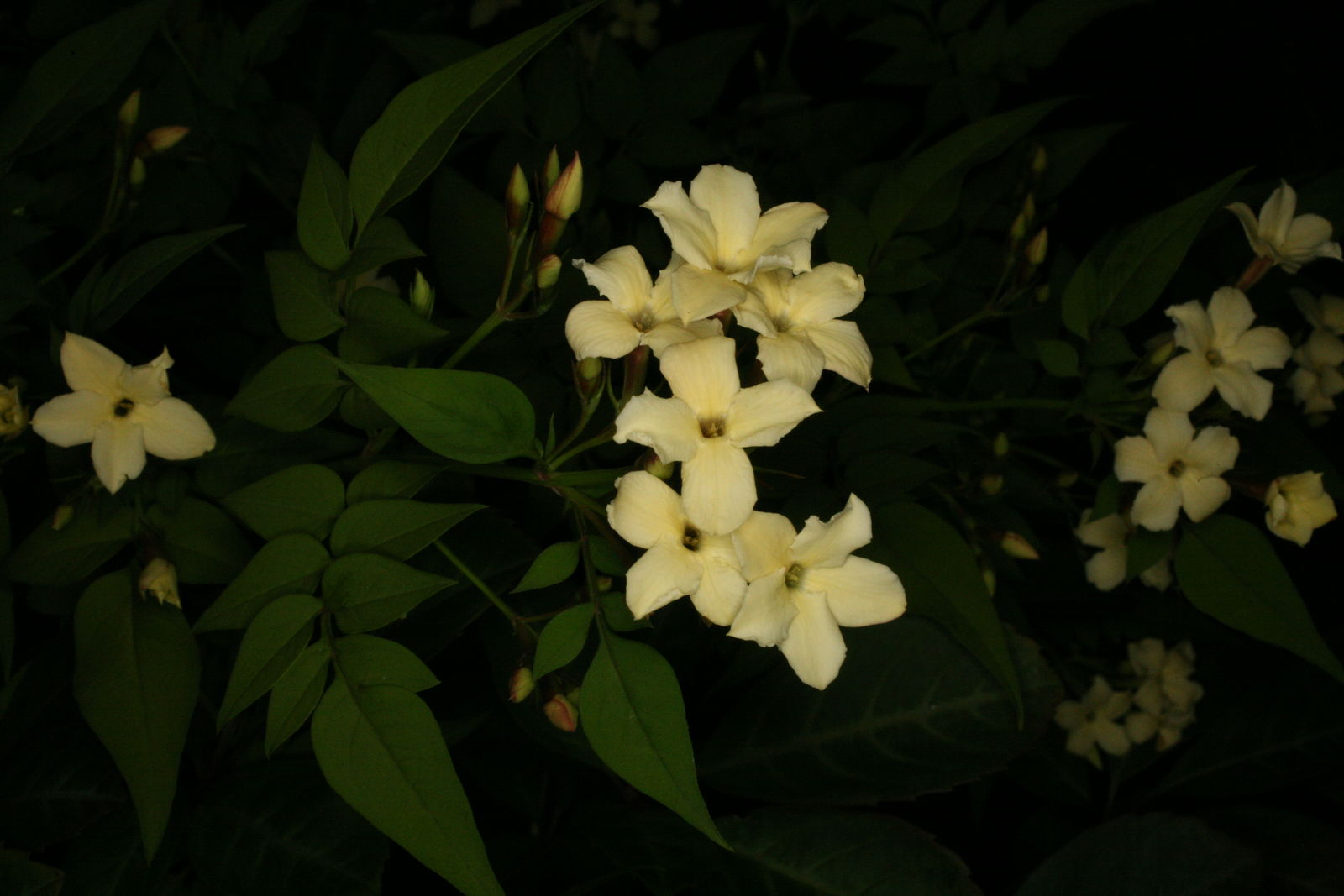
Supple stems twine or can be trained onto supports, carrying opposite, compound leaves. Buds are often pink before opening into white, star-shaped, tubular flowers with a strong fragrance. That combination of leaf arrangement, stem habit and flower structure is more useful than flower color alone. 5 6
Fragrance helps determine where to plant it. One vine can scent a balcony, entrance or bright conservatory, but a plant far from a frequently used route loses some of its appeal. Its flowers are best appreciated where people can pass close to them. 8 5
Flowering can continue over a long period, peaking from summer into early fall according to climate and pruning. Long shoots with few flowers often point to inadequate light, poorly managed support or excessively hard pruning at the wrong time. 7 8
Distinguish common jasmine from gardenia as well. Both offer white flowers and scent, but jasmine is a climber that needs training, whereas gardenia is a shrub often grown in a pot and more demanding of humidity and acidic conditions. They do not fill the same structural role. 5 8
Useful taxonomy
The botanical name Jasminum officinale L. is accepted in the Wikidata, POWO, WFO and IPNI references. Using it alongside the common name helps keep horticultural descriptions and taxonomic records connected, especially where several plants are sold as jasmine. 1 2 3
The epithet officinale recalls a history of medicinal or herbal use, also noted in NC State’s explanation of the name. That history is not a therapeutic recommendation. The species can be appreciated as a fragrant ornamental without turning its name into advice to prepare or ingest it. 5
Cultivars such as Affine and Aureovariegatum differ chiefly in flower size or foliage. Their essential growing needs remain support, light, drainage, moisture around the roots and protection from severe cold. Decorative leaf markings do not remove those basic requirements. 5
Common jasmine, star jasmine and winter jasmine should be distinguished when choosing a plant. A familiar common name may suggest fragrance, but the binomial identifies the actual species being grown. Similar names should not be used to assume identical behavior or cultivation needs. 4 6
Growing conditions
Gentle sun to bright partial shade, drained soil and roots that do not dry abruptly suit common jasmine. In sheltered open ground it soon makes a more generous plant than in a small pot on a scorching paved surface. Light and root conditions work together. 5 8
Plan the support before stems become tangled. A railing, trellis or strong wires give them direction. Without guidance, the vine becomes harder to prune and its flowers are less clearly displayed, even when the plant itself continues to grow vigorously. 8
In cold climates, a large container allows the plant to be moved to a cool conservatory or a very bright room for winter. NC State cautions against relying on it in colder zones and notes that indoor plants still require support and pruning. 5
Prune after flowering. An overenthusiastic spring cut removes part of the flowering potential, while an old plant that is never renewed becomes tangled and bushy. The purpose is to guide and maintain the framework, rather than repeatedly cutting the plant back without regard to its cycle. 7
Uses
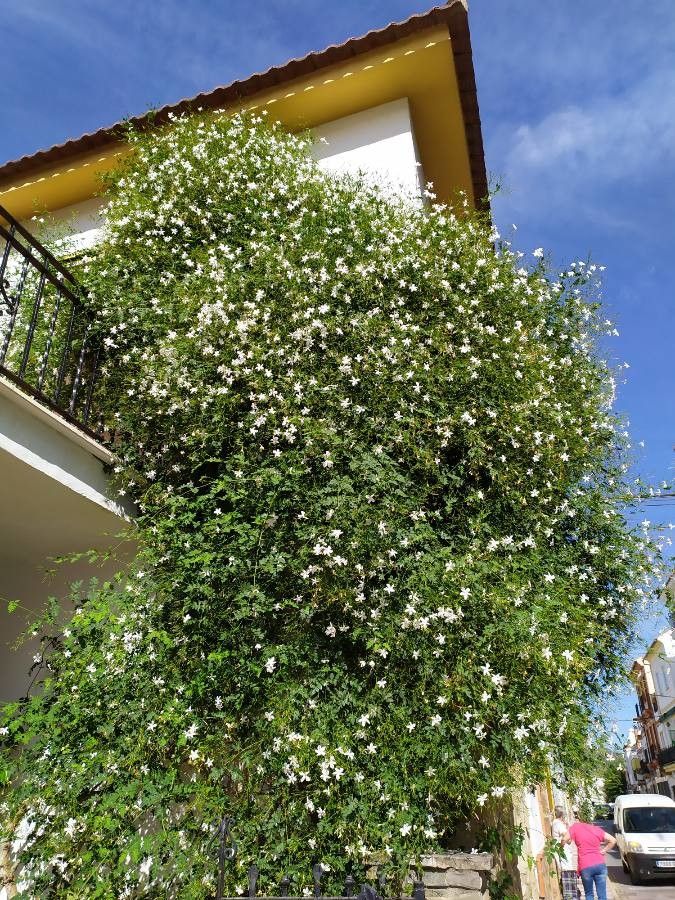
A fragrant trellis makes particularly good use of this climber: a balcony, light pergola, railing, sunny entrance or corner of a white garden can all benefit from its loose, flowering vertical growth. Its stems create height without the rigid outline of a shrub. 8
In an evening garden, place it near a seat or path rather than at the back of a border. Scent depends on proximity to the flowers. Common jasmine rewards a position chosen for the nose as well as the eye. 5
White clematis, lightly built roses, gray foliage and other fragrant container plants can accompany it. In a small space, one well-trained jasmine often gives a clearer structure than a collection of white-flowered plants with no framework to connect them. 8
Fragrant flowering also provides a seasonal cue. It suggests that a balcony supplies enough light and that the root ball has not repeatedly suffered dry stress. Observing the plant is more useful than following a rigid calendar, since urban microclimates vary considerably. 5
For households with animals, horticultural references describe another useful feature: NC State classifies the species as nontoxic to dogs and cats. Normal precautions still apply, because a nontoxic ornamental is not food for a curious pet. Avoid encouraging chewing or ingestion. 5
Precautions
NC State describes common jasmine as nontoxic to cats and dogs, a reassuring feature in family spaces. Leaves and flowers should still not be offered for eating. This is a different risk profile from that of genuinely poisonous ornamentals, rather than a reason to encourage ingestion. 5
The more common limitations are horticultural: severe frost, a dry pot, too little light and badly timed pruning. An unsuitable position can quickly produce a leafy mass with few flowers. Understanding those conditions is more helpful than treating the plant as uniformly easy or difficult. 8 7
A suitable position supplies light, a sturdy support and moisture around the roots. A plant squeezed into an unsuitable decorative corner may produce leaves rather than the expected flowers. These conditions explain many failures, especially on hot balconies, alongside the limits imposed by winter hardiness. 5 8
Given the light and support it needs, Jasminum officinale makes an excellent fragrant white-flowered climber. It creates a living vertical feature rather than replacing a border shrub. Choosing it for that role makes its flexible habit an advantage instead of a maintenance problem. 8 5
Main sources
- Wikidata, Jasminum officinale
- Plants of the World Online / Kew, Jasminum officinale
- World Flora Online, Jasminum officinale
- International Plant Names Index, Jasminum officinale
- NC State Extension, Jasminum officinale
- Wikipedia EN, Jasminum officinale
- Royal Horticultural Society, Jasminum officinale
- Floralens, selection of white flowers
If you are unsure about a plant’s toxicity, ask a botanist or veterinarian for advice.