
Great Basin bristlecone pine (Pinus longaeva, )
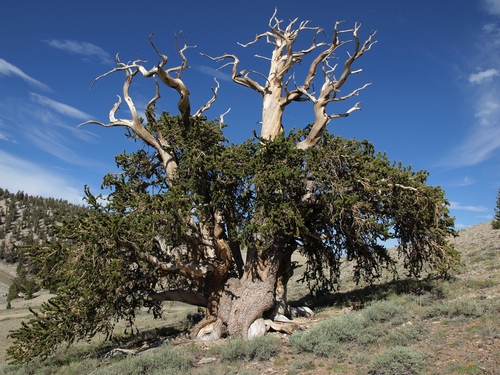
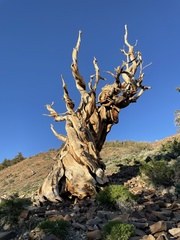
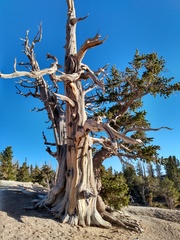
Great Basin bristlecone pine (Pinus longaeva) is a conifer in the Pinaceae family endemic to the high mountains of California, Nevada and Utah. Its open stands grow on poor dolomite soils at 1800–3650 m (5900–12,000 ft), where exceptionally slow growth produces dense wood and supports the oldest known non-clonal organisms on Earth.
Read moreGreat Basin bristlecone pine, Bristlecone pine and Intermountain bristlecone pine


© photo
(c) Jim Morefield, some rights reserved (CC BY), uploaded by Jim Morefield · cc-by
Chris · cc0
John Powers · cc-by
© copyright of the Board of Trustees of the Royal Botanic Gardens, Kew.


Global distribution
Pinus longaeva is restricted to a few Great Basin mountain ranges spanning eastern California (the White, Panamint and Inyo Mountains), Nevada and western Utah. It forms scattered high-elevation populations; no naturalization beyond this range is documented.
- Native3
- United States (California)
- United States (Nevada)
- United States (Utah)
Hexagons: regions where the plant occurs. Green dots: native range.1
Identity
Great Basin bristlecone pine (Pinus longaeva D.K.Bailey, 1971) is a conifer in the Pinaceae family endemic to a few mountain ranges of the western United States. Botanist Dana K. Bailey described it as a distinct species in 1971, separating the Great Basin populations from Pinus aristata, with which they had previously been grouped. 1 3
Only three Pinus species belong to the bristlecone pine group: Pinus longaeva, Pinus aristata and Pinus balfouriana. All are confined to mountains of the western United States and have needles in bundles of five. The name Intermountain bristlecone pine also refers to Pinus longaeva. 3
The Latin epithet longaeva means “long-lived.” It describes the feature that made this pine famous: some individuals rank among the oldest non-clonal organisms ever dated on Earth, with ages established by counting growth rings rather than by estimation. 3
Recognition
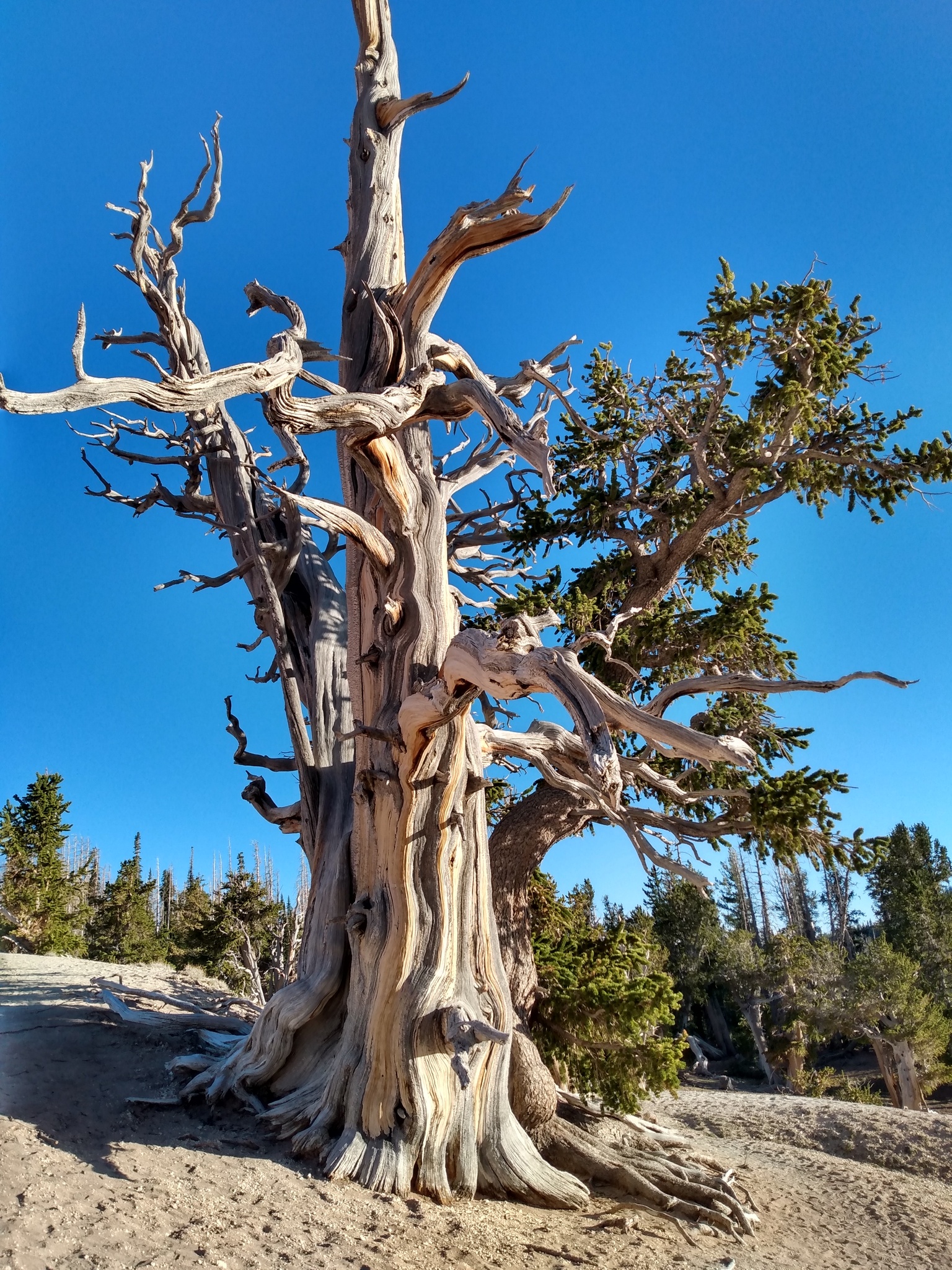
A typical tree reaches 5–16 m (16–52 ft), while very old trunks may exceed 2 m (6.6 ft) in diameter. Its stocky shape, twisted by mountain winds, contrasts with the straight trunk of a lowland pine. 3
Five needles grow in each fascicle. They measure 15–35 mm (0.6–1.4 in), with few visible resin droplets, and remain on the branch for 10 to more than 40 years. This exceptional persistence, among the longest known in conifers, creates dense, foxtail-like tufts at branch tips. 3
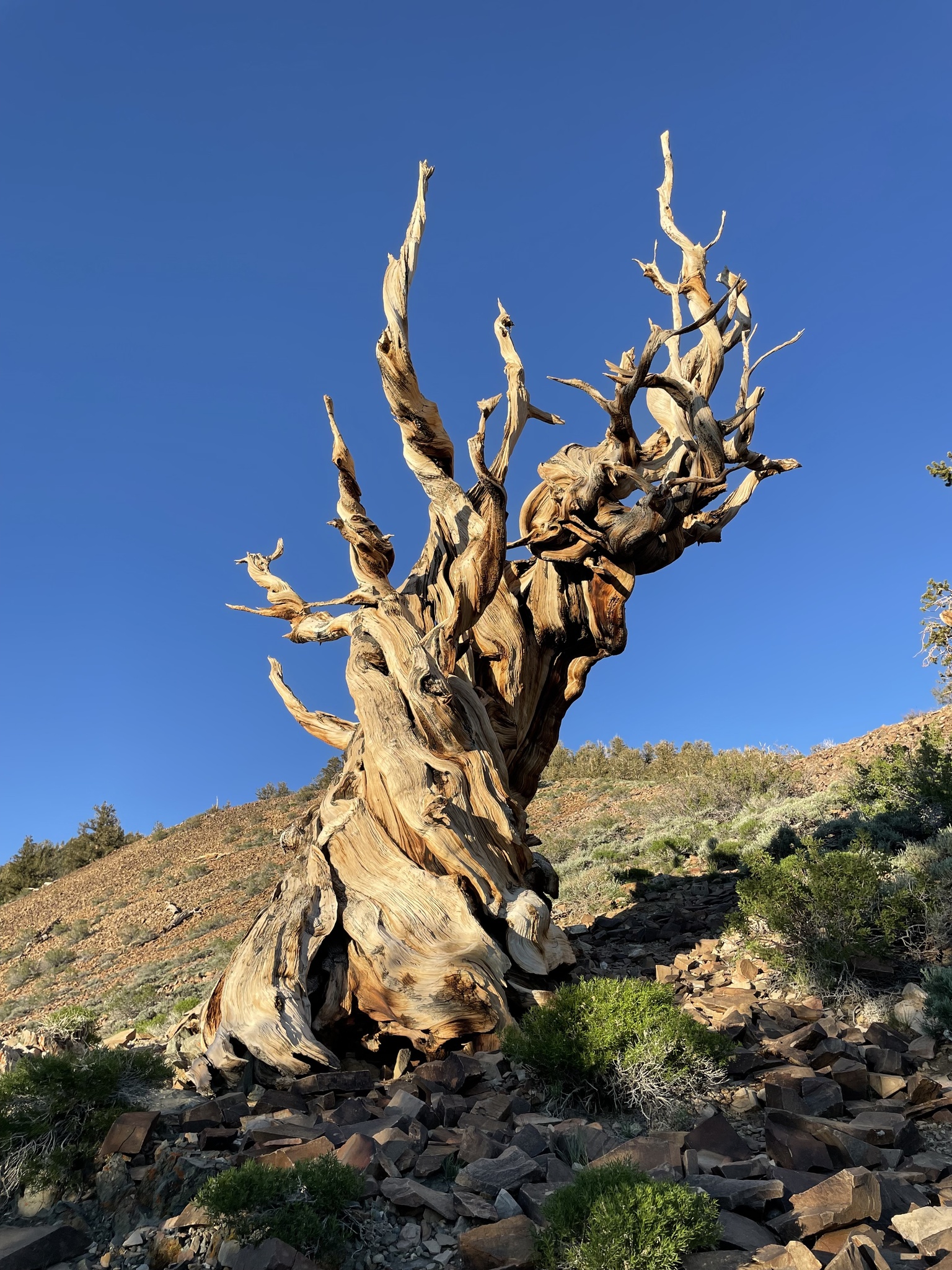
Bristled cones measure 6–9.5 cm (2.4–3.7 in), turning from purple to reddish brown as they mature. Each scale bears a slender, stiff bristle 1–6 mm (0.04–0.24 in) long, giving bristlecone pine its English name. On the oldest trees, much of the trunk dies; only a narrow living bark strip continues supplying a few leafy branches. This is known as strip-bark growth. 4 3
Useful taxonomy
Within subgenus Strobus, the five-needle pines, Pinus longaeva belongs to the bristlecone group alongside Pinus aristata and Pinus balfouriana. Before 1971 these populations were grouped under a single name, explaining the older combinations still found in some books:
- Pinus aristata var. longaeva D.K.Bailey, historical variety name
- Pinus aristata subsp. longaeva (D.K.Bailey) A.E.Murray, historical subspecies name
- Pinus balfouriana subsp. longaeva (D.K.Bailey) A.E.Murray, historical subspecies name
For identification, POWO’s accepted name Pinus longaeva provides a reliable reference, together with the number of resin canals in the needles. This microscopic character helped justify its separation from Pinus aristata. 1 2
The USDA PLANTS code PILO refers specifically to this species. It is useful when the three historical synonyms overlap in older North American literature. 5
Habitat and range
Scattered populations occupy very high elevations, 1800–3650 m (5900–12,000 ft), in three states: eastern California, including the White, Panamint and Inyo Mountains, Nevada and western Utah. They grow in the subalpine zone, often reaching the upper tree line. 4
Soil is the decisive factor here. This pine strongly favors limestone and dolomite, carbonate substrates low in phosphorus that suit few other conifers. These poor conditions reduce competition and slow growth, both of which paradoxically favor a longer life. 4
On the harshest sites, trunk diameter may increase by only about 1 cm per century (0.4 in). The same pine grows faster in deeper, more fertile soil but lives substantially less long, making dolomite populations a natural setting for studying longevity. 4
Life cycle and reproduction
Reproduction in Pinus longaeva occurs through winged, wind-dispersed seeds; no natural vegetative propagation is documented. Cones take two years to mature, and seed production remains relatively regular between years, without the pronounced lean years seen in other pines. 4
Seedling establishment is uncommon because poor soils and the dry Great Basin climate restrict germination to infrequent favorable periods. Sparse recruitment also prevents excessive stand density, which would increase vulnerability to fire and competition. 4
Fire poses a particular weakness for Pinus longaeva: thin bark offers little trunk protection, and intense fires kill most affected trees. Fortunately, its high-elevation sites lack continuous fuel between trees, limiting the spread of fire. 4
Longevity and uses
Among reliably dated non-clonal organisms, the living White Mountains tree in California is unmatched. Cores taken by dendrochronologist Edmund Schulman put its age at 4756 years in 1957; it is now over 4800 years old. Its exact location is kept secret to protect it from vandalism. 3 7
A Nevada tree named Prometheus was cut down in 1964 by a researcher trying to date its stand. Growth rings counted after felling revealed an age of about 4844 years, making its loss one of modern dendrochronology’s most regretted episodes. A trunk section is displayed at the Great Basin National Park visitor center. 3
Precisely dated growth rings provide a valuable climate archive. They improve radiocarbon dating and help reconstruct centuries of temperature and precipitation in the western United States. The IUCN lists the species as Least Concern, with a population considered stable, although warming and the uphill spread of mountain pine beetles remain under observation. 6 4
No toxicity to domestic animals is documented for this species. The ASPCA lists ponderosa pine, another member of Pinus, as non-toxic to cats and dogs; this is a genus-level reference rather than a dedicated assessment of Pinus longaeva. 8
Varieties, look-alikes and related plants
Established horticultural cultivars of this species are not widely available, and cultivation remains rare outside its native range. Trees in collections almost always come from wild-source seed, without extensive cultivar selection.
Rocky Mountain bristlecone pine, Pinus aristata, is the main look-alike. Its needles carry conspicuous whitish resin droplets, absent or inconspicuous in Pinus longaeva, and its cone bristles are longer: 6–10 mm (0.24–0.39 in) rather than 1–6 mm (0.04–0.24 in). Foxtail pine, Pinus balfouriana, belongs to the same group but has less prickly cones and a narrower range restricted to the Sierra Nevada and Klamath Mountains.
Older literature often confused these three bristlecone pines before resin-canal counts and cone characters allowed reliable separation. The scientific name therefore identifies the species more precisely than the shared name “bristlecone pine.” 1
Main sources
- Plants of the World Online / Kew, Pinus longaeva D.K.Bailey
- GBIF, Pinus longaeva D.K.Bailey
- The Gymnosperm Database, Pinus longaeva
- USDA Forest Service, Fire Effects Information System, Pinus longaeva
- USDA PLANTS Database, plant profile PILO (Pinus longaeva)
- IUCN Red List, Pinus longaeva assessment
- Encyclopaedia Britannica, bristlecone pine
- ASPCA, Ponderosa Pine toxicity entry (genus Pinus reference)
Frequently asked questions
Is Great Basin bristlecone pine really the oldest tree in the world?
Among reliably dated non-clonal organisms, a White Mountains tree is now over 4800 years old, according to cores taken by Edmund Schulman in the 1950s. Some vegetative clones of other species are older, but Pinus longaeva remains the reference for an individual, non-clonal tree.
Why does Great Basin bristlecone pine live so long?
Very slow growth on poor dolomite soils produces dense, resin-rich wood that resists insects and fungi. Strip-bark growth also reduces the water and living tissue needed to sustain an old trunk.
How can I tell Pinus longaeva from Pinus aristata?
Pinus longaeva needles have few visible resin droplets, whereas those of Pinus aristata are covered with them. Cone bristles also differ: each scale has a bristle 1–6 mm long in Pinus longaeva, compared with 6–10 mm in Pinus aristata.
Is Great Basin bristlecone pine threatened?
The IUCN lists the species as Least Concern, with a population considered stable across most of its range. Climate change and the spread of mountain pine beetles to higher elevations remain threats being monitored for the decades ahead.
Can I grow Great Basin bristlecone pine in a garden?
It is possible in a cold, dry climate with very poor, freely draining soil. Growth remains extremely slow, however, and much of its interest depends on its natural high-elevation setting. It is rarely available from nurseries outside its native range.
Is all the dead-looking wood on an old Pinus longaeva actually dead?
Not all of it. Much of a strip-bark tree’s trunk is indeed dead, but a narrow band of living bark continues to sustain the roots and a few leafy branches. The tree can survive for centuries in this form.
If you are unsure about a plant’s toxicity, ask a botanist or veterinarian for advice.