
Goat willow (Salix caprea, )
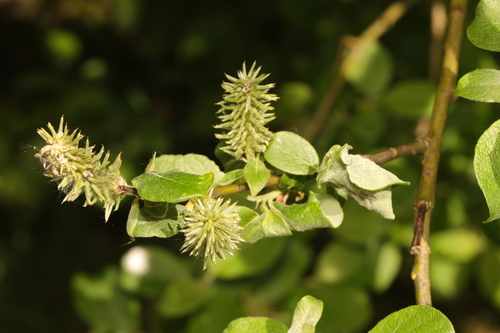

Goat willow (Salix caprea L., 1753) is a dioecious shrub or small tree in the Salicaceae family, found across Europe and temperate Asia. Silvery catkins open in late winter before the leaves. Its broad, downy foliage is much wider than that of most other willows.
Read moreGoat willow, Pussy willow and Great sallow

© photo
Stephen James McWilliam · cc0
(c) Colin, some rights reserved (CC BY-NC-ND) · cc-by-nc-nd
Dilrukshan Priyantha Wijesinghe · cc-by
(c) Екатерина Гущина, some rights reserved (CC BY) · cc-by
(c) Dilrukshan Priyantha Wijesinghe, some rights reserved (CC BY) · cc-by
Global distribution
According to POWO, goat willow is native throughout Europe and temperate Asia, from Portugal and the British Isles to northern China and Japan. It is also widely planted as an ornamental beyond that range, notably in North America as the weeping cultivar Kilmarnock, without documented widespread invasive naturalization.
- Native5
- Europe
- Russia (Siberia)
- Northern China
- Japan
- Metropolitan France
Hexagons: regions where the plant occurs. Green dots: native range.1
Identity
Goat willow (Salix caprea L., 1753), also known as pussy willow or great sallow, stands out in late winter through its silvery catkins on bare branches. They may open as early as February, before any leaves appear. This dioecious shrub or small tree belongs to the Salicaceae family. Carl Linnaeus described it in his Species Plantarum in 1753, and POWO retains the name as accepted within Salix. 1
The epithet caprea means “goat” in Latin, reflecting an old belief that goats particularly enjoyed its foliage. The French name marsault has a separate history: medieval Latin marensalicem, recorded in 1217, literally meant “male willow.” It originally referred to the silvery male catkins, the same structures that make the plant conspicuous at the end of winter. The English name goat willow likewise keeps the reference to goats visible. 6
Recognition
Broad leaves and changing twig surfaces help distinguish Salix caprea from neighboring willows. It commonly grows 6–14 m (20–46 ft) tall, with records above 20 m (65 ft), substantially taller than most willows maintained as low hedges. Young twigs begin gray and downy, then become hairless and yellow-green within a year. Closely related willows retain hairs on their young shoots much longer. 6 9
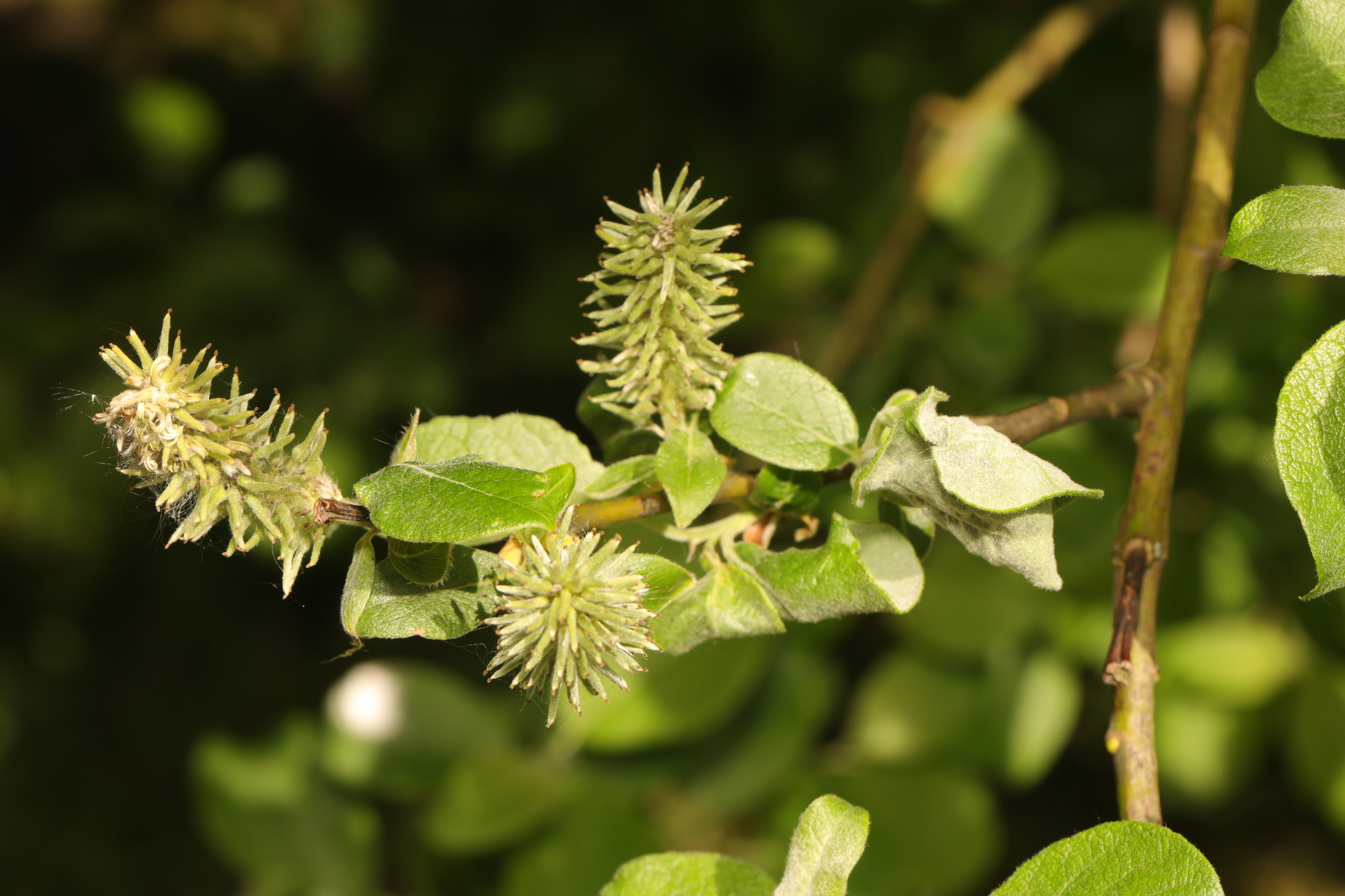
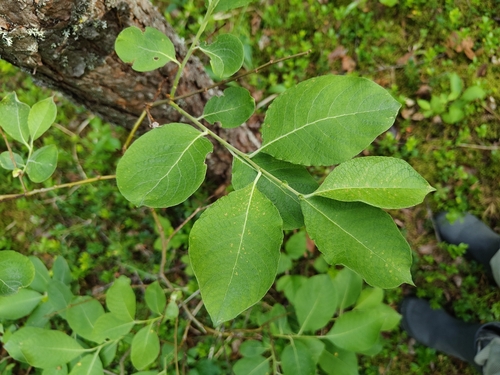
Leaves measure 6–10 cm (2.5–4 in) long and are oval to obovate, noticeably broader than those of most willows. Their undersides carry a dense gray felt with prominent veins. Together, the breadth and strongly veined lower surface distinguish goat willow from narrow-leaved willows sharing the habitat. The upper surface remains gray-green and slightly puckered. 9
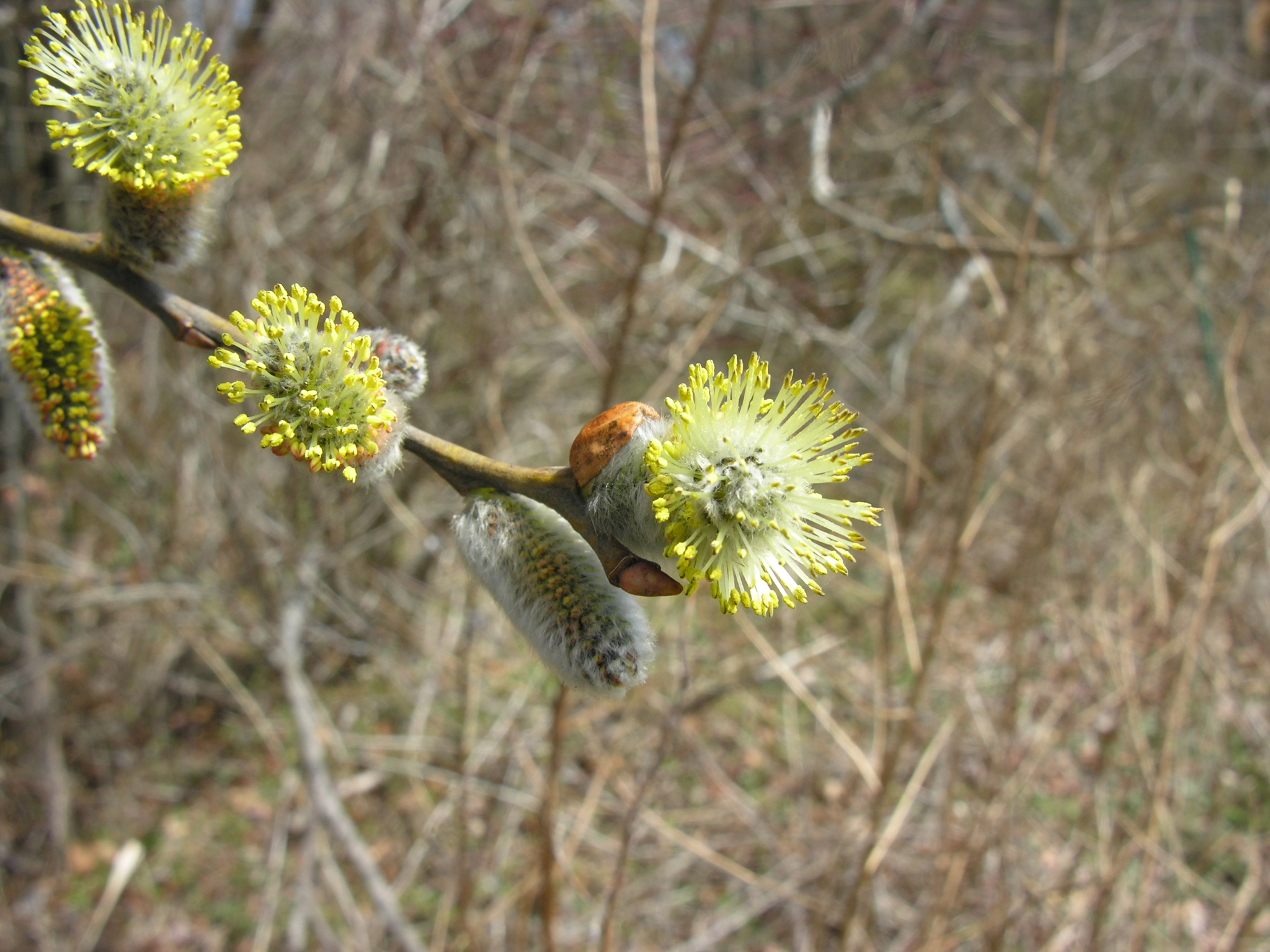
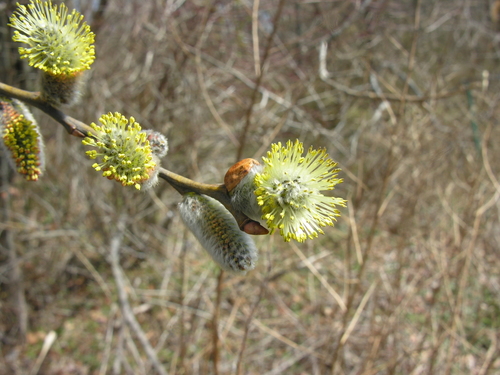
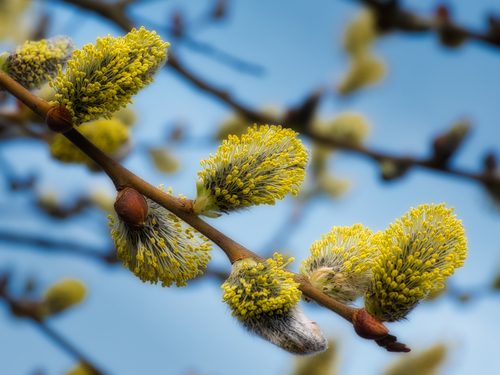
Flowering runs from February to April, depending on climate, and always precedes the leaves. Oval, silky male catkins change from silver-gray to golden yellow as the anthers open. Female catkins are greener and less conspicuous, later lengthening to as much as 7 cm (3 in) as they carry their cottony seeds. 2 7
Useful taxonomy
Numerous botanical synonyms reflect the variability of goat willow. The World Checklist of Vascular Plants brings them under the accepted name Salix caprea L. The following combinations represent names that may still appear in botanical treatments, including a weeping form associated with garden selections:
- Salix caprea subsp. hultenii Kom., a subspecies name;
- Salix caprea var. sericea Andersson, a varietal name;
- Salix caprea f. pendula (T.Lang) Rehder, associated with weeping cultivars;
- Salix caprea var. tomentosa Lecoq & Lamotte, another varietal name.
One nomenclatural trap needs particular attention. Salix caprea Boiss. & Buhse, published in 1860, is an illegitimate name referring to a synonym of Salix cinerea, the species most often confused with goat willow. Leaving out the authority can therefore identify the wrong plant. The full name Salix caprea L. is the dependable reference for botanical sources and nursery labels. 1
Habitat and range
From Portugal and the British Isles east to northern China and Japan, goat willow ranges across Europe and temperate Asia. This broad native distribution encompasses a much wider range of settings than the familiar image of a willow growing beside water might suggest. 1 4
Wet banks are only part of its habitat. Unlike most willows, Salix caprea also grows on dry waste ground and disturbed slopes wherever bare soil is exposed. It is a pioneer species, among the first plants to colonize newly uncovered ground, occurring up to 840 m (2,760 ft) above sea level. 7 4
IUCN assesses goat willow as Least Concern (LC). Its pioneer character favors it, since fresh disturbance and newly abandoned ground provide further opportunities for colonization. Beyond its native range it is mainly planted as an ornamental, notably in North America in the form of the weeping cultivar Kilmarnock. Widespread invasive naturalization has not been documented. 11
Life cycle and reproduction
Separate plants bear the male and female catkins of goat willow. Both wind and insects contribute to pollination. Flowers can open in February, well before leaf emergence, and the flowering season extends into April, with the precise timing depending on local conditions. 2 7
Tiny seeds travel on cottony down but remain viable for only a few days. To establish, they must quickly encounter bare, moist soil and germinate there. Without that brief opportunity, they die rather than waiting through a long dormant period. 4
Cuttings reveal an unusual feature of this willow. A pure Salix caprea roots poorly from cuttings, unlike most willows, which root readily. A plant that takes without difficulty is therefore often already a hybrid with another member of the genus. Weeping cultivars such as Kilmarnock are usually propagated by grafting onto willow rootstocks instead. 6 3
Uses and risks
Late winter catkins give goat willow both ornamental and ecological value. It flowers before most other woody plants, offering one of spring's earliest sources of nectar and pollen to queen bumblebees emerging from hibernation in February and March, when alternatives are scarce. Its leaves also feed many moth caterpillars, including poplar hawk-moth and puss moth. 10 8
The bark contains salicin, a precursor of salicylic acid traditionally used against fever and pain, as well as tannins used as a substitute in leather tanning. Very bitter inner bark has served as emergency food. The light, brittle wood crackles strongly when burned and has little value for joinery, though it serves as firewood. Flexible twigs can also be used for simple basketry. 4
For animal safety, ASPCA lists the genus Salix, including goat willow, as non-toxic to dogs, cats and horses. No dangerous active principle is documented for this species in that classification. 5
Varieties, look-alikes and related plants
Kilmarnock is a male weeping clone grafted onto a stem at 1.5–2.5 m (5–8 ft). Named after the Scottish town, it is the form most commonly sold for small gardens. Grafting controls its height and avoids the upward development of the wild type. Its female counterpart, Weeping Sally, is less common. 3
The closest identification problem involves Salix cinerea, whose leaves are narrower and whose twigs remain hairy longer than those of Salix caprea. The two hybridize naturally as Salix × reichardtii. Such hybrids are common in the field, and truly pure individuals are less frequent than is often assumed. The twig surface and leaf shape should therefore be considered together. 7 9
Main sources
- Plants of the World Online / Kew, Salix caprea L.
- Royal Horticultural Society, Salix caprea - goat willow
- Royal Horticultural Society, Salix caprea 'Kilmarnock' (m)
- Plants For A Future, Salix caprea database entry
- ASPCA, Willow (Salix) toxicity entry
- Wikipedia (FR), Goat willow
- Wikipedia (EN), Salix caprea
- The Wildlife Trusts, Goat willow
- Trees and Shrubs Online, Salix caprea
- Trees for Life, Goat willow facts
- IUCN Red List, Salix caprea assessment (2018)
Frequently asked questions
Is goat willow toxic to dogs or cats?
No. ASPCA lists the genus Salix, including goat willow, as non-toxic to dogs, cats and horses. No dangerous active principle is documented for this species.
Why do goat willow cuttings fail to root?
Unlike most willows, a pure Salix caprea roots poorly from cuttings. A plant that roots easily is often already a hybrid with another species, most commonly Salix cinerea.
How can I tell goat willow from gray willow?
Salix caprea has broader leaves with strongly raised veins, and year-old twigs that are hairless and yellow-green. Salix cinerea has narrower leaves and twigs that stay hairy longer. The two hybridize naturally as Salix × reichardtii.
Why are goat willow branches used at Easter?
In European regions where palms do not grow, Eastern churches and some Western churches bless goat willow branches on Palm Sunday. This also explains the German name Palmkätzchen.
When does goat willow flower?
From February to April, depending on climate, always before the leaves emerge. It provides one of the earliest spring sources of nectar and pollen for bees and bumblebees.
Does goat willow need wet soil?
Less than most other willows. It grows on wet banks as well as waste ground and dry slopes, making it a pioneer colonizer of bare, disturbed soils.
What is the Kilmarnock cultivar?
It is a male weeping clone grafted on a stem at 1.5–2.5 m (5–8 ft), named after the Scottish town of Kilmarnock. It is the nursery form most widely sold for small gardens.
If you are unsure about a plant’s toxicity, ask a botanist or veterinarian for advice.