
Common groundsel (Senecio vulgaris, )
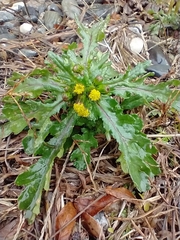
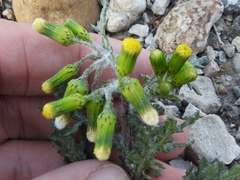
Common groundsel (Senecio vulgaris L., 1753) is an annual in the Asteraceae family, native to Europe, North Africa and temperate Asia and now naturalized on disturbed ground across most continents. Its small, fast-growing plants have cylindrical yellow flower heads without ray florets and black-tipped bracts. Every part contains liver-toxic pyrrolizidine alkaloids, posing a documented risk especially to horses and livestock eating contaminated hay.
Read moreCommon groundsel, Groundsel and Old-man-in-the-spring
Allow a few hours of direct sun per day, preferably morning or evening.
Full sun to light partial shade; avoids dense shade
© photo
(c) Inge Biller, some rights reserved (CC BY-NC), uploaded by Inge Biller · cc-by-nc
Tom Norton · cc-by
Sam Kieschnick · cc-by
(c) Douglas Goldman, some rights reserved (CC BY-SA) · cc-by-sa
(c) Tom Norton, some rights reserved (CC BY) · cc-by
Global distribution
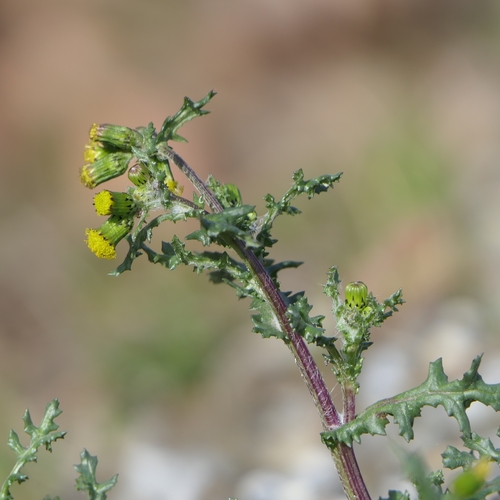
EPPO records the native range of Senecio vulgaris in the Euro-Mediterranean region, Macaronesia, the Caucasus, Siberia, Central and Western Asia, China and Mongolia. It has since naturalized on most continents; North American agencies do not always agree on whether it is native or introduced in individual states.
- Native4
- Introduced4
- France
- Europe
- North Africa
- China
- United States
- Canada
- Australia
- New Zealand
Hexagons: regions where the plant occurs. Green dots: native range.1
Identity
Common groundsel (Senecio vulgaris L., 1753), also called groundsel or old-man-in-the-spring, is an accepted species in the genus Senecio, family Asteraceae. POWO attributes the name to Linnaeus in 1753 and places its native range around Europe, North Africa and temperate Asia. 1
Latin senex, meaning “old man,” gives the genus its name: the white, downy tuft on ripe fruits resembles gray hair. The epithet vulgaris means common or ordinary, an apt description for a plant found almost everywhere soil has been turned. 2
Liver-toxic pyrrolizidine alkaloids occur throughout the plant, posing a documented risk particularly to horses and livestock fed contaminated hay. 3 Its complete cycle takes no more than 100 days from germination to ripe seed, allowing up to three generations yearly. This speed explains how it recolonizes bare ground before a neighboring sown crop has even emerged. 2
Recognition
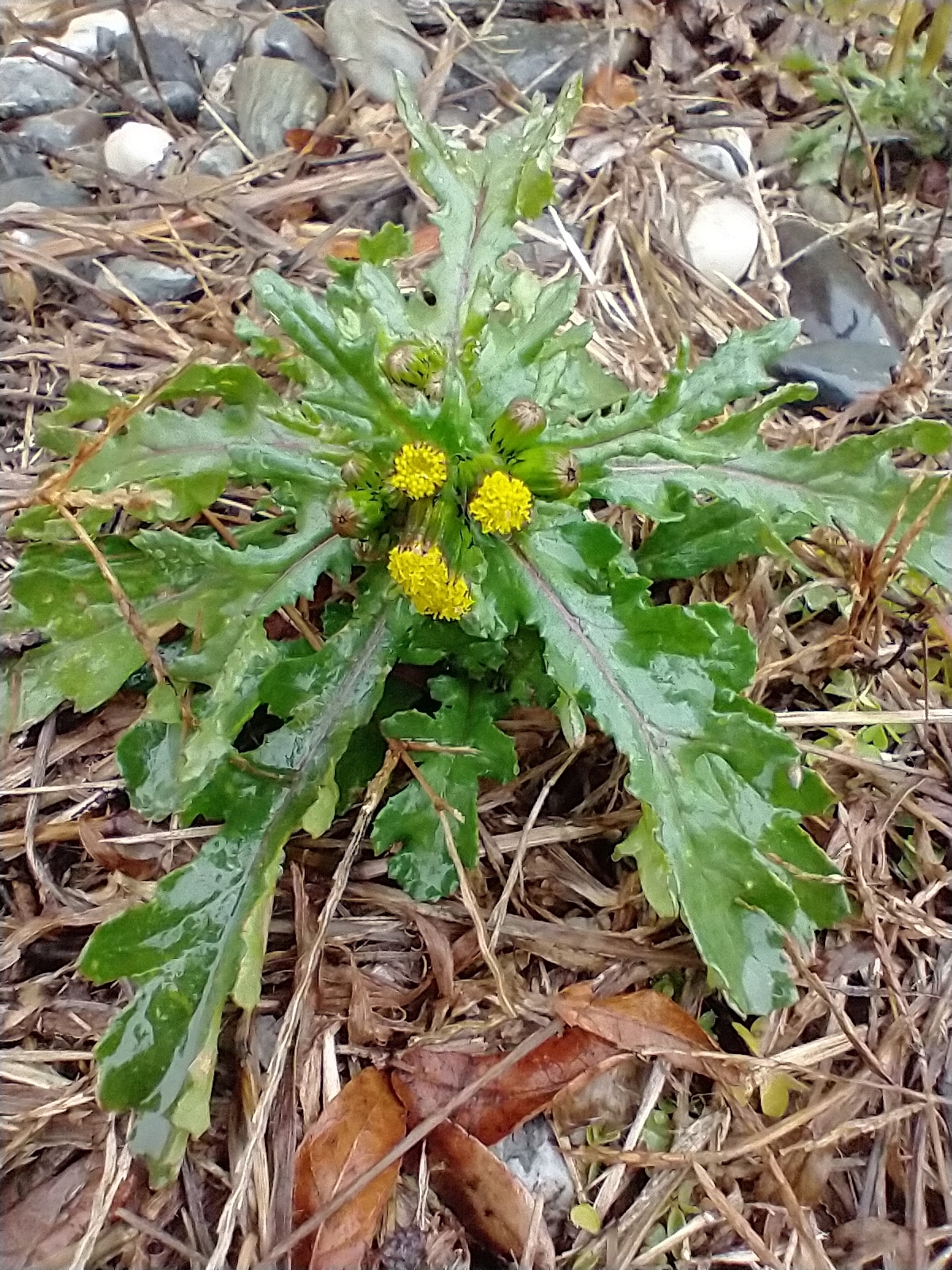
Common groundsel's upright stem is hairless to sparsely hairy and branches at both the top and the base. Plants usually reach 10–50 cm (4–20 in), sometimes 60 cm (24 in) in California, depending on growing conditions. 2 5
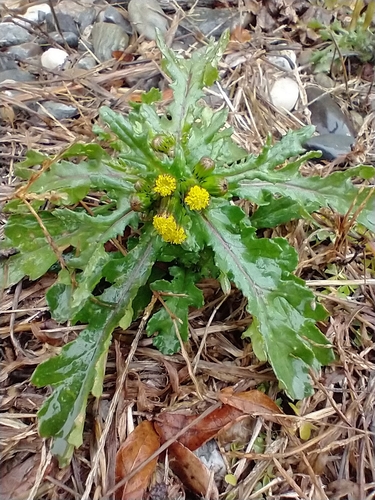
Irregular, angular, toothed lobes divide the pinnatifid leaves. Lower leaves have short stalks, while the stalkless upper leaves clasp the stem directly. 5
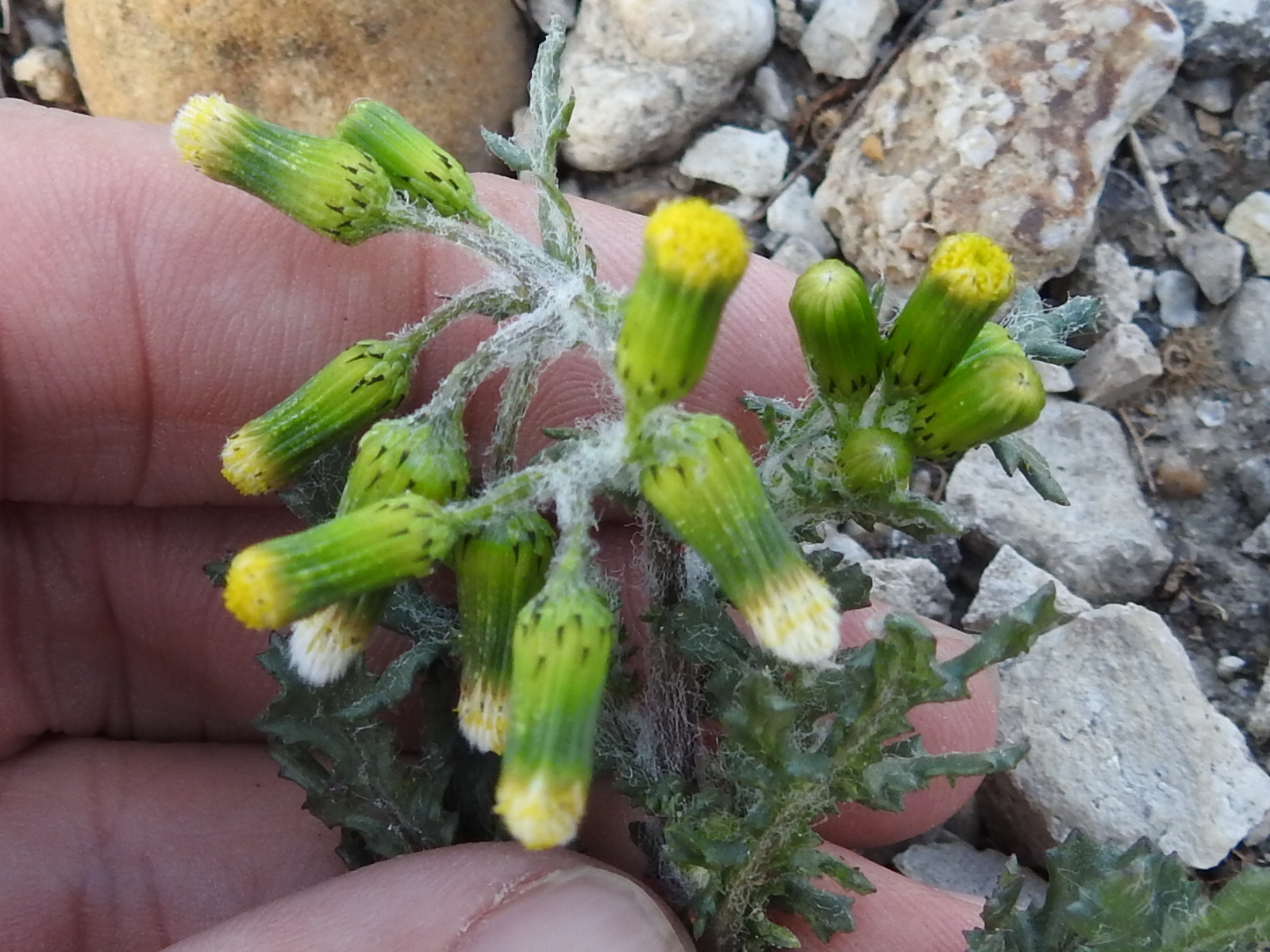
Tiny cylindrical yellow flower heads form dense corymbs at the stem tips. Their almost complete lack of ray florets is a reliable diagnostic feature, together with the conspicuous collar of green, black-tipped bracts at each head's base. 2 5 These black-tipped bracts provide a quick distinction from sticky groundsel (Senecio viscosus), whose sticky leaves give off a strong smell. 5
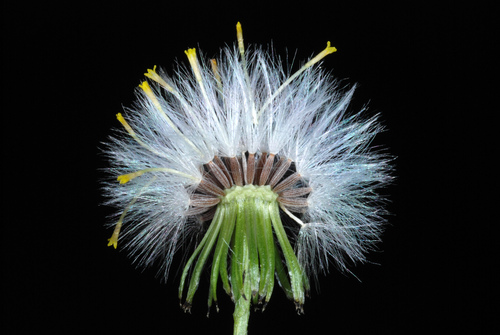
Ribbed, pale brown achenes measure less than 3 mm (0.12 in) and often carry small hairs. Each has a tuft of white bristles that detaches at full maturity like a tiny pompom. 5
Taxonomy and names
For common groundsel, the accepted name is Senecio vulgaris L. POWO recognizes two accepted subspecies: Senecio vulgaris subsp. vulgaris, the familiar cosmopolitan form, and Senecio vulgaris subsp. denticulatus (O.F.Müll.) P.D.Sell, a coastal form ranging from Europe to the eastern Aegean. 1
Historical synonyms include Senecio vulgaris var. hibernicus Syme and Senecio vulgaris var. villosus Iverus, without changing the species' field identity. Some older floras treated Senecio viscosus as a subspecies of common groundsel; it is a distinct species with stickier foliage and a stronger odor. 1
Yellow ray florets occur in some populations, creating a radiate form once described as a botanical variety. A 2008 study in Science showed that this trait came from regulatory genes transferred through hybridization with Senecio squalidus. It is a documented example of a morphological trait passing between related species. 9
Habitat and range
EPPO records Senecio vulgaris as native to the Euro-Mediterranean region, Macaronesia, the Caucasus, Siberia, Central and Western Asia, China and Mongolia. 6
Naturalization has since carried it across most continents. Its long history in North America complicates assessments: the USDA PLANTS Database considers it native in several states, while other regional databases treat it as introduced because the historical record is insufficient to settle the question. 8
Cultivated soils, gardens, waste ground, construction sites and roadsides support common groundsel up to about 500 m (1,640 ft) in temperate Europe and 1,500 m (4,920 ft) in parts of California. 5 Cool, wet winters trigger new waves of seedlings, whereas prolonged dry heat kills established plants. 5
Life cycle and reproduction
One common groundsel plant can produce up to 1,700 seeds, with a thousand weighing only 0.21 g (0.0074 oz). Germination approaches 100% in fresh seed and remains 87% after three years of cool, dry storage. 4 Together with a full cycle of barely 100 days, this output allows one uncontrolled generation to start another before summer ends. 2
Mild coastal conditions allow flowering almost year-round, without a clear winter interruption. 2
Heads cut at full bloom can continue ripening after mowing, producing seeds with a germination rate of about 35%. Mowing too late therefore fails to prevent replenishment of the soil seed bank. 5
Historical uses and toxicity
Young leaves were once eaten in salads in several regions. Traditional herbal practice used the whole plant as a purgative and diuretic, sometimes also to expel intestinal worms. These uses are now discouraged: the human liver does not readily detoxify pyrrolizidine alkaloids, whose effects are cumulative. 4
The ASPCA lists groundsel as toxic to cats, dogs and horses. Reported clinical signs include weight loss, marked drowsiness, jaundice and neurological problems arising from liver damage, a syndrome sometimes called “sleeping sickness” in horses. 3
Low palatability discourages animals from eating fresh plants. Poisoning chiefly follows ingestion of contaminated hay or silage, because neither drying nor fermentation destroys the alkaloids. 7 The liver then converts them into reactive pyrrole derivatives that cause the observed liver lesions. 7
Ecology, pests and agricultural impact
Two organisms tested as biological control agents use common groundsel as a host: the cinnabar moth caterpillar (Tyria jacobaeae) and the rust Puccinia lagenophorae. Neither has proved sufficient on its own to contain the species. Several seed-eating birds also feed on its foliage. 6
Agricultural damage is limited but real. The weed has been reported chiefly as a troublesome competitor in cultivated mint, where effective broad-spectrum herbicides also damage the crop. 5
Hand removal before flower heads develop is the preferred management approach. Deep plowing alone does not solve the problem: it brings dormant seeds back to the surface, where they germinate as soon as temperatures become suitable. 5
Main sources
- Plants of the World Online / Kew, Senecio vulgaris L.
- Tela Botanica / BDTFX reference database, Senecio vulgaris L.
- ASPCA, Groundsel (Senecio species) toxicity entry
- Plants For A Future, Senecio vulgaris
- UC Statewide IPM Program, Common Groundsel identification gallery
- EPPO Global Database, Senecio vulgaris (SENVU)
- Cornell Department of Animal Science, Pyrrolizidine Alkaloids
- USDA PLANTS Database, Senecio vulgaris plant profile
- Kim et al. 2008, Regulatory genes control a key morphological and ecological trait transferred between species
Frequently asked questions
Is common groundsel poisonous?
Yes. Every part contains liver-toxic pyrrolizidine alkaloids. The ASPCA lists it as toxic to cats, dogs and horses, with a particular risk from repeated consumption of contaminated hay.
Can you eat common groundsel?
Its young leaves were once eaten in salads, but this use is now discouraged because the liver does not readily detoxify pyrrolizidine alkaloids accumulated through repeated ingestion.
How can I distinguish Senecio vulgaris from Senecio viscosus?
Senecio viscosus has sticky glandular hairs, a stronger smell and sometimes short ray florets. Typical common groundsel lacks these traits.
Why do some common groundsel plants have petal-like flowers?
The radiate form results from natural hybridization with Senecio squalidus, which transferred a gene regulating flower development. It is not a separate botanical variety.
Where does common groundsel come from?
According to EPPO, its native range covers Europe, North Africa and temperate Asia as far as China and Mongolia. Agriculture and the seed trade have since helped it naturalize on most continents.
How long does common groundsel live?
Its full life cycle, from germination to ripe seed, takes about one hundred days, allowing up to three generations a year in favorable climates.
How do I remove common groundsel from a garden?
Pulling out plants with their roots before flower heads develop remains the most reliable method. Deep plowing alone brings dormant seeds to the surface without destroying them.
If you are unsure about a plant’s toxicity, ask a botanist or veterinarian for advice.