
Giant reed (Arundo donax, )
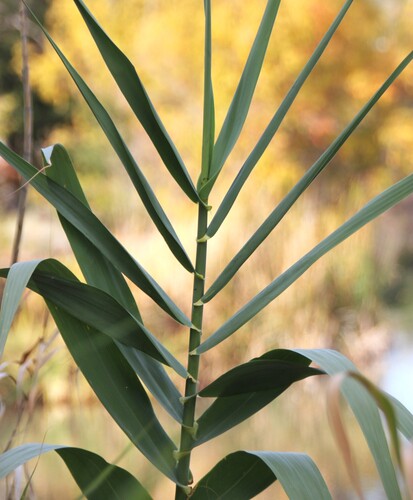

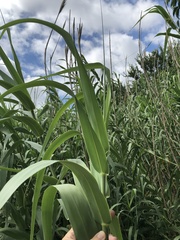
Giant reed (Arundo donax) is a towering perennial grass in the Poaceae family, with spreading rhizomes and upright, bamboo-like stems. Grown for windbreaks and clarinet reeds, it also ranks among the IUCN list of 100 of the world’s worst invasive species outside its native range.
Read moreGiant reed, Giant cane and Spanish cane




© photo
(c) columbidaeperson, some rights reserved (CC BY-NC), uploaded by columbidaeperson · cc-by-nc
Jade Fortnash · cc0
Sam Kieschnick · cc-by
Taken Sep 3, 2020 by Alain Bigou (cc-by-sa)
Taken Aug 17, 2014 by Tela Botanica − Patrick LEBOULENGER (cc-by-sa)
Taken Oct 14, 2014 by Tela Botanica − Mathieu Sinet (cc-by-sa)
Taken Jun 22, 2021 by Sanchez Cesar (cc-by-sa)
© copyright of the Board of Trustees of the Royal Botanic Gardens, Kew.




Global distribution
The native range of Arundo donax remains debated. Recent genetic evidence points to an Asian or Near Eastern origin, followed by spread around the Mediterranean in antiquity, blurring the distinction between native and long-introduced populations. Beyond this broad range, it is planted and often naturalized in nearly all warm regions of the world and ranks among the 100 most damaging invasive species worldwide.
- Native2
- Invasive6
- Near East
- Mediterranean Basin
- California
- Texas
- Australia
- New Zealand
- New Caledonia
- Canary Islands
Hexagons: regions where the plant occurs. Green dots: native range.1
Identity
Giant reed (Arundo donax L., 1753), also known as giant cane or Spanish cane, is a giant perennial grass in the genus Arundo, family Poaceae. The Latin genus name arundo already meant reed in antiquity, while donax comes from an ancient Greek word for a sturdy reed. 1 2
Its hollow, jointed canes can exceed 8 m (26 ft) and resemble bamboo, but giant reed belongs to Arundinoideae, a different Poaceae subfamily from the bamboos' Bambusoideae. Its French name, canne de Provence, reflects a long tradition of cultivation in the Var region, where canes are still harvested to make reeds for wind instruments. 3
Recognition
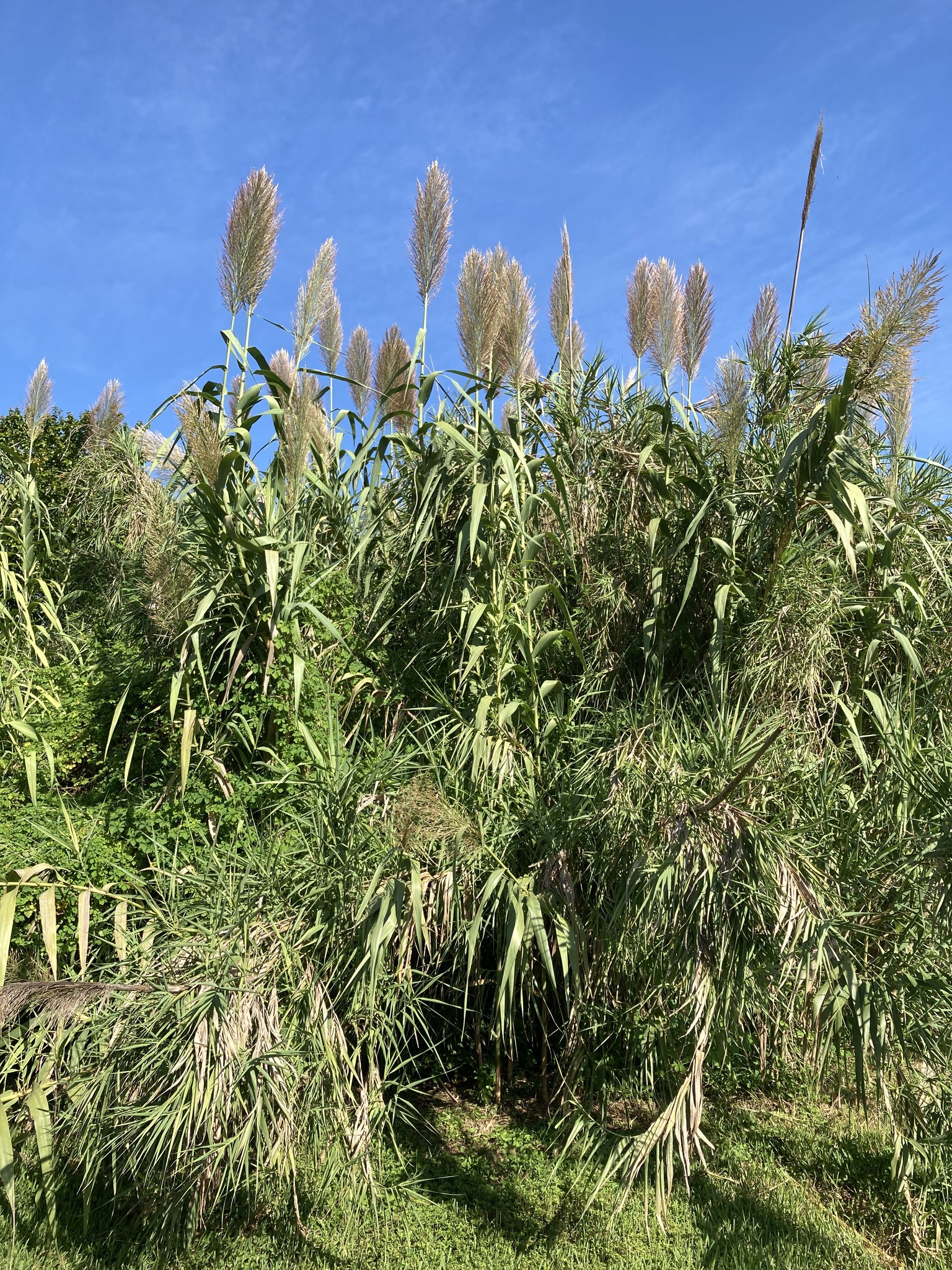
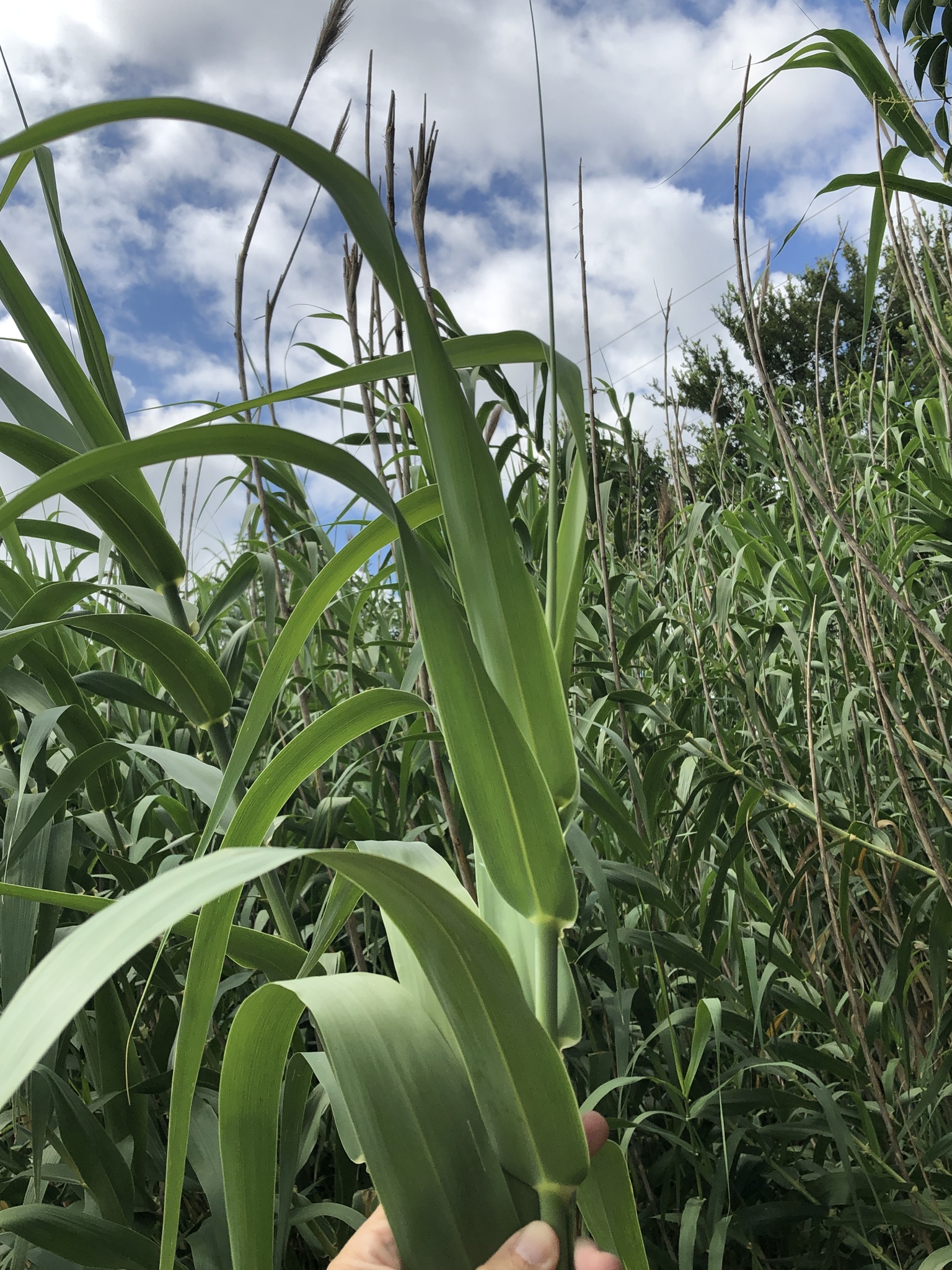
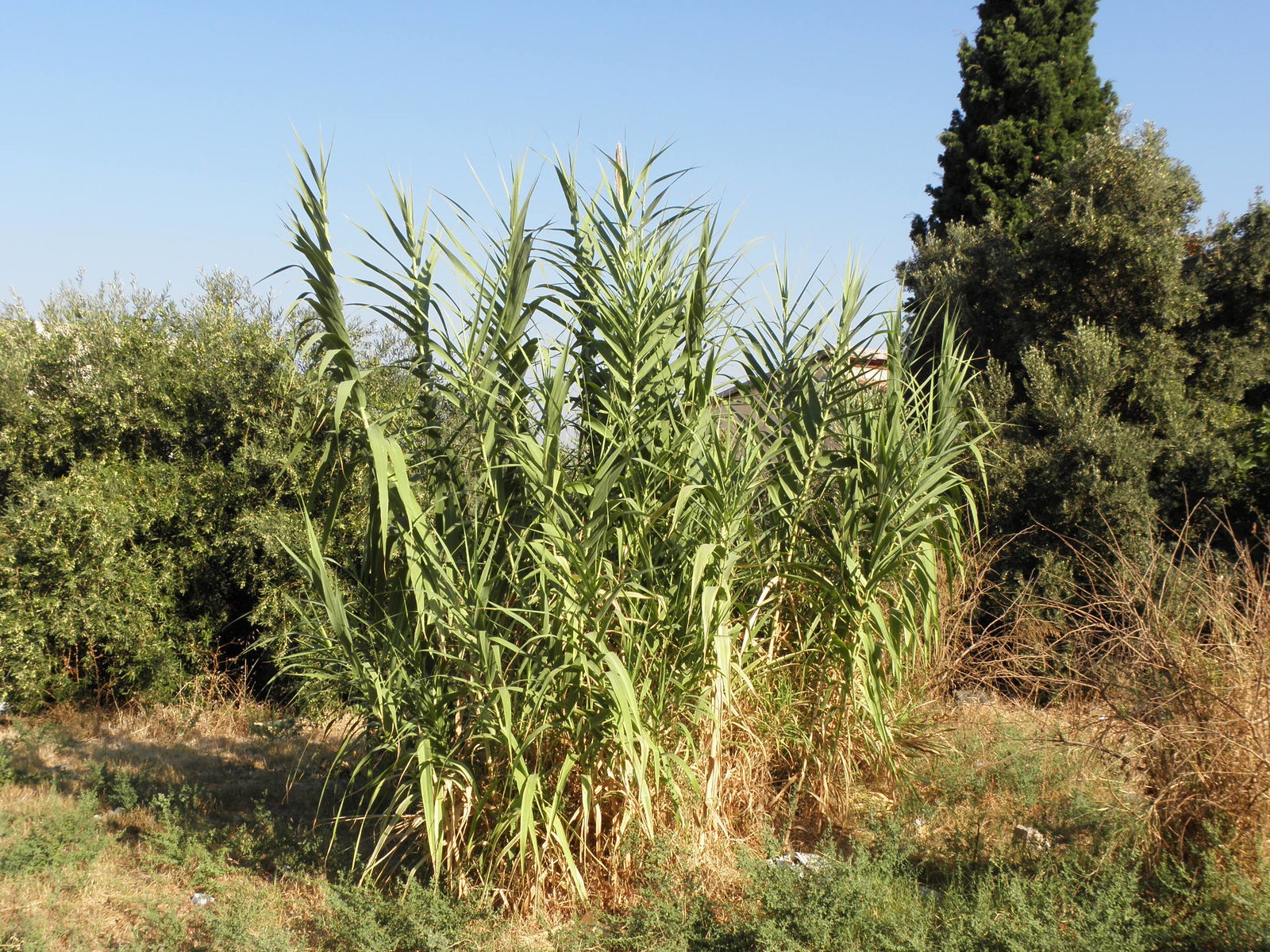
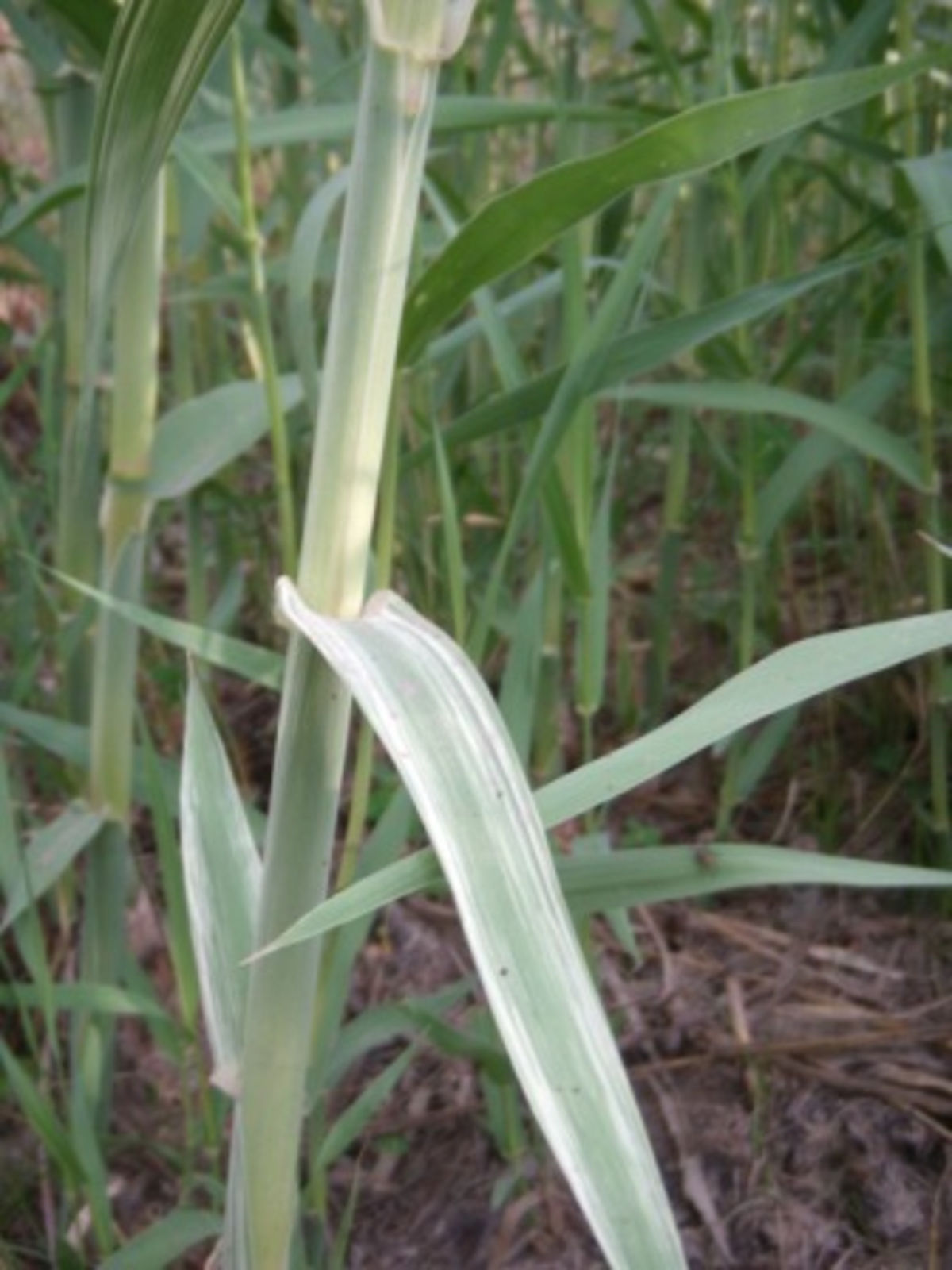
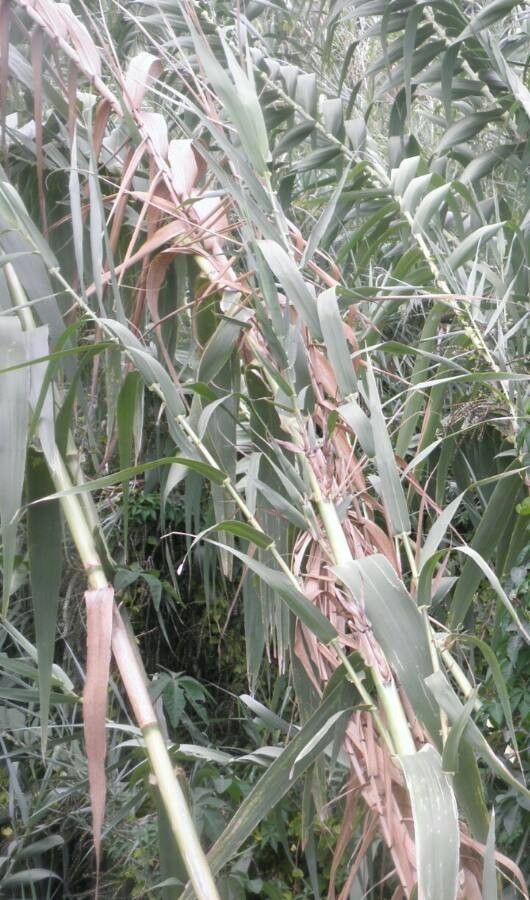
Upright canes commonly reach 3–6 m (10–20 ft), sometimes exceeding 8 m (26 ft) in favorable warm conditions near water. Broad, gray-green, arching leaf blades run in two rows along each cane, unlike the finer foliage of common reed (Phragmites australis). 3 2
Daily growth can approach 10 cm (4 in) during the warm growing season, among the fastest rates known in terrestrial plants. When flowering occurs, a terminal feathery panicle 40–60 cm (16–24 in) long develops in late summer in the warmest regions, ranging from pale green to purplish. 5
Taxonomy and names
For giant reed, POWO accepts the name Arundo donax L., published in 1753. Several historical varieties and forms still appear in horticulture and older literature:
- Arundo donax var. versicolor (Mill.) Aiton (a historical variety)
- Arundo donax f. versicolor (Mill.) Beetle (a historical form)
- Arundo donax subsp. plinii (Turra) Mateo & Figuerola (a historical subspecies)
- Arundo donax var. angustifolia Döll (a historical variety)
Nursery labels illustrate the ambiguity of versicolor: the name circulates both as an old botanical synonym and as a trade designation for the variegated cultivar Variegata, without always referring to exactly the same plant. 1
Habitat and range
Uncertainty surrounds the original range of Arundo donax. Recent genetic analyses point toward the Near East or Asia, followed by spread to the Mediterranean Basin in antiquity. This long history makes it difficult to separate native populations from ancient introductions. 2 8
Riverbanks, damp ditches and disturbed soils are favored habitats, with tough fibrous rhizomes reaching 1 m (3.3 ft) deep. Outside that broad original range, giant reed is established in nearly all warm regions of the world. The IUCN includes it among 100 of the world's worst invasive species. 6 5
Dense, uniform stands displace native streamside vegetation in California, Australia and New Zealand. They also reduce shade over waterways and increase the amount of combustible vegetation in dry climates. 7 5
Life cycle and reproduction
Natural reproduction from seed is uncommon: most populations produce few or no fertile seeds, associated with defective division of the megaspore mother cell. Spread therefore occurs almost entirely through vegetative reproduction, when floods or earthmoving carry away rhizome fragments or stem pieces bearing a node. 5 7
A rhizome fragment only a few centimeters long, with a single node, can regenerate a whole clump within weeks. That ability explains its rapid colonization of waterways and makes mechanical control difficult: incomplete rhizome removal leaves fragments that sprout again. 5
Under controlled cultivation, propagation uses rhizome division or stem cuttings with a node, planted directly into moist soil in spring. 4
Uses and risks
Instrument makers value giant reed for clarinet, saxophone and oboe reeds. Its silica-rich canes resist bending better than common reed and vibrate evenly under the player's breath. The Var region of France still supplies most of the reeds used worldwide. 3 2
Other uses include windbreaks, dense garden screens and, historically, woven supports for plaster in traditional Mediterranean buildings. Giant reed is also studied as an energy biomass crop grown without irrigation or fertilizer on soils too poor for other crops. 4
The source account documents no toxicity from ingestion in people, cats or dogs. Its principal documented risk here is uncontrolled spread: planting restrictions vary by territory, with prohibitions reported for New Caledonia and the Canary Islands, while the French account describes mainland France as unregulated. Readers should check the current rules that apply where they live. 6
Varieties, look-alikes and related plants
Variegata, with cream-white striped leaves, is the ornamental cultivar most often sold in garden centers. It grows much less vigorously than the typical form, limiting its invasive potential in the ground. Before planting, check local restrictions and plan containment, such as a rhizome barrier buried 60–80 cm (24–31 in) deep. 5
Plants commonly mistaken for giant reed include:
- Phragmites australis, a finer, more flexible reed of permanently flooded ground;
- Saccharum ravennae, with a more silvery panicle and less woody canes;
- some large ornamental bamboos, despite their different botanical classification.
Woody canes with leaves in two rows, combined with a rhizome system able to regenerate from a small fragment, help distinguish Arundo donax from these related-looking grasses in the field.
Main sources
- Plants of the World Online / Kew, Arundo donax L.
- Encyclopaedia Britannica, Giant reed
- Missouri Botanical Garden Plant Finder, Arundo donax
- Plants For A Future, Arundo donax
- California Invasive Plant Council, Arundo donax profile
- IUCN Invasive Species Specialist Group, Global Invasive Species Database — Arundo donax
- US Forest Service, Fire Effects Information System, Arundo donax
- Global Biodiversity Information Facility, Arundo donax L.
Frequently asked questions
Is giant reed invasive in France?
Giant reed has long been cultivated in mainland France, where the source account describes it as unregulated. Planting is prohibited in some territories, including New Caledonia and the Canary Islands, where it aggressively colonizes riverbanks. Check current rules for your location before planting.
Is giant reed a bamboo?
No. Although its hollow, jointed canes resemble bamboo, Arundo donax belongs to a different Poaceae subfamily, Arundinoideae. Bamboos belong to Bambusoideae.
Why is giant reed used for clarinet reeds?
Its silica-rich canes combine stiffness and elasticity valued by reed makers. Crops grown specifically for this purpose in the Var region of France still supply most of the clarinet, saxophone and oboe reeds used worldwide.
How can I keep giant reed from spreading in a garden?
A rhizome barrier buried 60–80 cm (24–31 in) deep before planting, or cultivation in a large container, limits its spread. Without containment, a single rhizome fragment carried away in a flood can establish a new colony downstream.
Does giant reed actually flower?
Yes, but seed fertility is often low and varies between populations. The feathery late-summer plume is mainly ornamental; the species spreads almost entirely through rhizome fragments rather than naturally sown seedlings.
Is giant reed poisonous to cats and dogs?
No toxicity from ingestion is documented in cats, dogs or people. Its finely abrasive leaf edges can, however, irritate skin when pressed against it.
How does giant reed differ from common reed?
Arundo donax has thicker, taller and much stiffer canes, with broader leaves arranged in two rows. Phragmites australis is finer and more flexible and favors permanently flooded ground over disturbed riverbanks.
Similar plants

If you are unsure about a plant’s toxicity, ask a botanist or veterinarian for advice.