
Common dogwood (Cornus sanguinea, )
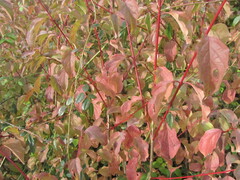
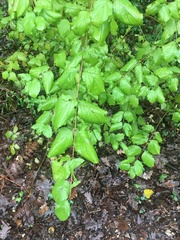
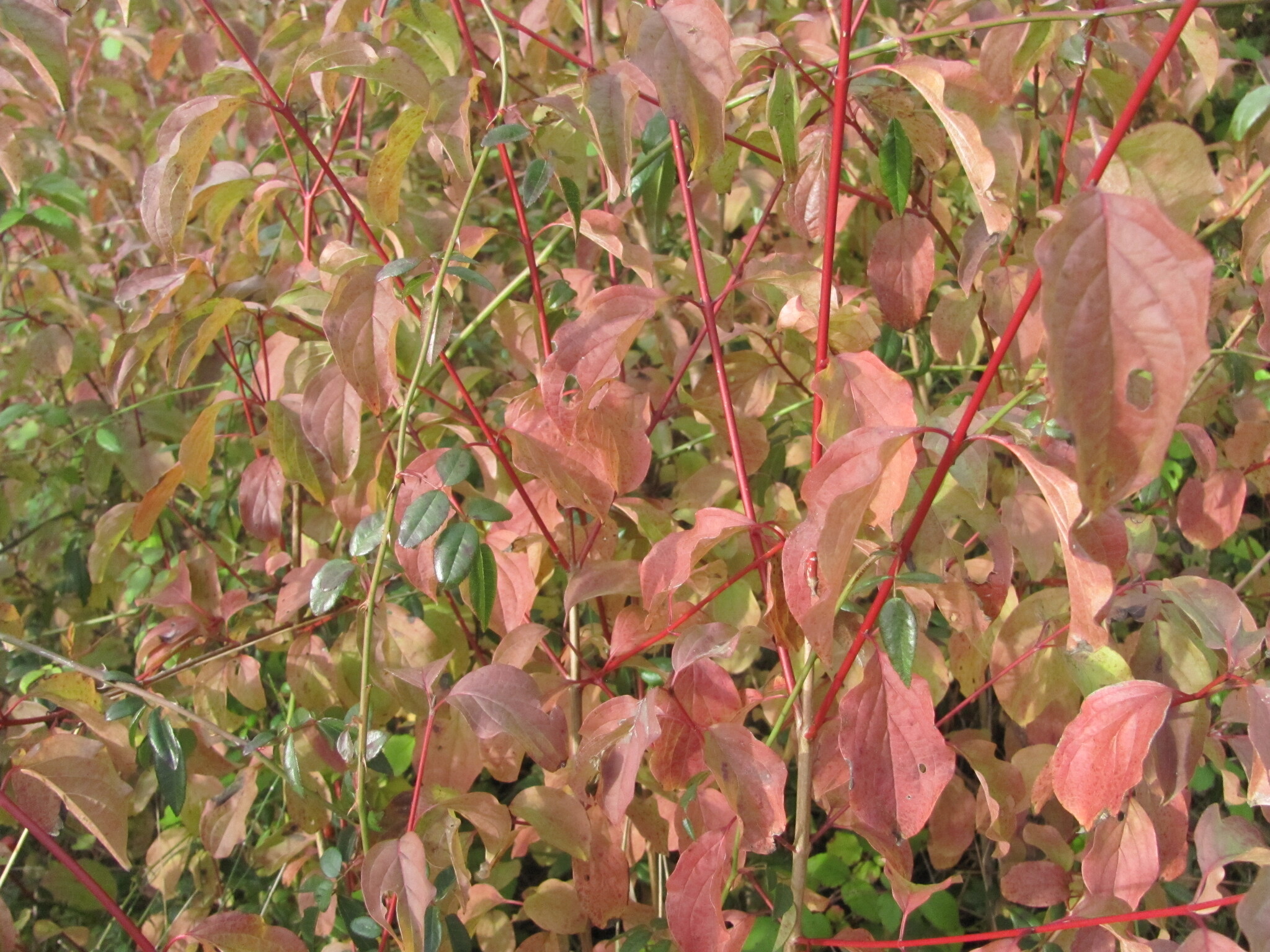
Common dogwood (Cornus sanguinea) is a deciduous shrub in the Cornaceae family, native to temperate Europe and western Asia. It grows in hedgerows and at woodland edges, often on calcareous soils. Blood-red young stems in fall and winter are its most distinctive feature and explain both its scientific name and ornamental appeal.
Read moreCommon dogwood, Bloodtwig dogwood and Bloody dogwood

© photo
(c) Ирина, some rights reserved (CC BY-NC), uploaded by Ирина · cc-by-nc
zebedeugalinha · cc-by
Ryan McMinds · cc-by
(c) zebedeugalinha, some rights reserved (CC BY) · cc-by
(c) Jose Gutierrez Higa, some rights reserved (CC BY) · cc-by
Global distribution
The native range of Cornus sanguinea covers temperate Europe and western Asia, from southern Scandinavia and the United Kingdom to the Caucasus and Lebanon. It is widely planted as an ornamental beyond this range, and a subspecies becomes locally naturalized, without a documented widespread invasive status.
- Native6
- Introduced2
- France
- United Kingdom
- Germany
- Switzerland
- Turkey
- Lebanon
- Lithuania
- Latvia
Hexagons: regions where the plant occurs. Green dots: native range.1
Identity
Common dogwood (Cornus sanguinea L., 1753), also called bloodtwig dogwood or bloody dogwood, is a deciduous shrub in the genus Cornus, family Cornaceae. Its epithet sanguinea describes the young stems, which turn blood red from fall onward and remain colorful throughout winter, especially where the wood receives direct sun. 3 7
Hedgerows and woodland margins support dense bushes usually 1.5–4 m (5–13 ft) tall, occasionally reaching 5 m (16 ft) when old and left unpruned. Both the flowers and freshly cut wood have an unpleasant smell, a useful additional identification clue when the plant is out of flower. The French vernacular name meaning “stinking wood” refers to this feature. 4 8
Recognition
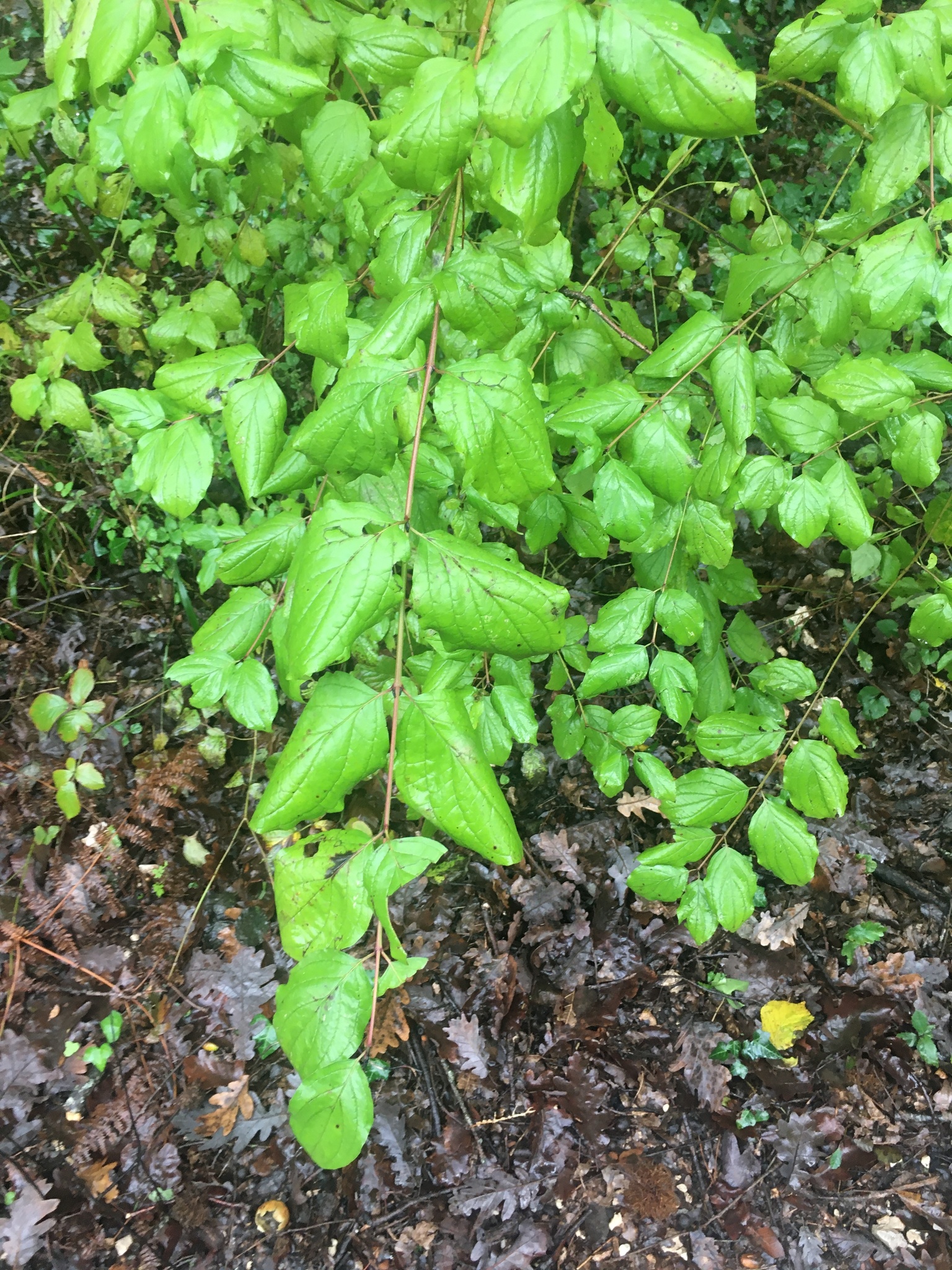
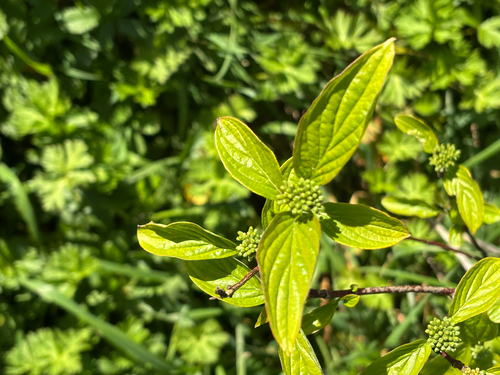
Opposite leaf pairs are a useful starting point: the oval to elliptical blades measure 4–10 cm (1.5–4 in) long and have short stalks. Their conspicuous secondary veins curve toward the tip without running straight into it. This venation is characteristic of Cornus and helps separate the shrub from plants with otherwise similar foliage. 4
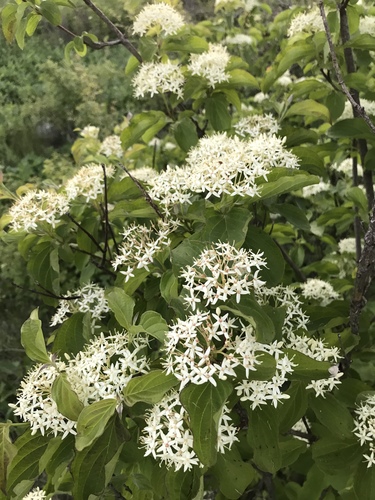
Small white flowers open in flat corymbs from May to June in its Northern Hemisphere cycle. Their smell is often described as fetid, contrasting with the ornamental appearance of the clusters and providing another identification clue. The fragrance, rather than the flower color alone, can help confirm a suspected dogwood. 5 4
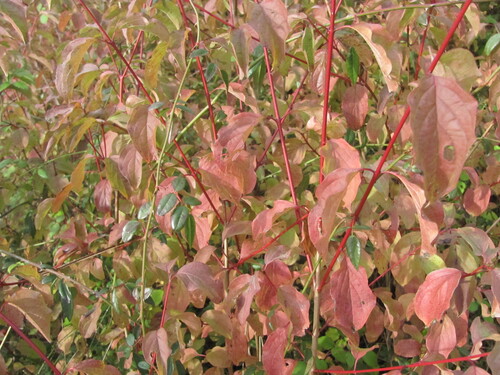
Round drupes measure about 6–8 mm (0.25–0.3 in) and change from green to purple-black as they ripen. They form small clusters from August to September. In fall, the leaves often turn purplish red, strengthening the blood-red impression that gives the shrub its epithet late in the season. 3 4
Useful taxonomy
For this shrub, POWO/WCVP accepts Cornus sanguinea L. Several subspecies are recognized geographically, including Cornus sanguinea subsp. australis (C.A.Mey.) Jáv. in central and eastern Europe, and Cornus sanguinea subsp. cilicica (Wangerin) D.F.Chamb. in Turkey and Lebanon. 1
Historical synonymy includes several botanical varieties and forms. Many represent differences in foliage or habit without a separate horticultural status:
- Cornus sanguinea var. variegata Weston, a historical varietal name;
- Cornus sanguinea f. viridissima Dieck, a historical form name;
- Cornus sanguinea var. atrosanguinea V.Gibbs, another historical varietal name.
Some old catalogs also use Svida sanguinea, placing the species in a genus now included in Cornus. That name is seldom encountered outside older botanical literature and does not identify a different garden shrub. 1
Habitat and range
Temperate Europe and western Asia form the native range, extending from southern Scandinavia and the United Kingdom to the Caucasus and Lebanon. 3 Common dogwood occupies hedgerows, woodland edges and calcareous scrub, as well as more localized stands of gray alder along streams. These are distinct habitats within the same broad range. 8
In Switzerland, where it is classified as Least Concern, it occurs from the hill belt to the lower montane belt on moist, neutral to basic soils with good exposure. 8 Beyond its native range, it is chiefly planted for winter stem color. Naturalized populations of subspecies australis in Lithuania and Latvia are locally fertile and tree-like. Their potential expansion is monitored, without a documented invasive listing for the typical species elsewhere in Europe. 6
Life cycle and reproduction
May and June bring the main flowering period, with numerous small bisexual flowers in each corymb. Several wild bees in the genus Andrena specialize on Cornus and depend on this early flowering to complete their life cycles, before many other hedgerow shrubs open their flowers. These dates describe the plant's Northern Hemisphere cycle. 4
Fruit ripens from August to September and is dispersed by birds, which eat the pulp despite its bitterness, while some other hedgerow shrubs have yet to fruit. The stone often germinates only after a delay. Seed propagation requires several months of cold stratification, sometimes followed by more than a year before emergence. 3
In cultivation, hardwood cuttings taken in fall establish faster and more reliably than seeds, with a good rooting rate by the following spring. The shrub also naturally produces suckers from its base, explaining the dense thickets in unpruned hedgerows. Removing unwanted suckers annually keeps its spread under control. 3
Uses and risks
Flexible reddish young stems have a long history in rural basketry, especially in the Perche, Burgundy and Alsace regions of France. Local use continues for ties and small baskets. The hard, dense wood was also fashioned into pegs, spindles and tool handles, providing a different use for older woody material. 6
Raw fruit is mildly toxic: eating around a dozen drupes may cause digestive problems and, depending on individual sensitivity, even cardiac or kidney problems. Microscopic T-shaped hairs in the leaves, encrusted with calcium carbonate, can irritate skin after repeated contact. The species is not listed by the ASPCA, whose coverage focuses chiefly on plants commonly grown indoors or in containers. 9 3
Pressed seeds yield an oil that is edible after refining. It was formerly used for soapmaking and lighting before rural electrification. That use has disappeared as oils from large-scale crop production replaced it; the refined seed oil should not be confused with the raw, irritating fruit. 3
Varieties, look-alikes and related plants
Nursery selections emphasize winter color, particularly 'Midwinter Fire', with orange stem bases and bright red tips on the current year's growth. 'Winter Flame' produces a more yellow version of the two-tone effect, though less striking. Both need regular hard pruning to replace older stems with colorful young wood. 5
Several shrubs can be confused with common dogwood:
- Cornus mas, Cornelian cherry, bears elongated edible red fruit, unlike the round black drupes of C. sanguinea;
- Sambucus nigra, black elder, has compound leaves and hanging fruit clusters rather than flat corymbs;
- Rhamnus cathartica, common buckthorn, has alternate leaves and sometimes thorny branches, neither of which occurs in C. sanguinea.
A suckering habit, colorful winter stems and opposite leaves with curved veins together provide the most reliable field confirmation of Cornus sanguinea. Looking for this combination remains useful even outside flowering or fruiting season, when a single missing feature would otherwise make identification harder. 4
Main sources
- Plants of the World Online / Kew, Cornus sanguinea L.
- Royal Horticultural Society, Cornus sanguinea
- Plants For A Future, Cornus sanguinea
- North Carolina Extension Gardener Plant Toolbox, Cornus sanguinea
- Missouri Botanical Garden Plant Finder, Cornus sanguinea
- Tela Botanica eFlore / BDTFX, Cornus sanguinea
- Trees and Shrubs Online (International Dendrology Society), Cornus sanguinea
- Info Flora, Cornus sanguinea
- Toxiplante, Cornus sanguinea monograph (common dogwood)
Frequently asked questions
Is common dogwood poisonous?
Mildly. Raw fruit contains aucubin and tannins that cause digestive upset when eaten in quantity, and repeated contact with the leaves can irritate skin. The species is not listed by the ASPCA, whose coverage focuses on commonly grown indoor plants.
How can I distinguish Cornus sanguinea from Cornus mas?
Cornus mas, Cornelian cherry, produces elongated edible red fruit and yellow flowers from late winter. Cornus sanguinea flowers white in spring and bears clustered purple-black drupes that are never red or elongated.
Why do common dogwood stems turn red in winter?
Anthocyanin pigments in the bark of young stems produce the color, especially after the first cold weather and on wood exposed directly to sunlight. Regular pruning renews this colorful wood.
Is common dogwood invasive?
In Europe it belongs to the native flora and is not considered invasive. A subspecies naturalized in Lithuania and Latvia is monitored locally, but no widespread invasive status is documented elsewhere.
What were common dogwood stems traditionally used for?
The flexible reddish stems were woven in rural basketry, particularly in the Perche, Burgundy and Alsace regions of France. Local uses for ties and small baskets survive.
When should common dogwood be pruned for colorful stems?
Prune in spring after enjoying the winter color. Remove some of the oldest stems each year, or cut back hard every 2–3 years, to encourage new wood with stronger color.
How does Cornus sanguinea differ from Cornus alba?
Asian Cornus alba bears white or bluish fruit and often more coral-red stems. European Cornus sanguinea has purple-black drupes and darker stems tending toward reddish brown.
Similar plants
If you are unsure about a plant’s toxicity, ask a botanist or veterinarian for advice.