
false dandelion (Hypochaeris radicata, )
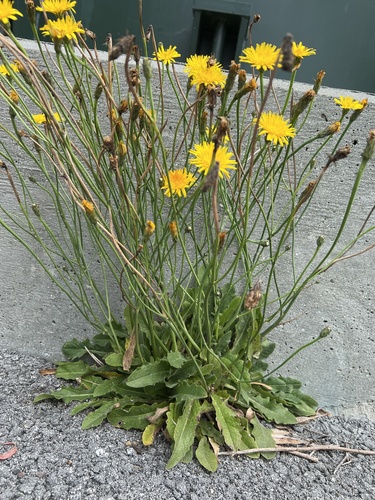
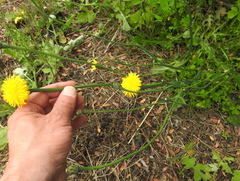

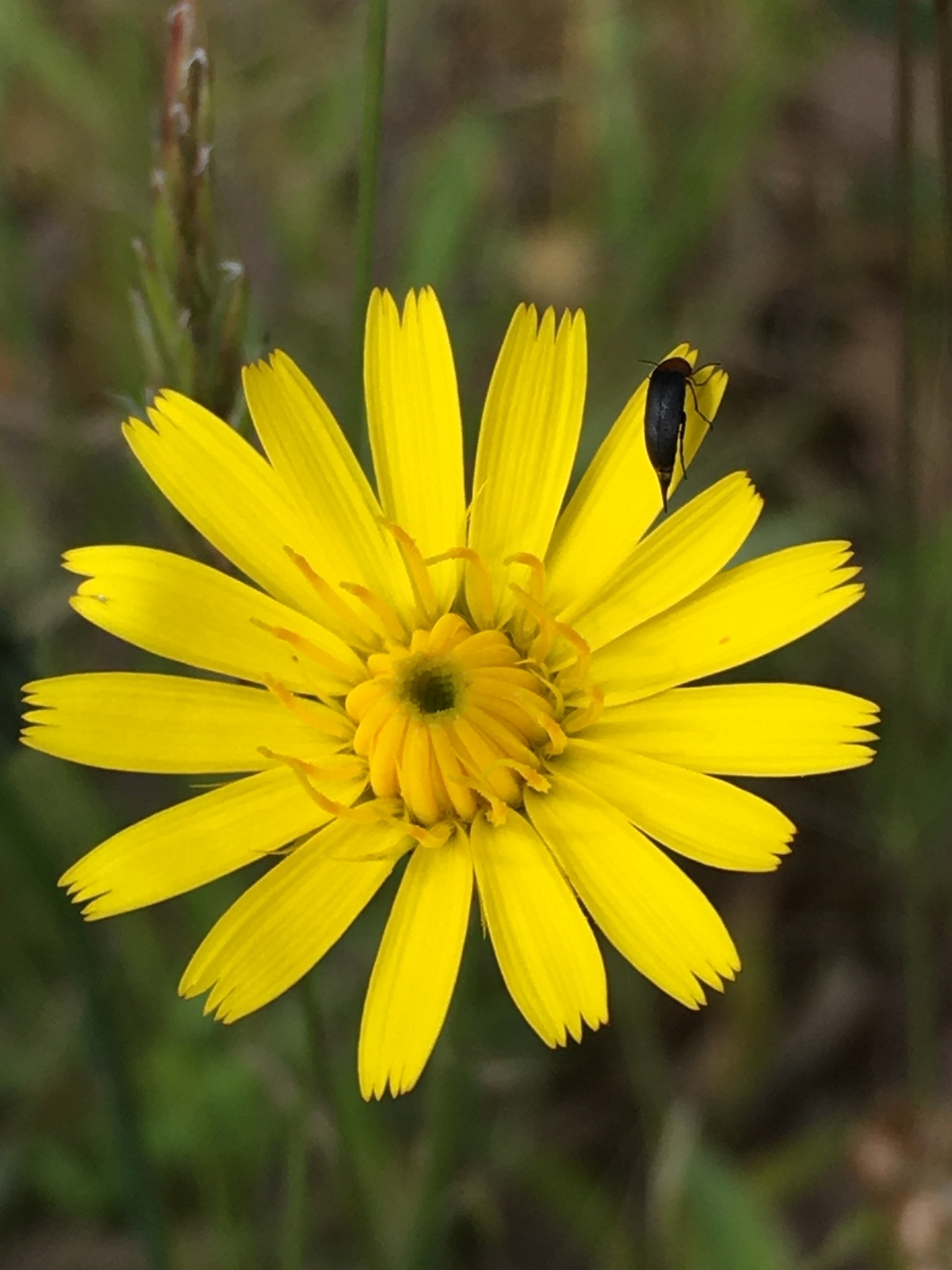
False dandelion (Hypochaeris radicata L., 1753) is a perennial in the Asteraceae, native to Europe and North Africa and now found on almost every continent. Its flat rosette of bristly leaves and leafless stems with yellow flower heads resemble a dandelion, but branching near the stem tips and rough foliage distinguish it.
Read morefalse dandelion, hairy cat's ear, cat's ear, flatweed and gosmore
Allow a few hours of direct sun per day, preferably morning or evening.
Full sun to light partial shade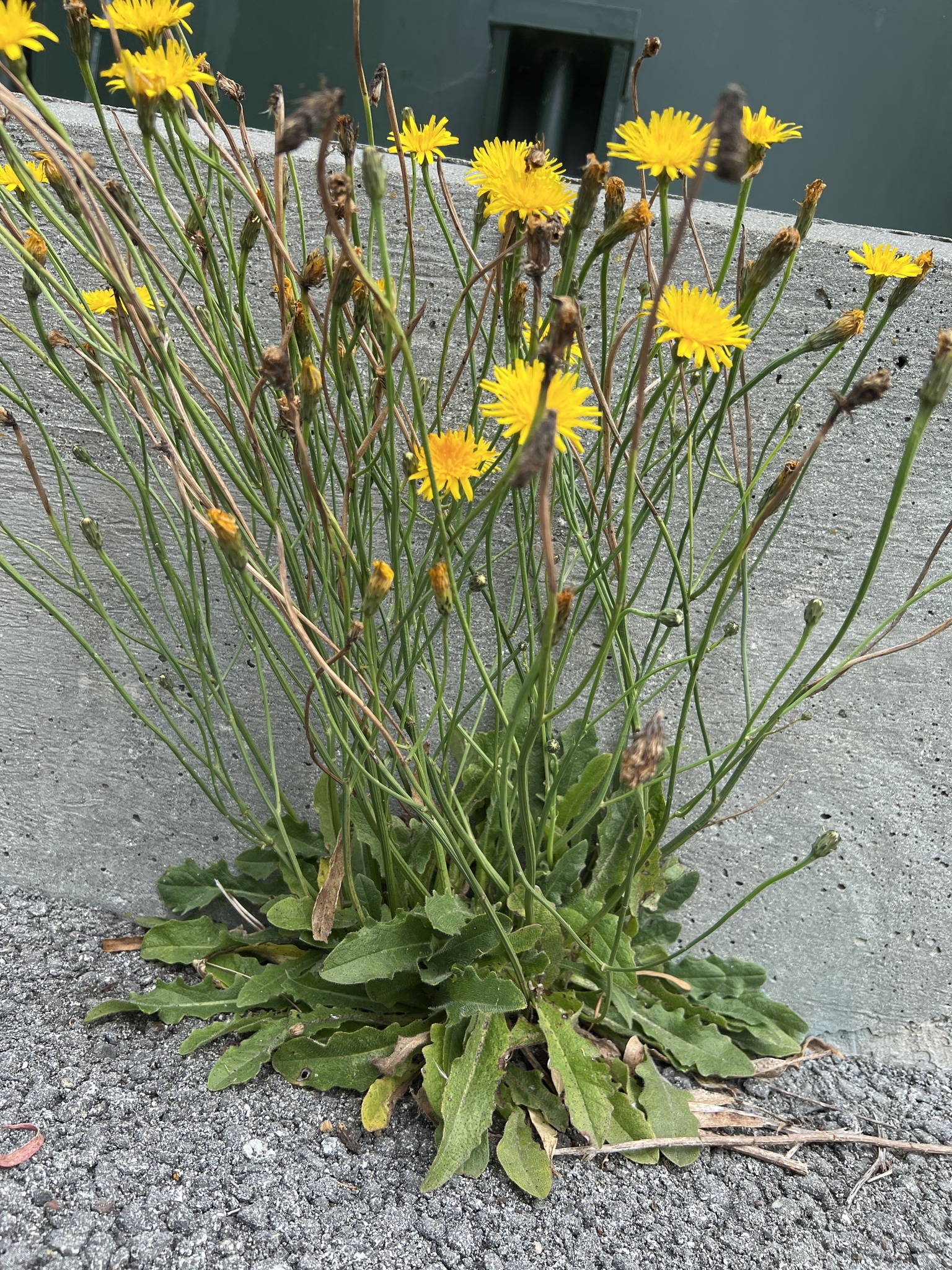

© photo
(c) demicook, some rights reserved (CC BY-NC) · cc-by-nc
Rudyard · cc0
Becky Dill · cc0
(c) Douglas Goldman, some rights reserved (CC BY-SA) · cc-by-sa
(c) Rudyard, some rights reserved (CC BY) · cc-by

Global distribution
WCVP places the native range of Hypochaeris radicata in Europe east to Belarus, western Russia, the Near East (Turkey, Lebanon and Syria), the North Caucasus and North Africa (Morocco, Algeria, Tunisia and Libya). It has been introduced to several US states, Colombia, Costa Rica, Ecuador, Guatemala, Jamaica, Paraguay, Venezuela and New Zealand, where it is considered locally invasive.
- Native4
- Introduced3
- Invasive1
- Metropolitan France
- Spain
- Morocco
- Turkey
- United States
- Costa Rica
- Venezuela
- New Zealand
Hexagons: regions where the plant occurs. Green dots: native range.1
Identity
false dandelion (Hypochaeris radicata L., 1753) is an herbaceous perennial in the Asteraceae, subfamily Cichorioideae. POWO accepts this name, published in 1753, and places the species in Hypochaeris. Its dandelion-like flower heads explain the English name, but the leaves and stems supply the characters needed to separate it from a true dandelion. 1 7
The generic name Hypochaeris comes from the Greek hypo and khoiros, referring to a young pig. The allusion may concern pigs’ supposed liking for the plant, or the bristles beneath its leaves, likened to those on a pig’s belly. The epithet radicata refers to conspicuous roots and the taproot that can become visible as the rosette establishes. 8
Other English names include hairy cat's ear, cat's ear, flatweed and gosmore. The rough hairs on the foliage and the flattened rosette are reflected particularly clearly in the first and third names. Those features also recur in field descriptions, making the names useful reminders of the plant’s appearance when no flowers are present. 2
Recognition
A ground-hugging basal rosette consists of thick, oblanceolate leaves with coarse, bristly hairs. Leaves measure 5–20 cm (2–8 in) long and 1–4 cm (0.4–1.6 in) wide, with wavy, toothed edges and rounded teeth. Spread flat over the soil, the rosette can suppress neighboring grass while remaining below the reach of a mower blade. 8 2
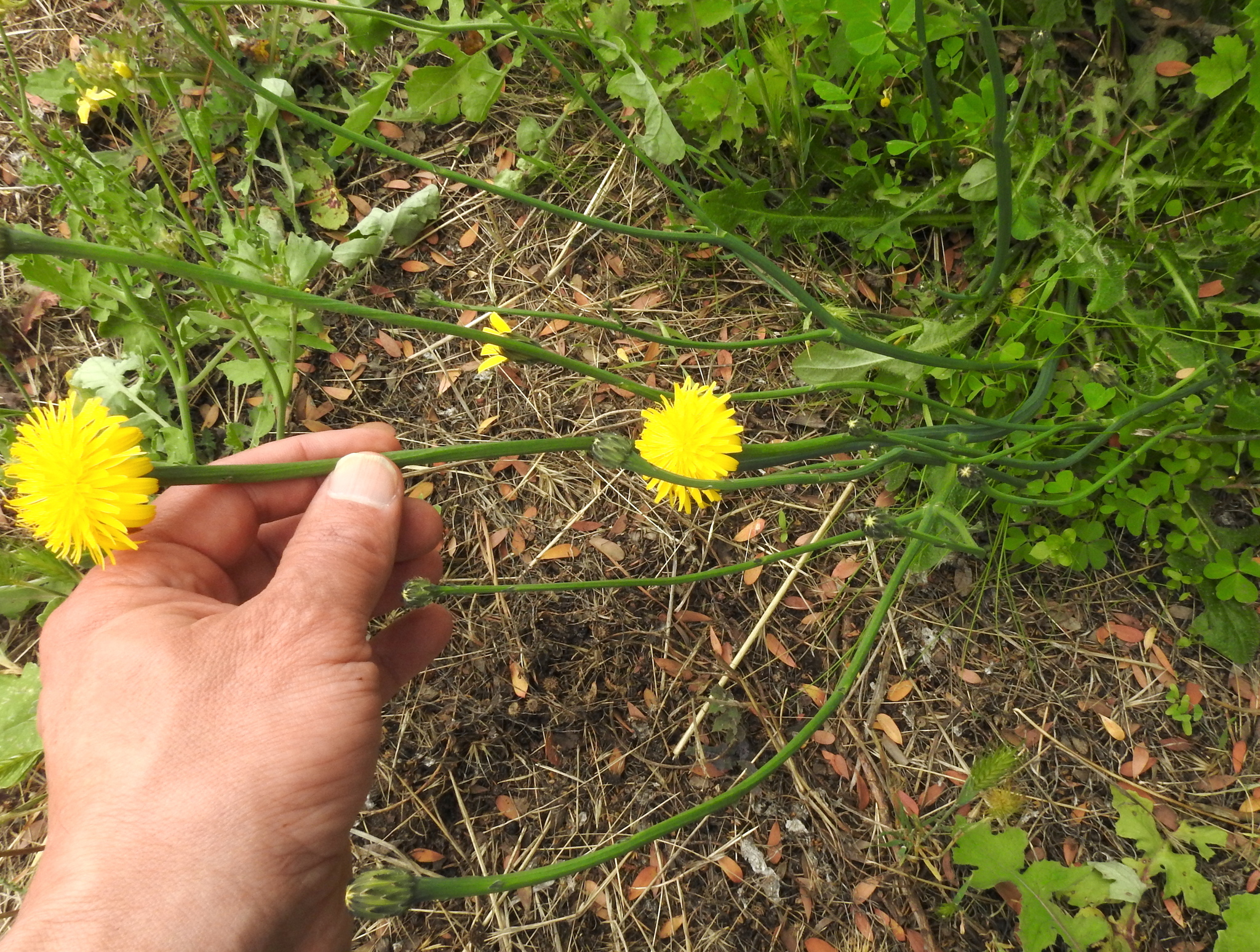
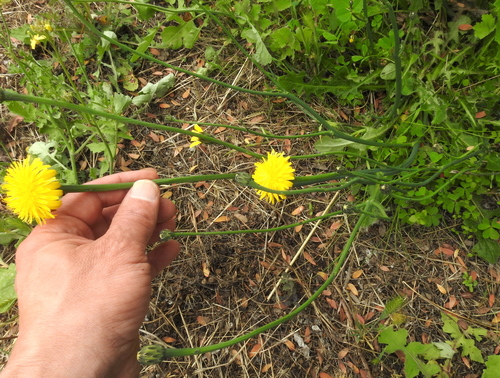
Several ascending, leafless stems arise from the rosette. They are simple or branch only near their tips and stand 30–70 cm (12–28 in) tall. One or more yellow flower heads, about 2 cm (0.8 in) across, sit on long stalks. Flowering extends from late spring into early fall in the temperate conditions described. Cut leaves and stems release white milky sap. 3 8
The fruit is a cylindrical brown achene, 3–7 mm (0.12–0.28 in) long, narrowing into a slender beak and topped by a plume of feathery bristles. This pappus carries the fruit on the wind. The parachute-like seed heads resemble those of dandelions, helping explain why the plants are so often confused in lawns. 8
Useful taxonomy
The accepted name, Hypochaeris radicata L., appeared in 1753 in Species Plantarum. POWO associates it with two principal synonyms: Achyrophorus radicatus (L.) Scop. and Porcellites radicata (L.) Cass.. These are older combinations that placed the same species in different genera, rather than names for separate garden forms. 1 8
Four subspecies are recognized in the treatment used here, including the typical Hypochaeris radicata subsp. radicata and Hypochaeris radicata subsp. ericetorum Soest, which is more localized in western Europe. Fine differences in fruit shape help separate them. A complete scientific name is therefore more dependable for subspecies identification than the appearance of the ground-level rosette alone. 1
Hypochaeris belongs to the tribe Cichorieae, alongside Taraxacum, Cichorium and Leontodon. Their relationship explains the broadly similar yellow heads and plumed achenes. Similarity at this level identifies a group of related plants, but does not by itself establish the species of a yellow-flowered rosette found in grass. 7
Habitat and range
WCVP places false dandelion’s native range across Europe as far east as Belarus, western Russia, the Near East, the North Caucasus and North Africa. The Near Eastern area includes Turkey, Lebanon and Syria; the North African range extends from Morocco to Libya. This is a wider native distribution than Europe alone. 1 8
Introduced populations have naturalized in several US states and in Colombia, Costa Rica, Ecuador, Guatemala, Jamaica, Paraguay and Venezuela. In New Zealand the species is considered locally invasive. An archived Washington State weed-board account records it as a noxious weed, particularly in the western part of the state; this is a regional record, rather than a rule applying throughout its introduced range. 8 3
Lawns in parks and gardens, grazed pastures, heaths, scree and roadsides are common habitats. Soils are often slightly acidic and compacted by foot traffic or repeated mowing. The low rosette withstands mower passes that remove other weeds, allowing established plants to persist in closely cut grass despite the loss of their taller flower stems. 2 8
Life cycle and reproduction
Germination can occur from spring through fall, followed first by a basal rosette and then a partly woody taproot. An established plant may produce 1–15 flowering stems from one woody crown. The shared crown and multiple stems distinguish a mature plant from a recent seedling and help explain its persistence after cutting. 3 2
Under favorable conditions, a plant arising from an achene can reach maturity in about two months. This short development period helps it colonize newly disturbed soil. In addition to reproduction by seed, shoots can develop from the crown, so mowing alone does not reliably eliminate an established plant or prevent it from growing again. 2
As a perennial, false dandelion can retain its rosette throughout the year in temperate climates where conditions allow. It does not simply disappear after fruiting like an annual weed. If the crown remains in place after mowing or shallow pulling, the surviving base usually produces fresh growth, making complete removal more demanding than cutting off the leaves. 2
Uses and risks
All parts are described as edible, although the young leaves and roots are the parts most often gathered. Leaves have a mild flavor and little of the bitterness associated with dandelion; they can be eaten raw in salads or steamed. Roasting and grinding the roots produces a coffee substitute, in much the same way as chicory. 8 2
The main documented animal-health concern involves horses. Excessive consumption, particularly on overgrazed pasture or during drought, is suspected of causing Australian stringhalt, progressive exaggerated flexion of the hind limbs associated with peripheral neuropathy of the sciatic, peroneal and tibial nerves. The Merck Veterinary Manual links some Australian cases to flatweed poisoning, but a specific toxic substance has not been identified and the exact cause remains uncertain. 4 8
For land managers and gardeners, the plant is chiefly a persistent weed of lawns and pastures. The cited Washington account describes control with 2,4-D or removal below the crown before flowering stems develop. Herbicide use depends on the locally authorized product and setting; the underlying practical point is to address the surviving crown rather than remove only the visible flower stalks. 3
Varieties, look-alikes and related plants
Horticultural cultivars do not account for the variation described in Hypochaeris radicata. Differences seen in wild plants, particularly in fruit form, chiefly concern the four accepted botanical subspecies in the treatment used here. They should be distinguished from named garden selections: a variable leaf or fruit shape does not automatically indicate a cultivar. 1
True dandelion, Taraxacum officinale, is the most frequent source of confusion. Each hollow, unbranched flowering stalk carries just one head, and the leaves are hairless or only slightly hairy. False dandelion instead has solid stems that often branch near the top and can carry several heads, together with leaves that feel distinctly bristly. 2
Related genera such as Leontodon and Crepis share the same broad arrangement of a basal rosette, yellow heads and plumed fruits. Leaf hairiness and stem branching are the most useful field characters for separating these superficially similar plants without dissecting their flowers. A whole-plant view is more informative than a close-up of a yellow head alone. 7
Main sources
- Plants of the World Online / Kew, Hypochaeris radicata L.
- NC State Extension Gardener Plant Toolbox, Hypochaeris radicata
- Washington State Noxious Weed Control Board, Common Catsear written finding
- Merck Veterinary Manual, Stringhalt in Horses
- Tela Botanica / eFlore, Hypochaeris radicata
- Plants For A Future, Hypochoeris radicata
- Integrated Taxonomic Information System, Hypochaeris radicata L.
- Wikipedia FR, Porcelle enracinée
Frequently asked questions
Is false dandelion poisonous?
The documented concern chiefly involves horses. Excessive consumption is suspected of causing Australian stringhalt, an exaggerated flexion of the hind legs. Toxicity in other animals remains poorly established, and the responsible substance has not been identified with certainty.
Can you eat false dandelion?
Yes. Young leaves can be eaten raw in salads or steamed, with much less bitterness than dandelion leaves. The root can be roasted and ground as a coffee substitute, like chicory.
How can I tell false dandelion from a true dandelion?
False dandelion has flower stems that branch near the top, often with several heads per plant, and bristly leaves that feel rough. A true dandelion carries one head on each hollow, unbranched stalk and has hairless or only slightly hairy leaves.
Why does false dandelion survive mowing?
Its basal rosette lies flat against the ground, below the mower blade, while its partly woody taproot supports regrowth after cutting. Removal below the crown is needed for lasting control.
Where does false dandelion come from?
Its native range includes Europe east to Belarus, western Russia, the Near East, the North Caucasus and North Africa. It has been introduced to several US states and New Zealand, where it is considered locally invasive.
What is Australian stringhalt?
It is a progressive exaggerated flexion of a horse’s hind legs associated with damage to peripheral nerves. The Merck Veterinary Manual links some cases in Australia to poisoning involving flatweed plants, without identifying a specific toxic compound.
Does false dandelion have subspecies?
Plants of the World Online recognizes four, including the typical subspecies and Hypochaeris radicata subsp. ericetorum, which is more localized in western Europe. These divisions depend on fine botanical characters and do not change basic field recognition.
Similar plants
If you are unsure about a plant’s toxicity, ask a botanist or veterinarian for advice.