
Chicory (Cichorium intybus, )
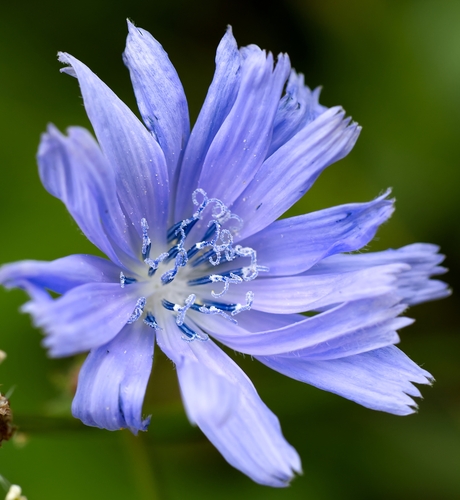
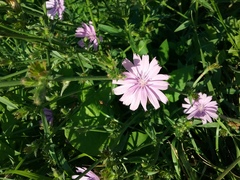
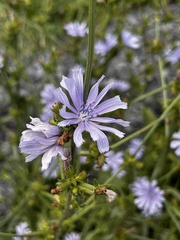
Chicory (Cichorium intybus), also called bitter chicory, is an herbaceous perennial in the Asteraceae, native to Europe, western Asia and North Africa. Its rosette of toothed leaves produces a stiff, much-branched flowering stem covered with sky-blue flowers that open for only one morning. It is the ancestral species of witloof, radicchio and root chicory, and its taproot has served as a coffee substitute for centuries.
Read moreChicory, Common chicory, Wild endive, Blue sailors, Blue dandelion and Coffee chicory
Allow a few hours of direct sun per day, preferably morning or evening.
Full sun; does not grow in shade
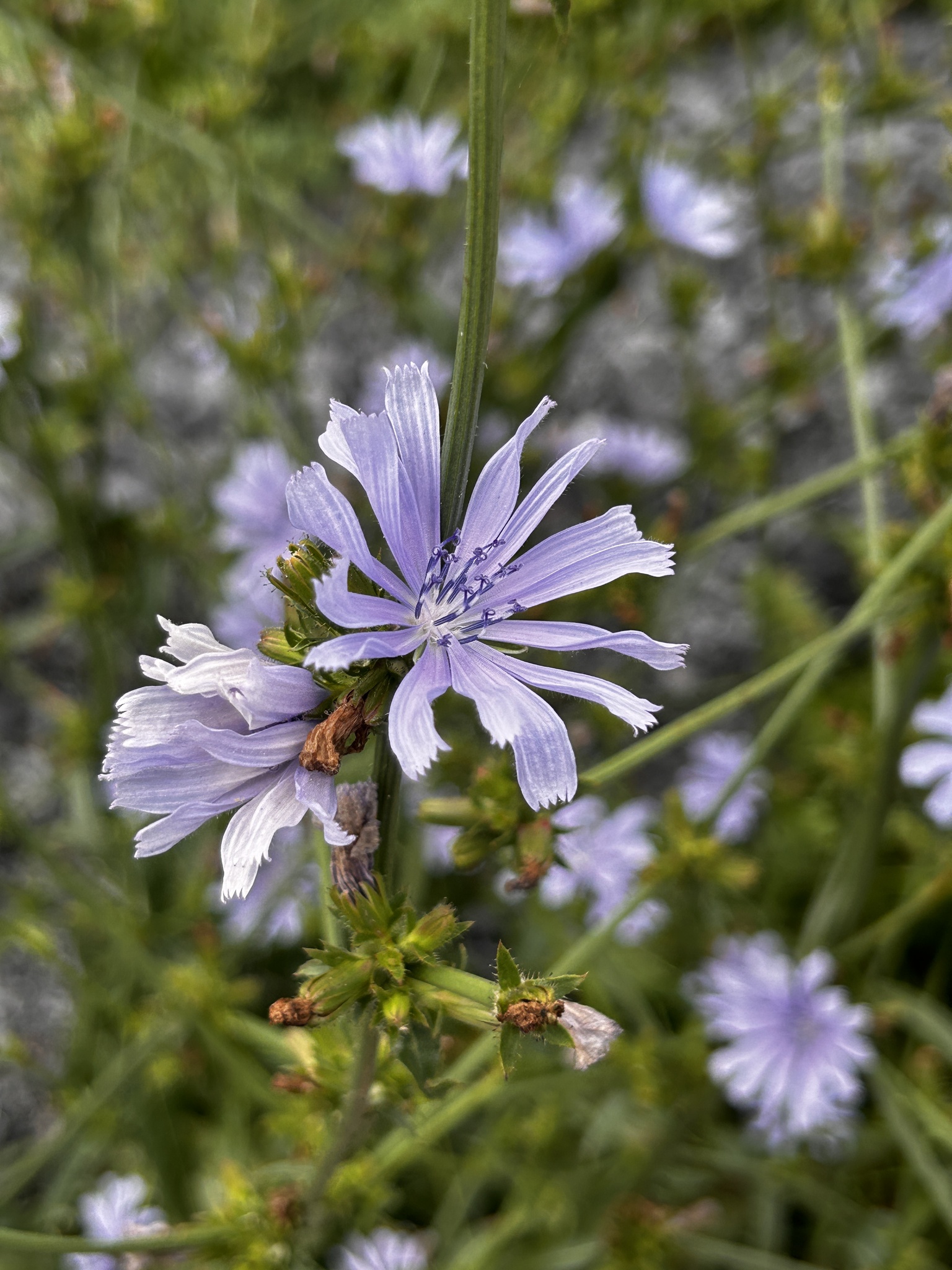


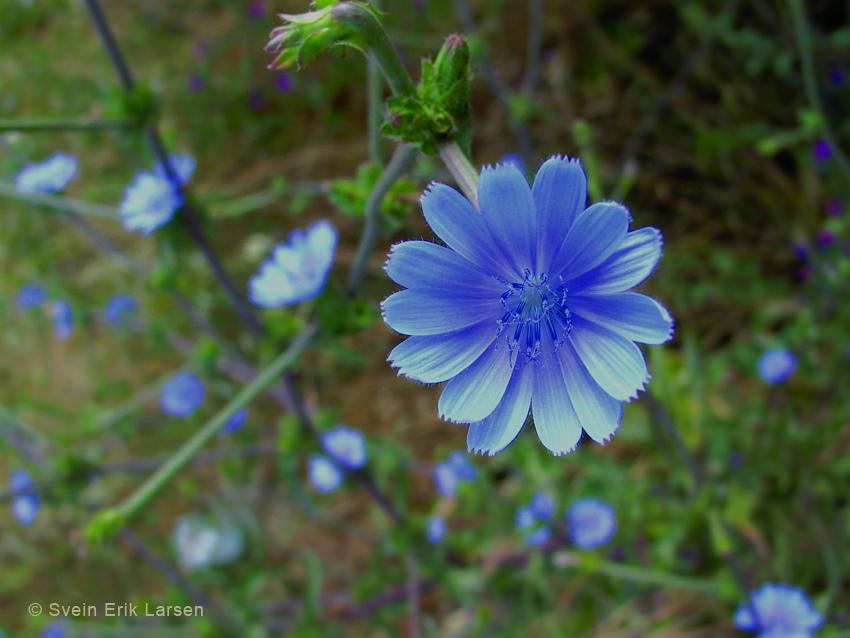
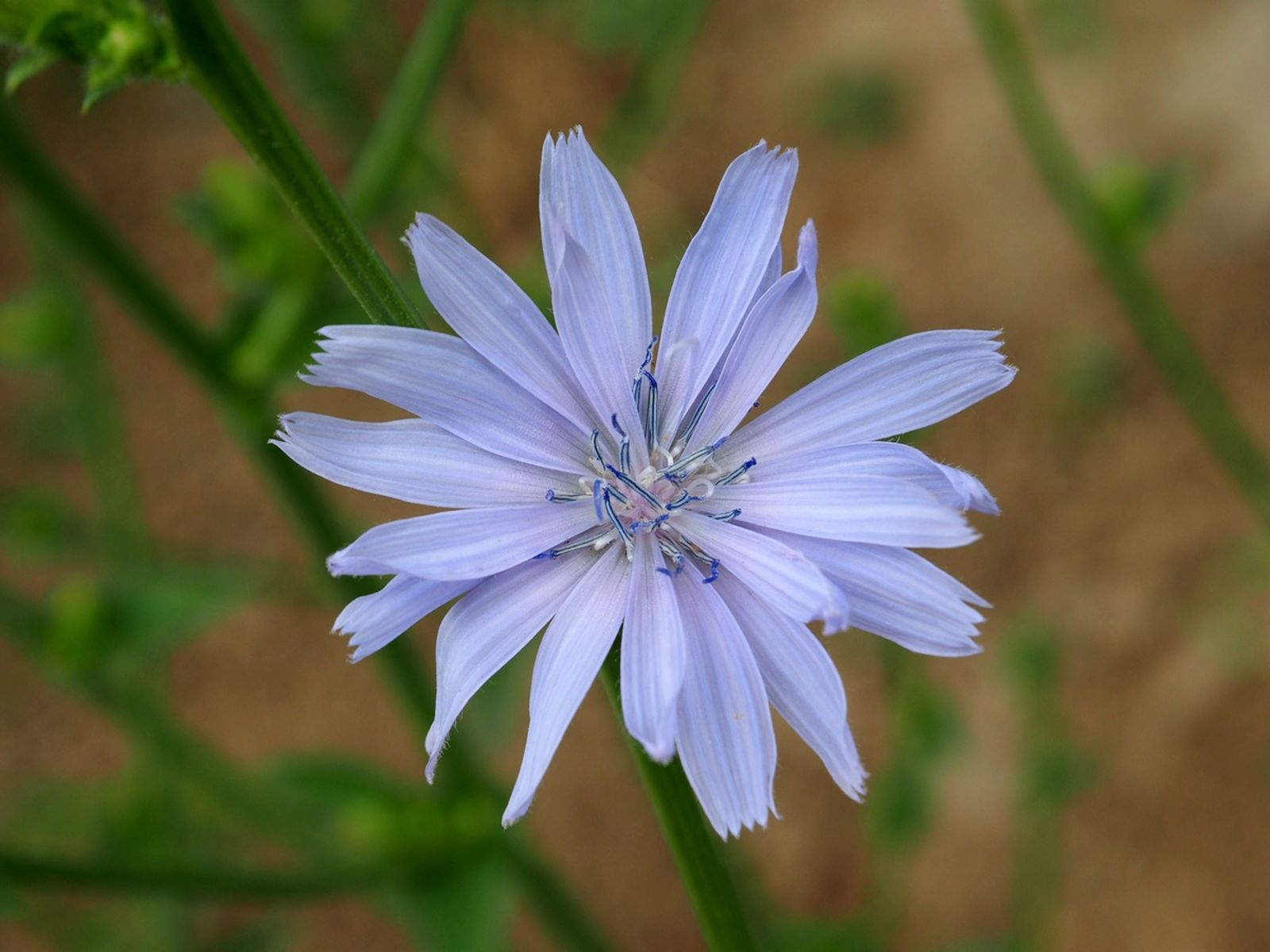

© photo
(c) akolter, some rights reserved (CC BY-NC) · cc-by-nc
Mary Crickmore · cc0
Scott Edmunds · cc0
Taken Oct 25, 2017 by Llandrich anna (cc-by-sa)
Taken Aug 20, 2008 by Andrzej Konstantynowicz (cc-by-sa)
Taken Jul 14, 2019 by Marc Laurent (cc-by-sa)
Taken Aug 4, 2022 by Andrzej Konstantynowicz (cc-by-sa)
Taken Aug 14, 2019 by Llandrich anna (cc-by-sa)
© copyright of the Board of Trustees of the Royal Botanic Gardens, Kew.


Global distribution
Cichorium intybus is native from Europe to Central Asia and the western Himalayas, as well as Macaronesia and North Africa. Mainland France lies within this native range. The species is widely naturalized elsewhere, notably in North America, where it grows chiefly on roadsides and waste ground. Colorado regulates it locally as a noxious weed; this status remains regional.
- Native5
- Introduced3
- Invasive1
- Mainland France
- Temperate Europe
- Western and Central Asia
- North Africa
- Macaronesia
- United States
- Canada
- Australia
- Colorado (United States)
Hexagons: regions where the plant occurs. Green dots: native range.1
Identity
Chicory (Cichorium intybus L., 1753), also called common chicory, is an herbaceous perennial in the genus Cichorium, family Asteraceae. The binomial Cichorium intybus identifies the ancestral species of most cultivated chicories, from witloof to radicchio and coffee chicory. 1 2
Chicory cultivation dates to antiquity: Pliny the Elder already described it in his Natural History as a vegetable with many uses. Its roasted root has served as a coffee substitute for centuries, a use that becomes especially prominent during coffee-bean shortages. 8 4
Recognition
A basal rosette of toothed to deeply lobed leaves forms first, resembling a dandelion’s. Even at this stage, one feature helps distinguish them: chicory lobes point outward from the rosette, while dandelion lobes point toward its center. Later, chicory develops a stiff, upright, much-branched flowering stem 60 cm to 1.5 m (2–5 ft) tall. 3 4
Upper leaves are much smaller than basal leaves, lack stalks and clasp the stem directly. When cut, chicory releases milky latex from a thick, light-brown, fleshy taproot. 4 5
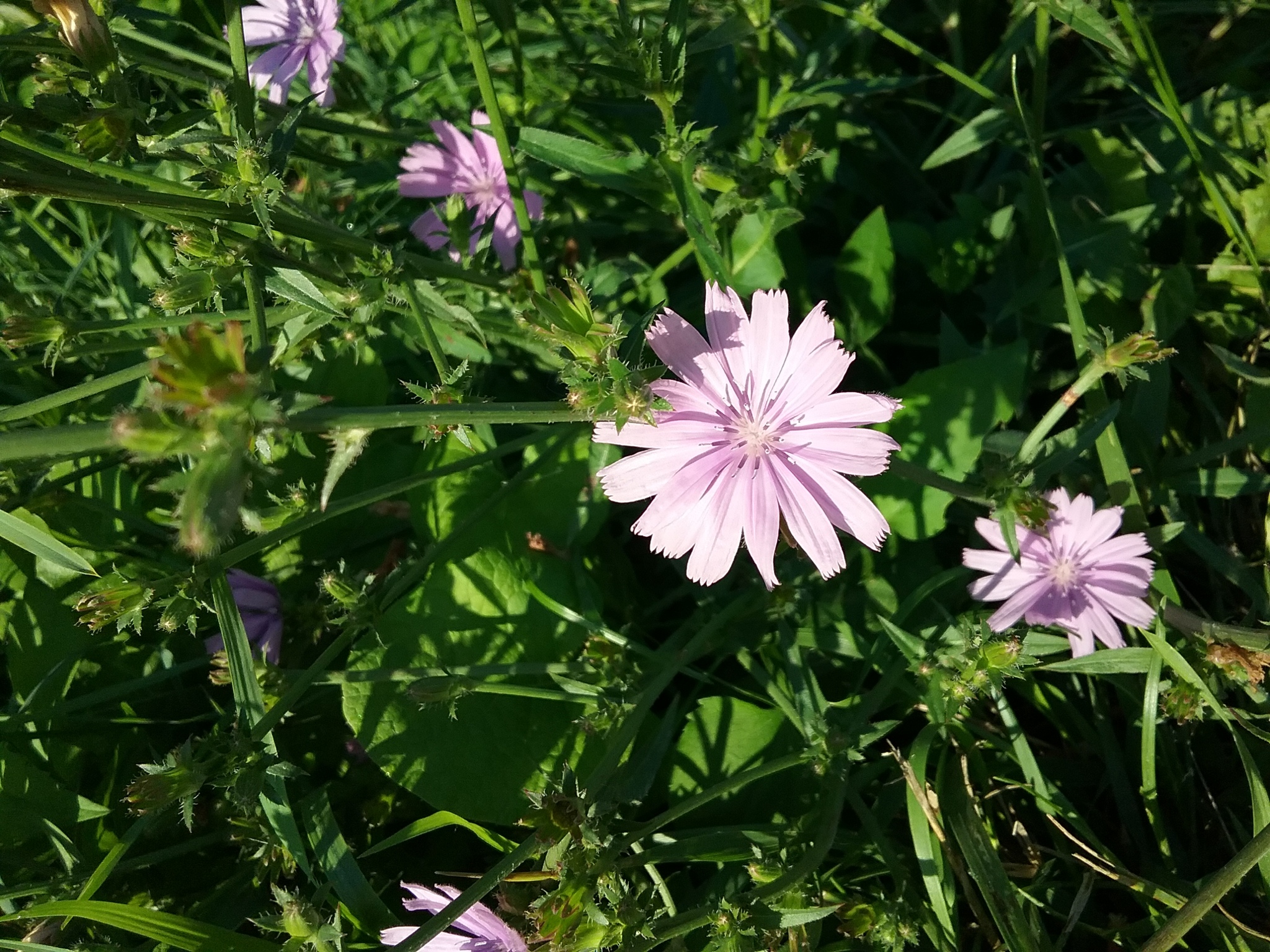
The characteristic sky-blue flowers, occasionally white or pink, reach 4 cm (1.6 in) across. They open in morning sun and close in early afternoon or rainy weather. Each head blooms for one day only, replaced the next day by a new bud higher on the same stem. 2 3
Useful taxonomy
Carl Linnaeus described this species in 1753 as Cichorium intybus L., still its accepted name. Cichorium, a small genus of Mediterranean and Eurasian species, belongs to the Cichorieae tribe of Asteraceae, alongside lettuces and dandelions. 1 7
Cultivated forms often carry botanical variety names, distinct from ordinary trade labels:
- Cichorium intybus var. foliosum (Hegi) Janch., the witloof group that produces white heads;
- Cichorium intybus var. sativum Gaudin, the group grown for coffee roots;
- Cichorium intybus var. endivia (L.) Mérat, a name sometimes confused with true endive, a distinct species;
- Cichorium intybus subsp. pumilum (Jacq.) Ball, a smaller Mediterranean subspecies.
The accepted name, Cichorium intybus, remains the reliable reference: horticultural groups such as witloof and radicchio are selections, rather than separate species. 1 2
Habitat and range
Chicory’s native range spans Europe, Central Asia and the western Himalayas, with extensions into Macaronesia and North Africa. Mainland France lies within this native range, where the species remains very common. 1 5
Favored habitats include roadsides, waste ground, banks and dry to moderately moist grasslands, often on limestone or compacted soils that its deep taproot can penetrate. 6 5
Naturalized widely in North America since colonial times, Cichorium intybus mainly occupies roadsides and disturbed ground there, without invading undisturbed natural habitats. Colorado lists it locally as a regulated noxious weed, a status that does not apply to its native range. 4 6
Life cycle and reproduction
As a perennial, Cichorium intybus first forms a rosette in its initial year, then develops a flowering stem and reaches maturity in one to two years, depending on conditions. The rootstock subsequently regrows from the taproot each spring. 2 6
Flowering extends from May to October in the Northern Hemisphere, from late spring into fall. Heads open in the morning, attracting many pollinating insects before closing in the afternoon. After pollination, each head produces small dry achenes dispersed by wind or animals. 3 2
In gardens, seed sown directly in spring to early summer (April to June in the Northern Hemisphere) germinates in one to two weeks. Some root selections can also be propagated by root cuttings. Witloof makes particular use of this root: lifted in fall and forced in warmth and complete darkness, it produces new crisp white shoots, or chicons, within a few weeks. 5 2
Uses and risks
Food is the primary use of Cichorium intybus. Its root is rich in inulin, up to 40% of dry weight, and has been roasted as a coffee substitute for centuries. Young leaves are eaten raw in salads or cooked, often blanched to reduce bitterness. 5 7
Chicory also appears in traditional medicine for digestive, diuretic and liver-related uses. Recent studies report a reassuring safety profile, with no sign of notable toxicity in rats, while reiterating the usual caution for people allergic to the Asteraceae family. 7 5
As forage, chicory proved too coarse for routine grazing. Trials with sheep nevertheless show a strong reduction in egg shedding by the parasite Haemonchus contortus, attributed to the bitter sesquiterpene lactones lactucin and lactucopicrin. 6 7
Varieties, look-alikes and related plants
Cultivated forms are selections from the same genetic pool, rather than separate species. Witloof, or Belgian endive, comes from a dark-forcing technique developed in Belgium in the 19th century: a root forced in warmth without light produces a crisp white head. Italian radicchio, with purple leaves packed into heads, and sugarloaf chicory, with elongated, less bitter heads, illustrate the same horticultural diversity. 2 5
Plants frequently confused with chicory include:
- Taraxacum, dandelion, whose young rosette resembles chicory’s, but whose flowering stalk stays single, hollow and unbranched, unlike the stiff, much-branched stem of Cichorium intybus;
- Cichorium endivia, true endive, a separate species grown for its leaves and sometimes confused with witloof because of the shared common name.
Sky-blue flowers, a much-branched stem and basal leaves with outward-pointing lobes remain the most reliable features for confirming Cichorium intybus. 3 4
Main sources
- Plants of the World Online / Kew, Cichorium intybus L.
- Royal Horticultural Society, Cichorium intybus - chicory
- Missouri Botanical Garden, Cichorium intybus
- University of Wisconsin Extension, Chicory, Cichorium intybus
- Plants For A Future, Cichorium intybus
- Utah State University Extension, Chicory, range plants
- Traditional uses, phytochemistry, pharmacology and toxicology of Cichorium intybus
- Pliny the Elder, Natural History, Book XX, on intybus
Frequently asked questions
Is chicory poisonous?
No. Cichorium intybus is not listed as toxic to people, cats or dogs; its status in horses remains uncertain. Like other Asteraceae, it may cause skin or digestive reactions in people sensitive to the family.
How does wild chicory differ from witloof?
Witloof, or Belgian endive, is the same species, Cichorium intybus, grown for its root and then forced in darkness. Forcing turns the taproot into crisp white heads, very different from the wild plant’s green foliage.
How can you distinguish chicory from dandelions?
Young rosettes look similar, but chicory later develops a stiff, upright, much-branched flowering stem. A dandelion has a single, hollow, unbranched stalk for each flower head. Chicory leaf lobes point outward from the rosette.
Can chicory root really replace coffee?
Its roasted root has been used as a caffeine-free coffee substitute for centuries, with a bitter, caramelized taste. It is rich in inulin, a fiber that can account for up to 40% of the root’s dry weight.
Is chicory invasive?
In France, where it is native, it is not considered invasive. Introduced to North America, it mainly colonizes roadsides and disturbed ground, and Colorado regulates it locally as a noxious weed.
Is chicory useful as livestock pasture?
It has been tested as a forage plant but proved too coarse for routine grazing. Trials with sheep mainly show reduced egg shedding by the parasite Haemonchus contortus.
Why do chicory flowers close in early afternoon?
Each flower head blooms for only one morning. It opens at sunrise to attract pollinating insects, then closes in early afternoon or cloudy weather, with another bud replacing it the following day.
Similar plants

If you are unsure about a plant’s toxicity, ask a botanist or veterinarian for advice.