
true indigo (Indigofera tinctoria, )


True indigo (Indigofera tinctoria) is a subshrub in the Fabaceae, native to tropical Africa and the Indian subcontinent through Indochina. Its indican-rich leaves supplied a major blue pigment for the global textile trade for millennia, before industrial synthesis largely replaced natural indigo in the late 19th century.
Read moretrue indigo
Place in full sun, with intense direct light all day long.


© photo
Siddarth Machado · cc-by
Ben Machado · cc-by-nc
Wikimedia Commons · CC BY-SA or Public Domain
Taken May 7, 2014 by Tela Botanica − Sénégal ENGOUEMENT (cc-by-sa)
Taken Dec 5, 2015 by Tela Botanica − Liliane ROUBAUDI (cc-by-sa)
© copyright of the Board of Trustees of the Royal Botanic Gardens, Kew.


Global distribution
The documented native range extends from tropical West Africa to Tanzania and southern Africa, and from the Indian subcontinent to Indochina. Millennia of dye cultivation have obscured its origins; some sources suggest China and tropical Asia without a definitive conclusion. Introduced and naturalized records must remain distinct from the native range.
- Native4
- Introduced1
- Invasive1
- India
- Tanzania
- South Africa
- Vietnam
- United States
- Australia
Hexagons: regions where the plant occurs. Green dots: native range.1
Identity
True indigo (Indigofera tinctoria L., 1753) is a subshrub in the bean family, Fabaceae, subfamily Faboideae. For thousands of years, its leaves supplied a major blue pigment for the international textile trade. Industrial synthetic dye largely displaced natural indigo in the late 19th century, but the plant retains the name associated with that long-established use. It belongs to Indigofera, a genus containing other dye-producing species as well. 1 2
The epithet tinctoria means “used for dyeing.” It describes what people do with the leaves, rather than a blue color on a living shrub. Blue develops after fermentation and exposure to air. The word indigo derives from Latin indicum, meaning a substance from India, and preserves the historical importance of the Indian subcontinent in dye production even though the species also grows wild in tropical Africa. 3
Recognition
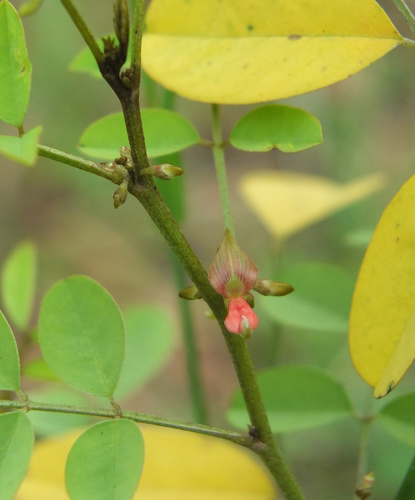
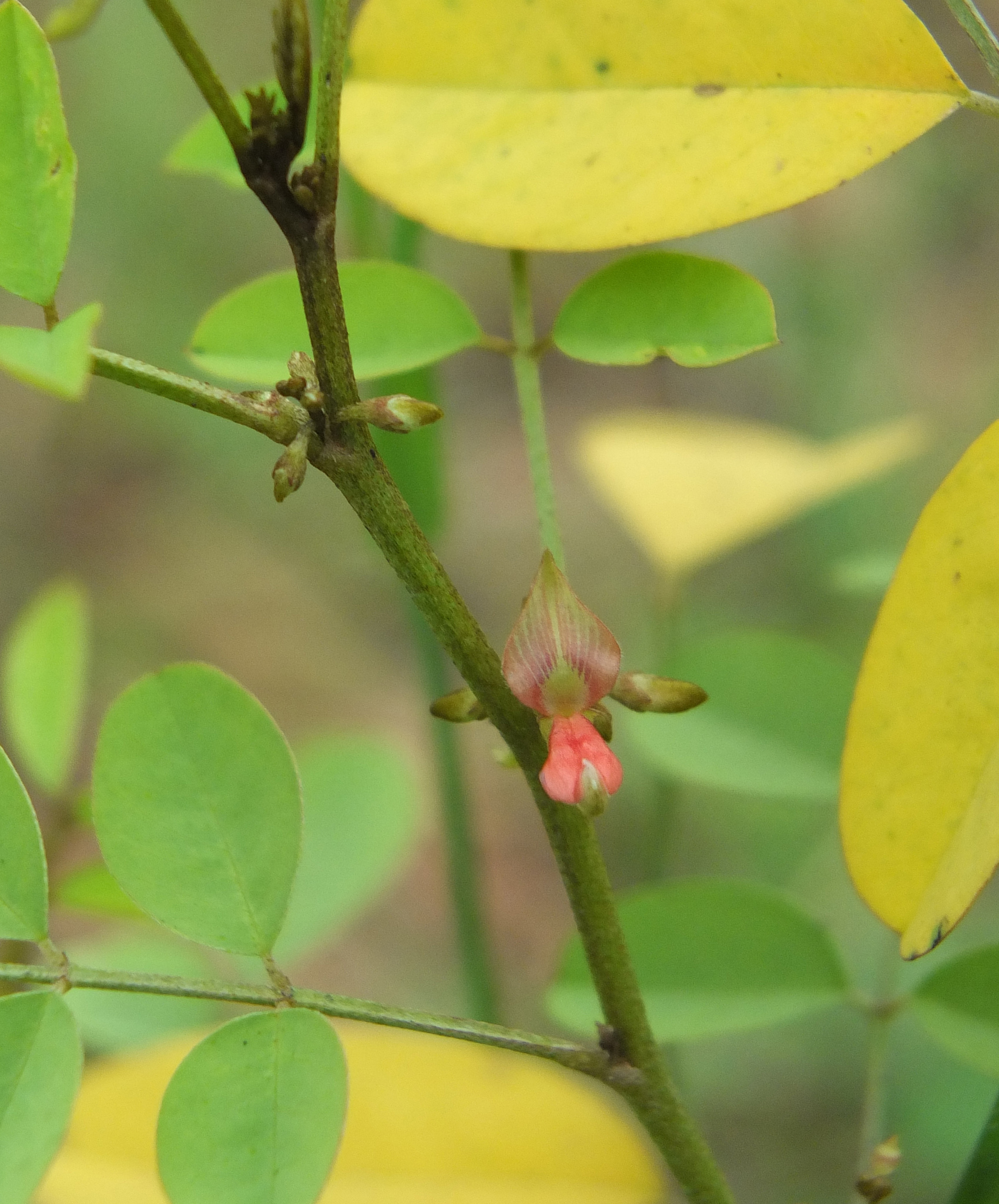
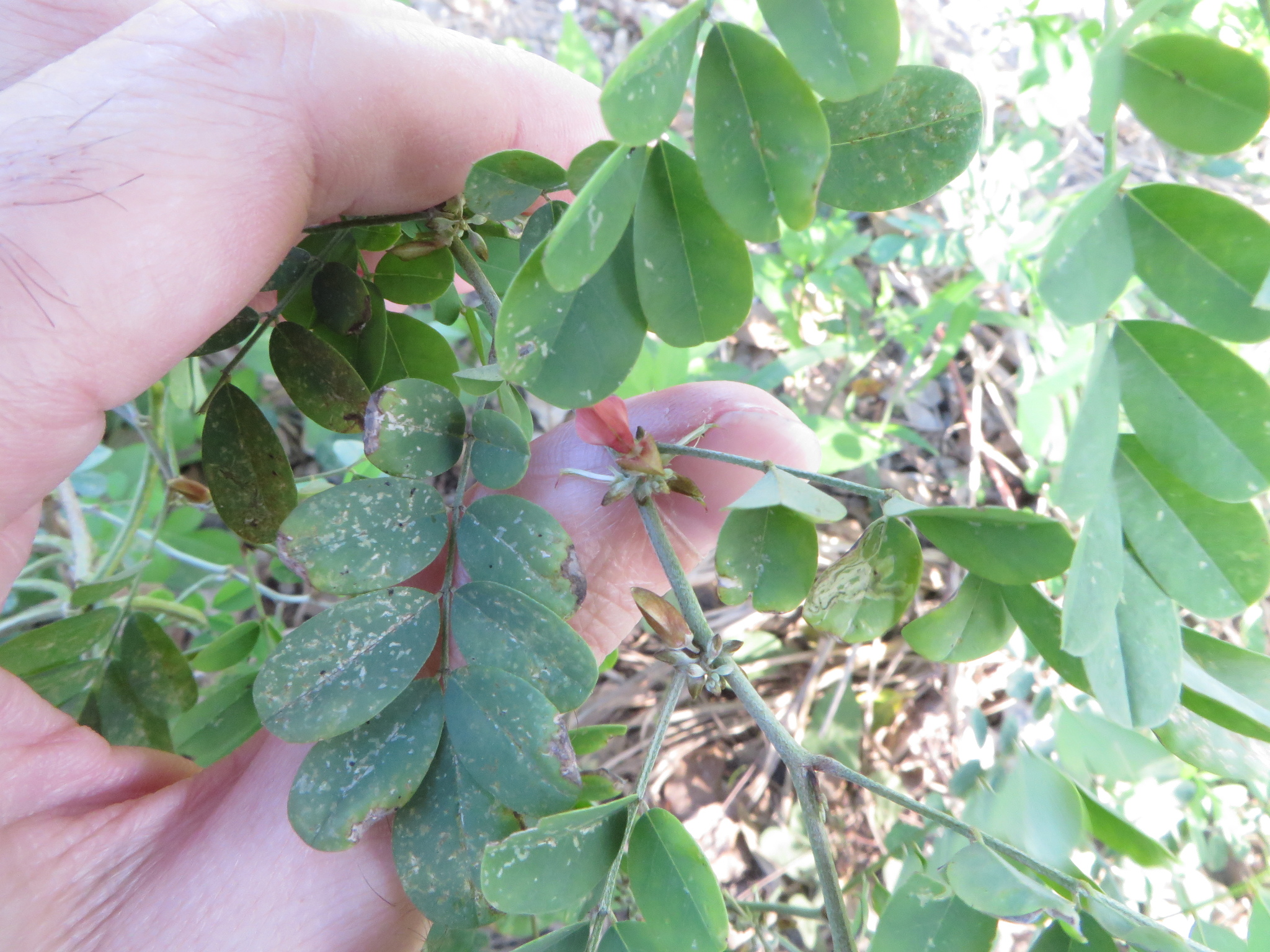
An upright subshrub or shrub, true indigo usually reaches 1–2.5 m (3–8 ft) in both height and spread. Fine branches carry short, silky hairs. The compound leaves have 7–13 oval leaflets, pale green above and lighter underneath, with a single leaflet at the tip. This relatively airy foliage contrasts with the denser outline of some other shrubs in the same family. 2 3
Small, pea-shaped flowers range from pink to reddish purple between populations. Short flower racemes arise in the leaf axils, mainly during warm conditions. They are followed by narrow, slightly curved brown pods, each containing 7–10 seeds. The sequence from axillary flowers to slender pods provides more identification detail than the general resemblance of its foliage to other legumes. 5
Bruised or dried leaves gradually turn blue, revealing the presence of indican, the colorless precursor of indigotin. This change offers an identification clue even when flowers are absent. The living leaf and the processed dye have different colors because the blue pigment forms through chemical changes after the tissue is damaged or harvested. 2
Useful taxonomy
Linnaeus's name, Indigofera tinctoria L., remains accepted by POWO/WCVP. Other botanists used the same species epithet for different plants, creating pitfalls in older catalogs:
- Indigofera tinctoria Forssk., 1775 refers to Indigofera articulata Gouan, a subshrub occurring from the Sahara to Pakistan;
- Indigofera tinctoria Chapm., 1860 refers to Indigofera sphaerocarpa A.Gray, from Arizona and northern Mexico;
- Anil tinctoria (L.) Kuntze is a direct synonym of true indigo.
The authority matters in these cases. Indigofera tinctoria L. identifies the intended species more reliably than the epithet alone, especially when interpreting a historical plant list or a record that predates modern taxonomic treatment. Similar names in old sources do not necessarily refer to the same biological plant. 1 6
Habitat and range
Two broad regions make up the documented native range: tropical West Africa through Tanzania to southern Africa, and the Indian subcontinent through Indochina. Thousands of years of cultivation have blurred the boundaries. Some sources instead suggest an origin in China and tropical Asia without settling it conclusively. Native occurrence must therefore be distinguished from ancient cultivation and subsequent naturalization. 1 3
Fallow ground, field margins and poor, well-drained soils in warm climates with a marked dry season provide typical habitat. Long introduced beyond its native range, the species has naturalized in northern Australia. In eastern Queensland and the Daintree region it can behave locally as a weed of disturbed ground, a regional observation rather than a universal classification wherever indigo is grown. 5
In conditions corresponding to USDA zones 10–12, active growth calls for soil that retains moisture without remaining waterlogged in winter. Cold below 5 °C (41 °F) can bring leaf loss and delay the following spring's recovery. Mulching the crown or moving container plants under shelter provides protection where winter conditions would otherwise be unsuitable. The significance of winter depends on the local climate, rather than the language spoken by the grower. 3
Life cycle and reproduction
Summer is the main flowering season in many cultivation climates. Growth is rapid in warm conditions but slows noticeably below 15 °C (59 °F). As with many legumes, root nodules house rhizobial bacteria that fix atmospheric nitrogen. This symbiosis can enrich the soil without a fertilizer application and helps explain why true indigo has agricultural uses beyond dye production. 2
Seeds sown in warm growing conditions generally germinate within a few days, much faster than those of many woody shrubs. Direct sowing can therefore establish a cover crop relatively quickly. The speed describes favorable warm conditions rather than a guarantee of equally rapid emergence in cool ground. 2
Propagation is by seed or semi-ripe stem cuttings. The species is also grown as green manure and as a cover crop in rice-growing systems. In that agricultural context it can reduce the need for synthetic nitrogen fertilizer by about 50%. Its nitrogen-fixing role and its use as a harvested dye crop are different ways of making use of the same plant. 2
Uses and risks
Dye production is the dominant historical use. Leaves are cut before full flowering, when their indican content is highest, then fermented and exposed to air so that blue indigotin precipitates. Natural indigo dominated the world's blue textile-dye trade until the late 19th century, notably through colonial plantations in Bengal. Industrial chemical synthesis then largely replaced the plant-derived pigment, although artisanal production continues in India and elsewhere. 3
For common domestic pets, no notable toxicity is listed. That absence must be distinguished from the effects of indospicine, a liver-toxic amino acid documented in other Indigofera species and associated with livestock poisoning during grazing. Feeding trials conducted specifically with I. tinctoria, however, reported no adverse effects at moderate inclusion levels in cattle diets. Evidence about another member of the genus should not automatically be transferred to this species, nor does a limited feeding trial establish unrestricted safety. 7 9
An ethanolic leaf extract has also shown measurable anthelmintic activity against gastrointestinal strongyles in sheep. Its activity was lower than that of the reference drug albendazole. This veterinary research concerns a particular extract and comparison, rather than proof that an unprocessed plant can replace a standard worm treatment. 8
Varieties, look-alikes and related plants
The typical variety, Indigofera tinctoria var. tinctoria, is accepted by POWO/WCVP and serves as the botanical reference form of the species. Bengal indigo and Guatemala indigo, familiar from commercial archives, refer to historical agricultural provenances rather than registered cultivars. Their names record trade and cultivation history; they do not by themselves define a separately bred garden selection. 1
Other dye-producing Indigofera species cause the most frequent confusion. Indigofera suffruticosa in the Americas and Indigofera arrecta in East Africa have closely similar uses and appearances. Woad, Isatis tinctoria, yields the same blue pigment through a different chemical pathway but belongs to the Brassicaceae. Its shared dyeing use does not make it a close botanical relative of true indigo. 4
Main sources
- Plants of the World Online / Kew, Indigofera tinctoria L.
- Plants For A Future, Indigofera tinctoria
- Missouri Botanical Garden Plant Finder, Indigofera tinctoria
- Royal Horticultural Society, Indigofera tinctoria
- eFlora of the Northern Territory (Australia), Indigofera tinctoria
- GBIF Backbone Taxonomy, Indigofera tinctoria L.
- Nature, indospicine hepatotoxic amino acid from Indigofera species
- PMC, anthelmintic activity of Indigofera tinctoria in sheep
- PMC, Indigofera tinctoria waste in growing beef cattle diets
Frequently asked questions
Is true indigo the same plant as woad?
No. Woad, Isatis tinctoria, belongs to the Brassicaceae rather than being closely related to Indigofera tinctoria. Both yield the blue pigment indigotin, through different chemical pathways.
Is true indigo poisonous to cats and dogs?
No notable toxicity is listed for common domestic pets. However, indospicine is documented in other Indigofera species and warrants caution when members of the genus are used as livestock forage.
Why do true indigo leaves turn blue as they dry?
They contain indican, a colorless precursor that becomes blue indigotin through fermentation followed by oxidation in air, without an externally added chemical being required for that color change.
Where does the name indigo come from?
It derives from Latin indicum, literally a substance from India, recalling the historical source of blue pigment imported into Europe.
Is natural indigo still produced?
Production declined sharply after industrial chemical synthesis developed in the late 19th century. Artisanal supply chains persist in India and elsewhere for traditional textile dyeing.
Can true indigo grow outdoors in cool temperate climates?
It is sensitive to cold below 5 °C (41 °F) and does not remain outdoors in most of metropolitan France. In similarly cool climates it is mainly grown in pots brought under cover in winter; outdoor cultivation suits very mild, sheltered sites.
Which plants are confused with true indigo?
Other dye-producing Indigofera, notably Indigofera suffruticosa and Indigofera arrecta, cause frequent confusion. Woad, Isatis tinctoria, shares the dyeing use but belongs to a different botanical family.
Similar plants
If you are unsure about a plant’s toxicity, ask a botanist or veterinarian for advice.