
Common juniper (Juniperus communis, )
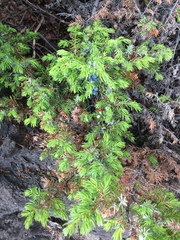
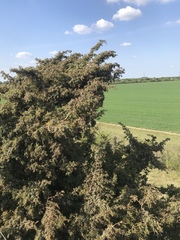
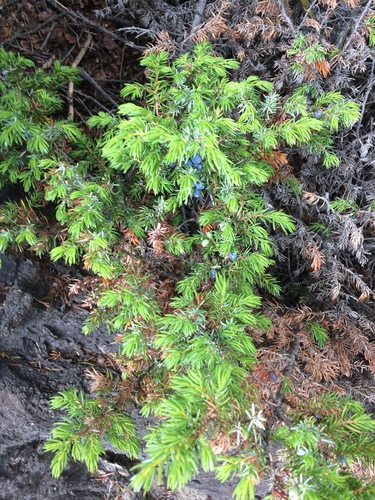
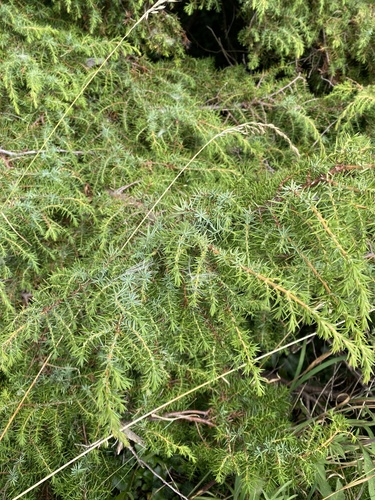
Common juniper (Juniperus communis) is a conifer in the Cupressaceae family with one of the widest natural ranges in the plant kingdom, from Alaska through Europe to Japan. Its form varies from a prostrate mat on windswept ridges to a small tree, and its fleshy blue-black cones take two to three years to ripen on the same branch.
Read moreCommon juniper, Juniper, Ground juniper and Mountain juniper

© photo
(c) FreckLes, some rights reserved (CC BY-NC), uploaded by FreckLes · cc-by-nc
Geoffrey Carter · cc0
Jonathan Hughes · cc0
no rights reserved · cc0
(c) William Stephens, some rights reserved (CC BY) · cc-by
Global distribution
Juniperus communis occupies almost the entire temperate and subarctic Northern Hemisphere, from Alaska and Canada through Europe to Siberia and Japan. This is one of the widest natural ranges of any woody plant species.
- Native8
- France
- United Kingdom
- Sweden
- Czech Republic
- Russia
- Canada
- United States
- Japan
Hexagons: regions where the plant occurs. Green dots: native range.↗
Identity
Common juniper (Juniperus communis L., 1753), also known as juniper, ground juniper, or mountain juniper, is a conifer in the Cupressaceae family and genus Juniperus. Carl Linnaeus described it in Species Plantarum, placing it among the plants named at the foundation of modern binomial nomenclature. 1
The origin of Juniperus remains debated. The most common hypothesis derives it from Celtic gen, “bush,” and prus, “acrid,” referring to the sharp taste of the cones. Another links it to Latin junior and parere, “to give birth,” echoing an ancient medicinal use. The epithet communis simply identifies a widespread species rather than a botanical rarity. 5
Recognition
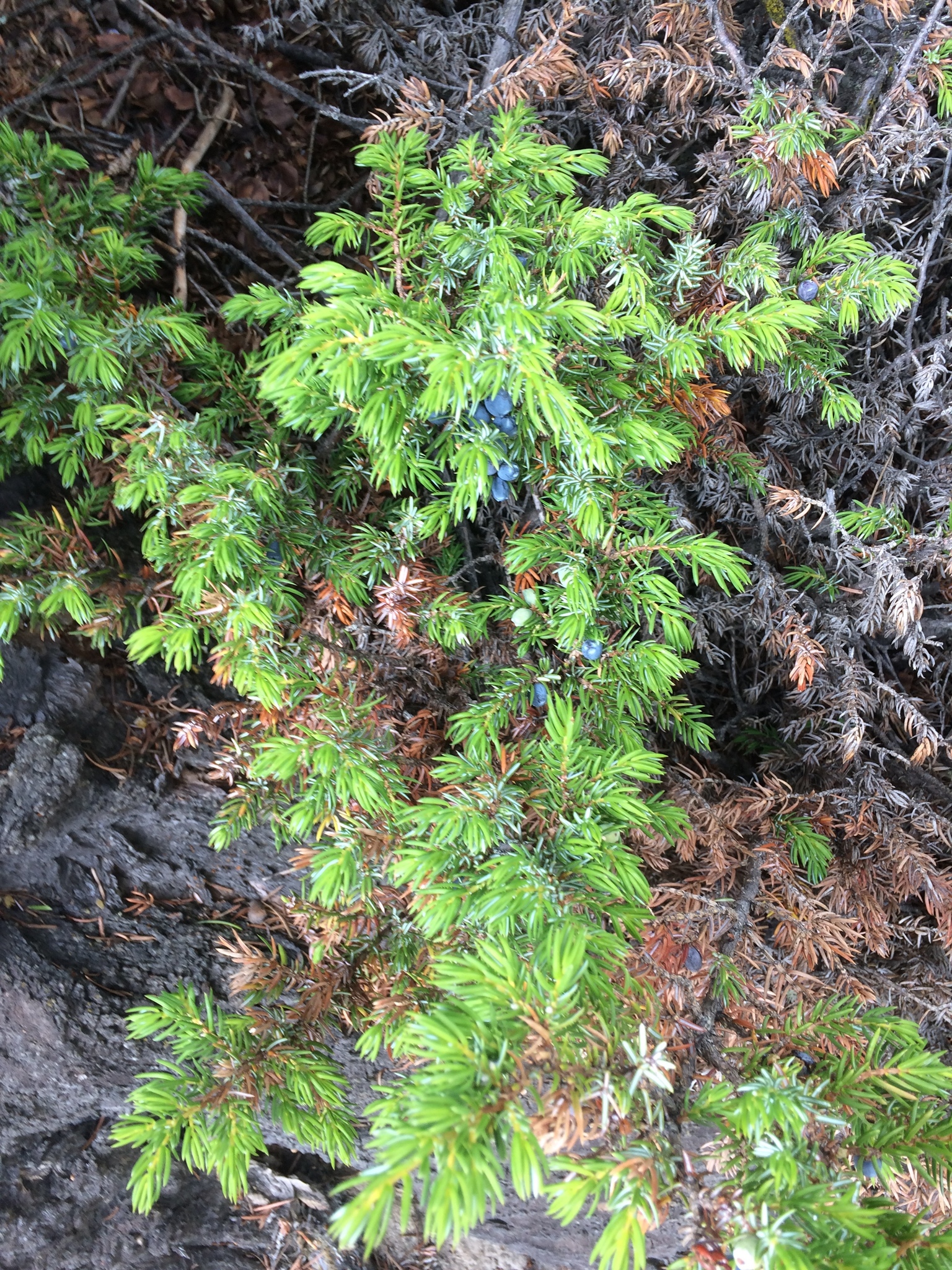
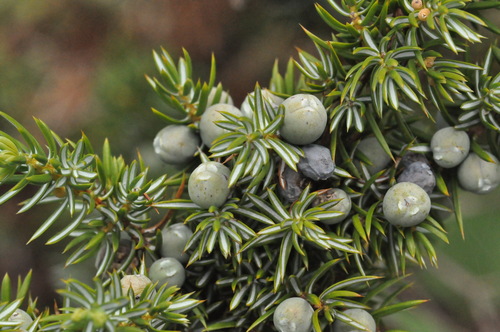
Sharp needles provide the first clue to Juniperus communis. Arranged in whorls of three, they measure 1 to 2 cm (0.4 to 0.8 in) long and barely 1 to 2 mm (0.04 to 0.08 in) wide. A single white stomatal band runs along each needle’s concave upper surface, distinguishing it from relatives with two bands. 7
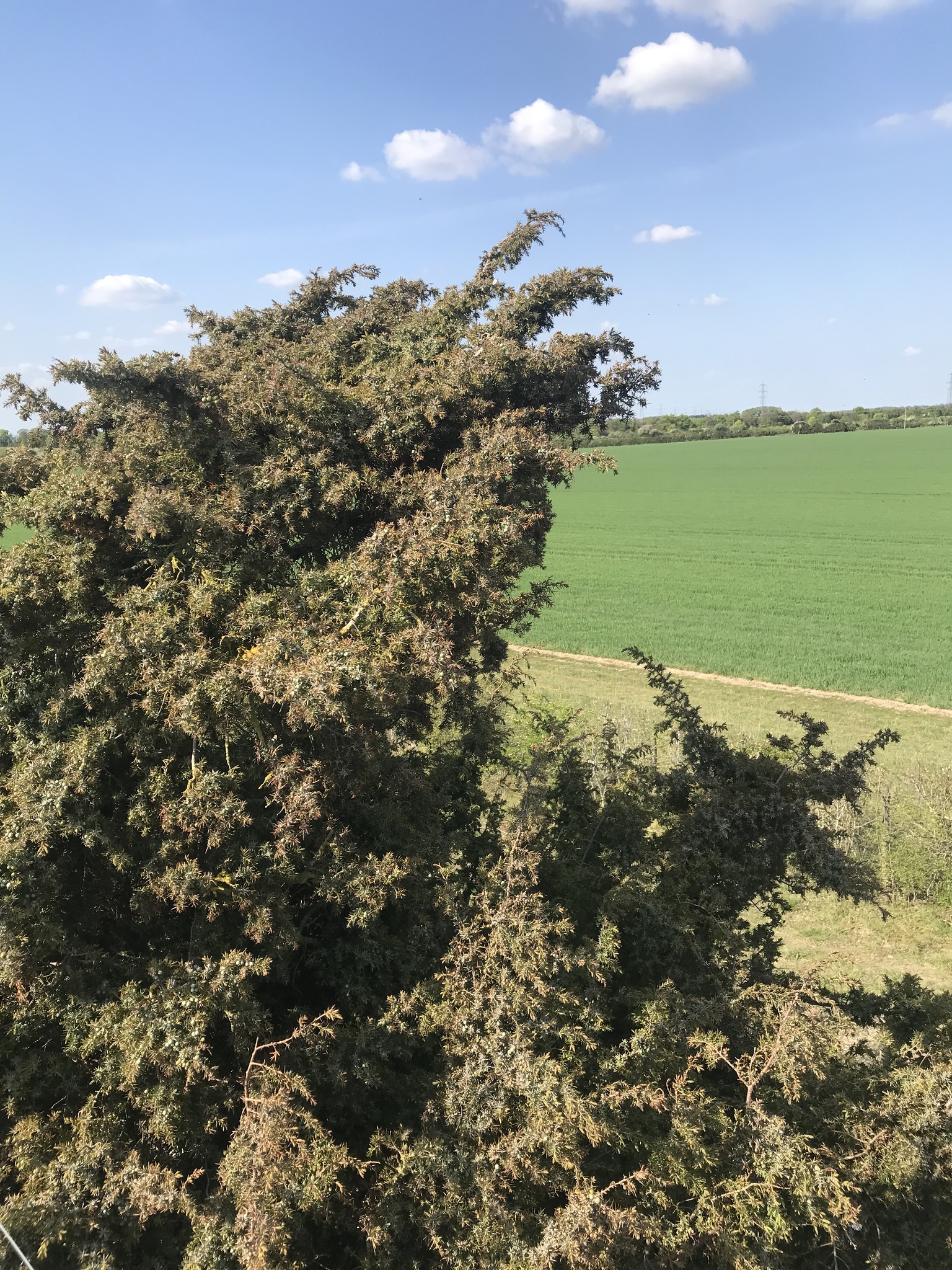
Exposure and altitude strongly influence common juniper’s form: it may spread as a prostrate mat on windswept ridges, grow as an upright shrub 1 to 3 m (3 to 10 ft) tall at woodland edges, or become a small tree exceeding 8 to 10 m (26 to 33 ft) in sheltered sites. On older plants, reddish-brown bark peels in thin strips. 2 6
Separate plants bear male and female cones: Juniperus communis is dioecious. Following pollination, the female cone closes into a fleshy, berry-like structure called a galbulus. Green in the first year, it becomes blue-black with a waxy bloom when ripe in its second or third year. One branch therefore often carries green and black cones simultaneously. 7 4
Useful taxonomy
Dozens of species belong to Juniperus, and Juniperus communis itself is divided into four recognized subspecies according to range and habit: communis, more upright and European; depressa (Pursh) Franco, prostrate and North American; hemisphaerica (J.Presl & C.Presl) Parl., Mediterranean; and nana (Baumg.) Syme, dwarf and found at high latitudes and in mountains. 7
Names once published as separate species are now synonyms of Juniperus communis: Juniperus sibirica Burgsd., Juniperus alpina Suter, Juniperus montana Čelak., and Juniperus oblonga Loudon.
The valid name remains Juniperus communis L. Nursery confusion most often involves cultivars sold under old varietal names such as suecica, which circulate both as synonymous botanical ranks and as sales names. 1
Habitat and range
Few woody plants match common juniper’s natural range. It covers almost the entire temperate and subarctic Northern Hemisphere, from Alaska and Canada through Europe to Siberia and Japan. 6 2
Poor, lime-rich soils support common juniper in heathland, dry grassland, bogs, open pine or birch woodland, and even arctic-alpine tundra. Tolerance of salt spray, drought, and browsing helps it establish in poor urban soils where few other conifers take hold. In France it occurs throughout the mainland and Corsica. 3 5
Birds, especially thrushes and waxwings, disperse most seeds by eating the berry-like cones. Passage through the digestive tract may even help germination rather than hinder it. In several European countries, the loss of extensive grazing and excessive fruit gathering have reduced populations enough for the species to appear on threatened lists in some regional floras, notably in the Czech Republic. 6 10
Life cycle and reproduction
During spring flowering, common juniper’s male cones release abundant pollen, carried by wind to female cones. Fertilization leads to ripe seed only after a complete two- to three-year cycle, unusually long among temperate conifers. 7
A ripe berry-like cone measures 0.6 to 1 cm (0.24 to 0.4 in) across and usually contains two or three seeds embedded in resinous pulp. Germination remains difficult in the wild: seeds need several months of cold stratification, sometimes preceded by a warm phase. Emergence is therefore irregular and often spread over more than one season. 4 6
Growers mainly propagate common juniper through stratified seed or semi-ripe cuttings taken in late summer. Natural layering also occurs when a low branch touching the ground roots spontaneously, explaining some spreading patches of prostrate plants on ridges. 4 2
Uses and risks
Juniper berries are the only conifer cones commonly used in cooking. Dried, they flavor sauerkraut, game, and marinades. This ingredient also gives gin its name and resinous flavor. 4
Essential oil rich in alpha-pinene and sabinene underlies traditional use as a diuretic and urinary antiseptic, now documented in recent pharmacological studies. Internal use requires caution: high doses or prolonged use may irritate the kidneys, and use during pregnancy is discouraged. 8 4
For pets, common juniper is not classed among severely toxic plants and does not appear on lists of the most dangerous plants for dogs and cats, but eating large amounts of cones or needles may cause vomiting and diarrhea. It also hosts some Gymnosporangium rusts whose life cycles alternate with rose-family plants such as apple or hawthorn, though it is generally considered less susceptible than other ornamental junipers. 9
Varieties, look-alikes and related plants
Horticultural selections offer several distinct forms of common juniper. Hibernica forms a narrow, dense column derived from Irish plants; dwarf Compressa suits containers and rock gardens; Repanda spreads as a low mat from wild Irish populations; and Depressa Aurea adds golden foliage to the prostrate North American form. Suecica is confusing because it names both a synonymous botanical variety and a separately marketed columnar cultivar. 7
Field identification most often requires comparison with:
- Juniperus oxycedrus, with longer needles marked by two white bands rather than one;
- Juniperus sabina, with nonprickly, scale-like foliage and an unpleasant smell when crushed;
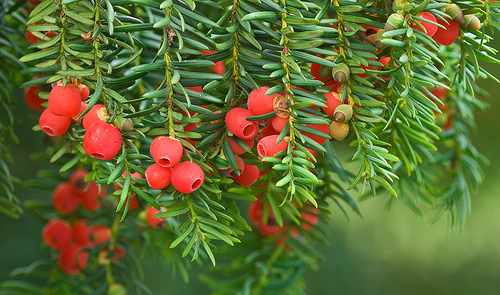
- Taxus baccata, common yew, whose flat needles are not whorled and whose red aril replaces the blue-black cone; its toxicity is much more severe.
Count the stomatal bands, check for needles in whorls of three, and note the ripe cone’s color: these remain the most reliable features for distinguishing the plants in the field.
Main sources
- International Plant Names Index, Juniperus communis L.
- Royal Horticultural Society, Juniperus communis - common juniper
- Missouri Botanical Garden Plant Finder, Juniperus communis
- Plants For A Future, Juniperus communis
- Tela Botanica / BDTFX, Juniperus communis L.
- US Forest Service FEIS, Juniperus communis species review
- Trees and Shrubs Online, Juniperus communis
- PMC, phytopharmacological review of Juniperus communis
- Ohio State University Extension, Cedar-apple rust host list
- Wikipedia (cs), Jalovec obecný - threatened regional status
Frequently asked questions
Is common juniper toxic to dogs and cats?
It is not among the most dangerous plants for pets, but eating large amounts of cones or needles may cause vomiting and diarrhea in dogs and cats.
Why do juniper berries take so long to ripen?
The berry-like cone stays green in its first year, then turns blue-black during the second or third year. A single branch therefore often carries both green and black cones at once.
How can you distinguish Juniperus communis from Juniperus oxycedrus?
Juniperus communis has one white stomatal band on each needle, while Juniperus oxycedrus has two bands and longer, stiffer needles.
Can common juniper threaten apple trees?
It can host Gymnosporangium rusts whose life cycle alternates with members of the rose family such as apple and hawthorn, although it is generally considered less susceptible than other ornamental junipers.
Does common juniper need watering in the ground?
Rarely, once rooted. The species tolerates drought well and is more vulnerable to waterlogged soil than to a temporary shortage of water.
Where does the name gin come from?
Gin owes its name and resinous flavor to dried common juniper berries, used to flavor the distillation for several centuries.
Does common juniper grow throughout the Northern Hemisphere?
Yes, its range extends from Alaska and Canada through Europe to Siberia and Japan, making it one of the most widely distributed woody species in the world.
Similar plants
If you are unsure about a plant’s toxicity, ask a botanist or veterinarian for advice.