
motherwort (Leonurus cardiaca, )
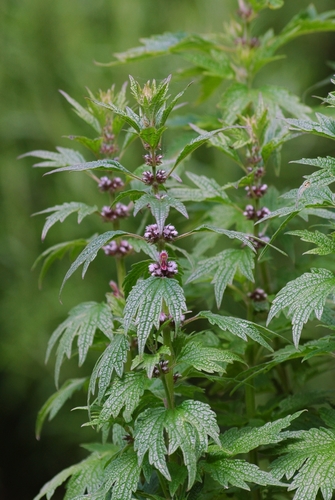
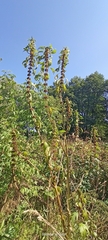

Motherwort (Leonurus cardiaca) is an herbaceous perennial in the Lamiaceae, native to Europe and western Asia and widely naturalized elsewhere through medicinal cultivation. Its upright square stem carries deeply lobed leaves and whorls of small pink flowers with prickly calyces, distinguishing it from other mint-family plants of waste ground.
Read moremotherwort
Give plenty of ambient light without direct sun on the leaves.
Partial shade to full sun


© photo
(c) AnneTanne, some rights reserved (CC BY-NC) · cc-by-nc
Евгения · cc0
Wikimedia Commons · CC BY-SA or Public Domain
Taken Mar 19, 2014 by Tela Botanica − Hugues TINGUY (cc-by-sa)
Taken May 20, 2019 by Mike Williams (cc-by-sa)
Taken Jul 19, 2022 by Sh4rp (cc-by-sa)
Taken Jul 1, 2021 by Michael McLaughlin (cc-by-sa)
Taken Jul 24, 2017 by sci nsk (cc-by-sa)
© copyright of the Board of Trustees of the Royal Botanic Gardens, Kew.




Global distribution
Leonurus cardiaca is native to central, eastern and southern Europe through Turkey and Iran. Long cultivated as a medicinal plant, it has widely naturalized beyond that area, particularly in western Europe and North America, where populations often originate as escapes rather than wild native plants.
- Native6
- Introduced2
- Invasive1
- France
- Germany
- Italy
- Russia
- Turkey
- Iran
- United Kingdom
- Canada
- United States
Hexagons: regions where the plant occurs. Green dots: native range.1
Identity
Prickly flower whorls give motherwort (Leonurus cardiaca L., 1753) a distinctive outline among the Lamiaceae. The genus name Leonurus means lion's tail in Greek, referring to those bristling tiers of flowers. The epithet cardiaca records its longstanding use to calm palpitations, well before modern pharmacology isolated its alkaloids. 1 2
Its French name agripaume is said to refer to the sharply lobed, palm-shaped leaf, drawing attention to the deeply divided foliage. The French names queue-de-lion and herbe au cœur respectively translate the genus's lion-tail image and recall its traditional heart-soothing use. These names describe different features of the same medicinal herb. 6 5
Recognition
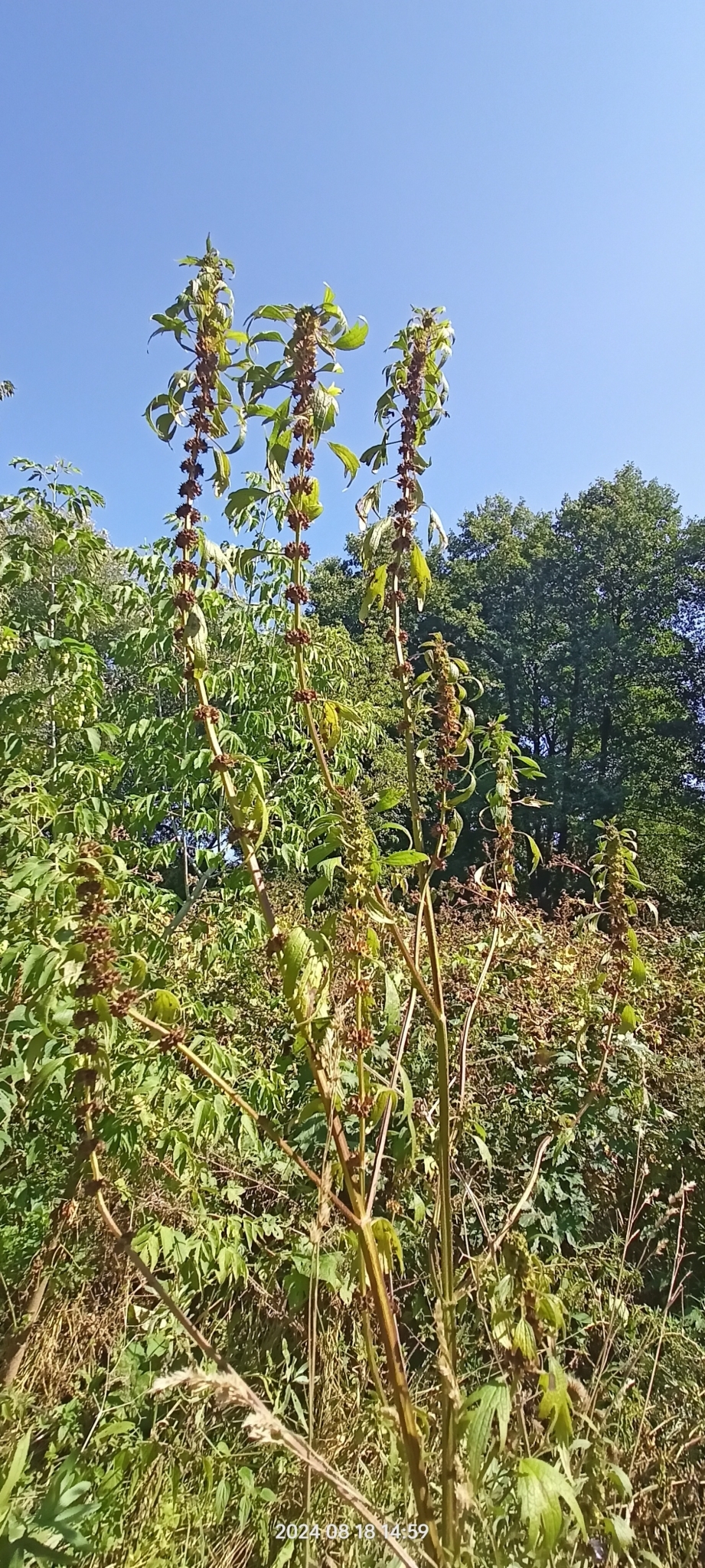
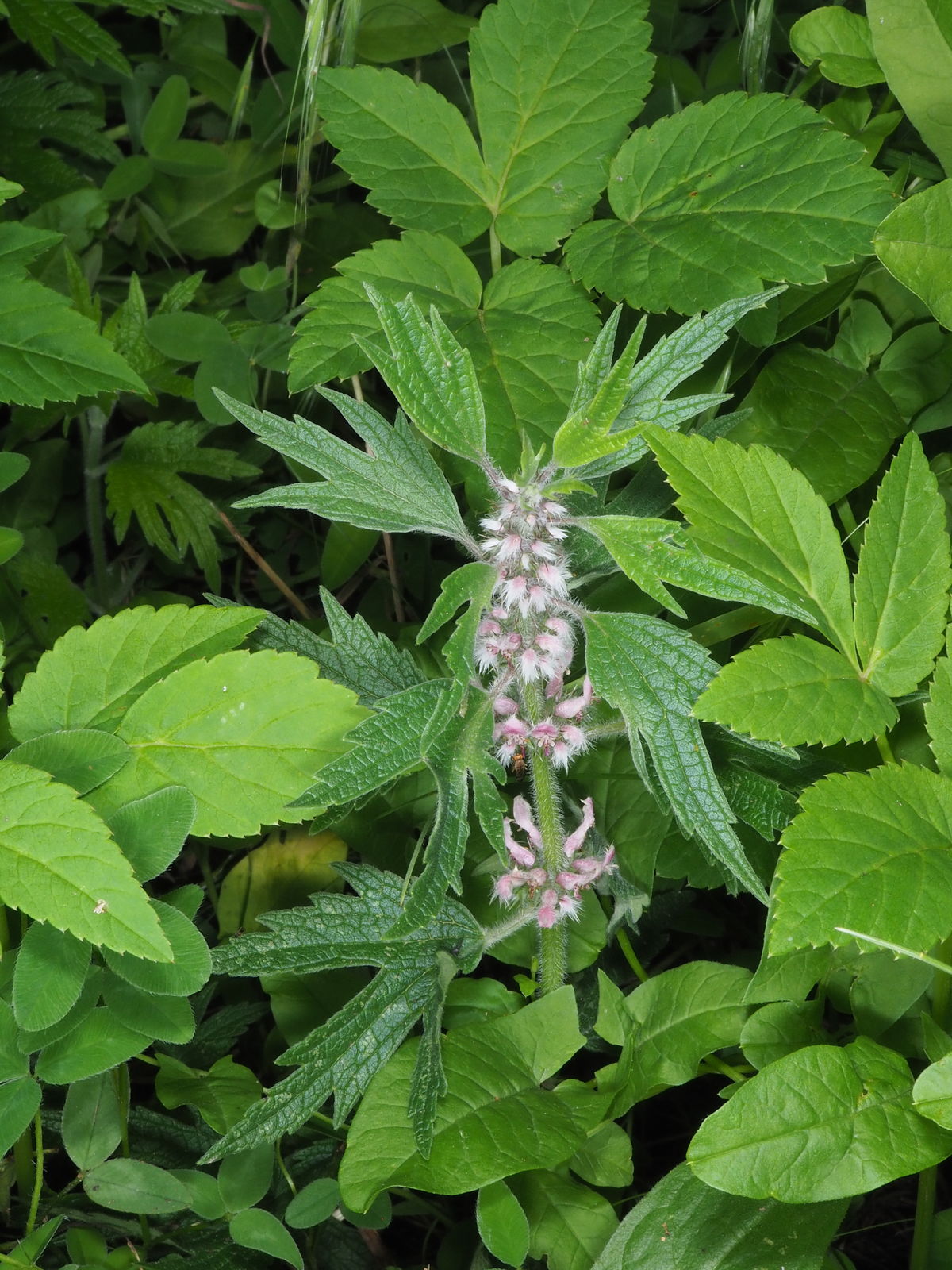
Given moist soil and good light, an upright clump commonly reaches 60 cm–1.5 m (2–5 ft), with exceptional plants reported at 2.5 m (8 ft) under optimal conditions. The square stem, characteristic of the mint family, often develops a purple tint and bears short hairs. 2 3
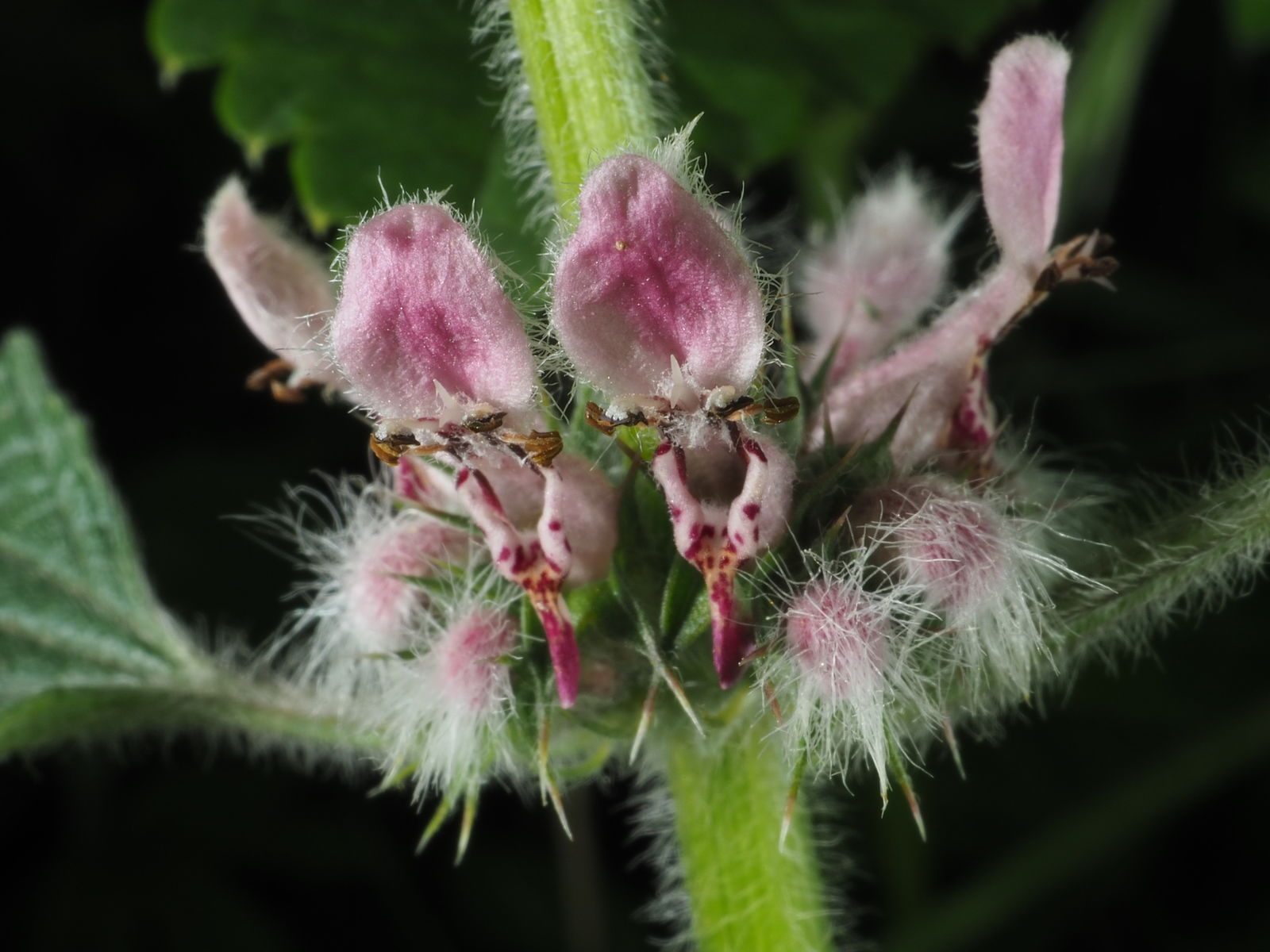
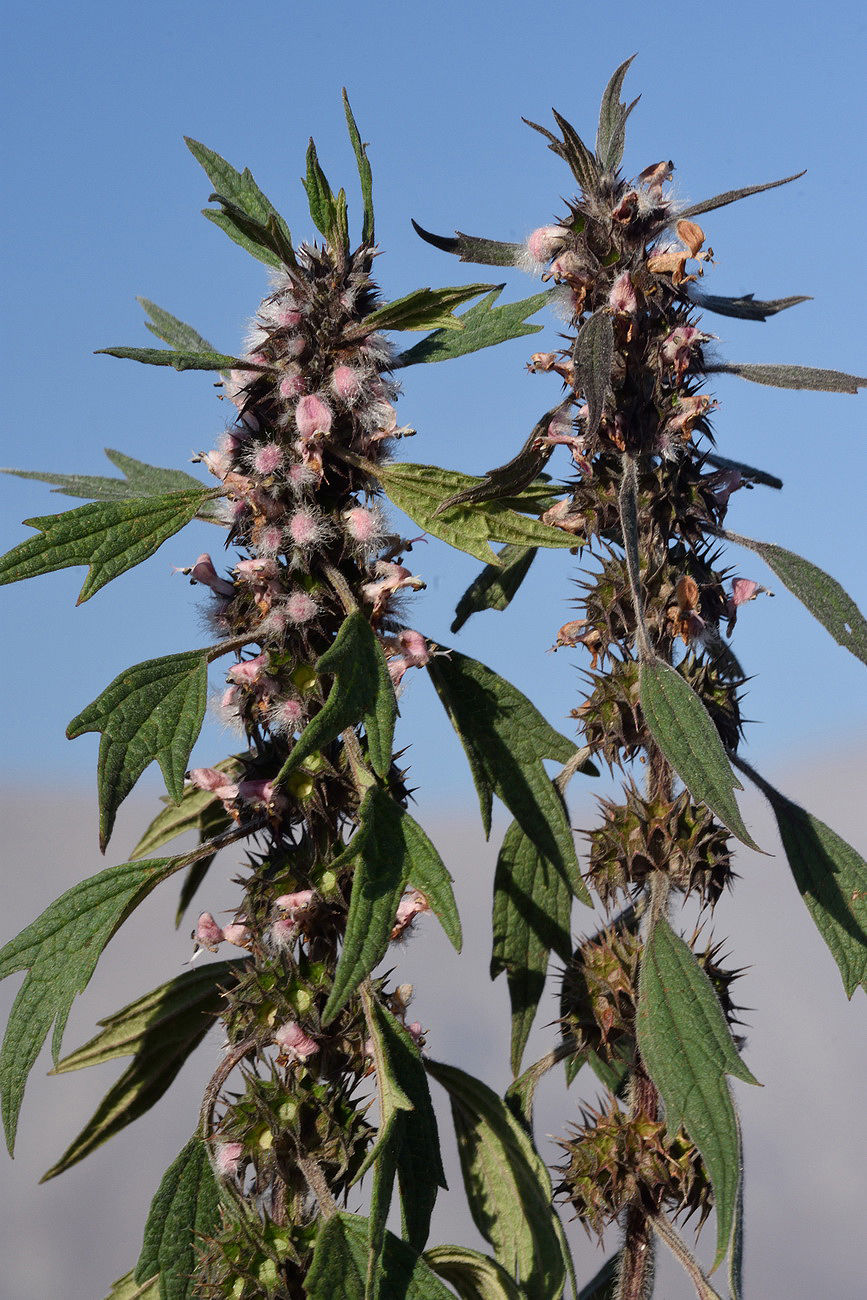
Opposite leaves are deeply palmately lobed, with toothed margins, unlike the simply oval leaves of many other garden mints. Flowers 0.8–1.5 cm (0.3–0.6 in) long crowd into whorls in the upper leaf axils. They range from pink to purple, occasionally nearly white, opening in summer at several levels along the stem. 3 2
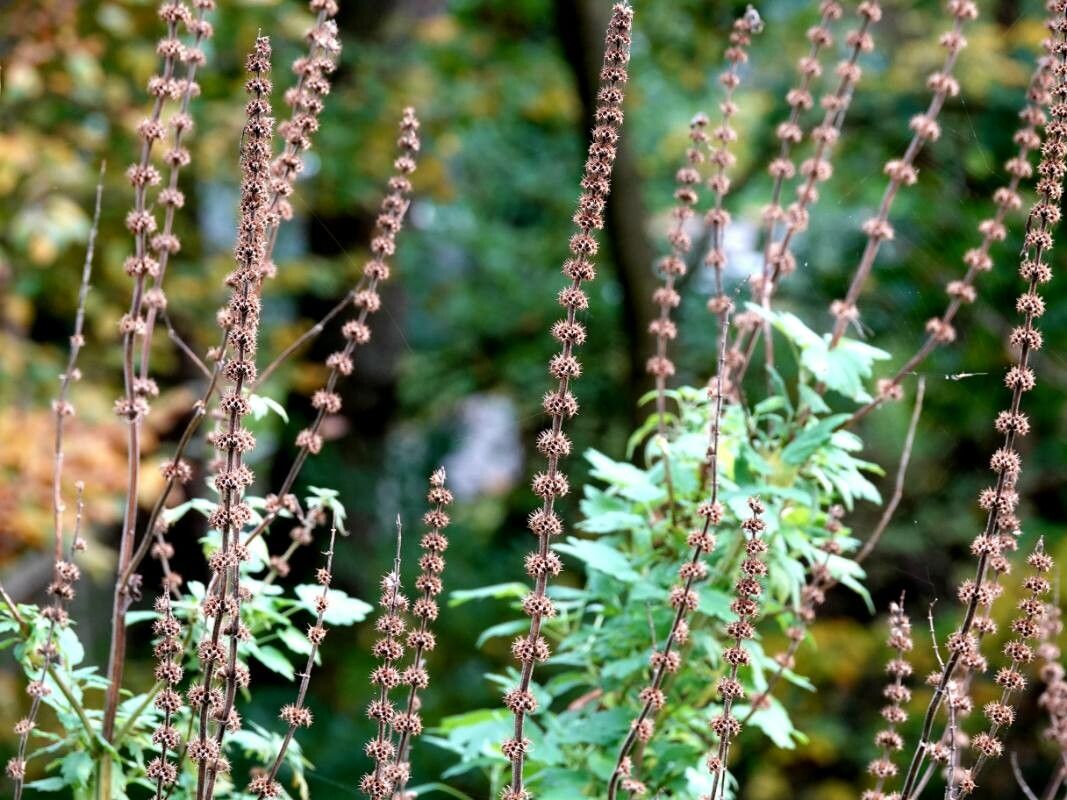
The calyx has five stiff, prickly teeth that remain useful for identification after the petals fall. A spent motherwort stem still feels slightly sharp to the touch, distinguishing it from a mint-family plant without prickles at the same stage. This persistent structure remains visible when flower color is no longer available as a clue. 3
Useful taxonomy
Published in 1753, the accepted name Leonurus cardiaca L. identifies the type species of Leonurus, in subfamily Lamioideae. Within the large Lamiaceae, the genus is relatively small, with only a handful of recognized Eurasian species. 1
Historical varieties and subspecies occur in regional floras, including Leonurus cardiaca var. villosus (Desf. ex d'Urv.) K.Koch and Leonurus cardiaca subsp. turkestanicus (V.I.Krecz. & Kuprian.) Rech.f.. These were chiefly distinguished by hairiness and geographical distribution, so their names may appear when comparing older accounts with modern treatments. 1
For herbal purchases or scientific references, use the accepted name Leonurus cardiaca. It should be distinguished from Leonurus japonicus, an East Asian relative sometimes sold under the same common name, motherwort. The shared vernacular name alone does not establish which species a product contains. 5 8
Habitat and range
Central, eastern and southern Europe, extending to Turkey and Iran, form its native range. There it grows in hedges, on banks and in often calcareous or disturbed soils near habitation. This association with human settlement is a recurring feature of its habitat. 1 5
Long cultivation for medicinal purposes has spread the plant well beyond that range. It is now widely naturalized, growing as an escape in the United Kingdom, North America and elsewhere on waste ground, rubble and roadsides. Cultivated origins should be distinguished from a naturally occurring native population. 4 6
In North America, hardiness to about -20 °C (-4 °F) lets it survive winters as far north as in continental Europe. That climatic tolerance helps explain naturalization beyond vacant lots: it also colonizes woodland edges and disturbed understory. It is consequently monitored locally for invasive behavior, even while nurseries continue selling it as a medicinal plant. This describes the cited North American context rather than a universal legal status. 7
Life cycle and reproduction
Seed germination is often slow and irregular. Winter cold stratification mimics natural conditions, markedly improving emergence and making spring sowing more dependable than summer sowing without prior chilling. A young plant first forms a lobed-leaf rosette 15–30 cm (6–12 in) tall, then develops a branched clump 40–80 cm (16–31 in) high during its first season, ready to flower the following year. 2
Summer flowering takes place on stems bearing several prickly whorls of small pink flowers. After fertilization, each flower produces four small brown achenes. These account for often abundant self-sowing if the spent stems are not cut in time. 3
Garden propagation uses stratified seed, division of established clumps every two to three years, or a stem cutting containing a node rooted in early summer. Dividing an established plant quickly produces another flowering clump, whereas stratified seedlings take about two years to flower for the first time. Use the local spring and early-summer seasons rather than transferring these operations to fixed months in another hemisphere. 2 4
Uses and risks
The main use is medicinal. Flowering tops harvested at the beginning of summer bloom, when daytime temperatures are 15–25 °C (59–77 °F), supply teas and tinctures traditionally used for palpitations and mild nervous complaints. A 2019 review covering 283 studies reports measurable effects on heart rate and blood pressure in people with hypertension, alongside affinity for GABA receptors consistent with traditional use for anxiety. 8 4
Constituents include stachydrine, an alkaloid that protects endothelial function, and phenolic acids such as rosmarinic and chlorogenic acid. Whether leonurine is present remains disputed between the extracts studied, helping explain apparently contradictory findings. The identity and composition of the extract therefore matter when comparing experimental results. 8
On risks, the ASPCA does not list motherwort among plants toxic to cats, dogs or horses. Prolonged sap contact can irritate the skin. Use is not recommended during pregnancy because of a documented uterotonic effect, or alongside anticoagulants such as warfarin. These cautions apply to medicinal use despite the plant's familiar herbal reputation. 8
Varieties, look-alikes and related plants
Motherwort has no true horticultural cultivars sold in the ornamental trade. Recognized variation instead concerns regional botanical varieties such as villosus, chiefly distinguished by hairiness and range. Despite heights varying from 60 cm to 1.5 m (2–5 ft) with soil and light, no dwarf or prolonged-flowering cultivar has been selected for ornamental gardening. 1
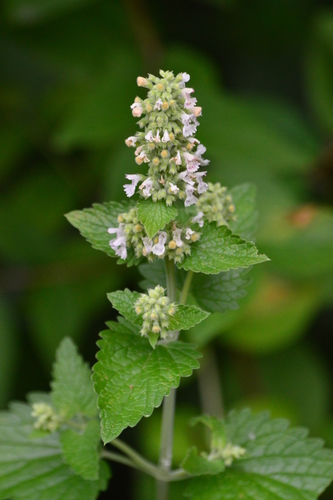
Three other square-stemmed Lamiaceae of disturbed ground regularly cause confusion:
- Ballota nigra, black horehound, has rounder leaves and a foul smell when crushed;
- Stachys sylvatica, hedge woundwort, has heart-shaped leaves and a similarly unpleasant smell;
- Leonurus japonicus, an East Asian relative, is often sold under the same common name, motherwort.
Deeply palmately lobed leaves combined with a stiff, five-toothed prickly calyx separate Leonurus cardiaca from the two usual morphological look-alikes: neither Ballota nigra nor Stachys sylvatica has such a rigid calyx, and their leaves are less deeply divided. Confusion with Leonurus japonicus is chiefly commercial, since the shared English name encourages mislabeling in the herbal trade. In the field, a quick check is helpful: a calyx that still prickles after petal fall on a stem taller than 60 cm (2 ft) almost certainly indicates motherwort rather than horehound or woundwort. 3 5
Main sources
- Plants of the World Online / Kew, Leonurus cardiaca L.
- Royal Horticultural Society, Leonurus cardiaca - motherwort
- Missouri Botanical Garden Plant Finder, Leonurus cardiaca
- Plants For A Future, Leonurus cardiaca
- USDA GRIN Global, Leonurus cardiaca L. taxonomy and distribution
- Tela Botanica / eFlore, Leonurus cardiaca L.
- Invasive Plant Atlas of the United States, motherwort
- PMC, 2019 review of Leonurus cardiaca phytochemistry and pharmacology
Frequently asked questions
Is motherwort toxic to cats or dogs?
No. The ASPCA does not list Leonurus cardiaca among plants toxic to cats, dogs or horses. Prolonged sap contact can irritate skin, and use is not recommended during pregnancy because of its uterotonic effect.
How can motherwort be distinguished from black horehound?
Ballota nigra shares its waste-ground habitat and square stem, but smells foul when crushed and has rounder leaves, less deeply lobed than those of Leonurus cardiaca.
Is motherwort invasive?
In North America it colonizes waste ground and natural woodland edges and appears on several local monitoring lists. In its native European range, its behavior is chiefly associated with disturbed soils near habitation.
Why is motherwort harvested at the start of flowering?
The flowering tops concentrate alkaloids and phenolic compounds valued in herbal medicine, notably stachydrine. Harvesting too late, after achenes form, yields more fibrous stems with fewer active constituents.
What does Leonurus cardiaca mean?
Leonurus is Greek for lion’s tail, referring to the bristling outline of flower whorls along the stem. The epithet cardiaca recalls traditional use to calm palpitations.
How is motherwort propagated in gardens?
Spring sowing, helped by cold stratification, is simplest. Dividing an established clump every 2 to 3 years and rooting a stem cutting with a node in early summer also work well.
What has recent research found about motherwort?
A 2019 review covering 283 studies confirms measurable cardiovascular and anxiety-related effects in laboratory work, while emphasizing still-limited human clinical data and use for a limited duration.
Similar plants
If you are unsure about a plant’s toxicity, ask a botanist or veterinarian for advice.