
Catnip (Nepeta cataria, )
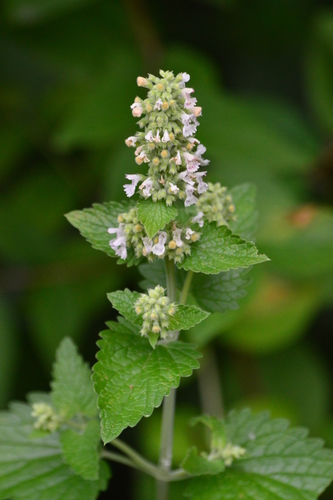
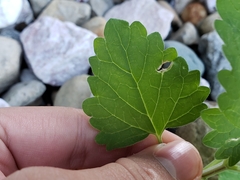
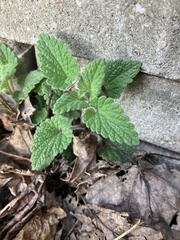
Catnip (Nepeta cataria) is an aromatic Lamiaceae perennial native from southern Europe to Japan. Known for its documented effects on domestic cats, it has grayish square stems, toothed heart-shaped leaves and white flowers spotted with purple, blooming from June to September in temperate Northern Hemisphere conditions.
Read moreCatnip, Catmint and Catswort
Allow a few hours of direct sun per day, preferably morning or evening.
Full sun; tolerates light partial shade with looser growth



© photo
(c) Mark Kluge, some rights reserved (CC BY-NC), uploaded by Mark Kluge · cc-by-nc
Tyler Bishop · cc0
Amy MacPherson · cc-by-sa
Taken Aug 15, 2018 by Photoflora - Jean-Luc TASSET (©)
Taken Jan 1, 1970 by Photoflora - L'Abbé COSTE (©)
Taken Feb 5, 2022 by Annemarie Ahrens-Stehle (cc-by-sa)
Taken Jun 20, 2022 by Robyn x (cc-by-sa)
Taken Jul 15, 2009 by Photoflora - Jean-Luc TASSET (©)
© copyright of the Board of Trustees of the Royal Botanic Gardens, Kew.





Global distribution
POWO places the native range of Nepeta cataria from southern Europe to Japan, with an isolated extension into northwestern Morocco. Introduced early as a medicinal and ornamental plant, it is widely naturalized in northern Europe, North America and New Zealand.
- Native4
- Introduced3
- Southern Europe
- France
- Morocco
- Japan
- United States
- Canada
- New Zealand
Hexagons: regions where the plant occurs. Green dots: native range.1
Identity
Catnip (Nepeta cataria L., 1753), also called catmint or catswort, is an aromatic perennial in the Lamiaceae family, described by Linnaeus in Species Plantarum. POWO accepts the name, with no major disputed synonymy. 1 3
The epithet cataria comes from the Latin catus, meaning cat, a direct reference to an effect on felines known since antiquity. The English name catnip follows a similar pattern, combining cat with an old term for a mint-family plant. 4 6
An aromatic perennial reaching 40 cm to 1 m (about 16–39 in), catnip has branched, densely hairy, grayish stems. Crushed leaves release a minty, lemony fragrance considerably stronger than ground-ivy, another common mint-family plant of waste ground. 3 2
Within Nepeta, ornamental plants such as Nepeta x faassenii have much weaker effects on cats and are grown in borders for blue-purple flowers rather than fragrance. True catnip remains the genus's familiar botanical and aromatic reference. 4
Recognition
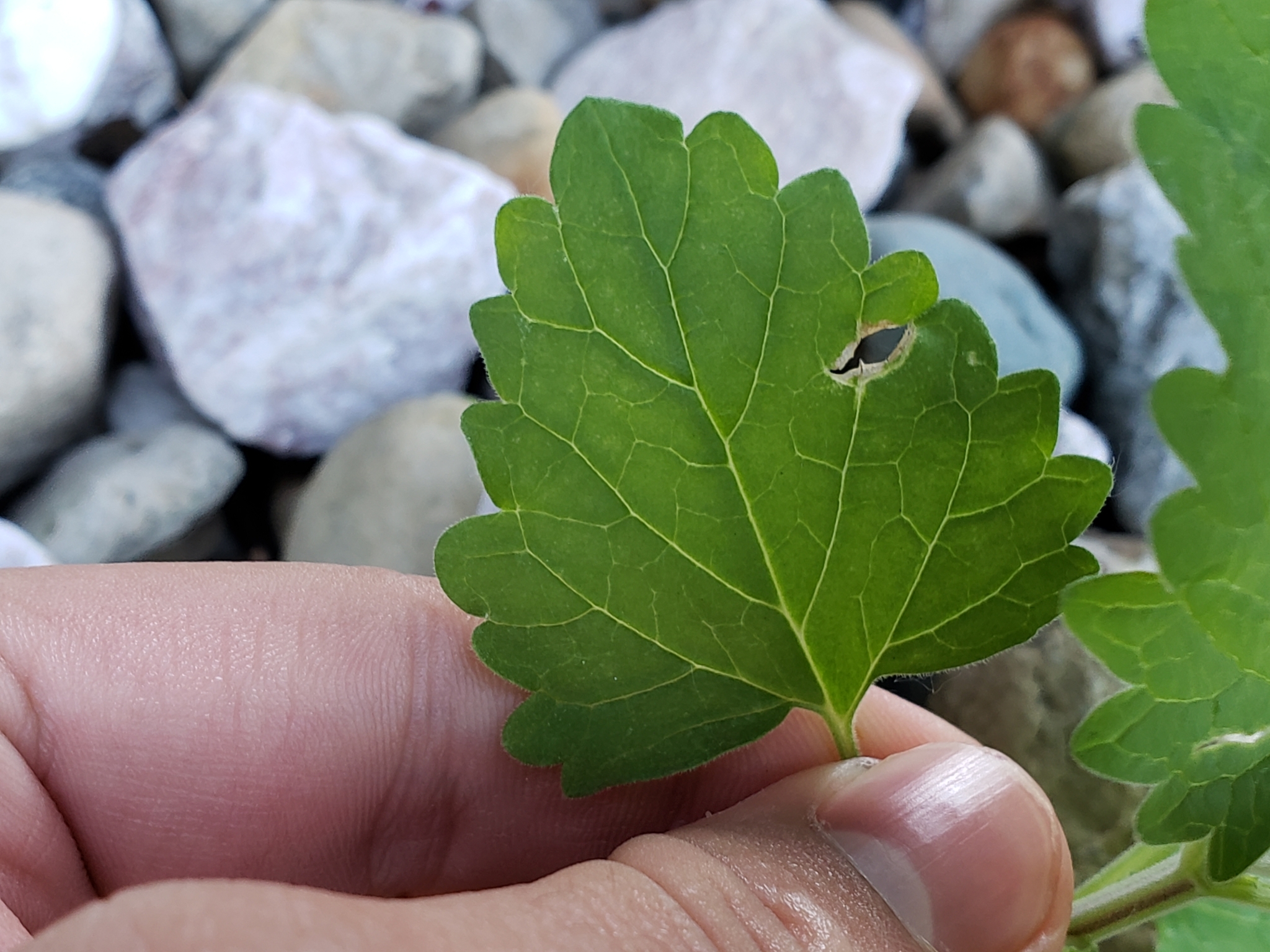
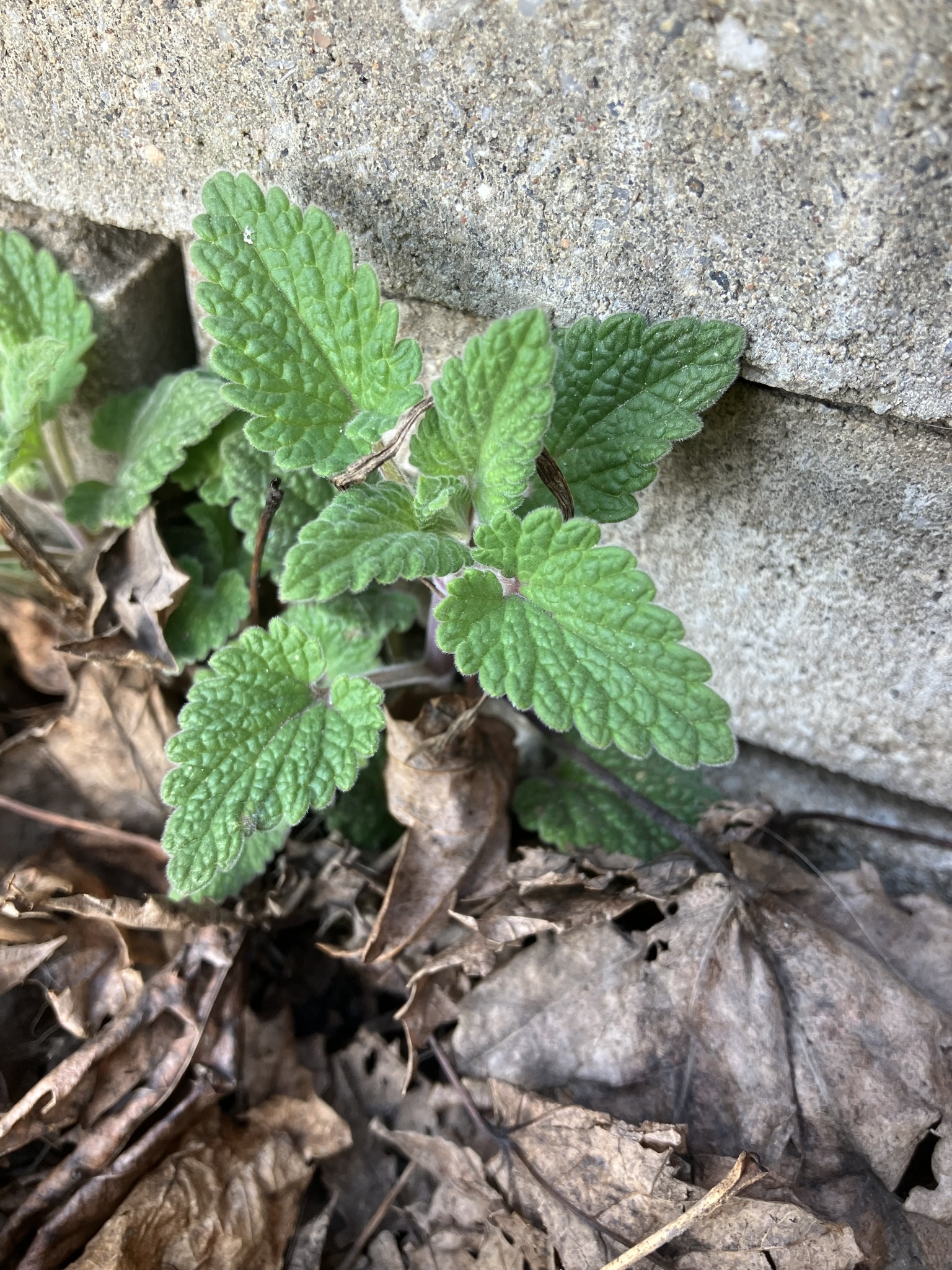
Upright, densely hairy stems are square in cross section, as is typical of the mint family. Heart-shaped oval leaves have strongly scalloped, toothed margins, gray-green upper surfaces and whitish, felted undersides; they measure about 5–8 cm (2–3 in) long. 2 3
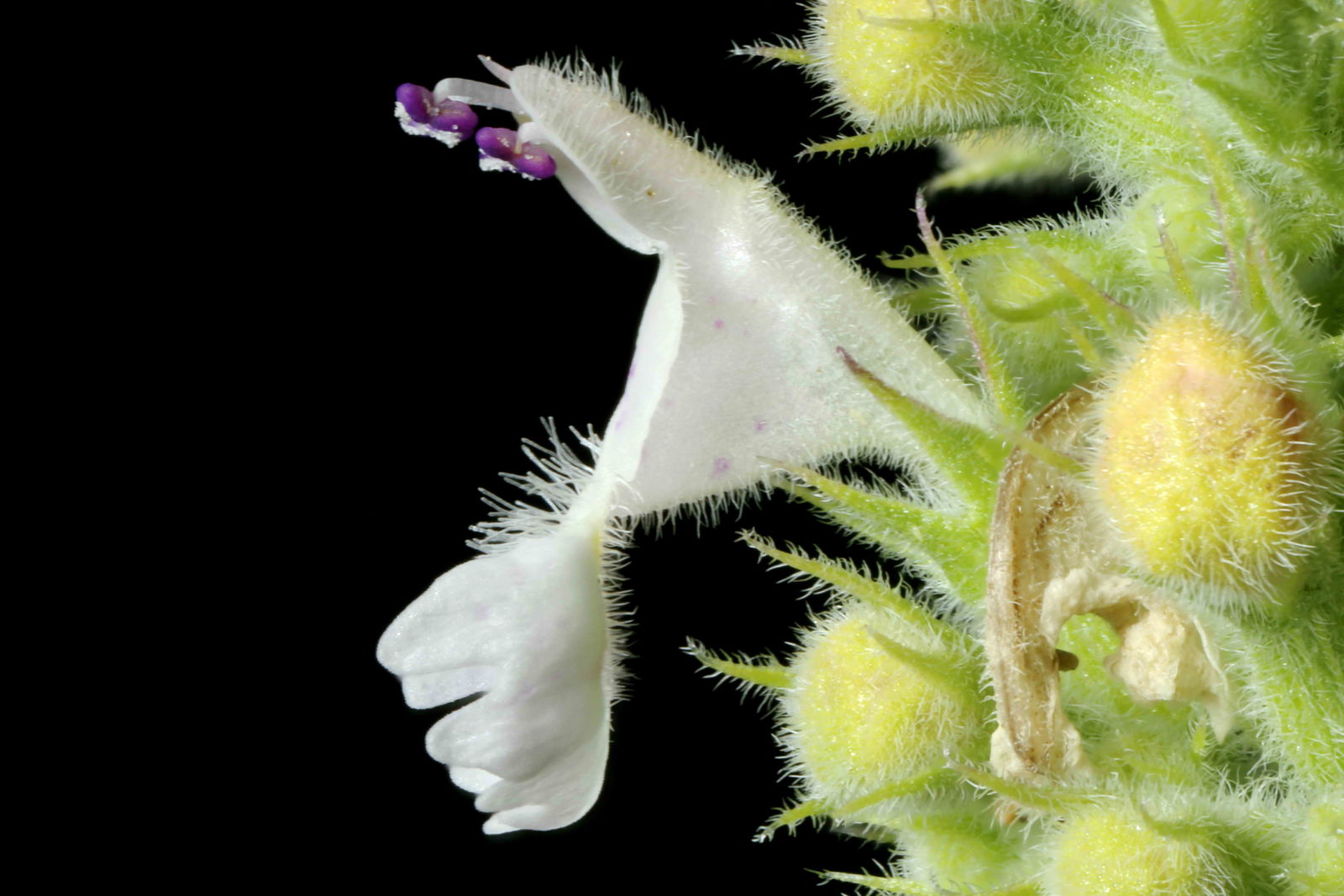
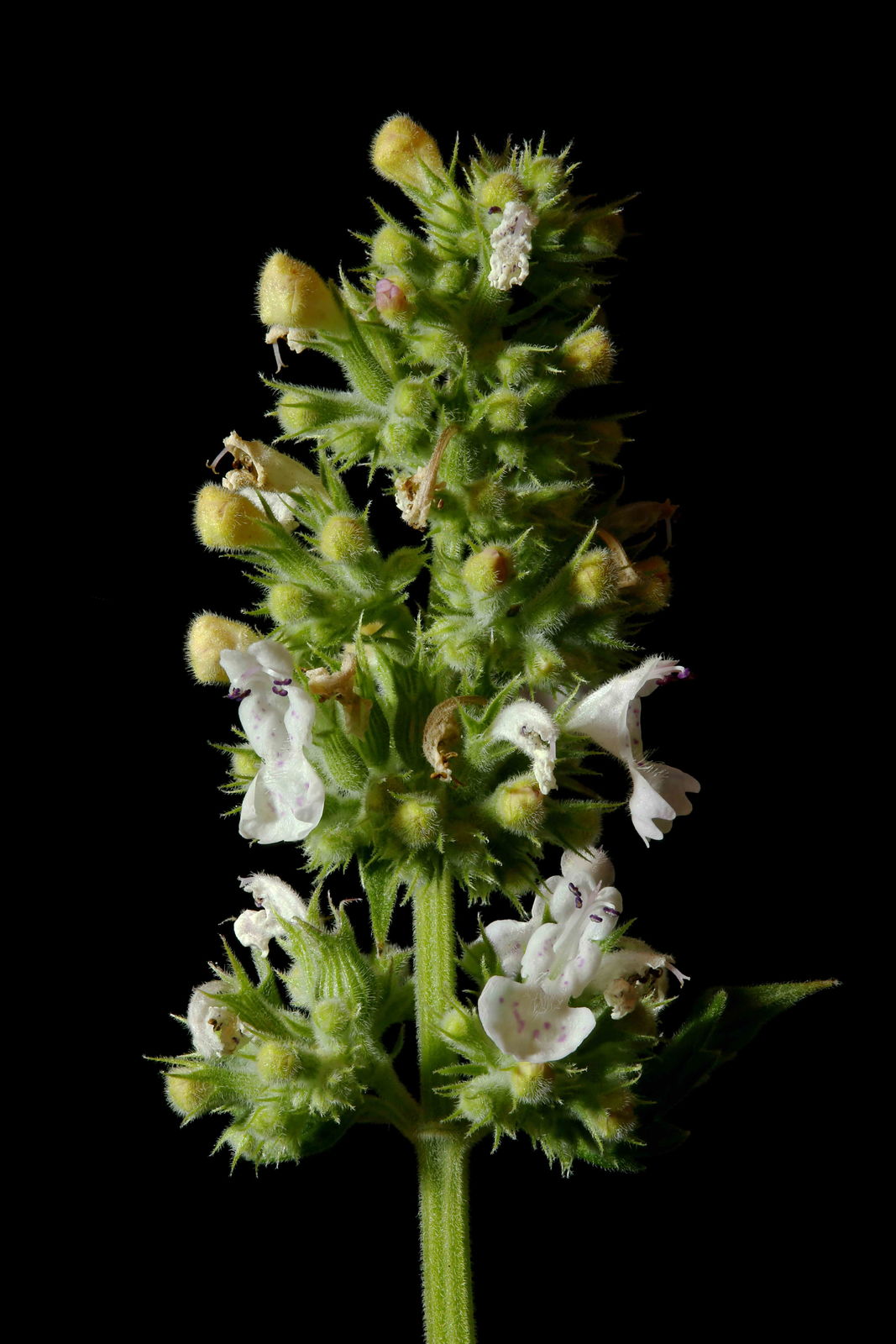
Small, tubular, two-lipped flowers are white with red or purple spots. Dense, many-flowered whorls form a short terminal spike; flowering runs from June to September in the temperate Northern Hemisphere, later than ground-ivy. 2 3
Clumps reach 30 cm to 1 m (12–39 in) tall and 30–60 cm (12–24 in) across, depending on conditions and age. Young seedlings without a bushy habit or well-developed square stems can be hard to distinguish from lemon balm (Melissa officinalis) or ground-ivy (Glechoma hederacea). 2
Useful taxonomy
POWO accepts Nepeta cataria within a genus of about 250 Eurasian species. Catnip belongs to the Nepetoideae subfamily alongside mint, sage and thyme. 1
Historical synonyms listed by Tela Botanica include Cataria tomentosa Bubani, Cataria vulgaris Gaterau and Glechoma cataria (L.) Kuntze. The last reflects an earlier taxonomic confusion with Glechoma, a related genus with similar square stems. 3
The historical botanical variety Nepeta cataria var. citriodora Dumoulin ex Lej. corresponds to the modern garden cultivar Citriodora, selected for a stronger lemon scent than the wild type. 3 4
Chemical analyses also distinguish two chemotypes, A and B, enriched in different nepetalactone isomers rather than a single compound. These differences help explain variation in fragrance intensity and effects on cats between plants. 7
Habitat and range
For catnip, POWO places the native range from southern Europe to Japan (central Honshu), with an isolated extension into northwestern Morocco. Early introduction as a medicinal and ornamental plant led to widespread naturalization in northern Europe, North America and New Zealand. 1 4
Across most of France and Corsica, catnip grows wild on waste ground, rubble and sunny rocky sites. It is not classified among the invasive species monitored in France. 3
In the United States and Canada, where catnip is introduced, it is described as naturalized throughout the territory, aided by tolerance of drought and poor soils. 2
Life cycle and reproduction
Spring germination produces a bushy clump within a few months, followed by June–September flowering in temperate Northern Hemisphere conditions. Each pollinated flower produces small seeds that fall to the ground, explaining frequent self-seeding between seasons. 2
Especially frequent flower visitors are long-tongued bees: honeybees, bumblebees, cuckoo bees in Epeolus and Triepeolus, long-horned bees in Melissodes and leafcutter bees in Megachile. The foliage also hosts caterpillars of several hawk moths, including the hermit sphinx (Sphinx eremitus). 2
Gardeners propagate catnip by dividing established clumps, sowing in spring or taking cuttings from young nonflowering shoots. Division rejuvenates older clumps that have become sparse at the center. 2
Uses and risks
Nepetalactone, a terpenoid extracted from the essential oil by steam distillation, accounts for the plant's scent and effects. It is a documented repellent against mosquitoes, flies, cockroaches and termites, with performance relative to synthetic DEET varying by application method. 4
In cats, nepetalactone and the related compound nepetalactol are detected by the olfactory epithelium rather than the vomeronasal organ. About 70% of domestic cats respond by rubbing, rolling and vocalizing for 5–15 minutes, a polygenic inherited trait generally absent in kittens under six months. Leopards, cougars, servals and lynxes show similar responses. 6 4
The ASPCA classifies catnip as toxic to cats: substantial ingestion can cause vomiting and diarrhea, with some animals becoming sedated and others stimulated. Humans traditionally drank it as a tea for digestive complaints and fevers; that historical use has declined with modern medicine and does not remove the need for caution with large amounts. 5 4 8
Varieties, look-alikes and related plants
Citriodora, or lemon catmint, has a gentler, more lemony fragrance than the wild type. It is the principal stable horticultural selection sold as Nepeta cataria. 4
Common look-alikes include:
- Nepeta x faassenii, the border ornamental sold in garden centers, with blue-purple flowers and a much weaker effect on cats;
- Glechoma hederacea, ground-ivy, another square-stemmed Lamiaceae, with a low, creeping habit rather than catnip's upright bushiness;
- Melissa officinalis, lemon balm, with similar aromatic leaves but a lemon scent and no documented effect on cats.
Cats insensitive to nepetalactone may instead respond to valerian root (Valeriana officinalis), silver vine (Actinidia polygama) or Tatarian honeysuckle wood (Lonicera tatarica). These plants belong to other families and can trigger the same feline response without being botanically related to catnip. 4
Main sources
- Plants of the World Online / Kew, Nepeta cataria L.
- NC State Extension Gardener Plant Toolbox, Nepeta cataria
- Tela Botanica / eFlore BDTFX, Nepeta cataria L.
- Wikipedia EN, Catnip (Nepeta cataria)
- ASPCA, Catnip toxicity entry
- Encyclopaedia Britannica, catnip
- Perrucci et al., interference in house dust mite foraging by catmint, Nepeta cataria
- Plants For A Future, Nepeta cataria
- Wikidata, Nepeta cataria
Frequently asked questions
Does catnip really affect cats?
Yes. Nepetalactone causes rubbing, rolling and vocalizing in most domestic cats. About 70% respond, an inherited trait generally absent in kittens under six months.
Is catnip toxic?
The ASPCA classifies it as toxic to cats; substantial ingestion can cause vomiting and diarrhea. Effects are generally mild and subside after a few minutes of exposure.
How can I tell catnip from ornamental catmint?
Ornamental catmints such as Nepeta x faassenii are selected for blue-purple flowers and attract cats much less strongly. True catnip, Nepeta cataria, has white flowers spotted with purple and a stronger minty scent.
Can people eat catnip?
The leaves have traditional uses in tea, soup and sauces, and were long used as a folk remedy for digestive complaints and fevers. This historical use involves small amounts and does not replace medical advice.
Is catnip invasive in France?
No. It grows wild across most of France and Corsica on waste ground and rocky sites, without being classified among the invasive species monitored there.
Why do some cats ignore catnip?
Sensitivity to nepetalactone is a polygenic inherited trait. About a third of cats do not respond at all, and kittens under six months are generally insensitive.
Does catnip repel mosquitoes?
Steam-distilled nepetalactone is a documented repellent against mosquitoes, flies, cockroaches and termites. Its performance compared with DEET varies with the application method.
Similar plants



If you are unsure about a plant’s toxicity, ask a botanist or veterinarian for advice.