
big blue lilyturf (Liriope muscari, )
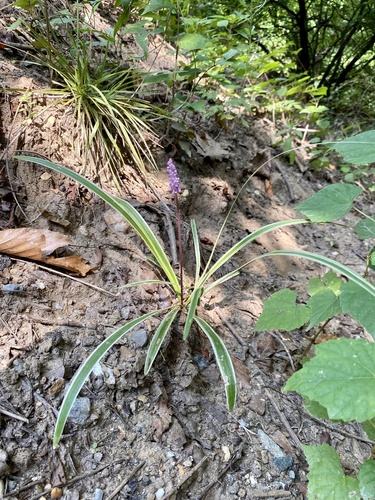
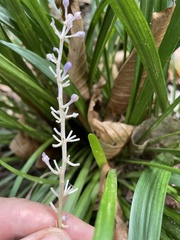
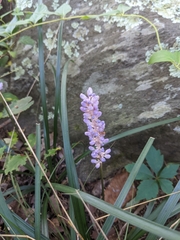
Big blue lilyturf (Liriope muscari) is an herbaceous perennial in the Asparagaceae, native to East Asia. It forms a dense, almost stemless clump of arching linear leaves, with violet flower spikes in late summer followed by black berries that persist through winter.
Read morebig blue lilyturf, lilyturf, border grass and monkey grass
Place in indirect light or in a shaded room.
Partial shade to shade; full sun tolerated in cool climates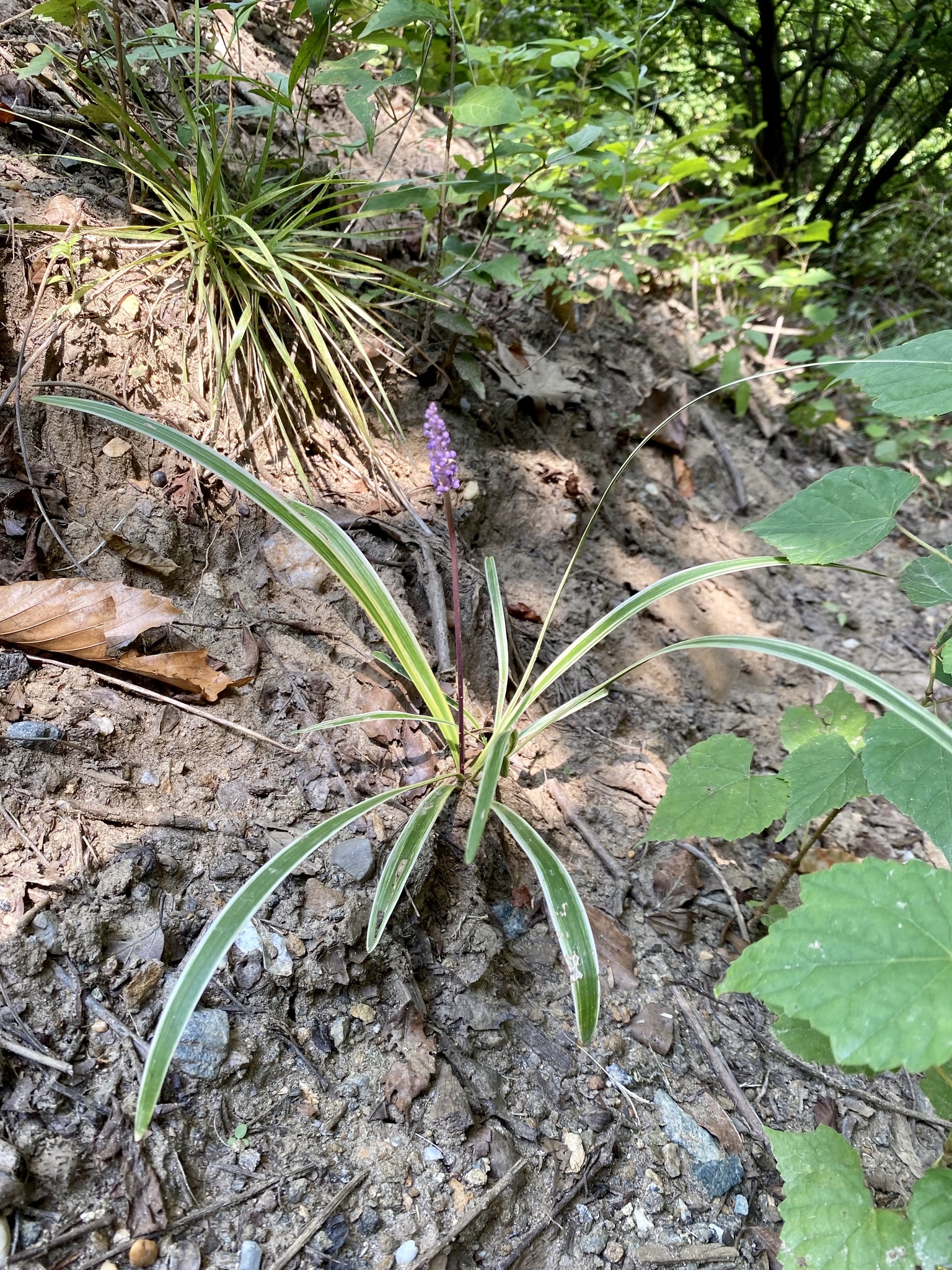
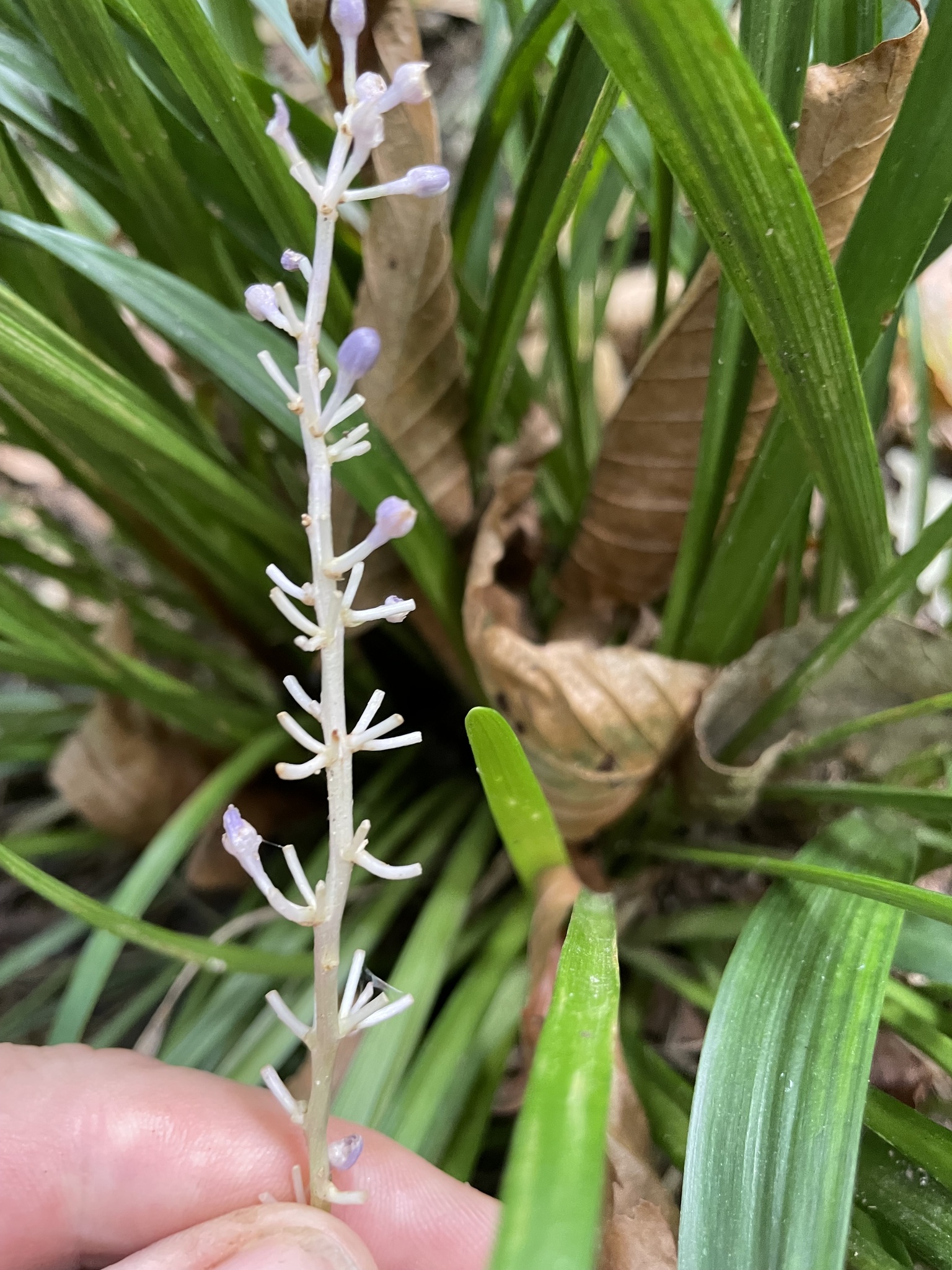
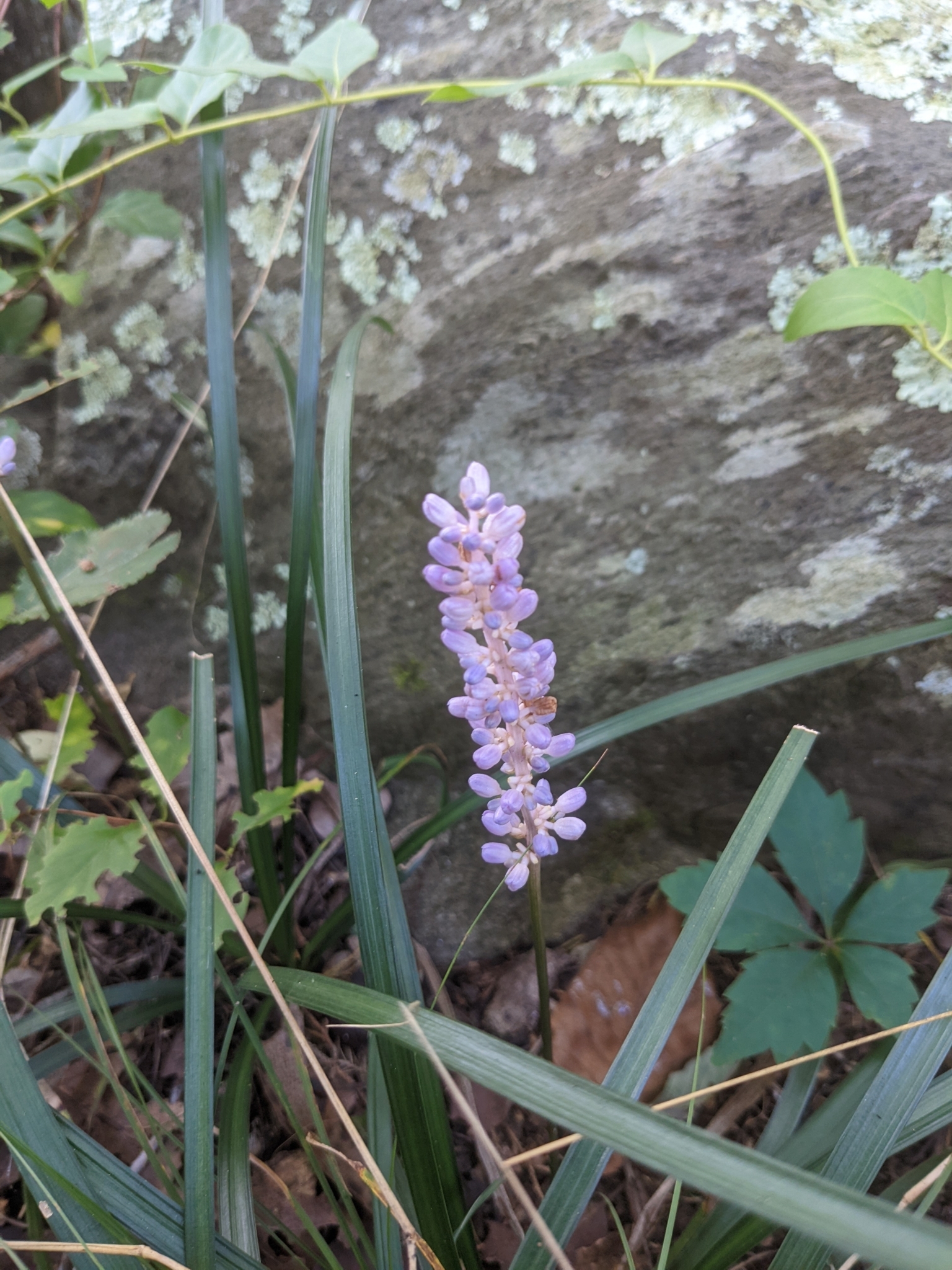


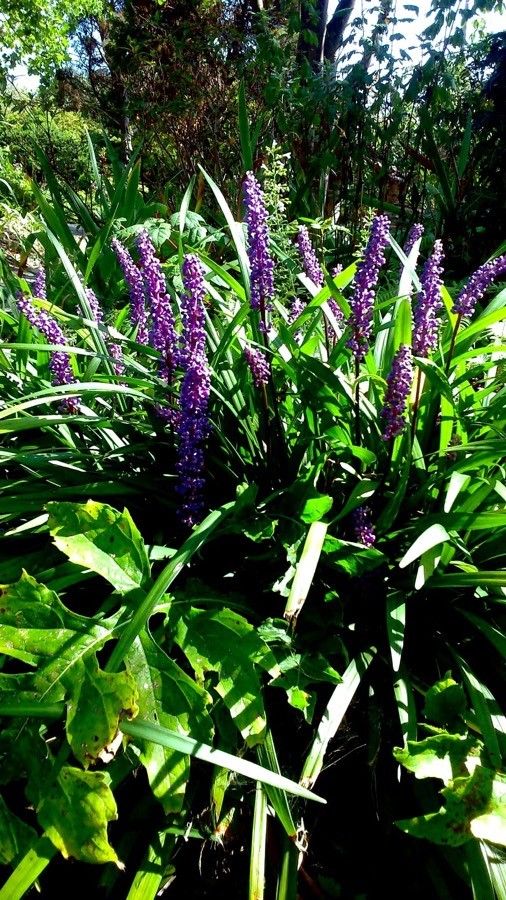
© photo
Emily Summerbell · cc-by
Liz Crafford · cc-by
Jacob Saucier · cc-by-nc
Taken Aug 22, 2022 by alterink (cc-by-sa)
Taken Sep 16, 2020 by Leandro Martins Santos (cc-by-sa)
Taken Feb 16, 2022 by Kozie WithA-K (cc-by-sa)
Taken Aug 25, 2020 by Helmut Schoos (cc-by-sa)
Taken Jun 24, 2018 by Susan Munoz (cc-by-sa)
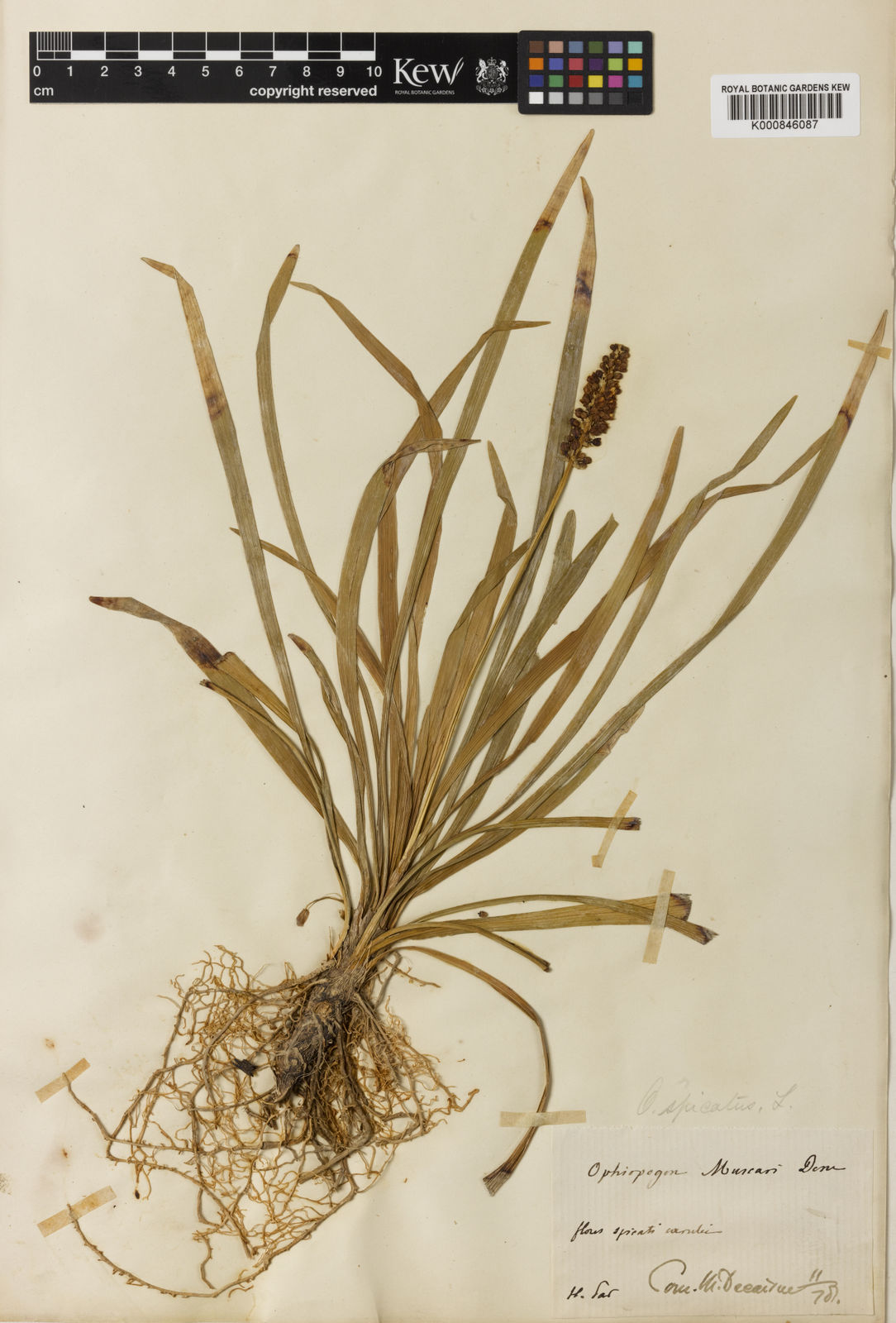
© copyright of the Board of Trustees of the Royal Botanic Gardens, Kew.




Global distribution
The native range of Liriope muscari includes China, Taiwan, Korea, Japan and northern Vietnam, where it grows in woodland understory. Long cultivated as an ornamental groundcover, it has been introduced far beyond this range, notably in the southeastern United States, without a generalized invasive status being established there.
- Native5
- Introduced1
- China
- Taiwan
- South Korea
- Japan
- Vietnam
- United States
Hexagons: regions where the plant occurs. Green dots: native range.1
Identity
A compact clump of arching leaves identifies big blue lilyturf (Liriope muscari (Decne.) L.H.Bailey, 1929), an herbaceous perennial in the Asparagaceae. Other established English names are lilyturf, border grass and monkey grass. The genus honors Liriope, the Greek nymph who was Narcissus's mother; Portuguese botanist João de Loureiro chose it in 1790 for this group of East Asian plants. 1 2
Joseph Decaisne first described the species as Ophiopogon muscari in 1867. Liberty Hyde Bailey transferred it to Liriope in 1929, explaining why the older name still appears in some horticultural catalogs. The accepted scientific name remains Liriope muscari. 1 9
Recognition
Glossy, leathery, linear leaves arch outward from a dense, almost stemless clump. Each leaf measures 20–45 cm (8–18 in) long and 8–12 mm (0.3–0.5 in) wide. Foliage stays green through the year in mild climates, but prolonged frost can turn it brown without killing the clump. 3 5
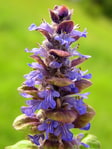
From late summer into early fall, upright flower stalks 15–20 cm (6–8 in) tall carry dense spikes of small violet flowers, sometimes mauve or white depending on the cultivar. They are followed by glossy, round black berries that stay on the stalk for much of winter. 4 5
Clump-forming growth separates Liriope muscari from its close relative Liriope spicata, which spreads quickly through underground stolons and can become invasive. Another look-alike is Ophiopogon japonicus: its leaves are very similar, but its discreet flowers remain hidden among them, followed by blue rather than black berries. 5 Beneath the clump, fleshy roots grow in bundles and store water, helping an established plant withstand drought. 3
Useful taxonomy
Family placement has changed with botanical revisions. Once included in the Liliaceae and later the Convallariaceae, Liriope muscari is now placed in Asparagaceae, subfamily Nolinoideae, alongside lily-of-the-valley and Ophiopogon. 1
The main synonyms worth recognizing when buying plants are:
- Ophiopogon muscari Decne., the original basionym;
- Liriope muscari var. communis (Maxim.) Nakai;
- Liriope muscari f. latifolia (Makino) H.Hara;
- Liriope muscari f. albiflora (Makino) Nemoto, a white-flowered form.
Whatever name appears on a nursery label, Liriope muscari remains the accepted botanical reference. Matching that name matters more than relying on a common name shared with other grass-like plants. 1 9
Habitat and range
Forests across China, Taiwan, Korea, Japan and northern Vietnam form its native range. It grows in woodland understory, on slopes and in bamboo groves at 100–1,400 m (330–4,590 ft) elevation. 6 9 Under this forest cover, lilyturf often shares the lower layer with other shade-growing monocots, in moist, well-drained soil rather than permanently saturated ground. 6
Long grown as an ornamental groundcover, it has been introduced far beyond its original range, notably into the southeastern United States. There, its occurrence outside gardens is monitored, although no generalized invasive status has been established. 8 5 Hardy to about -15 °C (5 °F), with a USDA 5–10 range, clumps survive temperate winters without special protection. Mulch becomes useful during severe, prolonged frost that scorches foliage without killing the crown. Suit protection to those conditions rather than assuming every English-speaking garden has the same winter. 3
In temperate Europe, including France, it remains a garden plant valued for carpeting woodland or edging a shaded path. This European gardening context is distinct from its native East Asian habitats. 3
Life cycle and flowering
Flower spikes appear in late summer once the clump is established. A young plant often needs two to three growing seasons before its first spikes. Failure to flower usually points to insufficient light, even filtered light, rather than a shortage of fertilizer. Establishment takes place gradually as the clump develops. 4
Following pollination, fruits slowly ripen into black berries that persist into winter. They provide a late food reserve for some birds when few other fruits remain available. Division in spring is the most reliable propagation method: each rooted division establishes in 2–4 weeks. Seed is slower, requiring cold stratification and producing less regular emergence. Spring here means the local growing season, not a fixed month across hemispheres. 5 6
Uses and risks
Ornamental planting is lilyturf's main role: path edging, groundcover beneath trees, stabilization of banks and container growing. A well-drained, acidic to neutral medium at pH 5.5–7 helps prevent crown rot in pots, the main threat when the clump is grown outside open ground. 3 5
In Asia, dried tuberous roots enter some traditional preparations, eaten cooked or candied. They are also used as a tonic and expectorant in Korean traditional medicine. These are recorded uses of the root rather than evidence that the ornamental berries are a food. 6
The ASPCA lists Liriope muscari as non-toxic to cats, dogs and horses. Large quantities of berries may cause no more than temporary digestive upset, with no serious cases documented. 7 In the garden, slugs and snails are the main nuisances, especially on young spring shoots. Stagnant moisture also favors anthracnose in poorly drained clumps; adequate spacing and freely draining soil help limit it. 5
Varieties, look-alikes and related plants
Nurseries distinguish several established cultivars: Big Blue, with lavender flowers and good sun tolerance; Variegata, with cream-variegated leaves, more widely sold than the other cultivars; Majestic, with taller flower stalks and a preference for shade; and white-flowered Monroe White. These names describe horticultural selections within the species. 3
The most frequent look-alikes are:
- Liriope spicata, which spreads through stolons and quickly colonizes a border;
- Ophiopogon japonicus, with concealed flowers and blue berries;
- some ornamental grasses with arching foliage, which are not closely related to Liriope.
Before buying, check the scientific name rather than relying on a shared common name. This helps distinguish clumping Liriope muscari from its invasive relative Liriope spicata, avoiding the planting of a spreading species where a restrained clump was intended.
Main sources
- Plants of the World Online / Kew, Liriope muscari (Decne.) L.H.Bailey
- International Plant Names Index, Liriope muscari (Decne.) L.H.Bailey
- Royal Horticultural Society, Liriope muscari
- Missouri Botanical Garden, Plant Finder — Liriope muscari
- NC State Extension Gardener Plant Toolbox, Liriope muscari
- Plants For A Future, Liriope muscari
- ASPCA, Turf Lily (Liriope muscari) toxicity entry
- Atlas of Florida Plants, Liriope muscari
- Integrated Taxonomic Information System (ITIS), Liriope muscari
Frequently asked questions
Is big blue lilyturf toxic to cats and dogs?
No. The ASPCA lists Liriope muscari as non-toxic to cats, dogs and horses. Large amounts of its black berries may cause no more than temporary digestive upset.
How do Liriope muscari and Liriope spicata differ?
Liriope muscari grows slowly in a compact clump, while Liriope spicata spreads quickly through underground stolons and readily becomes invasive. This difference guides their garden use.
Can it be confused with Ophiopogon japonicus?
Yes. Both form very similar clumps of linear leaves. Flowers offer the clearest distinction: Liriope muscari spikes stand well above the foliage, whereas Ophiopogon japonicus flowers remain hidden among the leaves.
Does big blue lilyturf need cutting back?
Cut damaged foliage to ground level in late winter before spring growth begins. This single cut removes frost-browned leaves and allows fresh growth to emerge cleanly.
How is big blue lilyturf propagated?
Spring division is the quickest and most reliable method. Seed is possible but requires cold stratification and slower emergence.
Does big blue lilyturf tolerate full sun?
It grows in partial shade or shade. In cool climates it tolerates full sun, but excessive summer heat and drought slow flowering.
Where does big blue lilyturf come from?
Its native range includes China, Taiwan, Korea, Japan and northern Vietnam, where it grows in woodland understory. Temperate regions worldwide now grow it as an ornamental groundcover.
Similar plants
If you are unsure about a plant’s toxicity, ask a botanist or veterinarian for advice.