
Stag's-horn clubmoss (Lycopodium clavatum, )
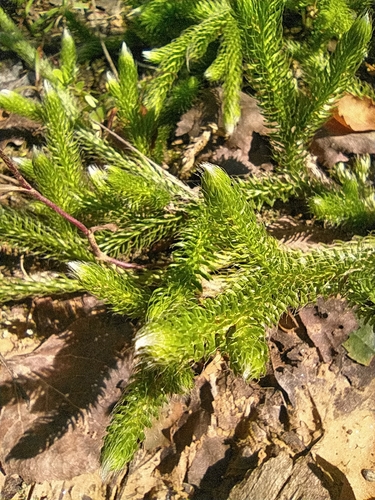
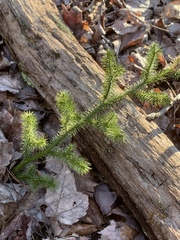
Stag's-horn clubmoss (Lycopodium clavatum L., 1753) is a perennial spore-bearing plant in the Lycopodiaceae, widespread across the temperate Northern Hemisphere and tropical mountains. Its creeping stems are clothed in fine, needlelike leaves and carry upright fertile cones that release a pale yellow powder, once collected for pharmaceutical and pyrotechnic uses.
Read moreStag's-horn clubmoss, common clubmoss and stag’s-horn clubmoss
Give plenty of ambient light without direct sun on the leaves.
Full light to light partial shade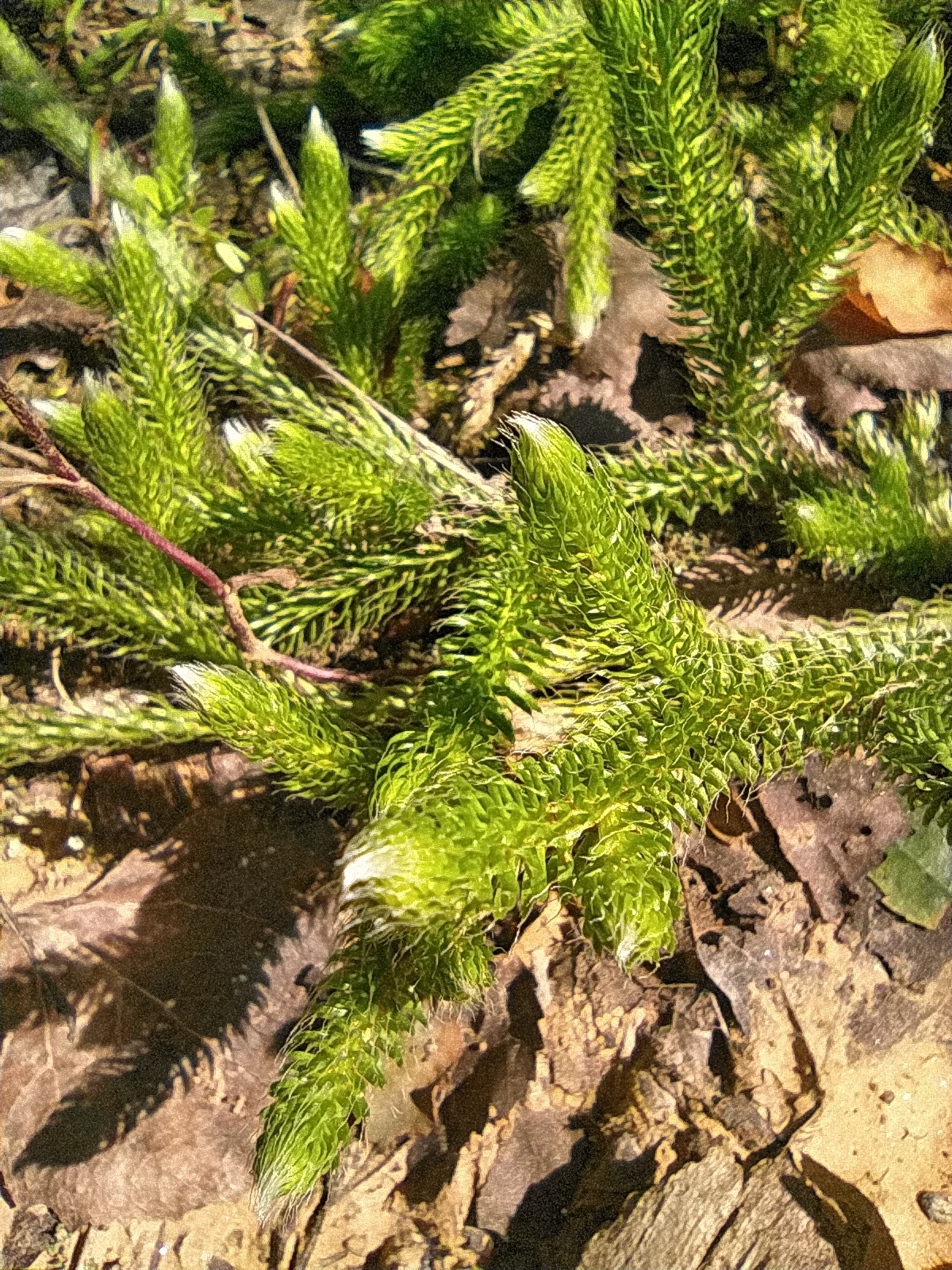



© photo
Svetlana vymysly · cc0
Healthy Yards · cc0
alicia penney · cc-by
Taken Aug 8, 2021 by HeyZeus (cc-by-sa)
Taken Jun 20, 2007 by Tela Botanica − Liliane Roubaudi (cc-by-sa)
Taken Jan 16, 2011 by Tela Botanica − Yoan MARTIN (cc-by-sa)
Taken Sep 13, 1883 by Tela Botanica − Anne-Marie GRIMAUD (cc-by-sa)
Taken Aug 27, 2016 by huy HO (cc-by-sa)
© copyright of the Board of Trustees of the Royal Botanic Gardens, Kew.




Global distribution
Lycopodium clavatum ranges across the temperate Northern Hemisphere, from Europe to North America and Asia, and tropical mountains in Central and South America, Africa and Asia. In France, drainage of wetlands and the overgrowth of heathland have caused a marked decline, leading to protection in several regions.
- Native7
- France
- United Kingdom
- Germany
- Poland
- United States
- Japan
- Mexico
Hexagons: regions where the plant occurs. Green dots: native range.1
Identity
stag's-horn clubmoss (Lycopodium clavatum L., 1753), also known as common clubmoss or stag’s-horn clubmoss, is a perennial spore-bearing plant in the genus Lycopodium, family Lycopodiaceae. It belongs to the pteridophytes: vascular plants with true stems, leaves and roots that reproduce by spores rather than seeds. 1 7
The name Lycopodium combines the Greek lykos, “wolf,” and podos, “foot.” Early botanists saw a wolf’s paw in the upright, hairy branches, an image preserved in the French name pied-de-loup. Despite the English name clubmoss, this species is not a moss: true mosses are nonvascular plants without true stems or roots. 5 7
Recognition
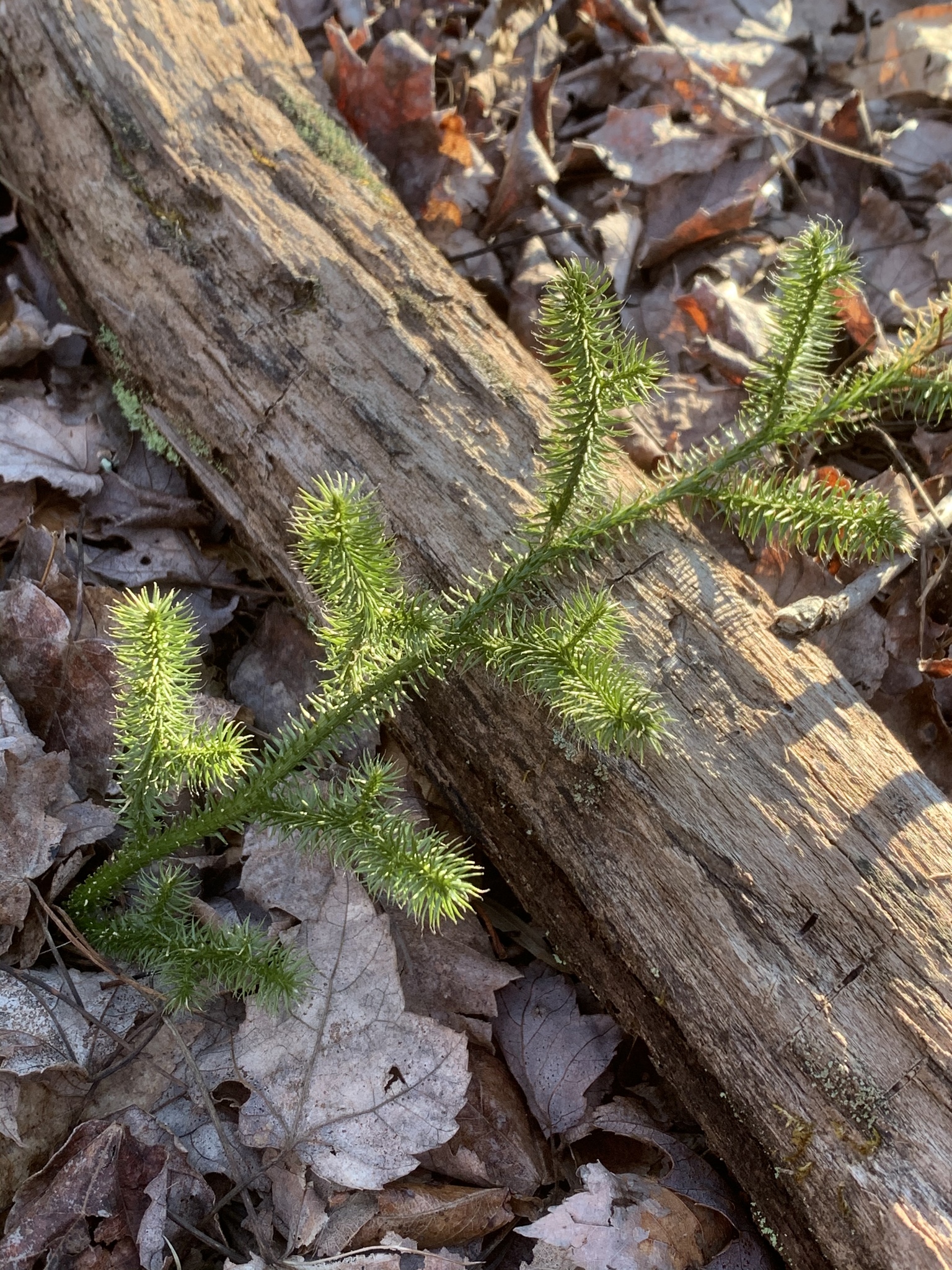
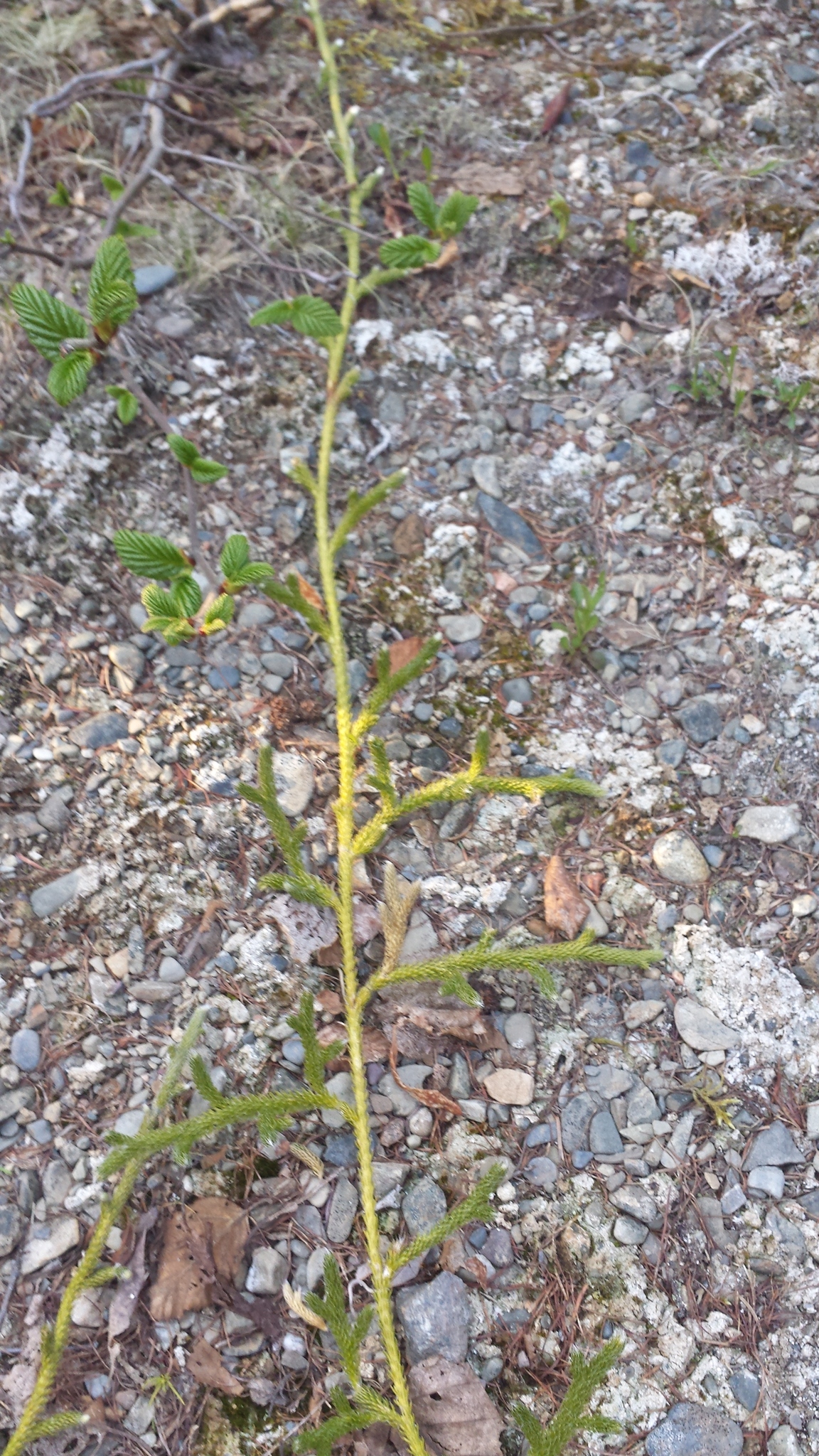
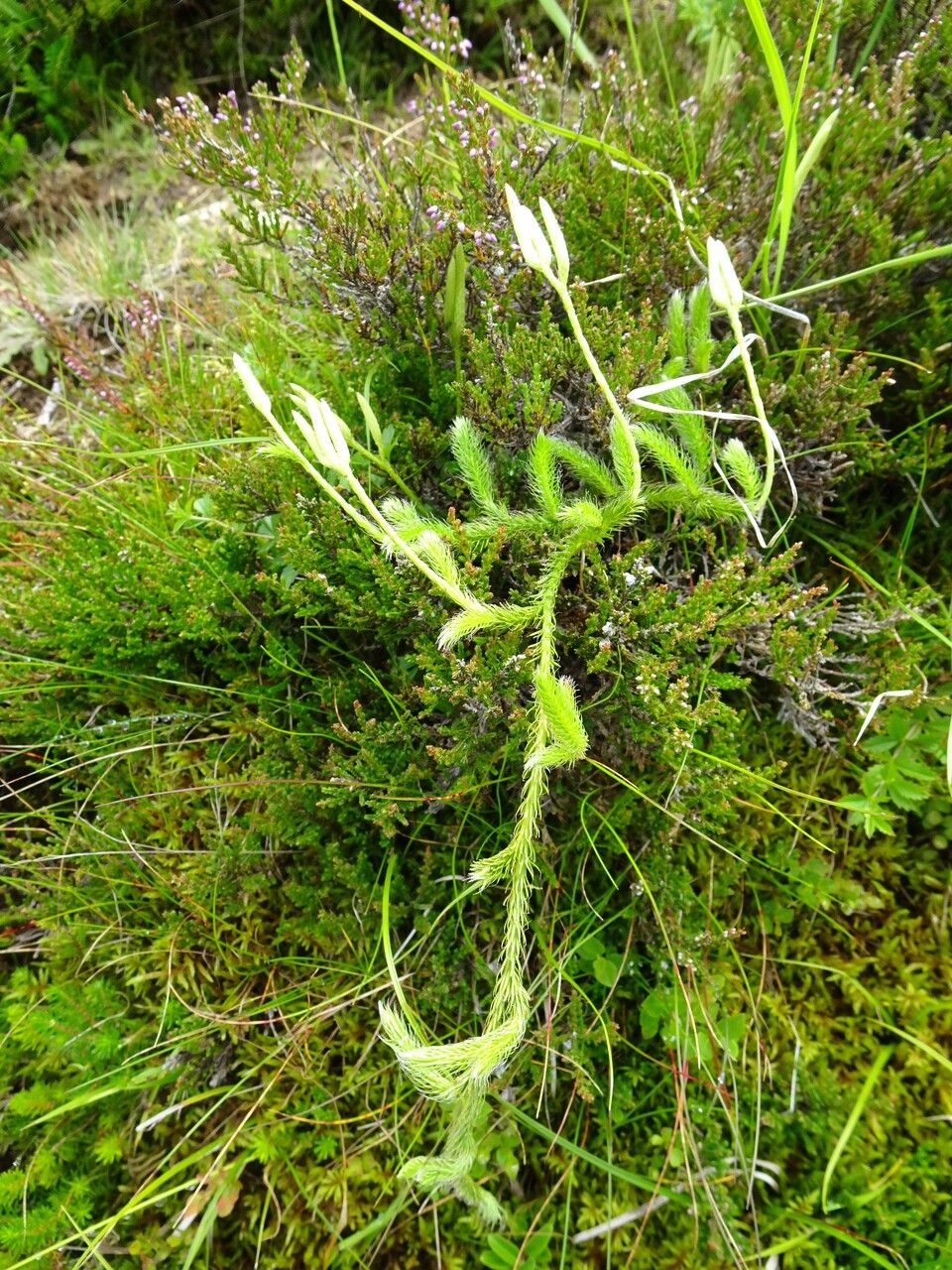
Its creeping stems reach 1 m (3.3 ft) in length. They branch profusely and produce dichotomously branching roots at regular intervals, allowing them to continue colonizing the ground indefinitely. 3 2
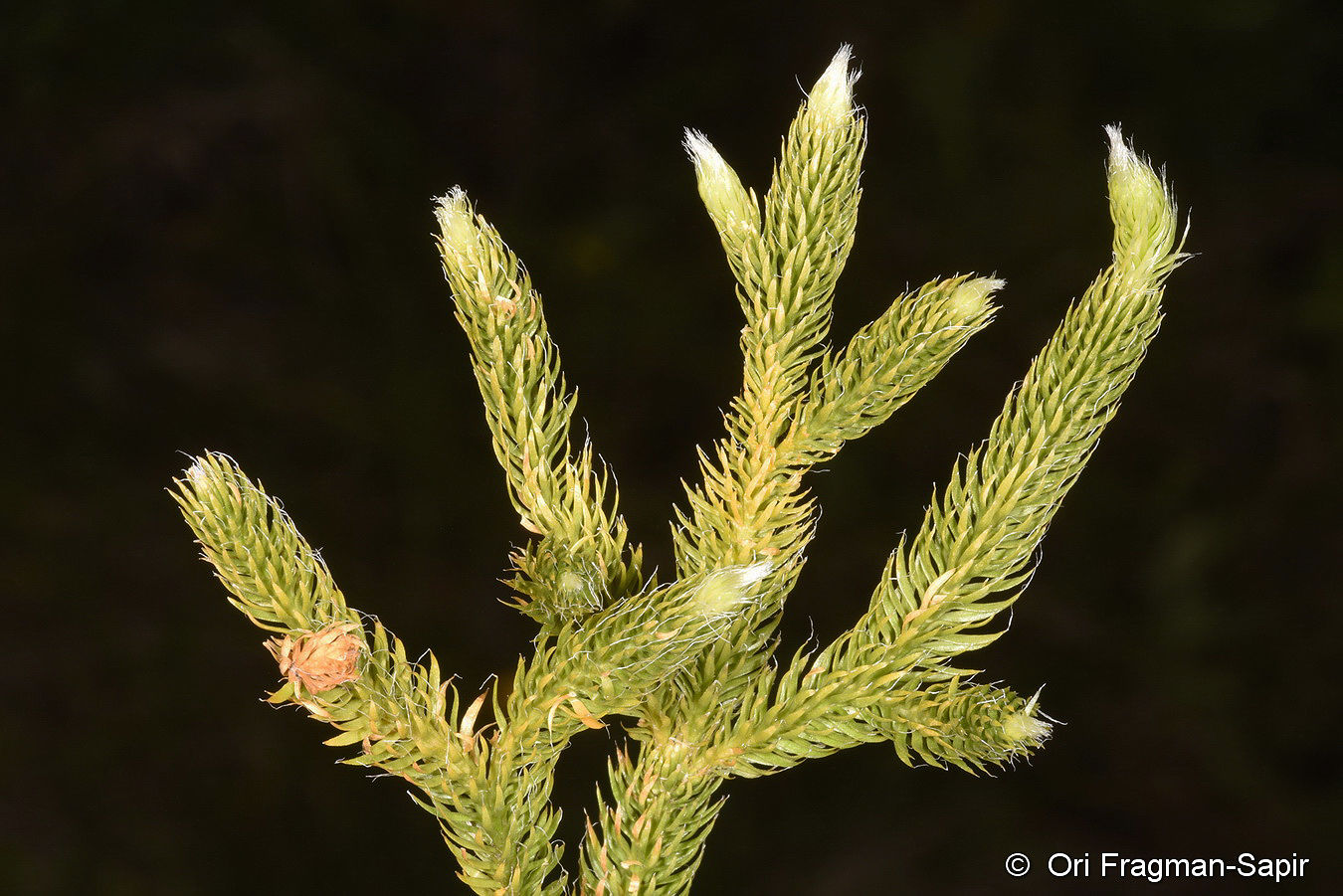
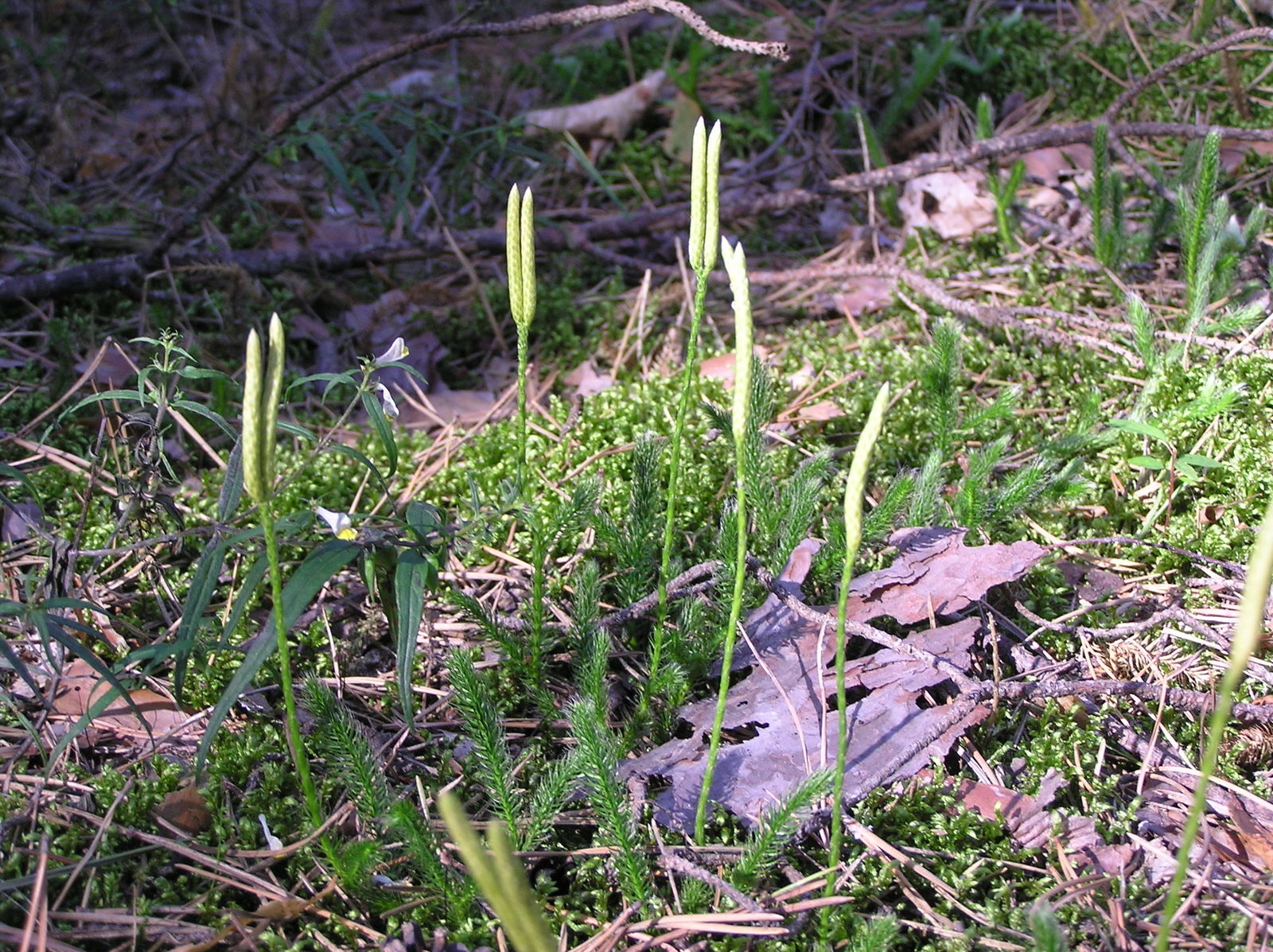
The leaves are small microphylls, 3–5 mm (0.12–0.2 in) long, arranged in a tight spiral around the stem and ending in a fine white hair. In summer, fertile stems rise 5–15 cm (2–6 in) above the vegetative carpet. Each stalk carries two or three yellow-green cones 2–3 cm (0.8–1.2 in) long; the number of cones remains the main feature separating this species from related Lycopodiaceae. 3 7
Each sporophyll in a cone bears a kidney-shaped sporangium at its base. At maturity, it releases a fine pale yellow powder of spores about 30 µm (0.0012 in) in diameter. The powder is so water-repellent that it floats on water without becoming wet, and it has a faint resinous scent. 6
Useful taxonomy
Lycopodium clavatum L., published in 1753, is the name accepted by Plants of the World Online. The genus Lycopodium contains several dozen species across the temperate Northern Hemisphere and tropical mountains. Several geographical varieties have been distinguished, including var. aristatum in Mexico and Central and South America, and var. asiaticum in Japan and northeastern China. 1 4
Long grouped with ferns under the broad term “pteridophytes,” the species actually belongs to a distinct lineage, the lycophytes, which separated from other vascular plants several hundred million years ago. This ancient separation of the lycophytes explains the many historical synonyms recorded for Lycopodium clavatum in botanical literature. 7 1
Habitat and range
Across its range, stag's-horn clubmoss occupies the temperate Northern Hemisphere from Europe through North America and Asia, as well as tropical mountains in Central and South America, Africa and Asia. 1 4
In France, INPN records the species across much of the country, but with a marked decline in lowland regions where acid heathlands and peatlands have been drained or converted to farmland. It has legal protection in several French regions and departments; those provisions are specific to France. 8 5
Typical habitats include acid heathland, peatland, poor pasture and open woodland edges, on siliceous, nutrient-poor, well-drained soil with a pH of 4–6. Within its native temperate range, the species tolerates winter temperatures down to −20 °C (−4 °F), corresponding to USDA hardiness zones 5–8. These zones describe winter cold rather than suitability in every climate. Like other clubmosses of acidic habitats, it quickly disappears from cultivated sites or places subjected to regular burning. 3
Life cycle and reproduction
Spores initiate a reproductive cycle quite unlike that of flowering plants. A spore germinates in the soil to form an underground prothallus without chlorophyll. Associated with a mycorrhizal fungus on which it depends entirely for nutrition, this gametophyte remains invisible at the surface for 6–15 years before fertilization. 7
After fertilization, the prothallus produces its first green creeping stem, which takes several more years to form its first fertile cones. From spore sowing to the first reproductive structures, a colony therefore takes six to fifteen years to become fertile. 7 3
Above ground, vegetative propagation is faster: an already rooted piece of creeping stem can break away and colonize a new site without repeating the full spore cycle. 3
Uses and risks
Spore powder had several historical uses. Its water-repellent surface made it useful for coating pills in pharmacies so that they would not stick together during storage. Rapid combustion when suspended in air also made it a flash powder for early photography, a use that survives in some magic acts. 6 7
The plant itself contains the alkaloids lycopodine and clavatine, which are toxic if ingested and can paralyze motor nerves in many mammals. The spores, by contrast, are not toxic; that lack of toxicity allowed their long-standing pharmaceutical use. 3
The species also appears in traditional medicine, notably in Finland as a diuretic, and in homeopathy as dilutions of crushed spores. 7 6
Varieties, look-alikes and related plants
No recognized horticultural cultivar exists for Lycopodium clavatum. It is a wild plant that has never been selected for ornament, and deliberate cultivation remains very difficult outside its natural habitat. 2
Several other Lycopodiaceae occupy similar habitats and can cause confusion, including Diphasiastrum species and other Lycopodium such as Lycopodium annotinum. The chief identifying feature is the number of fertile cones per stalk, two or three in Lycopodium clavatum, combined with needlelike leaves tipped by a conspicuous white hair. 4
Other creeping woodland plants, including Selaginella kraussiana and some true mosses, can also look similar from a distance. Yet true vascular leaves and upright fertile cones clearly distinguish Lycopodium clavatum from mosses in the strict sense, which lack true leaves and stems. 7
Main sources
- Plants of the World Online / Kew, Lycopodium clavatum L.
- Royal Horticultural Society, Lycopodium clavatum - stag's horn clubmoss
- Plants For A Future, Lycopodium clavatum
- GBIF, Lycopodium clavatum L.
- Tela Botanica / eFlore bdtfx, Lycopodium clavatum L.
- Boiron, Le lycopode en massue
- Encyclopaedia Britannica, Club moss
- INPN / MNHN, Lycopodium clavatum L., 1753
Frequently asked questions
Is stag's-horn clubmoss toxic?
The plant contains the alkaloids lycopodine and clavatine, which are toxic to many mammals if ingested. The spores themselves are not toxic and were long used as a pharmaceutical excipient.
Why were clubmoss spores used in early photography?
The very fine, oil-rich spores ignite rapidly when densely suspended in air. This made them useful as photographic flash powder, and they are still used in some magic acts.
Can Lycopodium clavatum be grown in a garden?
Cultivation remains very difficult. The species depends on an underground prothallus associated with a mycorrhizal fungus, which may take more than ten years to reach fertilization, and on acidic, nutrient-poor soil rarely found in ordinary gardens.
Is stag's-horn clubmoss protected in France?
Yes, in several French regions and departments, where the decline of heathland and peatland habitats has led to local legal protection. Collection there is prohibited without authorization; these are French provisions, not a statement of the law elsewhere.
How can Lycopodium clavatum be distinguished from other Lycopodiaceae?
The most reliable feature is the number of fertile cones on each stalk, usually two or three in Lycopodium clavatum, together with needlelike leaves ending in a conspicuous white hair.
Where does the name Lycopodium come from?
It comes from the Greek lykos, wolf, and podos, foot. Early botanists compared the upright, hairy branches to a wolf’s paw, an image also reflected in the French name pied-de-loup.
What was clubmoss powder used for in pharmacy?
Its fine, water-repellent texture made it useful for coating pills to prevent them sticking together during storage, a common pharmaceutical use before synthetic excipients became widespread.
Similar plants
If you are unsure about a plant’s toxicity, ask a botanist or veterinarian for advice.