
Acerola (Malpighia emarginata, )
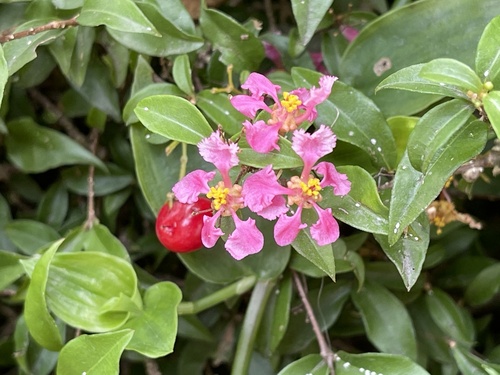

Acerola (Malpighia emarginata) is a fruiting shrub or small tree in the Malpighiaceae family, native to the West Indies and northern South America. Its fruit, also called West Indian cherry, ranks among the richest known sources of vitamin C. This explains its commercial expansion in Brazil and its widespread use in dietary supplements.
Read moreAcerola, Barbados cherry and West Indian cherry
Allow a few hours of direct sun per day, preferably morning or evening.
Full sun for good fruiting


© photo
(c) suchihfen, some rights reserved (CC BY-NC) · cc-by-nc
Wikimedia Commons · CC BY-SA or Public Domain
Wikipedia · CC BY-SA
Taken Mar 4, 2021 by Sébastien TRASBOT (cc-by-sa)
Taken Aug 31, 2022 by Bibiana Marín (cc-by-sa)
Taken Mar 10, 2019 by Leonardo Leonardo Trindade De Jesus (cc-by-sa)
Taken Jul 26, 2022 by Plantae Curacao (cc-by-sa)
Taken Oct 16, 2013 by Thomas Delhotal (cc-by-sa)
© copyright of the Board of Trustees of the Royal Botanic Gardens, Kew.


Global distribution
The native range of Malpighia emarginata covers the Lesser Antilles, Curaçao, Margarita and northern South America as far as Brazil. The species is now grown well beyond this range, particularly in northeastern Brazil and the Mekong Delta of Vietnam, clearly distinguishing its native range from its production centers.
- Native4
- Introduced1
- Lesser Antilles
- Curaçao
- Colombia
- Venezuela
- United States (Florida)
Hexagons: regions where the plant occurs. Green dots: native range.↗
Identity
Acerola (Malpighia emarginata DC., 1824) is a fruiting shrub in the Malpighiaceae family. In the French West Indies and Réunion, the plant is called acérolier or cerisier-pays; the fruit is called acérola, cerise des Antilles or cerise pays. The names refer to its resemblance in shape and color to a European cherry, with which it has no botanical relationship. West Indian cherry is an established English name for the plant and fruit. 8 1
The name acerola comes from the European azarole (Crataegus azarolus), an unrelated hawthorn whose red fruit early settlers thought looked similar. Another English name, Barbados cherry, refers to Barbados, one of the islands where the fruit was long harvested and traded, although its actual native range extends much farther, into northern South America. 5
Recognition
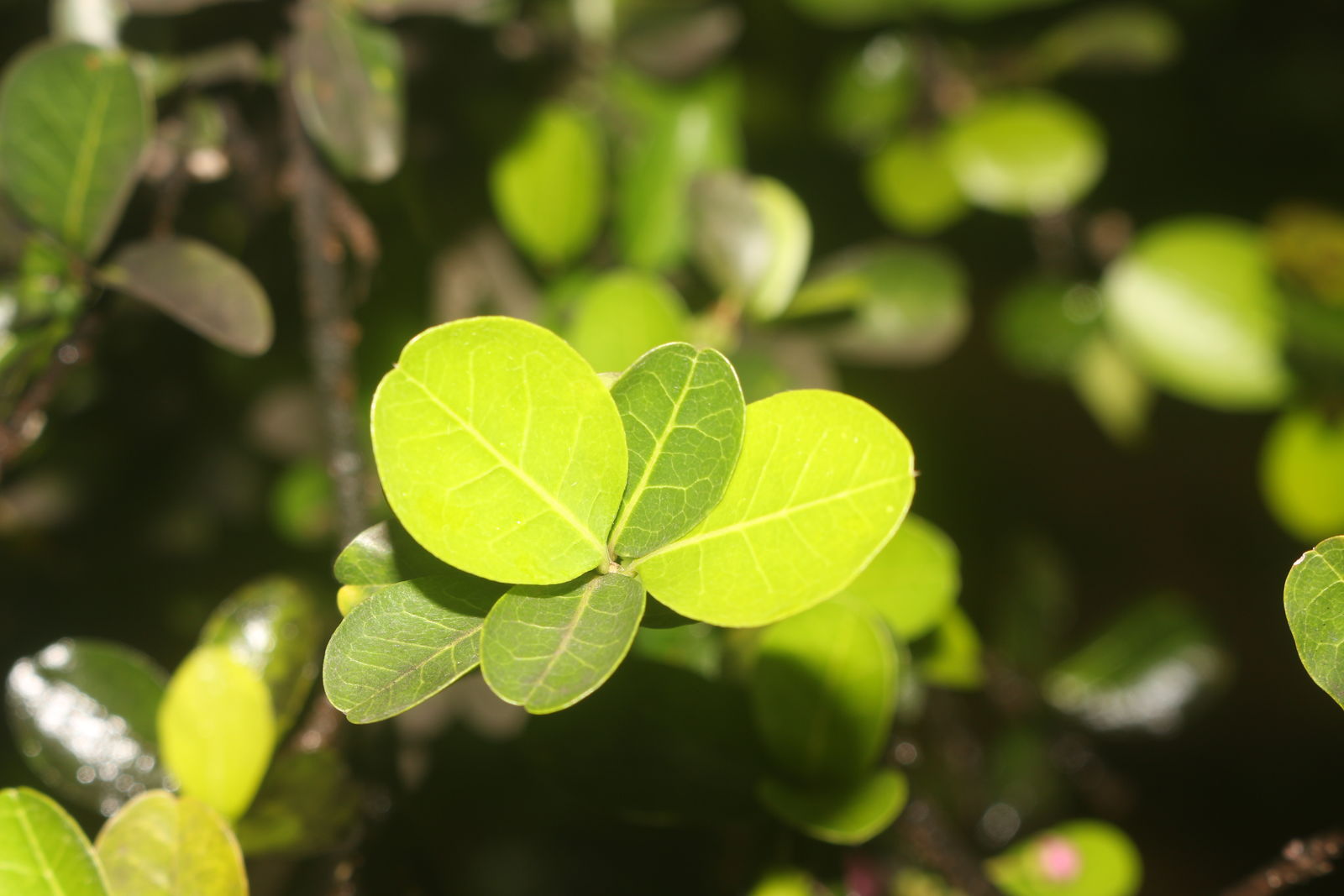
Spreading branches on a short trunk form a shrub or small tree usually 2–3 m (6.5–10 ft) tall, sometimes reaching 6 m (20 ft) with an equal spread. The glossy, elliptical evergreen leaves measure 2–7 cm (0.8–2.8 in) long. Their edges lack teeth or spines, a useful distinction from true hollies. 5
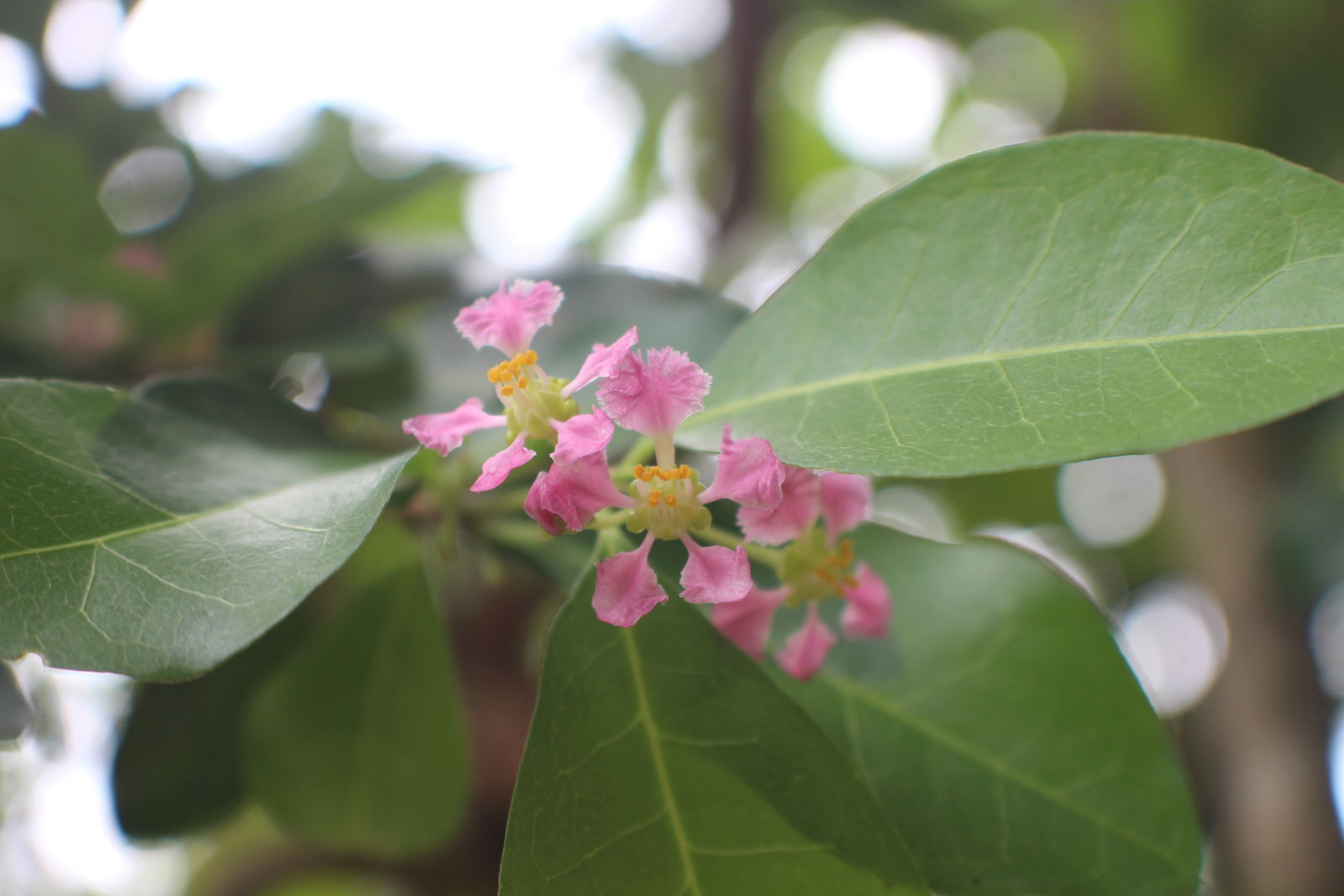
Small flowers have five pink or lavender petals, fringed along their edges, clustered in the leaf axils. Flowering recurs several times a year after rain, allowing 2–3 harvests annually in favorable climates. 5 4
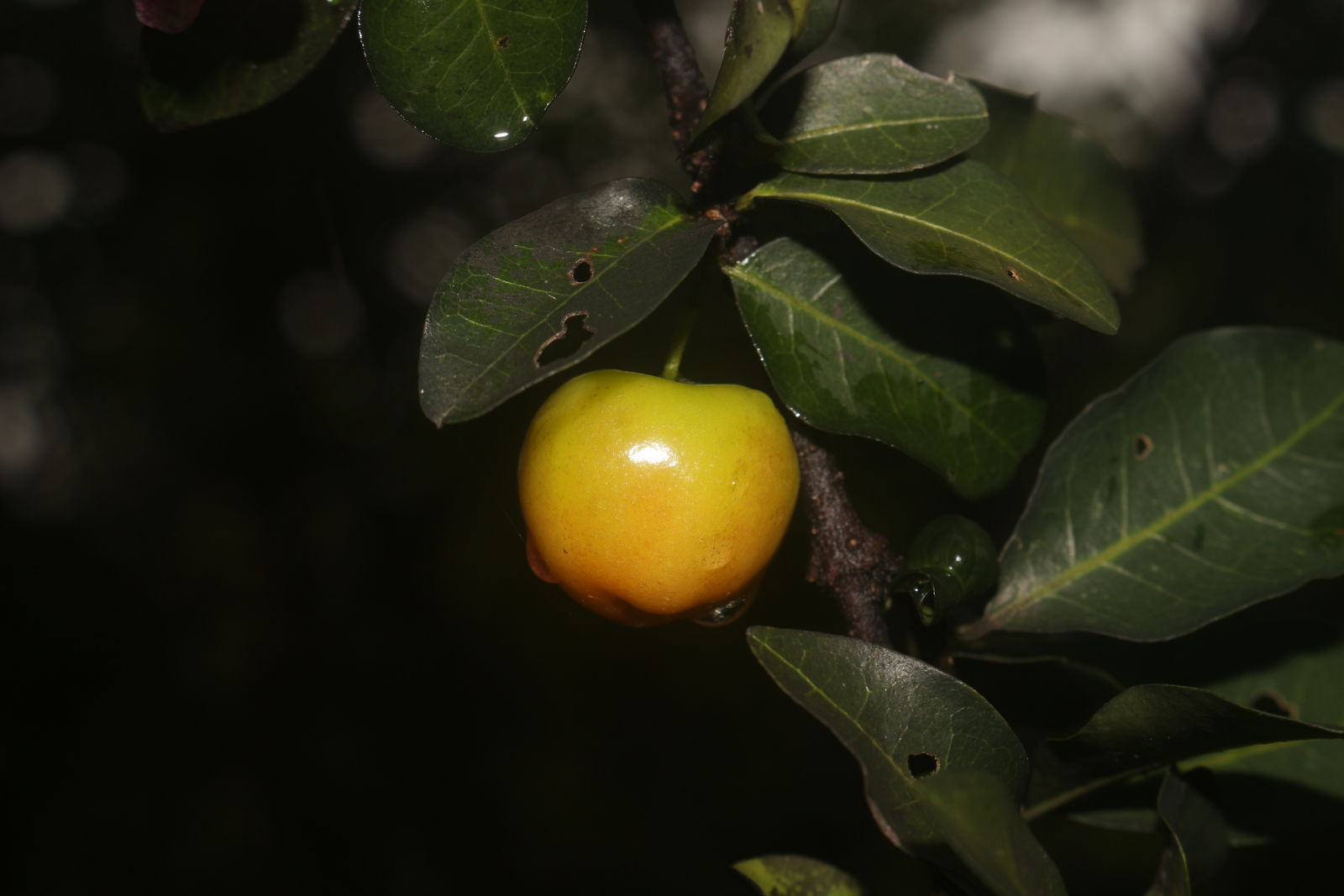
The fleshy drupe is bright red, flattened to rounded and often visibly three-lobed, measuring 1.25–2.5 cm (0.5–1 in) across. Its very juicy orange pulp ranges from tart to mildly acidic according to ripeness. Vitamin C content is exceptional: up to 4,676 mg per 100 g (3.5 oz) in green fruit, still about 2,000 mg per 100 g (3.5 oz) when ripe. 5
Useful taxonomy
The accepted scientific name, Malpighia emarginata DC., dates to 1824. USDA GRIN brings together several names historically associated with this fruit crop: Malpighia punicifolia L., Malpighia retusa Benth. and Malpighia umbellata Rose. 2 1
Malpighia glabra L. causes the most frequent nursery confusion. A distinct species distributed from southern Texas through the Caribbean to Venezuela and Ecuador, it is often sold under the same commercial name as acerola. The nursery trade long used that name, or Malpighia punicifolia, for the cultivated fruit, although Malpighia emarginata is the stable botanical name for commercial production. 2 6
Recent sequencing of the acerola genome established a chromosome number of 2n = 20 and an assembly of approximately 1.03 billion base pairs containing more than 35,000 predicted genes. The high level of heterozygosity explains why seedlings produce fruit of variable quality, providing another argument for vegetative propagation. 7
Habitat and distribution
The Lesser Antilles, from Saint Croix to Trinidad, together with Curaçao, Margarita and northern South America as far as Brazil, make up the species' native range. 5 4
Introduction to Florida dates to 1887, followed by commercial development in Puerto Rico after 1945. Today, the main production centers lie in northeastern Brazil and Vietnam's Mekong Delta, far beyond the original native range. 5 7
In the French West Indies and Réunion, acerola grows from the coast to about 800 m (2,625 ft) in elevation. There it is cultivated in Creole gardens and small household orchards rather than large plantations. 8
Life cycle and reproduction
Rain commonly triggers flowering several times a year, followed by very rapid fruit ripening. This pace calls for picking almost daily, or at least every two to three days, before fruit falls or spoils on the ground. 5
In cultivation, semi-ripe stem cuttings are much more widely used than seeds. A 20–25 cm (8–10 in) section of the current year's wood roots in about 60 days, whereas seed germination is often below 50%. Morton links low germination to uneven development of seeds within the fruit; the heterozygosity reported in the genome study does not establish that causal link. 5 7
A cutting-grown plant generally flowers and fruits from 2–3 years in a warm, sunny climate. Without both warmth and sunlight, production remains low and irregular.
Uses and risks
Fresh fruit is acerola's primary use. It is eaten raw, juiced, made into jam or syrup, or processed into vitamin C powders and tablets, an industry built directly on its exceptionally high ascorbic acid concentration. 4 5
Folk medicine also attributes uses against liver complaints, diarrhea, dysentery and cough to the shrub; gum from the bark has traditionally been used for respiratory ailments. These remain traditional uses and do not replace medical advice. 4
People commonly eat the fruit raw or processed. This food use documented by Morton does not establish its safety in domestic animals. The main cultivation risks are pests: root-knot nematode (Meloidogyne incognita) attacks the roots, and Caribbean fruit fly (Anastrepha suspensa) attacks ripe fruit directly. 5
Varieties, look-alikes and related plants
Brazilian breeding has produced several cultivars for commercial fruit production. Sertaneja (BRS 152) is adapted to the Northeast's semi-arid climate, while Jaburu (BRS 366) has high vitamin C content. The older selection Florida Sweet bears large, semi-sweet fruit. 7
The most frequent confusions involve:
- Malpighia glabra L., a distinct species often sold under the same commercial name, Barbados cherry;
- Malpighia punicifolia auct., a name historically misapplied to the same fruit crop;
- Malpighia coccigera L., a small ornamental shrub with prickly, holly-like leaves, sold for edging or bonsai and unrelated to the edible fruit despite sharing its genus.
Leaf texture resolves the distinction immediately: entire and smooth in Malpighia emarginata, toothed and prickly in Malpighia coccigera. Fruit color alone cannot reveal that contrast. The full scientific name, including its author DC., then helps avoid the most common commercial confusion, the continued association of Malpighia glabra with acerola sold in garden centers. 6 2
Main sources
- International Plant Names Index, Malpighia emarginata DC.
- USDA GRIN Taxonomy, Malpighia emarginata DC.
- GBIF, Malpighia emarginata DC.
- Plants For A Future, Malpighia emarginata
- Morton, Fruits of Warm Climates — Barbados Cherry
- Useful Tropical Plants, Malpighia emarginata
- Chromosome-scale genome assembly of acerola (Malpighia emarginata DC.)
- Cirad Caribfruits, Cerise des Antilles
Frequently asked questions
Do acerola and the French name acérolier mean the same thing?
In French, acérolier denotes the shrub, Malpighia emarginata, while acérola denotes its red, vitamin C-rich fruit. In the French West Indies, cerisier-pays and cerise des Antilles are also used for this plant-and-fruit pair. English acerola can refer to the plant or its fruit.
Why is acerola sold as a vitamin C supplement?
The fruit contains exceptionally high amounts of vitamin C, up to about 2,000 mg per 100 g (3.5 oz) of ripe pulp and even more when green. This concentration explains its use in powders, concentrated juices and vitamin tablets.
Is acerola toxic to cats and dogs?
People commonly eat the fruit raw. This food use does not establish its safety in cats, dogs or horses; their status remains uncertain in the available information.
Which plants are confused with Malpighia emarginata?
The most frequent confusions involve Malpighia glabra and Malpighia punicifolia, two names historically associated with the same fruit crop, as well as Malpighia coccigera, a small ornamental shrub with prickly leaves sold as miniature holly.
Can acerola be grown outside the tropics?
Yes, in a container in a heated greenhouse or sunroom, provided it receives full sun and winter temperatures above 10 °C (50 °F). Outdoors, young plants cannot withstand temperatures below -1 °C (30 °F).
How long before the first harvest?
A cutting-grown plant can flower and fruit from 2–3 years in a warm, bright climate. Seedlings generally take longer and produce fruit of more variable quality.
How can you recognize ripe acerola fruit?
The fruit changes from green to bright red at full ripeness, and its orange pulp becomes juicier and less acidic. Its fragility calls for frequent picking, often daily at peak harvest.
Similar plants
If you are unsure about a plant’s toxicity, ask a botanist or veterinarian for advice.