
sensitive plant (Mimosa pudica, )
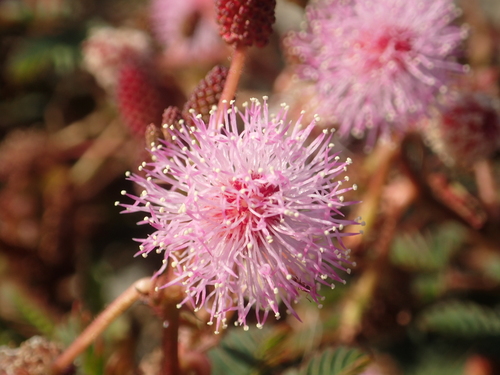

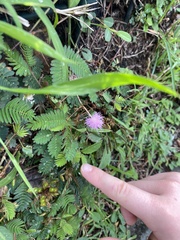
sensitive plant (Mimosa pudica) is a creeping member of the Fabaceae native to the Caribbean and tropical America, now widespread across warm regions. Its compound leaves fold within seconds after touch, heat or a jolt, then reopen a few minutes later. Grown in pots for this striking response, it is also a persistent weed of disturbed tropical ground.
Read moresensitive plant and Touch-me-not
Allow a few hours of direct sun per day, preferably morning or evening.
Full sun to light partial shade



© photo
no rights reserved, uploaded by 葉子 · cc0
Peter Desmet · cc0
Chris Parminter · cc-by
Taken Nov 2, 2016 by Yoan MARTIN (cc-by-sa)
Taken May 4, 2022 by Tristan Jaton-Maria (cc-by-sa)
Taken Dec 26, 2020 by pratiwir pratiwir (cc-by-sa)
Taken Jul 4, 2022 by Tristan Jaton-Maria (cc-by-sa)
© copyright of the Board of Trustees of the Royal Botanic Gardens, Kew.


Global distribution
The native range of Mimosa pudica covers the Caribbean, Central America and northern South America. Introductions have made it pantropical, reaching South and Southeast Asia, Australia, tropical Africa and some French overseas territories, where it often becomes a crop weed.
- Native3
- Introduced3
- Invasive3
- Brazil
- Mexico
- French Guiana
- United States
- Réunion
- Indonesia
- India
- Australia
- Tanzania
Hexagons: regions where the plant occurs. Green dots: native range.1
Identity
The sensitive plant (Mimosa pudica L., 1753), also known as touch-me-not, is a creeping member of the pea family, Fabaceae. Depending on climate, it grows as an annual or a short-lived perennial. Touch, heat or a sudden jolt makes its compound leaves fold within seconds. This rapid, reversible movement distinguishes it from most plants, whose responses are much less immediately visible. 3 1
Originally from the Caribbean and tropical America, the species now occurs throughout the tropics. Deliberate and accidental introductions have carried it into warm regions around the world, where it often becomes a persistent weed of disturbed ground. The common name “mimosa” can be misleading: the yellow-flowered plant sold by florists belongs to an entirely different species. 4 5
Recognition
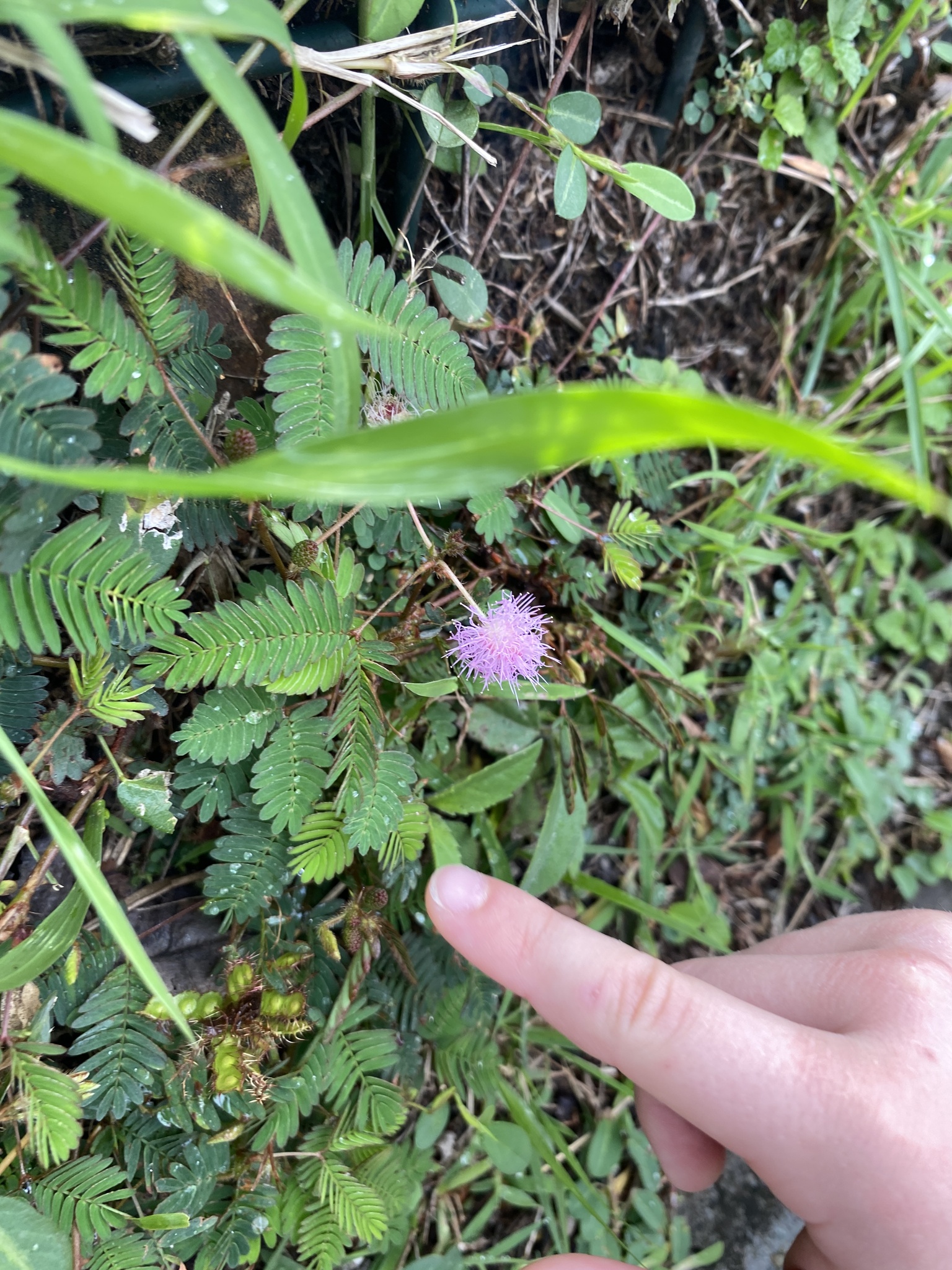
A young stem stands upright, then becomes creeping or trailing with age. Slender and armed with small prickles, it rarely exceeds 30 cm (12 in) in height, although its length can reach 1 m (3.3 ft) and sometimes more in the wild. Height alone therefore gives a poor impression of how much ground an established plant can cover. 3 5
The twice-divided leaves usually have two pairs of pinnae, each bearing 10–20 pairs of narrow, elongated leaflets. Contact triggers an electrical signal that moves water out of cells in the pulvinus, the swollen joint at the base of each leaflet and leaf stalk. The resulting loss of internal pressure makes the leaflets droop and fold within seconds; they reopen 10–20 minutes later. Leaves also fold every night without being touched, a daily rhythm called nyctinasty. 10 3
Small, rounded pink to purple flower heads, about 8–10 mm (0.3–0.4 in) across, arise in the leaf axils during summer in the seasonal setting described. Each flower lasts only a day. The flattened pods are approximately 1.8 cm (0.7 in) long, bristly along their edges and grouped in clusters of two to eight. At maturity they break into separate segments, each containing one pale brown seed. 3 10
Useful taxonomy
POWO/WCVP accepts the name Mimosa pudica L., described by Carl Linnaeus in Species Plantarum in 1753. The epithet pudica comes from Latin for “bashful” or “shrinking,” referring to the leaves drawing together when touched. The scientific name thus records the same response that gives the plant its familiar English names. 1 2
The taxon has a well-documented homotypic synonym and several recognized botanical varieties, distinguished mainly by stem hairiness and geographical distribution:
- Eburnax pudica (L.) Raf.
- Mimosa pudica var. unijuga (Duchass. & Walp.) Griseb.
- Mimosa pudica var. tetrandra (Humb. & Bonpl. ex Willd.) DC.
- Mimosa pudica var. hispida Brenan
The variety unijuga, more often mentioned in South American accounts, has also been associated with skin disease in farm horses. Identifying the variety therefore matters for animal health as well as botanical classification. Reports about this variety should retain that identification rather than silently broadening the subject. 7 1
Habitat and distribution
Caribbean islands, Central America and northern South America make up its native range. There it occupies sunny, disturbed habitats at elevations up to 1300 m (4300 ft). Waste ground, field margins, pasture and roadsides provide the open conditions in which this low-growing plant establishes readily. 5 4
The IUCN assesses Mimosa pudica as Least Concern. Its very broad distribution and abundant reproduction by seed support that assessment, despite local pressures on some natural habitats. A widespread conservation status does not prevent the same species from causing problems where it has been introduced. 9
Introductions have made the species pantropical, including South and Southeast Asia, Australia and East Africa. In some of these regions it is treated as a regulated crop weed; those regional designations do not apply automatically to every reader's country. On Réunion, it can form dense cover in sugarcane fields and hinder the establishment of other plants. 5
Life cycle and reproduction
A hard seed coat slows germination unless it is treated. Soaking in hot water or lightly scarifying the coat reduces emergence time to one to three weeks. High temperatures break dormancy more effectively than soil moisture or acidity. The hard coat explains why untreated seed can remain slow even when the sowing medium appears adequately moist. 4
Summer flowering in the source's seasonal context produces short-lived, delicate flowers, each fading in less than a day. Both insects and wind carry pollen. Fertilized flowers develop into bristly pods, whose segmentation releases the seeds. The brief life of an individual flower therefore contrasts with the lasting contribution of its seed to new populations. 3 10
Like many legumes, Mimosa pudica houses nitrogen-fixing bacteria in root nodules. These bacteria convert atmospheric nitrogen into a form the plant can use. This partnership helps it establish on poor, newly disturbed soils before more demanding species arrive, contributing to its effectiveness as an early colonizer. 4
Uses and risks
The plant contains mimosine, a toxic amino acid known to affect hair and wool growth in livestock. Horses grazing for long periods in land invaded by var. unijuga developed loss of mane and tail hair, accompanied by skin disease confirmed through skin biopsy. These are exposure-related animal-health findings, rather than a claim that every brief contact causes poisoning. 7 8
Roots contain higher concentrations of the toxin than the rest of the plant. Food use or unsupervised medicinal use is therefore discouraged, despite a long history of traditional applications for digestive disorders. A record of traditional use does not remove the risk associated with the plant's constituents. 4
In horticulture, the sensitive plant is primarily an educational curiosity. Its immediate, visible response to touch offers children an introduction to plant physiology. That teaching role is more common than its use as an ornamental bedding plant, although both depend on the same distinctive foliage. 6
Varieties, look-alikes and related plants
The word mimosa often causes confusion in French. The fragrant, yellow-flowered stems sold in late winter bouquets are usually Acacia dealbata, a tree rather than a member of the genus Mimosa. The two plants share a common name, not an identity or a direct relationship at genus level.
Other plants with sensitive leaves can also be mistaken for this species. Some belong to Biophytum, a botanically distant genus; another is Neptunia dimorphantha, which is sometimes also called “sensitive plant” in English. Rapid leaf folding alone is consequently insufficient to establish a plant's identity.
Within the same genus, Mimosa pigra, the giant sensitive plant, shares the leaf-folding response but reaches several meters in height in wet habitats. It is among the most troublesome aquatic weeds of tropical regions. Similar-looking leaves should not obscure the substantial difference in size and habitat between it and Mimosa pudica.
Main sources
- Plants of the World Online / Kew, Mimosa pudica L.
- International Plant Names Index, Mimosa pudica L.
- Royal Horticultural Society, Mimosa pudica
- Plants For A Future, Mimosa pudica
- Useful Tropical Plants Database, Mimosa pudica
- Société Nationale d'Horticulture de France, Mimosa pudique ou sensitive
- PubMed, Hair loss and endocrine dermatosis on horses raised in a Mimosa pudica var. unijuga-invaded area
- Cornell University, Poisonous Plants Informational Database, Mimosa pudica seeds
- IUCN Red List, Mimosa pudica assessment (Groom, 2012)
- Flora of China via eFloras, Mimosa pudica
Frequently asked questions
Why do sensitive plant leaves close when touched?
Contact triggers an electrical signal that moves water out of cells in the pulvinus, the swollen joint at the base of each leaflet and leaf stalk. This local loss of water lowers internal pressure and causes almost immediate folding.
Is Mimosa pudica the same mimosa sold by florists?
No. The mimosa sold in bouquets is almost always Acacia dealbata, a tree with fragrant yellow flowers, without a direct relationship to the sensitive plant, which belongs to the genus Mimosa.
Is the sensitive plant toxic?
The plant contains mimosine, a toxic amino acid. In horses and cattle, repeated ingestion while grazing mainly causes hair loss and skin disease, documented in horses exposed to invaded land.
How long does the sensitive plant take to reopen its leaves?
Leaflets generally reopen about 10–20 minutes after a single contact. Repeated folding over a short period exhausts the plant because each cycle costs energy.
How do you germinate Mimosa pudica seeds?
The seed has a hard coat that slows germination. Soaking for several hours in lukewarm water or light scarification, followed by sowing at 20–25 °C (68–77 °F), reduces emergence time to 1–3 weeks.
Can a sensitive plant live for several years?
Yes, in tropical climates that never freeze. In temperate climates it is most often grown as an annual because it cannot tolerate prolonged temperatures below 13 °C (55 °F).
Why is Mimosa pudica considered invasive in some countries?
Rapid growth on disturbed ground, abundant seed production and a lack of natural predators make it a difficult crop weed to control in tropical regions, including South and Southeast Asia and Australia.
Similar plants

If you are unsure about a plant’s toxicity, ask a botanist or veterinarian for advice.