
Ghost pipe (Monotropa uniflora, )
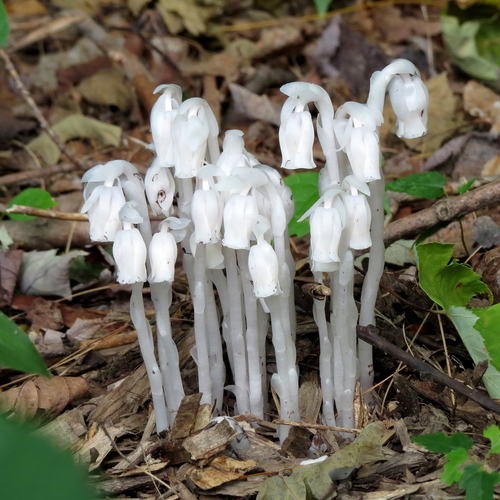
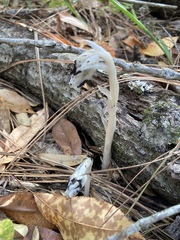
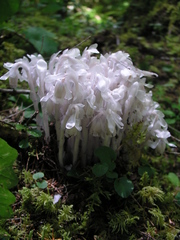
Ghost pipe (Monotropa uniflora) is a herbaceous perennial in the Ericaceae family, entirely without chlorophyll. Native to temperate North America and East Asia, it grows in dark, damp woodland, obtaining sugars through fungi connected to nearby tree roots rather than through photosynthesis.
Read moreGhost pipe and Indian pipe




© photo
(c) cgbb2004, some rights reserved (CC BY-NC), uploaded by cgbb2004 · cc-by-nc
Jade Fortnash · cc0
Lee Cain · cc-by
Taken Jul 14, 2021 by Frédérick Marois-Lefebvre (cc-by-sa)
© copyright of the Board of Trustees of the Royal Botanic Gardens, Kew.


Global distribution
Ghost pipe has a disjunct native range in temperate North America, from Canada to Mexico, and temperate East Asia, from northern Pakistan to the Russian Far East and Japan. Vast areas separate these two blocks, with no known populations between them, making this one of the most widely disjunct distributions in the plant kingdom.
- Native8
- Canada
- United States
- Mexico
- China
- Japan
- South Korea
- Russia (Far East)
- Nepal
Hexagons: regions where the plant occurs. Green dots: native range.1
Identity
Ghost pipe (Monotropa uniflora L., 1753), also called Indian pipe, is a herbaceous perennial in the Ericaceae family and the subfamily Monotropoideae. 1 2
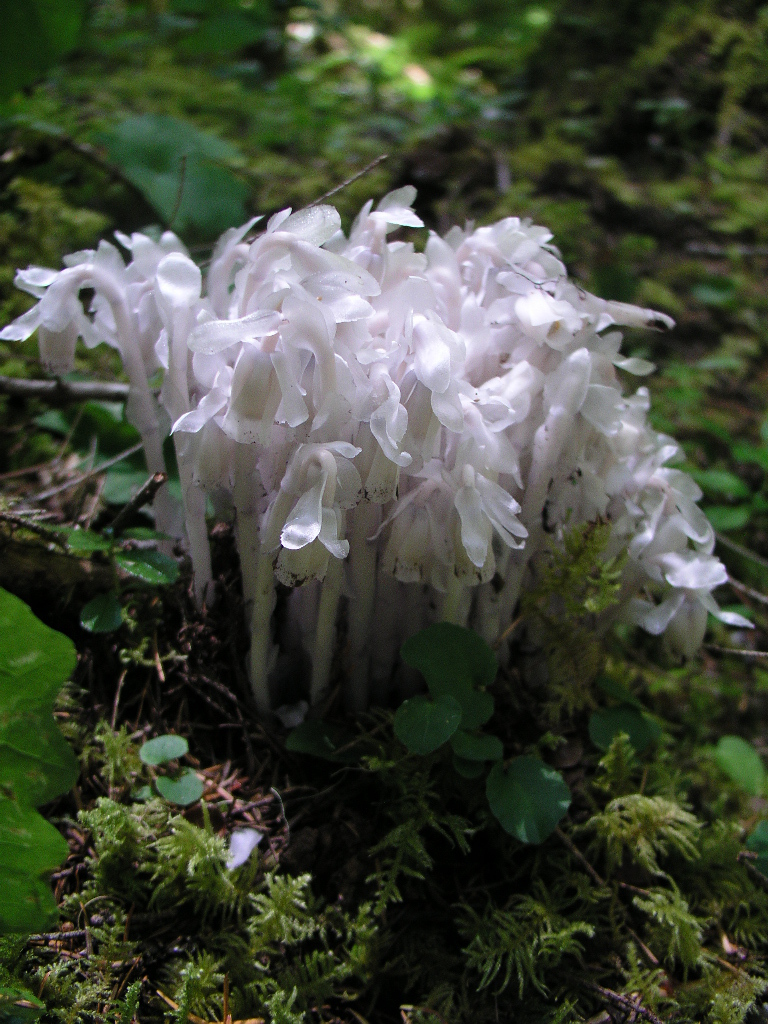
Almost all flowering plants produce chlorophyll, but ghost pipe produces none. Its stem and scale-like leaves remain waxy, translucent white, sometimes tinged pink or, in rare individuals, dark red. 4 8
Both English names, Indian pipe and Ghost pipe, describe its ghostly outline. Its white color and fleeting appearance in the woodland understory have associated it with mourning and forest silence in North American oral tradition. 7
Recognition
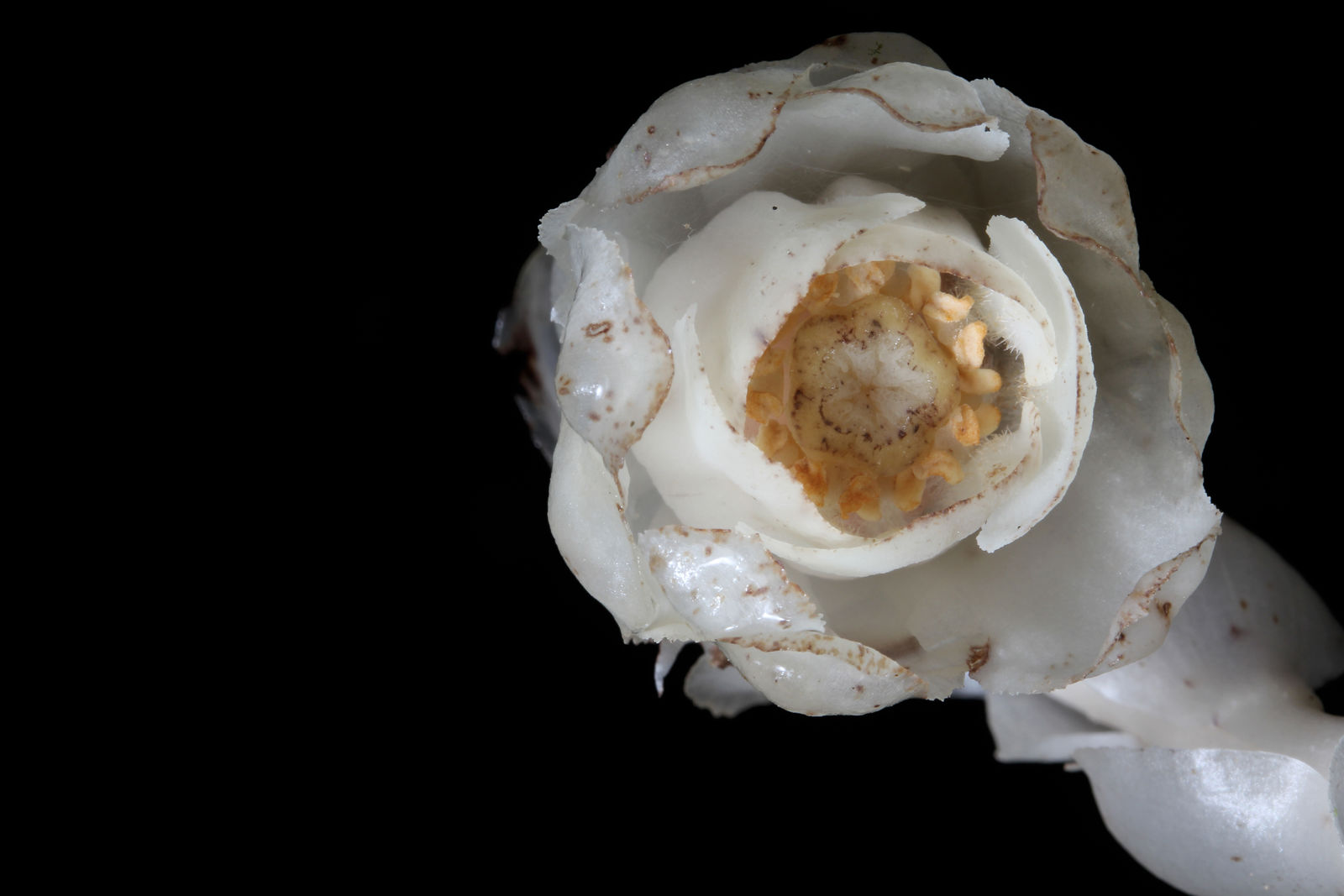
A single curved flower crowns each stem, which generally stands 5–30 cm (2–12 in) tall. The flower measures 1–2 cm (0.4–0.8 in) long, with 3–8 translucent petals and about ten stamens. Leaves are reduced to small 5–10 mm (0.2–0.4 in) scales that sheath the stem instead of forming a true blade. 8 4
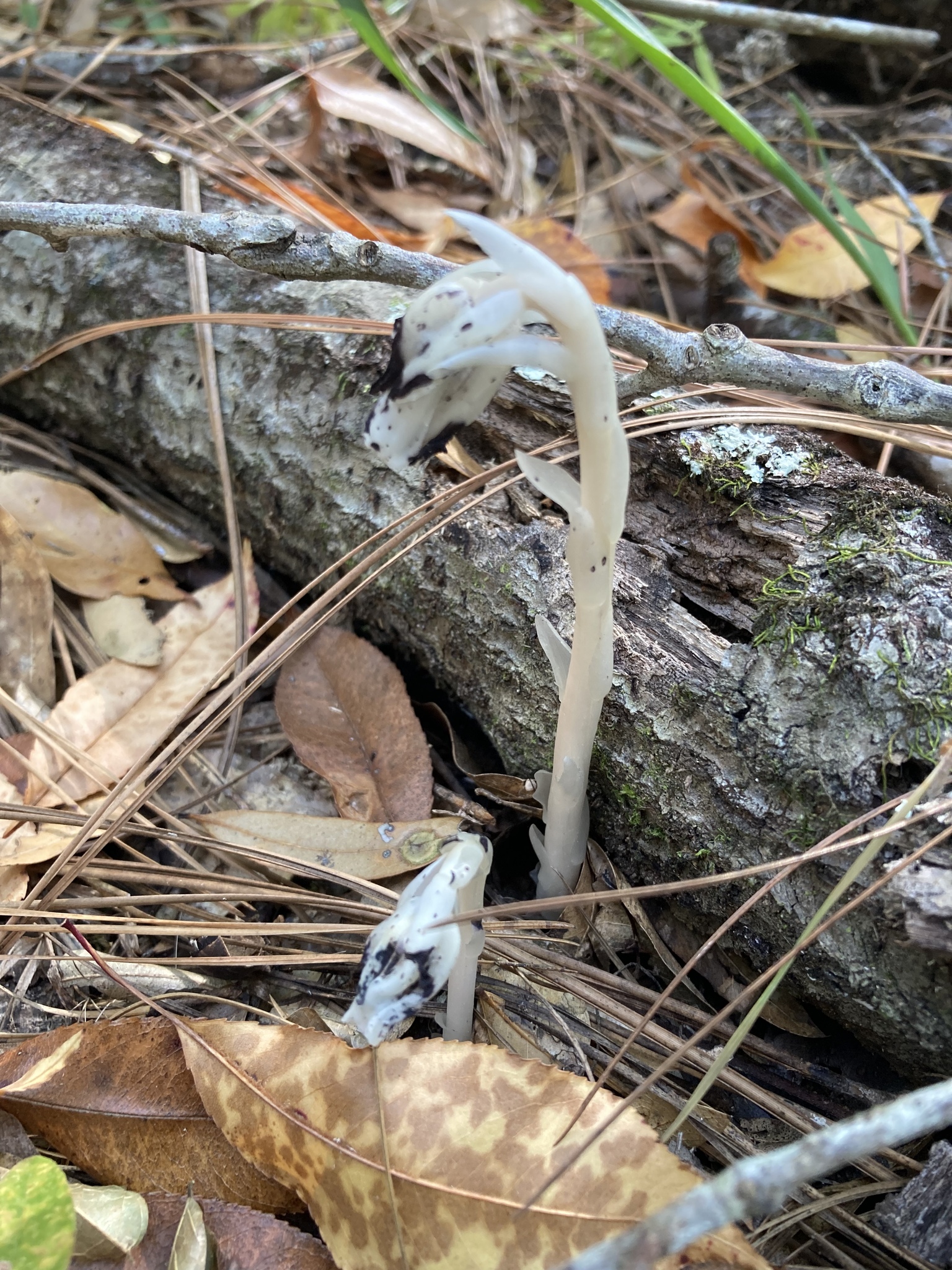
In the field, ghost pipe blackens within hours after picking or at full maturity. This is a more distinctive clue than its white color alone when separating it from fungi. The dry capsule that follows turns brown-black and releases tiny winged seeds 0.6–0.8 mm (0.02–0.03 in) long. 7 4
Without green leaves or visible roots resembling those of other woodland plants, ghost pipe is frequently mistaken for a mushroom at first sight. 5
Useful taxonomy
An older scientific name for ghost pipe is Hypopitys uniflora (L.) Crantz. The monotropes, now placed in Ericaceae, were formerly treated as a separate family, Monotropaceae. 1 8
The genus Monotropa contains two recognized species, Monotropa uniflora and pinesap (Monotropa hypopitys), which also occurs in Europe. One practical distinction separates them: M. uniflora has a single flower on each stem, while M. hypopitys has several flowers clustered on a hairy stem. 4 1
Habitat and mycoheterotrophy
Deep shade and abundant humus in deciduous or mixed forests provide ghost pipe's habitat, close to the roots of host trees. Its native range is strikingly discontinuous: temperate North America, from Canada to Mexico, and temperate East Asia, from northern Pakistan to the Russian Far East and Japan. Long distances with no known populations separate these areas. 1 5
Ghost pipe does not parasitize a tree directly. Through roots covered in specialized cystidia, it diverts sugars that ectomycorrhizal fungi in the genera Russula or Lactarius (Russulaceae) normally exchange with tree roots, including those of beech and certain conifers. This mycoheterotrophy explains its complete lack of photosynthesis. 7 6
Dependence on a fungal intermediary also explains why the plant is absent from full light and poor soil. Without a host fungus already connected to a living tree, a seed cannot develop, even when climate and moisture conditions otherwise seem suitable. 7
Its emergence is brief and unpredictable. Rain after a dry spell can bring a complete plant above ground in just a few days, so successful field observation depends heavily on local weather. 8
Life cycle and reproduction
Flowering takes place in summer into early fall, corresponding to July–September in the Northern Hemisphere, depending on latitude. Bumblebees in the genus Bombus do most of the pollination, crawling into flowers to collect pollen. 3 7
The raised stigma limits self-fertilization to about 20% of cases, promoting genetic mixing despite sparse, scattered populations. After pollination, the capsule dries and blackens before releasing tiny winged seeds through slits for wind dispersal. 7
Seeds contain very limited nutrient reserves. They must germinate immediately beside compatible fungal mycelium to survive, explaining why ghost pipe can be uncommon even in otherwise suitable habitat. Moth caterpillars also regularly attack nearly ripe seeds, further reducing the production of viable fruits. 7
Uses and risks
Several Indigenous peoples of North America used the clear stem sap as eye drops and a root decoction as a nerve sedative and toothache remedy. These are historical uses. 3
Cooked plants have been described as edible, with an asparagus-like flavor; raw plants are bland. Their reported chemistry, including glycosides, salicylic acid and grayanotoxins, calls for caution rather than routine consumption. No dedicated veterinary toxicity profile for pets has been published. 3 8
Attempts at horticultural cultivation face the same obstacle: without an established mycorrhizal network linking a compatible fungus and a living tree, neither sowing nor transplanting reliably establishes the plant outside its natural habitat. The few documented trials suggest, at most, sowing near a beech or conifer already hosting the right fungus, with no guarantee of success. 3
Varieties, look-alikes and related plants
There are no horticultural cultivars of ghost pipe. Pink or dark red plants found in the wild are individual variations rather than stable selections or distinct botanical varieties. 8
Its closest frequent look-alike is pinesap (Monotropa hypopitys), with several clustered flowers on a hairy, yellowish to brown stem. M. uniflora carries just one flower on a smooth white stem. 4
Before botanical identification, many observers mistake it for a mushroom or white mold. No familiar plant features seem to challenge that impression: it has neither green leaves nor a chlorophyll-bearing stem, and its roots are not visible above ground. 5
Main sources
- Plants of the World Online / Kew, Monotropa uniflora L.
- International Plant Names Index, Monotropa uniflora L. (Species Plantarum, 1753)
- Plants For A Future, Monotropa uniflora
- Go Botany / Native Plant Trust, Monotropa uniflora
- USDA PLANTS Database, Monotropa uniflora profile (MOUN3)
- Atlas of Florida Plants / University of South Florida, Monotropa uniflora
- Wikipedia FR, Monotropa uniflora
- Wikipedia EN, Monotropa uniflora
Frequently asked questions
Is ghost pipe a mushroom?
No. It is a flowering plant in the Ericaceae family, with a flower, stamens and a seed capsule. Its lack of chlorophyll and white color often lead first-time observers to mistake it for a fungus.
Can I grow ghost pipe in a garden?
In practice, no. The plant depends on an established mycorrhizal network linking a compatible fungus to a living tree. Neither sowing nor cuttings allow it to establish reliably outside its natural habitat.
Is ghost pipe poisonous?
Its toxicity remains uncertain. The plant contains glycosides, salicylic acid and grayanotoxins, which justify caution, but no dedicated veterinary toxicity profile for pets has been published.
Why does ghost pipe turn black so quickly?
Blackening follows picking, prolonged contact or simply full capsule maturity. It affects the entire fragile, waxy stem and makes the plant unsuitable for keeping as a cut flower.
How does ghost pipe differ from pinesap?
Monotropa hypopitys bears several flowers in a cluster on a hairy, yellowish to brown stem. Monotropa uniflora bears just one flower on a smooth white stem.
Where does the name Indian pipe come from?
It describes the stem curved at the tip, which early North American observers compared with a ceremonial pipe.
Is ghost pipe rare or threatened?
The species has not been assessed globally by the IUCN and remains widespread in suitable forests. Its brief, weather-dependent emergence makes it easy to overlook in the field.
Similar plants
If you are unsure about a plant’s toxicity, ask a botanist or veterinarian for advice.