
Cotton thistle (Onopordum acanthium, )
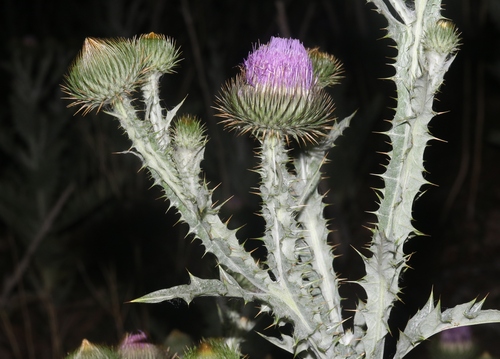
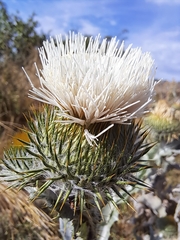
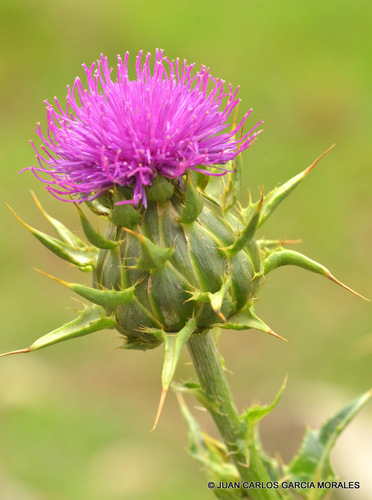
Cotton thistle (Onopordum acanthium L., 1753) is a biennial in the Asteraceae family, native to Europe and western Asia from the Iberian Peninsula to Kazakhstan and the western Himalayas. White woolly hairs give it a silvery appearance, while its robust stem carries continuous spiny wings and large rounded purple flower heads. Popular tradition associates it with Scotland's heraldic thistle, although it is not native to the British Isles.
Read moreCotton thistle, Scotch thistle, Scots thistle, Scottish thistle, Heraldic thistle and Woolly thistle

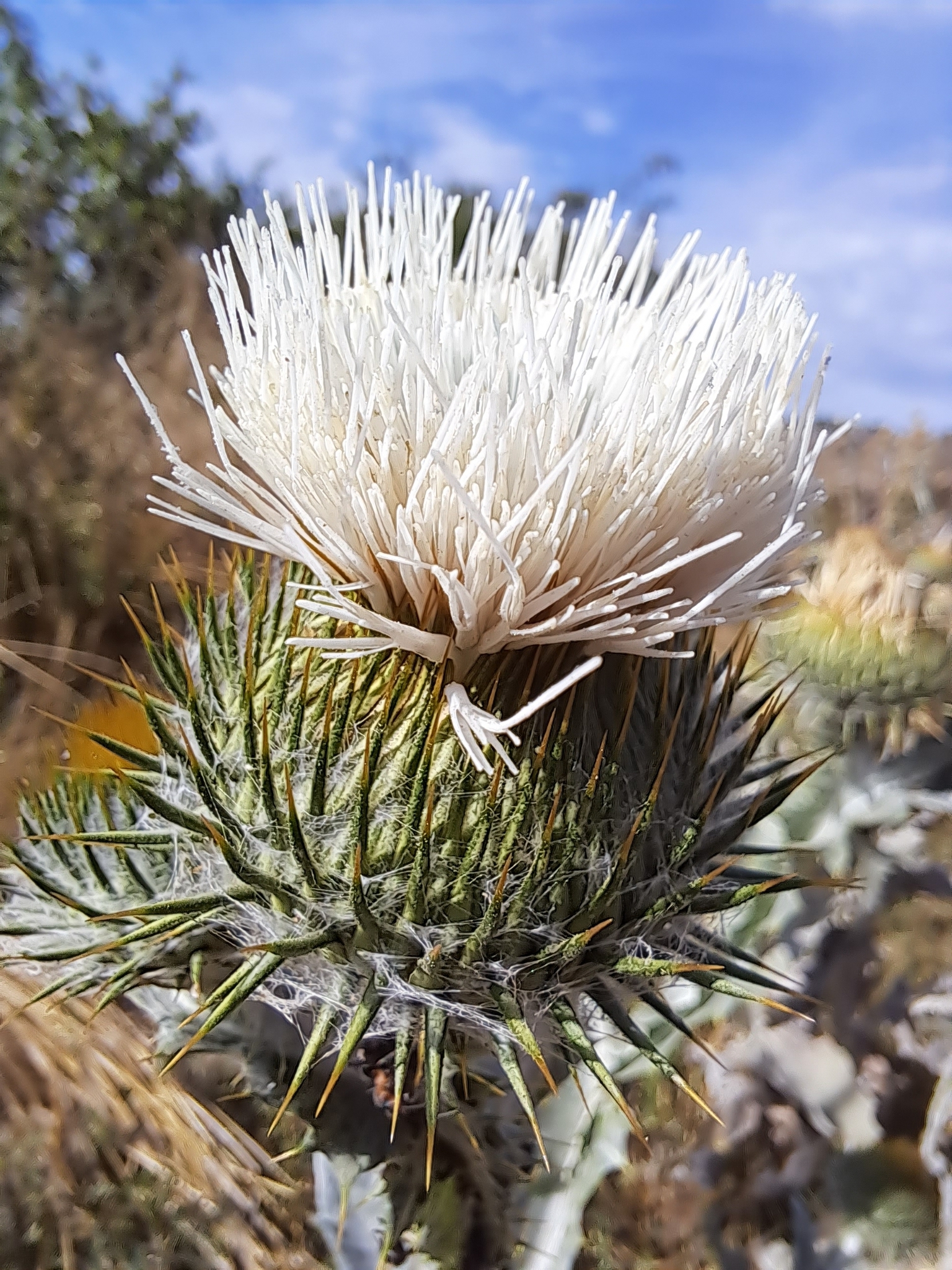


© photo
(c) James Bailey, some rights reserved (CC BY-NC), uploaded by James Bailey · cc-by-nc
Xavier · cc0
Andrew R. · cc-by
Taken May 18, 2013 by Tela Botanica − Genevieve BOTTI (cc-by-sa)
Taken May 29, 2014 by Tela Botanica − Dominique REMAUD (cc-by-sa)
Taken Jul 11, 2014 by Tela Botanica − Geneviève Botti (cc-by-sa)
Taken Jul 10, 2014 by Tela Botanica − Liliane Roubaudi (cc-by-sa)
Taken Jun 6, 2022 by Kai Best (cc-by-sa)
© copyright of the Board of Trustees of the Royal Botanic Gardens, Kew.




Global distribution
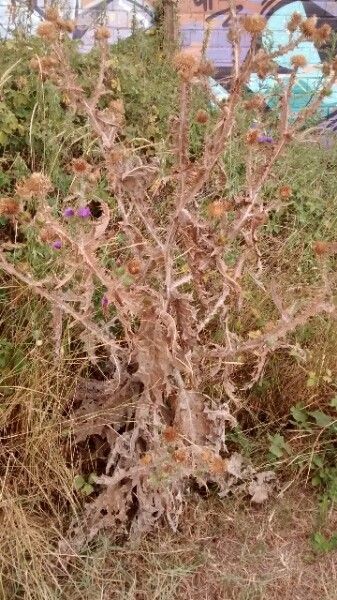
WCVP places the native range of Onopordum acanthium in Europe and western Asia, from the Iberian Peninsula to Xinjiang and the western Himalayas, extending into northwestern Africa and including mainland France. It is now naturalized on most continents, with especially large populations in the United States and Australia.
- Native4
- Introduced3
- Invasive2
- Mainland France
- Spain
- Greece
- Kazakhstan
- United Kingdom
- Canada
- New Zealand
- United States
- Australia
Hexagons: regions where the plant occurs. Green dots: native range.1
Identity
Cotton thistle (Onopordum acanthium L., 1753), also called Scotch thistle, is a biennial in the genus Onopordum, in the Asteraceae family. The genus name comes from Greek onos (donkey) and perdesthai (to fart): tradition held that donkeys grazing on the plant became especially flatulent, a rustic etymology repeated since antiquity. 5 1
The epithet acanthium comes from Greek akantha, meaning a thorn, referring to the stiff spines on the leaf margins and involucral bracts. Its French name, literally donkey thistle, reflects the same pastoral association: the fleshy flower receptacle and bases of the bracts, rich in inulin, were traditionally fed to donkeys. 4 6
Popular tradition identifies cotton thistle as Scotland's heraldic thistle, linked to the legend of a Viking invader betrayed by a thorn under his bare foot. Yet the species is not native to the British Isles. Some botanists assign this role to Cirsium vulgare, which occurs in Scotland, whereas Onopordum acanthium was introduced later. 5
Recognition
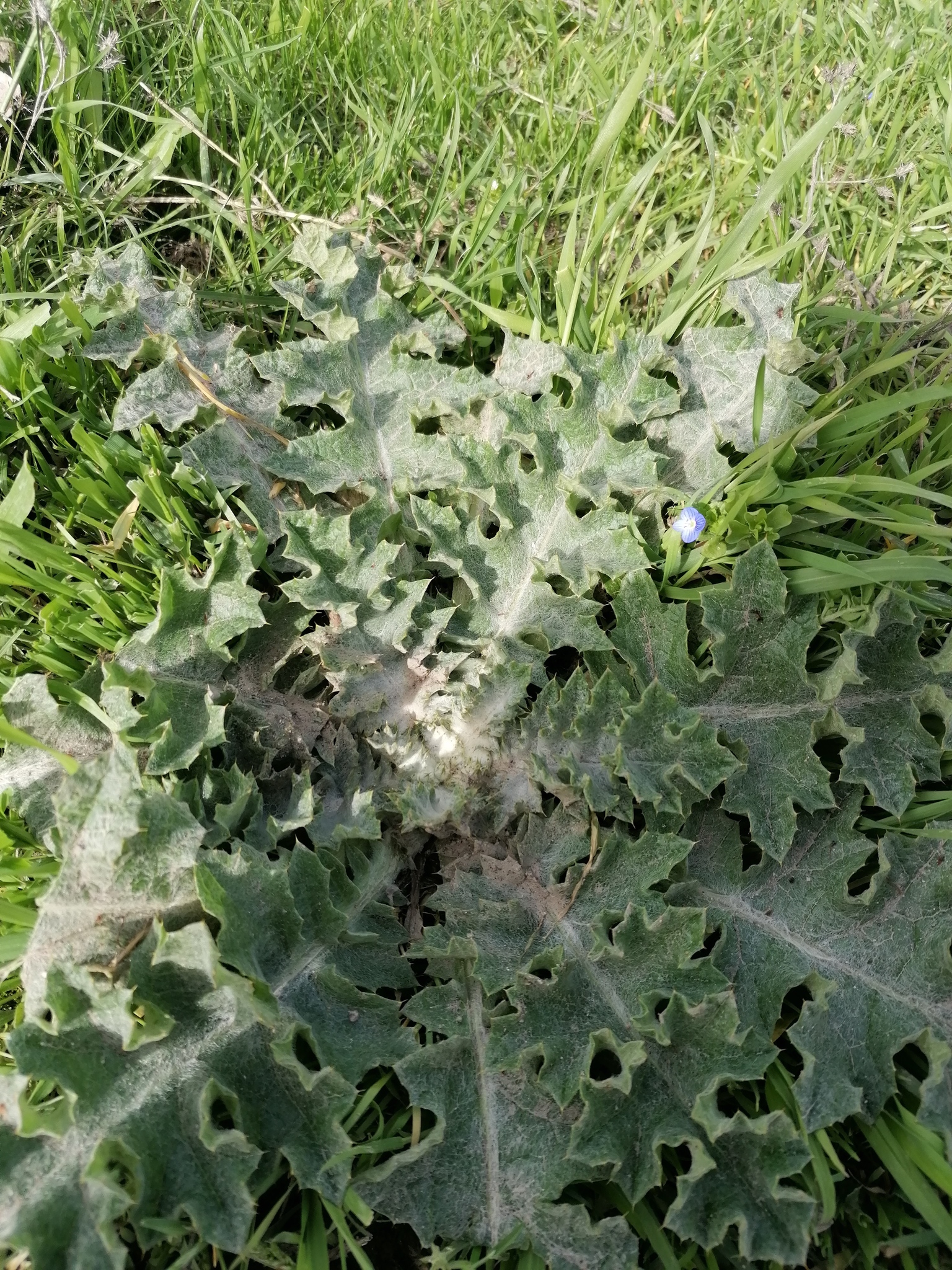
A distinctive white woolly covering across the whole plant, including both leaves and stems, gives Onopordum acanthium its uniformly silvery appearance. This covering helps separate it from other European thistles and explains the names cotton thistle and woolly thistle. 5 2
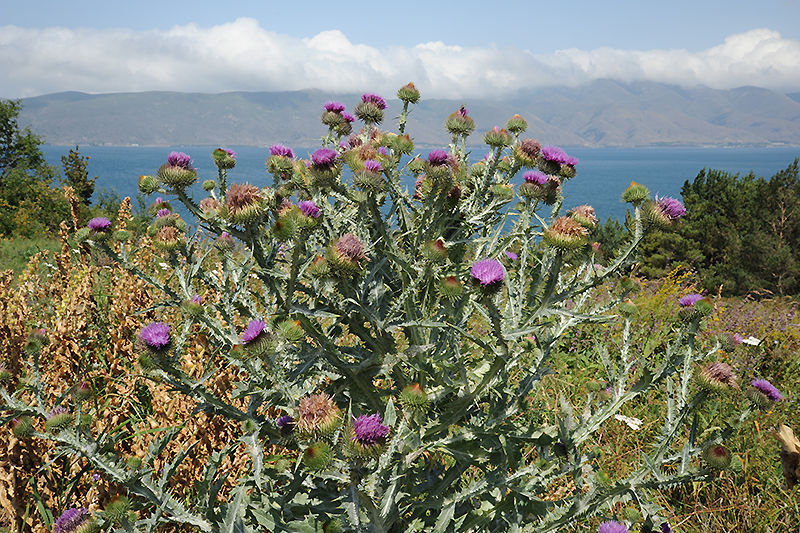
Plants commonly reach 1.5–3 m (5–10 ft) tall. The robust stem can measure 10 cm (4 in) thick at the base and carries continuous spiny leaf wings 2–3 cm (0.8–1.2 in) wide along its full height. The leaves, 10–50 cm (4–20 in) wide, are deeply lobed and edged with long, stiff spines. 5 2
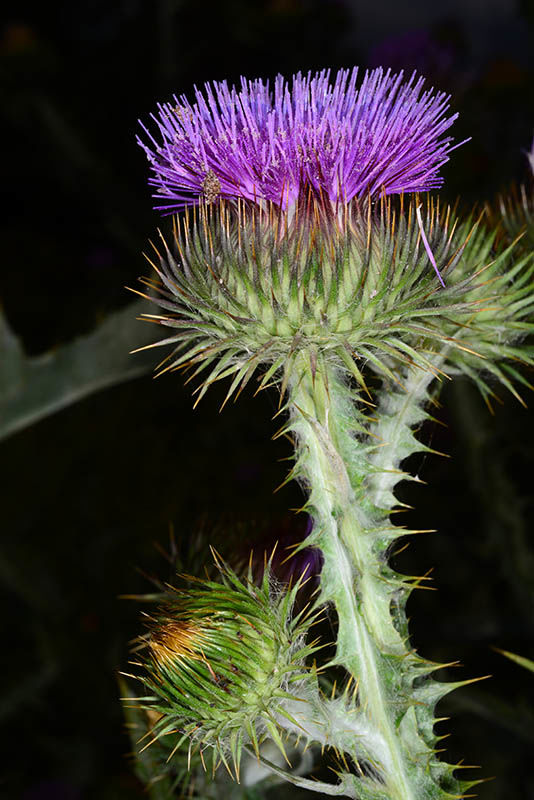
Rounded flower heads measure 2.5–6 cm (1–2.4 in) across, with purple to pink florets surrounded by numerous spiny bracts. In its Northern Hemisphere setting, flowering extends from early summer into early fall, June to September. 6 2
Useful taxonomy
Onopordum acanthium L. is accepted by Plants of the World Online and is the type species of Onopordum. Linnaeus published both in Species Plantarum in 1753. The World Checklist of Vascular Plants recognizes several infraspecific taxa relevant to precise field identification:
- Onopordum acanthium subsp. gautieri (Rouy) R.C.V.Douin, restricted to the central and eastern Pyrenees
- Onopordum acanthium subsp. gypsicola Gonz.Sierra & al., described from Spain
- Onopordum acanthium subsp. ceretanum (Sennen) Arènes, also Pyrenean
- Onopordum acanthium var. araneosotomentosum (Rech.f.) Parsa, described from Iran
These regional taxa share the species' overall outline but occupy limited ranges: subsp. gautieri occurs only in the central and eastern Pyrenees. Outside those areas, the typical subspecies acanthium remains the main reference for reliable field identification because it covers most of the range. 1 5
Habitat and range
WCVP records a native range across Europe and western Asia, from the Iberian Peninsula to Xinjiang and the western Himalayas, extending into northwestern Africa and including mainland France. In the field, cotton thistle colonizes waste ground, roadsides, abandoned pastures and disturbed, nitrogen-rich soils in full sun. 1 5
Introduced outside its native range as an ornamental in the late 19th century, the species formed especially large populations in the United States and Australia and is now recorded in nearly fifty countries. In Utah, the occupied area more than tripled in eight years: about 6,070 hectares (15,000 acres) across 17 counties in 1981 became more than 22,540 hectares (55,700 acres) across 22 counties in 1989. 7 8
Dense stands form an almost impassable barrier for livestock and people. They reduce access to grazing, causing economic losses for livestock farmers in invaded regions. 7
Life cycle and reproduction
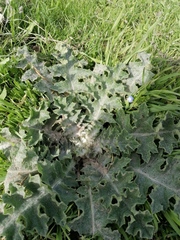
A biennial, strictly monocarpic cycle begins mainly with autumn germination. Germination depends on light and succeeds best near the soil surface. A spiny, woolly rosette then develops, with a taproot reaching more than 30 cm (12 in) deep in the first year and no flowering stem. 5 3
After overwintering as a rosette, the flowering stem develops the following spring and flowers from early summer into early fall in its Northern Hemisphere range. One plant can produce 8,400–40,000 seeds, dispersed by wind with the help of their feathery pappus. 5
Buried seeds remain viable in the soil for 7–20 years. This persistence explains why a single episode of mowing or uprooting is never enough to eliminate an established population. 5
Uses and risks
The flower receptacle can be prepared as a small, labor-intensive artichoke substitute, and peeled young stems can replace cardoon. Seeds yield an edible oil at about 25% oil content, with no documented toxic risk from ingestion. 3
Traditional medicinal uses included applying the juice to cancers and ulcers and using a root decoction as an astringent. Flowering plants also entered cardiotonic preparations. More recent work has explored activity against glioblastoma, but this does not establish a medical use. 3 5
The main hazard is mechanical: stiff spines on the stems, leaves and bracts irritate skin and the muzzles of livestock, which avoid the plant while grazing. This avoidance favors its spread as competing vegetation is removed and new rosettes establish on disturbed ground. 2 7
Control and look-alikes
Mowing or uprooting at the rosette stage is more effective than intervening after the flowering stem has developed. Failing that, cutting the heads as they turn brown prevents wind dispersal of the seeds. Herbicides likewise work better at the rosette stage than after flowering; several years of treatment remain necessary because the seed bank persists. 7
Biological control has had mixed results. The flower-head weevil Rhinocyllus conicus, introduced as a control agent, itself became invasive, while the crown weevil Trichosirocalus horridus has shown promising results in Australia. 7
The most likely look-alike is Cirsium vulgare. White woolly hairs cover all of Onopordum acanthium, including the stem, whereas in Cirsium vulgare they are confined to the leaf undersides and the stem's spiny wings are much narrower. Carduus nutans, with its nodding habit and solitary flower heads, and Silybum marianum, with white-marbled but non-woolly leaves, can also cause confusion at the rosette stage. 5
Main sources
- Plants of the World Online / Kew, Onopordum acanthium L.
- Royal Horticultural Society, Onopordum acanthium - cotton thistle
- Plants For A Future, Onopordum acanthium
- Tela Botanica, BDTFX, Onopordum acanthium L.
- Wikipedia EN, Onopordum acanthium
- Wikipedia FR, Onopordum acanthium
- Invasive Species Info / USDA, Scotch thistle profile
- USDA PLANTS Database, Onopordum acanthium (ONAC)
Frequently asked questions
Is cotton thistle toxic to cats and dogs?
No ingestion toxicity is documented in dogs, cats or humans. The main hazard is mechanical: stiff spines cover the stems and leaves.
Is cotton thistle really Scotland’s emblem?
That is the most widespread tradition, linked to the legend of a Viking soldier betrayed by a thorn beneath his bare foot. The species is not native to the British Isles, however; some botanists assign this role to Cirsium vulgare, which occurs in Scotland.
How can I distinguish Onopordum acanthium from Cirsium vulgare?
White woolly hairs cover the whole of Onopordum acanthium, including the stem, whereas they are confined to the leaf undersides in Cirsium vulgare. The spiny stem wings are also much broader in cotton thistle.
Can you eat cotton thistle?
Some parts have been eaten. The flower receptacle is prepared as an artichoke substitute, peeled young stems replace cardoon, and the seeds yield edible oil at about 25% oil content.
Why is cotton thistle invasive in the United States and Australia?
Introduced as an ornamental in the late 19th century, it formed large populations without its original natural enemies. In Utah, the occupied area increased from about 6,070 hectares (15,000 acres) in 1981 to more than 22,540 hectares (55,700 acres) in 1989.
How long do the seeds remain viable in soil?
Buried seeds can remain viable for 7–20 years, explaining why one year of mowing or uprooting is never enough to eliminate an established population.
When is the best time to limit its spread?
The rosette stage, before the flowering stem develops, is the most effective time. Failing that, mowing or removing the flower heads before they open prevents wind dispersal of the achenes.
Similar plants
If you are unsure about a plant’s toxicity, ask a botanist or veterinarian for advice.