
Persian ironwood (Parrotia persica, )


Persian ironwood (Parrotia persica) is a deciduous tree or large shrub in the Hamamelidaceae, endemic to a narrow strip south of the Caspian Sea, from northern Iran to southeastern Azerbaijan. Its bark peels in gray, cream and brown patches. Petal-free flowers with red stamens open on bare branches in late winter, followed later in the year by some of the brightest fall foliage among temperate trees.
Read morePersian ironwood, Persian parrotia and Iron tree
Allow a few hours of direct sun per day, preferably morning or evening.
Full sun for the best fall color


© photo
Wikimedia Commons · CC BY-SA or Public Domain
Wikipedia · CC BY-SA
© copyright of the Board of Trustees of the Royal Botanic Gardens, Kew.
Global distribution
Parrotia persica is native only to a narrow strip south of the Caspian Sea, on the humid foothills of the Alborz Mountains in Iran and the Talysh Mountains in Azerbaijan. Grown in Europe since the mid-19th century, it is now planted as an ornamental tree in many temperate countries, with no documented naturalization outside its native range.
Identity
Persian ironwood (Parrotia persica (DC.) C.A.Mey., 1831), also called Persian parrotia or iron tree, is a deciduous tree or large shrub in the Hamamelidaceae, related to Hamamelis. After about thirty years, the smooth gray bark of a young tree breaks into cream, green and brown patches, an identifying feature even without leaves or flowers. Geneva botanist Augustin Pyramus de Candolle first described it as Hamamelis persica in 1830. 1 2
A separate genus followed in 1831, when Carl Anton von Meyer established Parrotia in honor of his friend and predecessor at the University of Dorpat, Baltic German naturalist Friedrich Parrot. In 1829 Parrot had made the first documented ascent of Mount Ararat, not far from the tree's natural range. 7
The common name ironwood refers to the hardness and density of the wood. Several unrelated trees share that name in different parts of the world, so it does not indicate a botanical relationship. 5
Recognition
Winter exposes the most dependable feature: patterned bark that is easier to recognize than a young tree's still-developing outline. Initially smooth and gray, it breaks with age into irregular cream, green, gray and brown plates. This jigsaw pattern becomes more pronounced after about thirty years, as the tree reaches maturity. 6 4
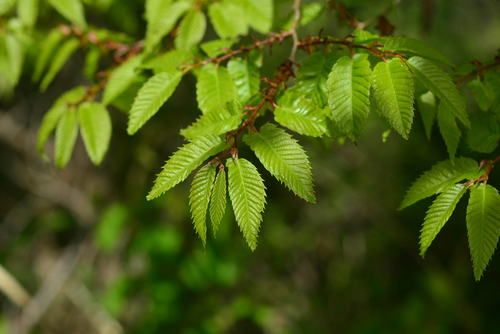
Simple, alternate leaves are 6–10 cm (2.4–4 in) long, oval to oblong, with wavy, coarsely toothed edges. They emerge reddish purple in spring, become glossy green in summer, then turn yellow, orange, red and sometimes purple in fall. Exposure within the crown affects each leaf, allowing several colors on the same tree. 7 5
Petal-free flowers consist of tight clusters of red stamens about 1 cm (0.4 in) across, surrounded by downy brownish bracts. They open on bare wood in late winter, before the leaves, providing another clue when bark alone leaves doubt. 6 4
Garden specimens commonly reach 4–12 m (13–39 ft) as multistemmed shrubs or rounded trees with a single trunk. Some forest trees exceed 20 m (66 ft). Growth remains slow to moderate. 7 4
Useful taxonomy
The accepted scientific name is Parrotia persica (DC.) C.A.Mey. Its basionym, the name under which it was first described, is:
- Hamamelis persica DC., 1830 (basionym)
Only one other species is recognized in Parrotia, endemic to eastern China:
- Parrotia subaequalis (Hung T.Chang) R.M.Hao & H.T.Wei, 1998 (Chinese species)
Chinese parrotia was long treated as a variety of Persian ironwood. Morphological and chromosome differences led to its recognition as a distinct species, almost 8,000 km (5,000 miles) from the Iranian range. 1 8
Habitat and range
A narrow belt south of the Caspian Sea contains the entire natural range of Parrotia persica. It grows on humid foothills of the Alborz Mountains in Iran and the Talysh Mountains in Azerbaijan, up to about 1,400 m (4,600 ft) elevation. 7 1
These are the humid temperate Hyrcanian forests, protected in places including Iran's Golestan National Park and Azerbaijan's Hirkan reserve. Locally, Persian ironwood forms almost pure stands. 7
European cultivation began in the mid-19th century, first at the imperial garden in St. Petersburg and then at Kew. Ornamental planting has since spread to France, the United Kingdom and North America, with no documented naturalization outside the native range. 7 5
Life cycle and flowering
Before the leaves emerge, flowers open from February to April in the Northern Hemisphere, depending on climate. Without visible petals, they are easily overlooked at a distance. Close up, clusters of red stamens on bare branches form a colored haze characteristic of the Hamamelidaceae. 4 6
A brown, downy, woody capsule less than 2 cm (0.8 in) long develops after flowering and encloses one or two glossy seeds. At maturity it bursts open and throws out its seeds, a dispersal mechanism shared with witch hazels. 5
Nursery seed propagation requires cold stratification and remains irregular. Named cultivars are usually propagated by softwood cuttings under mist, or by grafting for forms that are difficult to root. 3
Uses and risks
Winter flowers and fall foliage make Persian ironwood a valued lawn specimen, small street tree or garden accent. Its principal use is ornamental, with those two seasons providing distinct displays. 5 4
Neither ASPCA lists nor university extension accounts identify it as poisonous; no toxic compound is documented for cats, dogs or humans. It is also considered little troubled by pests or diseases, although occasional Japanese beetle damage is reported in North America. 5 6
Established trees tolerate roughly −20 °C (−4 °F), drought, lime and urban pollution. They adapt to chalky, clay, loamy or sandy soils. Permanently waterlogged ground is the exception: it deprives roots of oxygen, even on mature, firmly established trees. 3 7
Varieties, look-alikes and related plants
More than forty cultivars have been named, mainly for shape or fall color. Columnar 'Vanessa', a recipient of the RHS Award of Garden Merit, remains the most widely marketed. 'Ruby Vase' and 'Persian Spire' also have narrow, upright habits, while 'Bella' is distinguished by reddish-purple spring growth. 3 7
Potential look-alikes include several different groups:
- Hamamelis spp., in the same family, with yellow or orange ribbonlike flowers rather than tufts of red stamens;
- Parrotia subaequalis, a Chinese look-alike separated by geography and chromosome differences;
- Platanus spp., which resemble it only in their peeling, patchy bark and are not close botanical relatives.
A nursery label is less reliable than the accepted scientific name when buying a tree. Parrotia persica and its named cultivars belong to the same taxon, regardless of the common name a garden center uses. 1
Main sources
- Plants of the World Online / Kew, Parrotia persica (DC.) C.A.Mey.
- International Plant Names Index, Parrotia persica (DC.) C.A.Mey.
- Royal Horticultural Society, Parrotia persica 'Vanessa'
- Missouri Botanical Garden Plant Finder, Parrotia persica
- NC State Extension, Parrotia persica (Iron Tree, Persian Ironwood)
- Clemson HGIC, Persian Parrotia
- Trees and Shrubs Online, Parrotia persica
- Arnoldia / Arnold Arboretum, The Chinese Parrotia, a sibling species of the Persian Parrotia
Frequently asked questions
Is Persian ironwood a witch hazel?
No, but the two genera are close relatives within Hamamelidaceae. Both flower on bare winter branches, but Persian ironwood has tufts of red stamens rather than the yellow or orange ribbons seen in witch hazels.
Is Persian ironwood poisonous to cats and dogs?
Neither ASPCA lists nor university extension accounts include Parrotia persica among poisonous plants. Contact irritation is not reported for the species either.
Why does one tree show several fall colors at once?
The dominant pigment varies between leaves according to exposure and position in the crown, producing a mixture of yellow, orange, red and sometimes purple on a single tree in fall.
Is Persian ironwood invasive?
No documented naturalization or invasiveness has been found outside its native range. It remains an ornamental tree with no reported invasive behavior.
How does it differ from Parrotia subaequalis?
Parrotia subaequalis is the only other member of the genus, endemic to eastern China and separated from Persian ironwood by almost 8,000 km (5,000 miles). Long treated as a Chinese variety, it was recognized as a distinct species on morphological and chromosome evidence.
Does Persian ironwood need pruning?
Rarely. Its naturally balanced shape needs little intervention. Light winter pruning during frost-free weather is enough to train a young tree or remove dead wood.
Who was Parrotia named after?
The genus honors Baltic German naturalist Friedrich Parrot, who made the first documented ascent of Mount Ararat in 1829. Botanist Carl Anton von Meyer dedicated the new genus to him in 1831.
Similar plants
If you are unsure about a plant’s toxicity, ask a botanist or veterinarian for advice.