
Fall phlox (Phlox paniculata, )
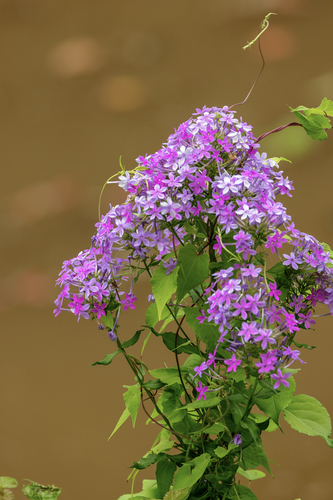
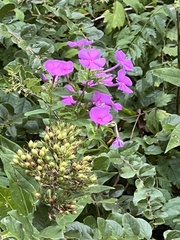
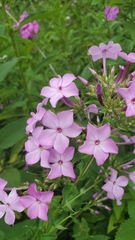
Fall phlox (Phlox paniculata) is an herbaceous perennial in the Polemoniaceae family, native to the eastern and central United States. In Northern Hemisphere gardens, its upright stems carry large, domed clusters of fragrant tubular flowers from July to September, making it a classic summer border perennial.
Read moreFall phlox, Panicled phlox, Summer phlox, Perennial phlox and Garden phlox
Allow a few hours of direct sun per day, preferably morning or evening.
Full sun; tolerates light partial shade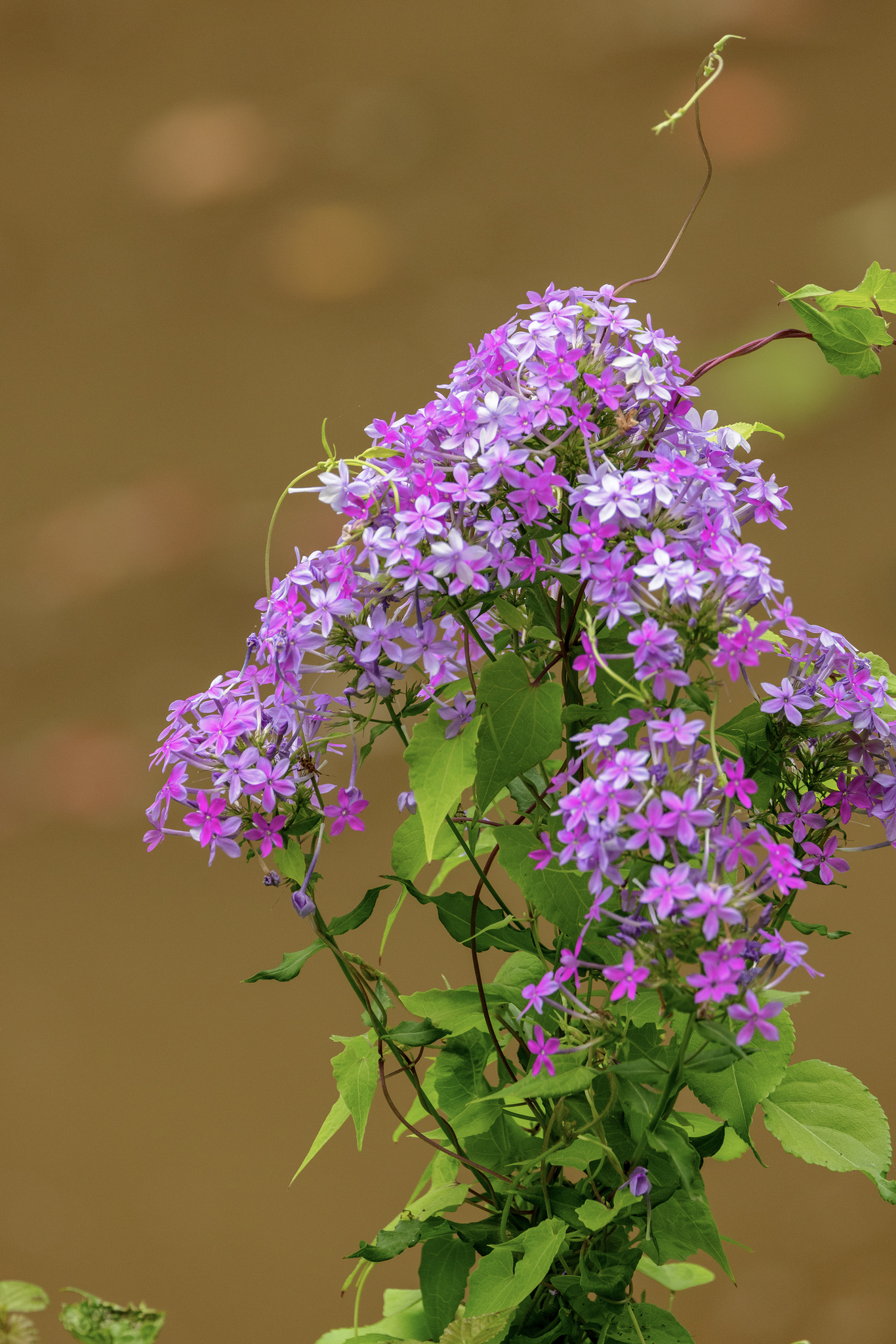



© photo
iNaturalist User · cc0
Anne Parker · cc0
Lexi Destria · cc-by
Taken Aug 29, 2022 by Jim Knopf (cc-by-sa)
Taken Apr 4, 2022 by Jim Knopf (cc-by-sa)
Taken May 31, 2015 by Tela Botanica − Maria Eugênia Secco (cc-by-sa)
Taken Jul 24, 2020 by vincent ca (cc-by-sa)
Taken Mar 1, 2020 by Karine Attali (cc-by-sa)
© copyright of the Board of Trustees of the Royal Botanic Gardens, Kew.




Global distribution
Phlox paniculata is native from New York State and Iowa in the north to Georgia, Mississippi and Arkansas in the south, mainly east of the Mississippi River. Widely cultivated since the nineteenth century, it has also become locally naturalized beyond this range, in North America and elsewhere, without being considered invasive worldwide.
- Native1
- Introduced1
- United States (east and center)
- Canada (southeast)
Hexagons: regions where the plant occurs. Green dots: native range.1
Identity
Fall phlox (Phlox paniculata L., 1753), also called panicled phlox, perennial phlox or summer phlox, is an herbaceous perennial in the Polemoniaceae family. Its fragrant panicles flower from July to September in Northern Hemisphere gardens, after many spring perennials have finished. Carl Linnaeus described it in 1753 in the work that established the genus Phlox; its accepted name has remained unchanged. 1 7
The Greek word phlox means flame: Linnaeus chose it for the vivid color of some members of this genus, which now includes 68 species, almost all North American. Garden phlox describes its familiar horticultural role, while fall phlox refers to flowering that often continues until the first frosts. 8
Recognition
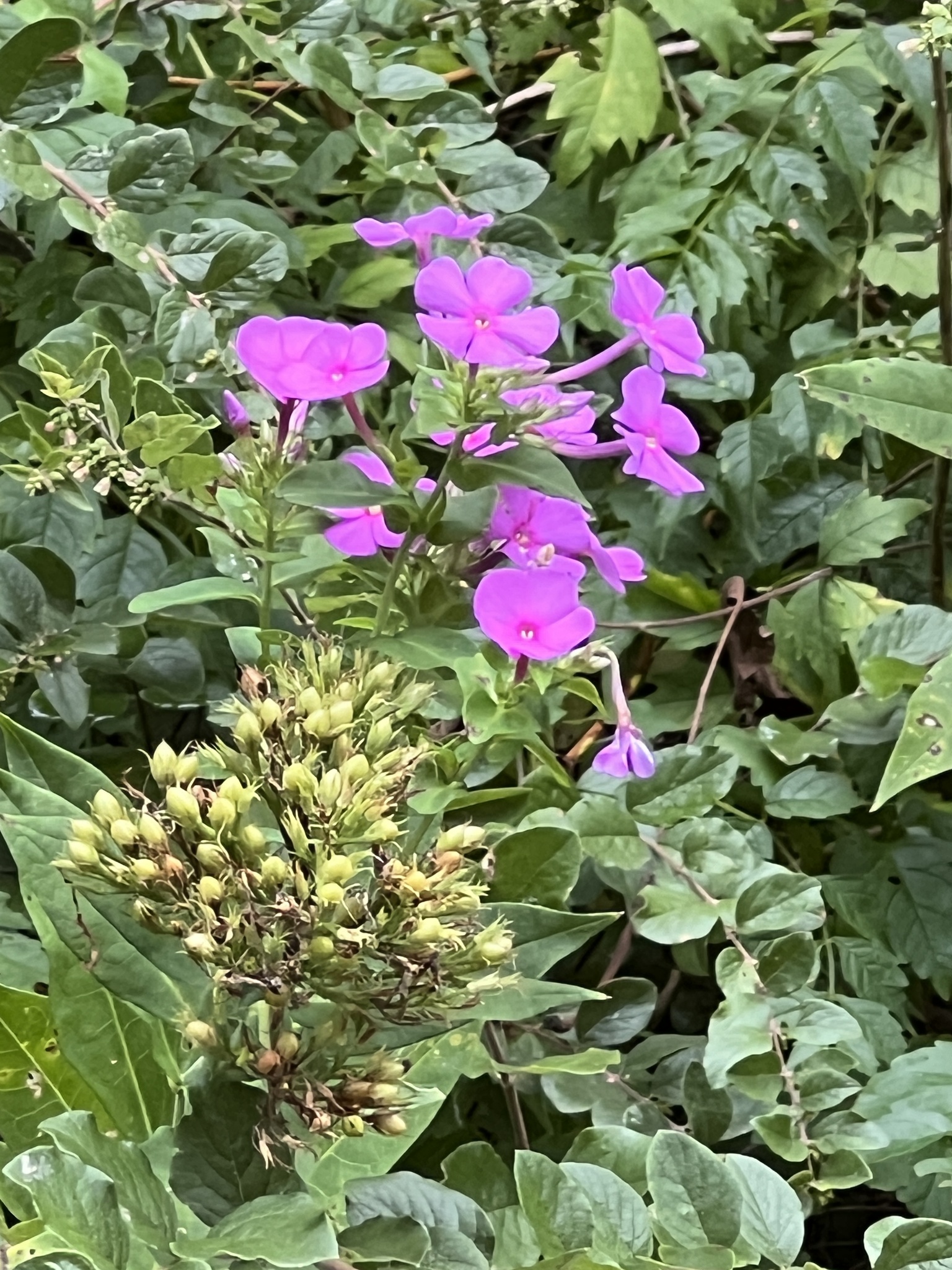
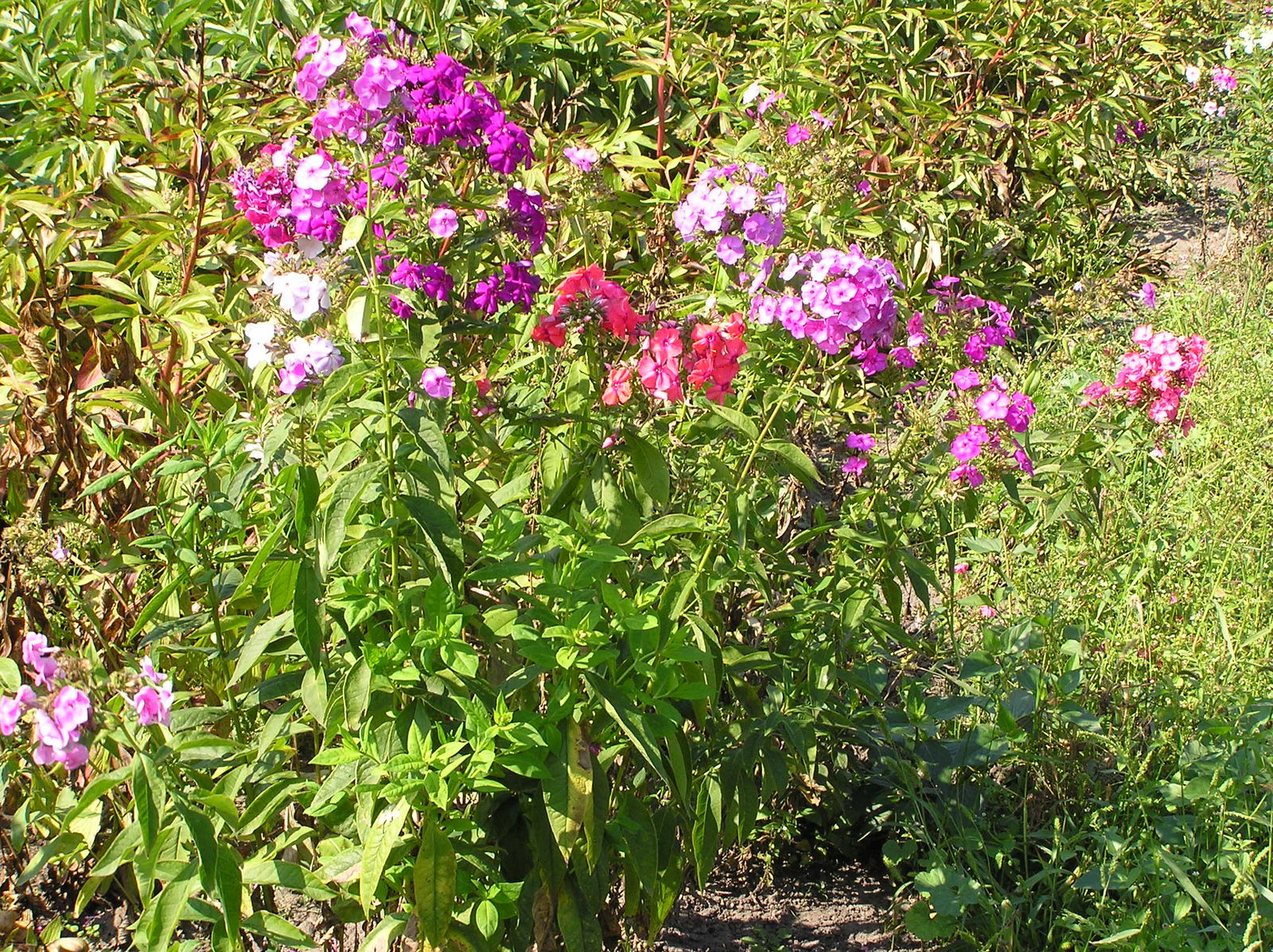
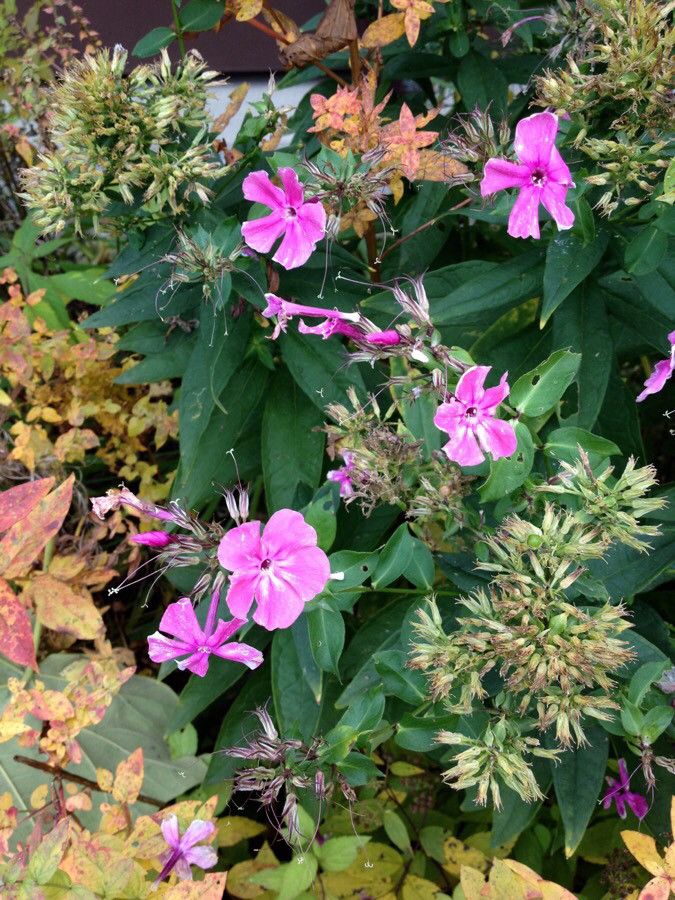
Upright clumps of Phlox paniculata carry stems unbranched at the base, 60 cm to 1.5 m (2–5 ft) tall, with a spread of 50–100 cm (20–39 in). Opposite, elliptical, pointed leaves measure 10–15 cm (4–6 in) long. The foliage stays clear green and the stems lack spots or speckles. 2 4
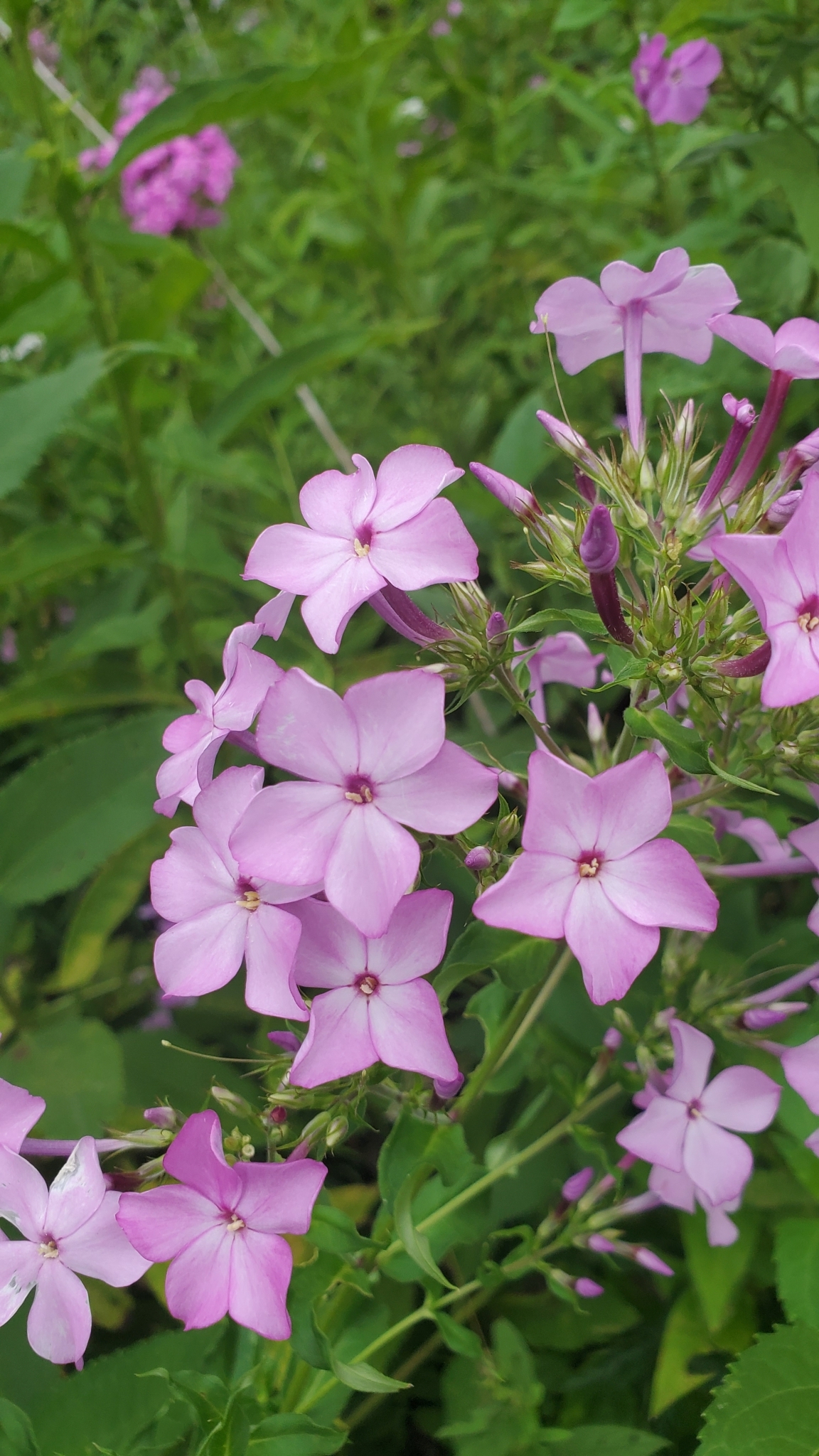
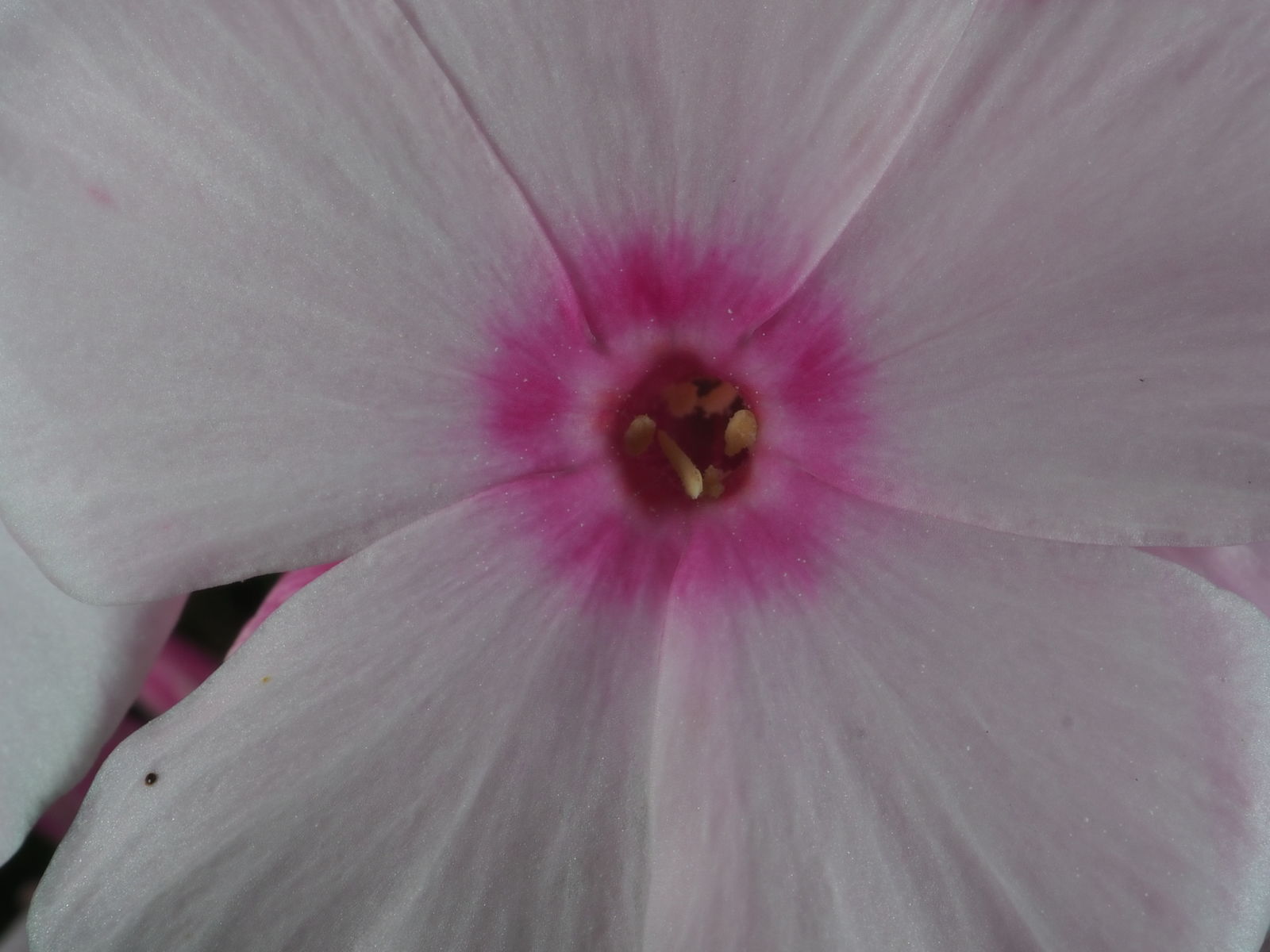
Tubular, five-lobed flowers measure 1.5–2.5 cm (0.6–1 in) across and gather into broad, domed panicles 15–20 cm (6–8 in) wide at the stem tips. Their sweet fragrance, often noticeable before the plant comes into view, is one of its best-known garden traits. 3 4
Expect flowering from July to September in the Northern Hemisphere, later than many border perennials, in pink, purple, white, red or orange depending on the cultivar. Red spotting near the stem base almost always points to Phlox maculata, a related species that flowers earlier; Phlox paniculata keeps plain green stems throughout. 3
Useful taxonomy
For this species, POWO accepts Phlox paniculata L. More than two centuries of intensive cultivation have left at least six recorded synonyms, several now found mainly in old catalogs and herbaria:
- Phlox decussata G.F.Lyon ex Pursh, a historical synonym
- Phlox acuminata Pursh, a historical synonym
- Phlox undulata Aiton, a historical synonym
- Phlox paniculata var. acuminata (Pursh) A.Gray, a historical synonym
- Armeria paniculata (L.) Kuntze, a historical synonym
- Phlox corymbosa Sweet, a historical synonym
The name decussata is especially useful to recognize. Horticulture long used it collectively for summer phlox hybrids and cultivars, including in nineteenth-century catalogs, although botanically it is simply a synonym of Phlox paniculata. 1 7
Habitat and range
From New York State and Iowa south to Georgia, Mississippi and Arkansas, fall phlox grows mainly east of the Mississippi River. Its habitats include open woods, thickets, often calcareous slopes, and stream banks and gravel bars. 5 6
Cold tolerance helps explain its spread beyond that range. Clumps cut back in late fall withstand temperatures below −20 °C (−4 °F), corresponding to USDA zones 4–8 and RHS H7, without special winter protection in most temperate gardens. 2 Widely cultivated in Europe and North America since the nineteenth century, it has also naturalized locally beyond its native range, including some urban and suburban areas of North America, without being considered invasive worldwide. 4
Life cycle and reproduction
Dividing established clumps in spring or fall is the fastest way to propagate plants ready to flower. Basal cuttings in spring and root cuttings in late fall also preserve a particular cultivar without growing it from seed. 2 3
Seed propagation takes longer and does not preserve the parent cultivar reliably. Seedlings may have paler flowers than their parent, a familiar occurrence in older borders allowed to self-seed. Initial flowering is sparse; full flowering begins only in the second or third year. 3
An established fall phlox clump expands from its crown each year and produces more flowering stems. After several years without intervention, its center thins and flowering becomes less dense. Division every 3 to 4 years renews the display and supplies new plants for the same border or another site. 2
Uses and risks
Summer perennial borders are the main setting for Phlox paniculata, planted toward the back for its height, dense flowers and fragrance. Its tubular flowers attract bees, butterflies and, within its native range, hummingbirds at a time when some other perennials have finished flowering. 4 3
Neither foliage nor flowers contain an identified toxic compound, and common horticultural databases do not list the species among plants toxic to cats or dogs. Toxicity in horses is undocumented. 5
Powdery mildew is the main cultivation risk, rather than toxicity. Poor air circulation and overhead watering favor this frequently reported disease; generous spacing and watering at soil level reduce the problem considerably. 4 2
Varieties, look-alikes and related plants
Decades of garden selection, beginning in the nineteenth century, have produced dozens of cultivars. Eva Cullum and Starfire offer classic pink and crimson flowers; Grey Lady and Prince of Orange add less common gray-mauve and orange shades. Norah Leigh has cream-variegated leaves. David resists powdery mildew much better than the wild type, making it a useful first choice in humid climates or dense borders. 2
Check the lower stems when distinguishing Phlox maculata: their red spots explain its epithet. It flowers earlier and resists powdery mildew better than Phlox paniculata. The hybrids Phlox × arendsii, crosses with Phlox divaricata, form another distinct group, generally earlier and more compact than fall phlox. 2
Main sources
- Plants of the World Online / Kew, Phlox paniculata L.
- Royal Horticultural Society, Phlox paniculata - garden phlox
- Missouri Botanical Garden Plant Finder, Phlox paniculata
- NC State Extension Gardener Plant Toolbox, Phlox paniculata
- Plants For A Future, Phlox paniculata
- USDA PLANTS Database, Phlox paniculata (PHPA9)
- International Plant Names Index, Phlox paniculata L.
- French Wikipedia, Phlox paniculata (panicled phlox)
Frequently asked questions
Is fall phlox toxic to cats and dogs?
No. Phlox paniculata is not listed among plants toxic to cats or dogs in common horticultural databases; its toxicity in horses is undocumented.
How can I prevent powdery mildew on fall phlox?
Powdery mildew develops particularly in poorly ventilated conditions and on wet foliage. Space clumps apart, water at soil level rather than overhead, and choose a resistant cultivar such as David to reduce the risk.
How does Phlox paniculata differ from Phlox maculata?
Phlox maculata has red-spotted lower stems and flowers earlier, while Phlox paniculata has plain green stems and flowers mainly from July to September in Northern Hemisphere gardens.
Does fall phlox need regular division?
Yes, every 3 to 4 years. An old clump flowers less and produces spindly stems; dividing in spring or fall renews flowering and provides new plants.
Why is my fall phlox not flowering?
The most common causes are insufficient light, an old clump that has not been divided, or poor soil. Full sun and periodic division correct most cases.
Is fall phlox invasive?
It is not considered invasive worldwide. Long cultivated outside its native range, it has sometimes naturalized locally along woodland edges or roadsides, without regulatory invasive-species status.
Where does the name Phlox come from?
The genus name comes from the ancient Greek phlox, meaning flame, chosen by Carl Linnaeus in 1753 for the vivid color of some species. Phlox paniculata is just one of 68 species in the genus.
Similar plants
If you are unsure about a plant’s toxicity, ask a botanist or veterinarian for advice.