
European aspen (Populus tremula, )
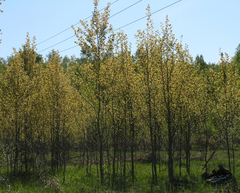
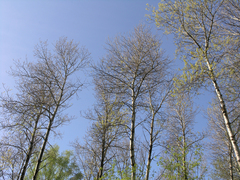
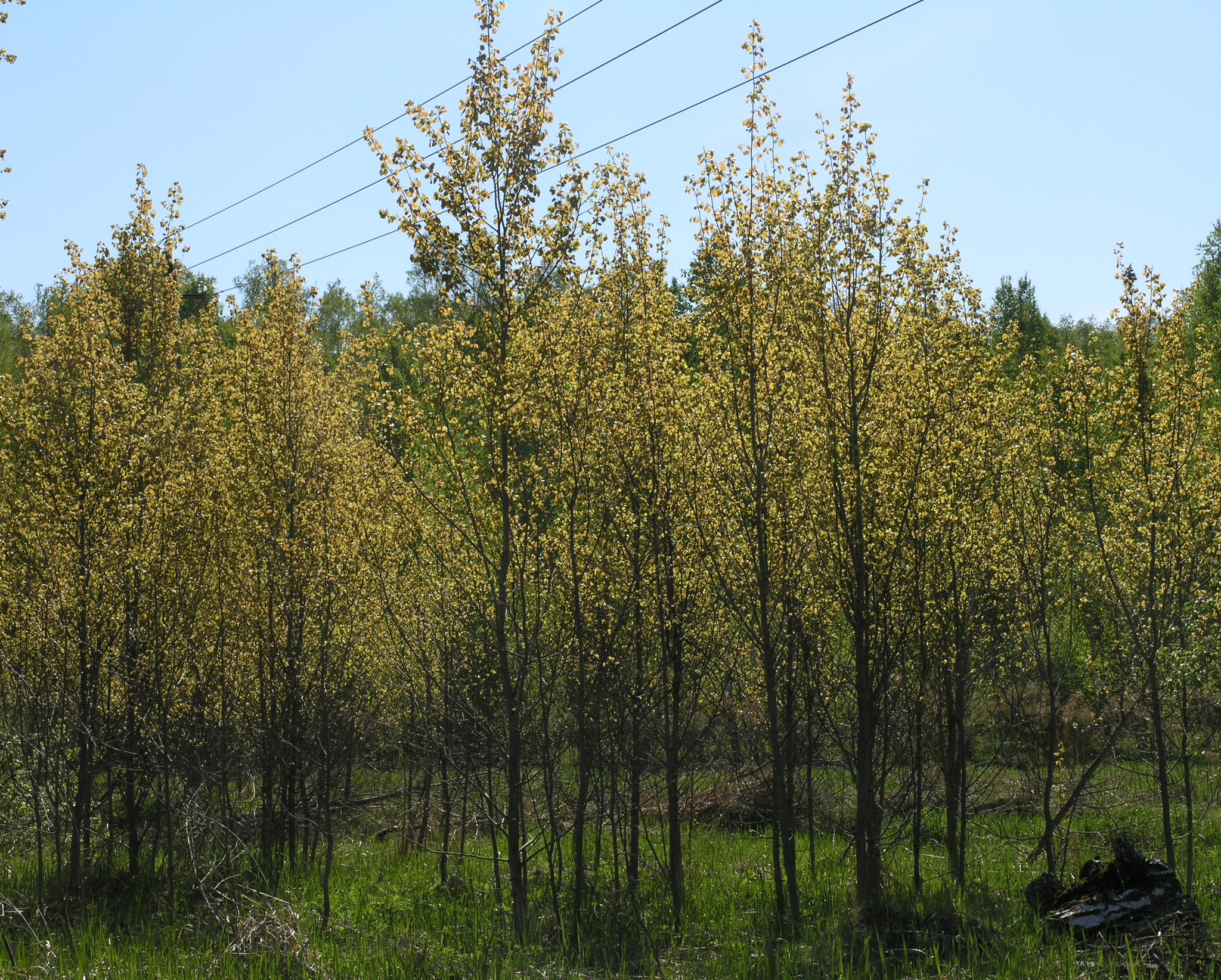
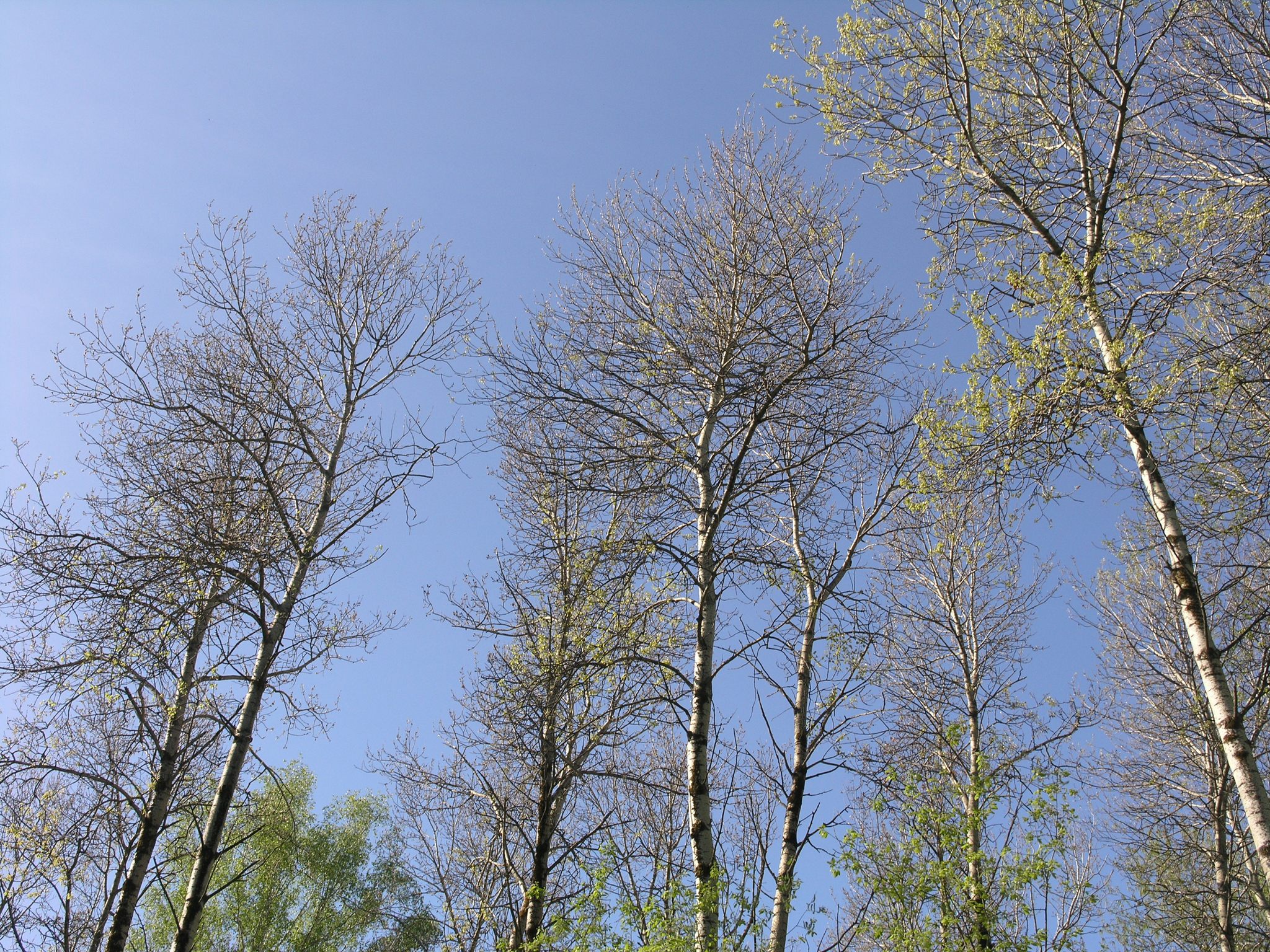
European aspen (Populus tremula) is a deciduous pioneer tree in the Salicaceae family, native to temperate Eurasia from Iceland to Kamchatka. Male and female trees bear hanging catkins before the leaves emerge. Flattened stalks set the foliage trembling in the slightest breeze.
Read moreEuropean aspen, Eurasian aspen, Common aspen and Aspen

© photo
(c) José María Escolano, some rights reserved (CC BY-NC-SA) · cc-by-nc-sa
Oleg Kosterin · cc0
(c) Dmitriy Bochkov, some rights reserved (CC BY) · cc-by
(c) Oleg Kosterin, some rights reserved (CC BY) · cc-by
Global distribution
Populus tremula is native across temperate Eurasia from the Atlantic to the Bering Sea, from Iceland and the British Isles in the north to the North African Atlas in the south. It is absent from the Himalayas and Japan, where related aspens take its place.
- Native6
- Introduced2
- France
- United Kingdom
- Norway
- Russia
- Germany
- Algeria
- United States
- Canada
Hexagons: regions where the plant occurs. Green dots: native range.1
Identity
European aspen (Populus tremula L., 1753) belongs to the genus Populus in the Salicaceae family. Also called Eurasian aspen, Common aspen or simply Aspen, it has leaf stalks flattened perpendicular to the blade. This turns the slightest breeze into continuous trembling, an unusual feature among European trees that inspired Linnaeus's epithet tremula. 1 5
From Iceland and the British Isles, its native range spans temperate Eurasia to the Bering Sea, with isolated populations in the North African Atlas. It is absent from the Himalayas and Japan, where related aspens occupy the corresponding ecological niche. 6
Recognition
In full sun, European aspen commonly reaches 15–21 m (50–70 ft) tall, exceeding 25 m (80 ft) where soil remained moist through its first two years. The young trunk is slender and upright, with smooth gray-green bark marked by dark, diamond-shaped lenticels. With age, the bark turns gray and fissures around the base. 3 4
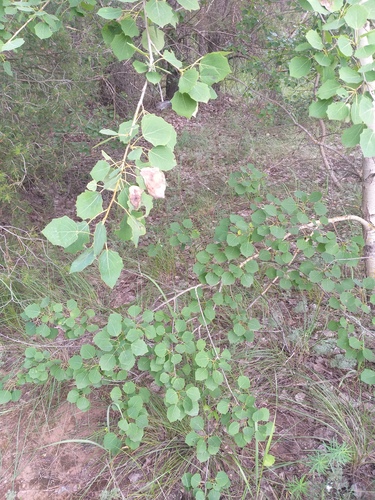
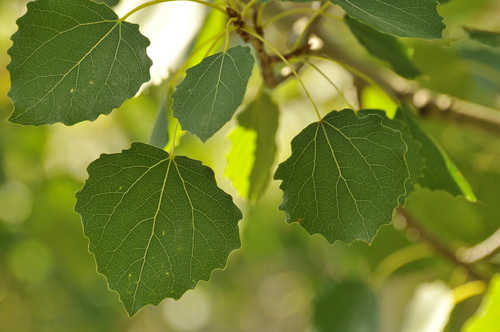
Rounded to oval leaves measure 3–8 cm (1–3 in) across and have a coarsely toothed margin. Their long, flattened stalks provide the decisive clue, converting faint air currents into continuous leaf movement, unlike the foliage of White or Black poplar. 5 3
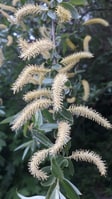
Each tree bears flowers of one sex: the species is dioecious. Brownish-red male catkins and greener female catkins develop on separate trees before leaf emergence, in late winter or at the very beginning of spring. 4 5
Useful taxonomy
For this Eurasian aspen, POWO/WCVP accepts Populus tremula L. Numerous regional varieties and forms have been described, most now treated as synonyms or geographical variation rather than distinct species. Historical names include:
- Populus tremula var. villosa (Láng) Peterm., a named regional variety
- Populus tremula var. pendula Loudon, a named form in the historical synonymy
- Populus tremula f. tomentella C.K.Schneid., a historical form name
- Populus tremula subsp. davidiana (Dode) Hultén, an eastern taxon
The last taxon, often treated separately as Populus davidiana, occupies the far eastern part of the range in East Asia. European aspen and Populus tremuloides remain distinct species, rather than synonyms: the North American aspen has an entirely separate native range west of the Atlantic. 1 2
Habitat and range
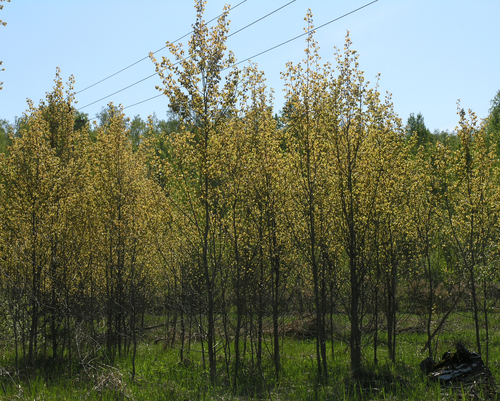
Openings created by fire, disturbance or clearing offer the bare ground and full light this pioneer tree needs. European aspen colonizes woodland clearings, burned areas and riverbanks early. Once more shade-tolerant trees such as beech close the canopy, aspen declines locally because insufficient light prevents regeneration. Its success therefore depends on open conditions rather than simply on the presence of woodland. 5 4
Most of temperate Eurasia lies within the range, from the Atlantic to the Bering Sea, with an isolated extension into the North African Atlas in Algeria and Morocco. IUCN assesses Populus tremula as Least Concern, consistent with its extensive continental distribution and broadly stable populations. 9 8
Cold tolerance is exceptional for a tree that can exceed 25 m (80 ft): the northernmost provenances tolerate temperatures down to −40 °C (−40 °F). This helps explain its presence far into boreal latitudes. In the southern part of the range, including France, aspen instead occupies cooler mountain slopes, often above cultivated land and the hottest lowlands. 4 9
Life cycle and reproduction
Late winter or early spring catkins always appear before the leaves, with timing varying by latitude. Tiny seeds surrounded by cottony hairs disperse on the wind but lose viability within a few days. Without bare, moist soil during that short window, seedlings cannot establish; root suckering then becomes the dominant means of reproduction. The brief life of the seed makes suitable ground especially important at the moment of dispersal. 4 5
Numerous root suckers arise along the spreading roots of European aspen. They form colonies whose stems are genetically identical to a single original tree, so a cluster need not represent separate seed-grown individuals. North American Populus tremuloides shares this strategy and forms some of the largest known clonal colonies. That record belongs to the North American relative, rather than to European aspen. 5
Uses and risks
White, lightweight aspen timber goes into matches, paper pulp and pallets. Because it is not readily flammable, it was formerly used for wooden clogs. The low-density wood also decomposes quickly after the trunk dies, providing valuable habitat for insects dependent on dead wood and for rare wood-decaying fungi. Its value therefore extends beyond harvested timber to the organisms that use aging and fallen trees. 4 5
The bark contains salicin, an aspirin-related compound used traditionally for fever and rheumatic pain. No documented toxic risk is associated with the leaves or bark for cats, dogs or humans. The status remains uncertain for horses, because species-specific evidence is lacking; that uncertainty should not be read as confirmation of safety. 4
Varieties, look-alikes and related plants
Swedish 'Erecta' has a narrow, upright habit and offers a compact alternative to the typical species in restricted urban spaces. It received the RHS Award of Garden Merit. The weeping cultivar 'Pendula', grafted onto Populus canescens, and slightly purple-leaved 'Purpurea' are less common in cultivation. These are horticultural selections, with their names retained unchanged. 7 6
Three related poplars are frequently confused with it:
- Populus alba, White poplar, has whitish felt on the underside of its leaves, absent in European aspen;
- Populus canescens, Gray poplar, is the hybrid of the preceding two species, with a less conspicuous, intermediate felted covering;
- Populus tremuloides, the North American aspen, closely resembles it in habit and trembling foliage, but differs in its paler young bark and strictly North American native range.
Together, a flattened leaf stalk and the absence of felt beneath the leaf distinguish Populus tremula from White and Gray poplar. The leaf underside is therefore a useful second check after observing the characteristic movement of the foliage.
Main sources
- Plants of the World Online / Kew, Populus tremula L.
- International Plant Names Index, Populus tremula L.
- Missouri Botanical Garden Plant Finder, Populus tremula
- Plants For A Future, Populus tremula
- Woodland Trust, Aspen (Populus tremula)
- Trees and Shrubs Online (Bean), Populus tremula
- Royal Horticultural Society, Populus tremula 'Erecta'
- IUCN Red List, Populus tremula assessment (Barstow et al., 2017)
- Tela Botanica (BDTFX reference database), Populus tremula L.
- USDA GRIN Taxonomy, Populus tremula L.
Frequently asked questions
Why do European aspen leaves move so much?
Each leaf stalk is flattened perpendicular to the blade, rather than rounded as in other poplars. This mechanical feature lets the leaf tilt in the slightest breeze, producing its characteristic trembling.
Are European aspen and North American aspen the same species?
No. Populus tremula grows in temperate Eurasia, while Populus tremuloides is its North American counterpart. Their trembling foliage looks similar, but their native ranges differ and the American species has paler young bark.
Is European aspen toxic to cats and dogs?
No documented toxic risk is associated with European aspen leaves or bark for cats, dogs or humans. The status for horses remains uncertain because reliable data are lacking.
How can I distinguish European aspen from White poplar?
White poplar (Populus alba) and its hybrid Gray poplar (Populus canescens) have a conspicuous whitish felt beneath the leaves. European aspen lacks this covering, with green, hairless leaves on both sides.
Why do several aspens often grow together?
Populus tremula spreads naturally by suckers arising from the spreading roots of one individual. An entire grove can therefore originate from one tree, with genetically identical stems.
Is European aspen wood useful?
Yes. Light, soft and not readily flammable, it is used for matches, paper pulp, pallets and historically wooden clogs. Its salicin-rich bark was also used traditionally against fever.
Is European aspen threatened?
No. IUCN assesses it as Least Concern because its range is very extensive and populations are broadly stable across Eurasia.
Similar plants
If you are unsure about a plant’s toxicity, ask a botanist or veterinarian for advice.