
Portuguese laurel (Prunus lusitanica, )
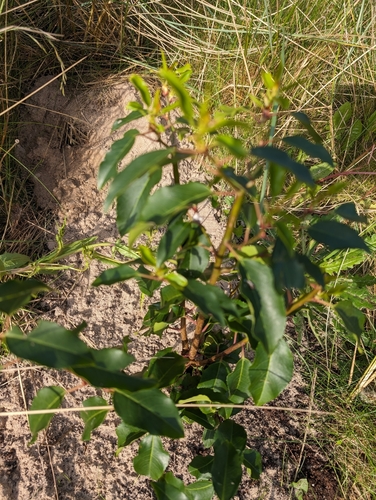

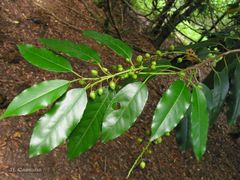
Portuguese laurel (Prunus lusitanica) is an evergreen shrub or small tree in the Rosaceae family, native to southwestern Europe, Morocco and Macaronesia. Often confused with cherry laurel (Prunus laurocerasus), it differs in its dark red leaf stalks and young shoots, a more reliable clue than leaf shape.
Read morePortuguese laurel, Portugal laurel and Portuguese laurel cherry
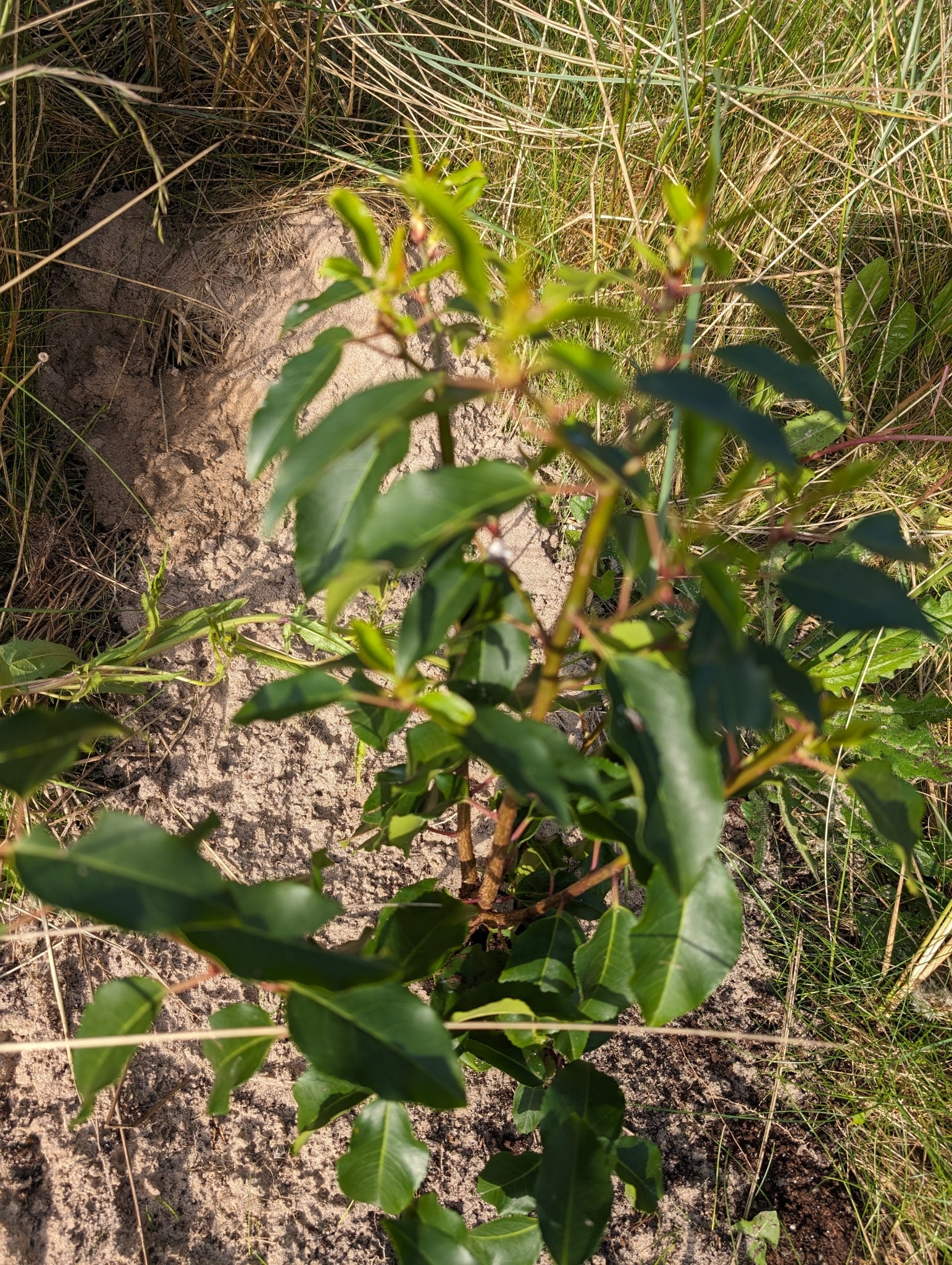

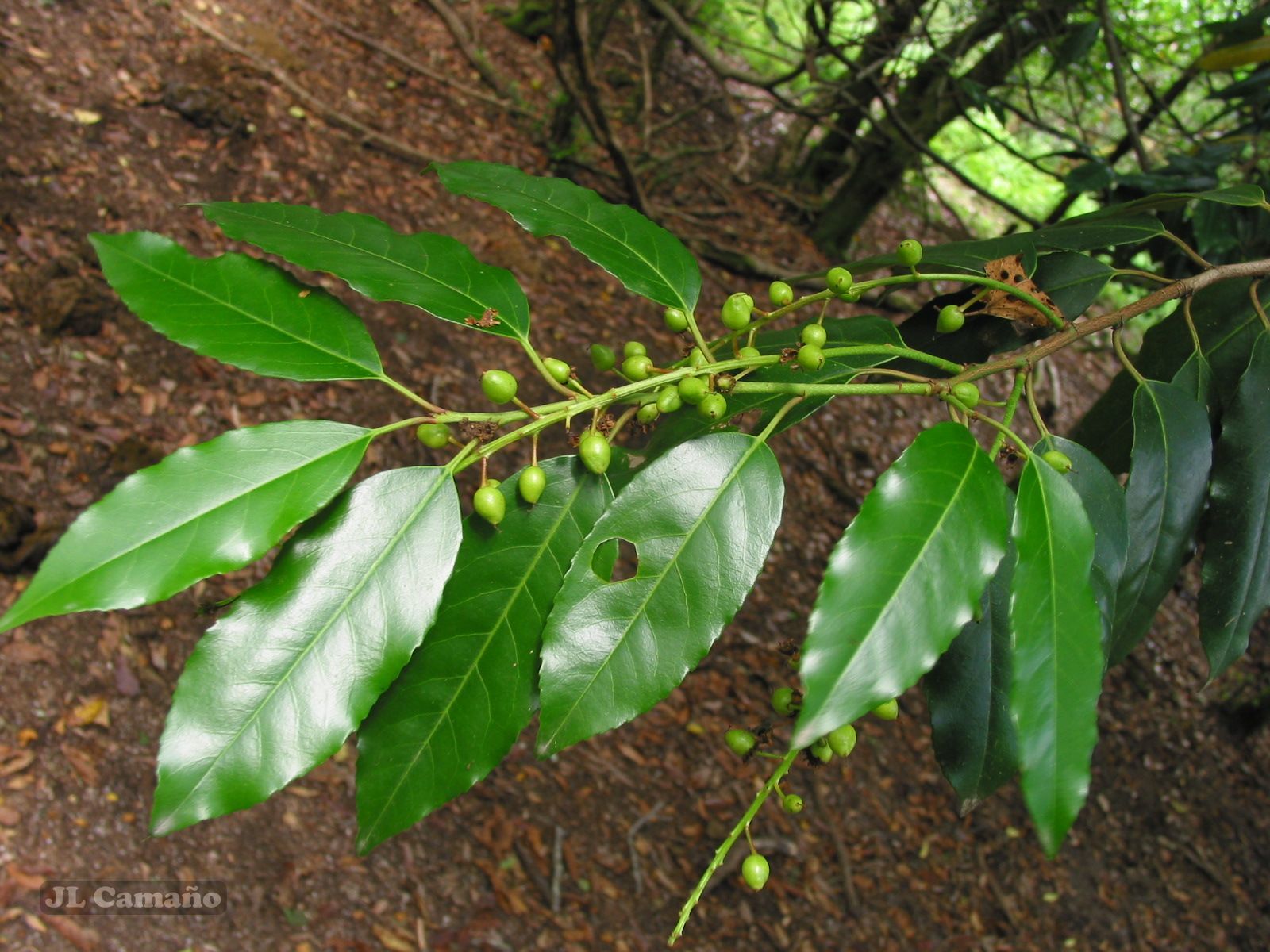


© photo
Jack Alcorn · cc-by
Duarte Frade · cc-by
José Luis Camaño · cc-by-nc
Taken Feb 15, 2008 by Photoflora - Benoit BOCK (©)
Taken Apr 18, 2022 by James Mwago (cc-by-sa)
Taken Dec 8, 2022 by Caw Vus (cc-by-sa)
Taken Jan 2, 2022 by Kim Lake (cc-by-sa)
Taken Jun 8, 2020 by Dieter Wagner (cc-by-sa)
© copyright of the Board of Trustees of the Royal Botanic Gardens, Kew.




Global distribution
Prunus lusitanica is native to southwestern Europe (Portugal, Spain and the French Basque Country), Morocco and the Macaronesian archipelagos of the Azores, Madeira and the Canary Islands. On the mainland it is a relict of Tertiary laurel forest, reduced to rare populations in cool gorges; in Macaronesia it remains a common component of laurel forest.
- Native7
- Introduced1
- Portugal
- Spain
- Metropolitan France
- Morocco
- Azores
- Madeira
- Canary Islands
- United Kingdom
Hexagons: regions where the plant occurs. Green dots: native range.1
Identity
Portuguese laurel (Prunus lusitanica L., 1753) is an evergreen shrub or small tree in the Rosaceae family, described by Carl Linnaeus in 1753. The epithet lusitanica refers to Lusitania, the Roman province corresponding to modern Portugal and parts of Extremadura and Salamanca in Spain. 1 6
Portugal supplies the common name, yet the native range reaches well beyond that country. It also includes Spain, the French Basque Country, Morocco and the Macaronesian archipelagos of the Azores, Madeira and the Canary Islands. A Canary Island population is therefore no less native than a Portuguese one. 7 1
Recognition
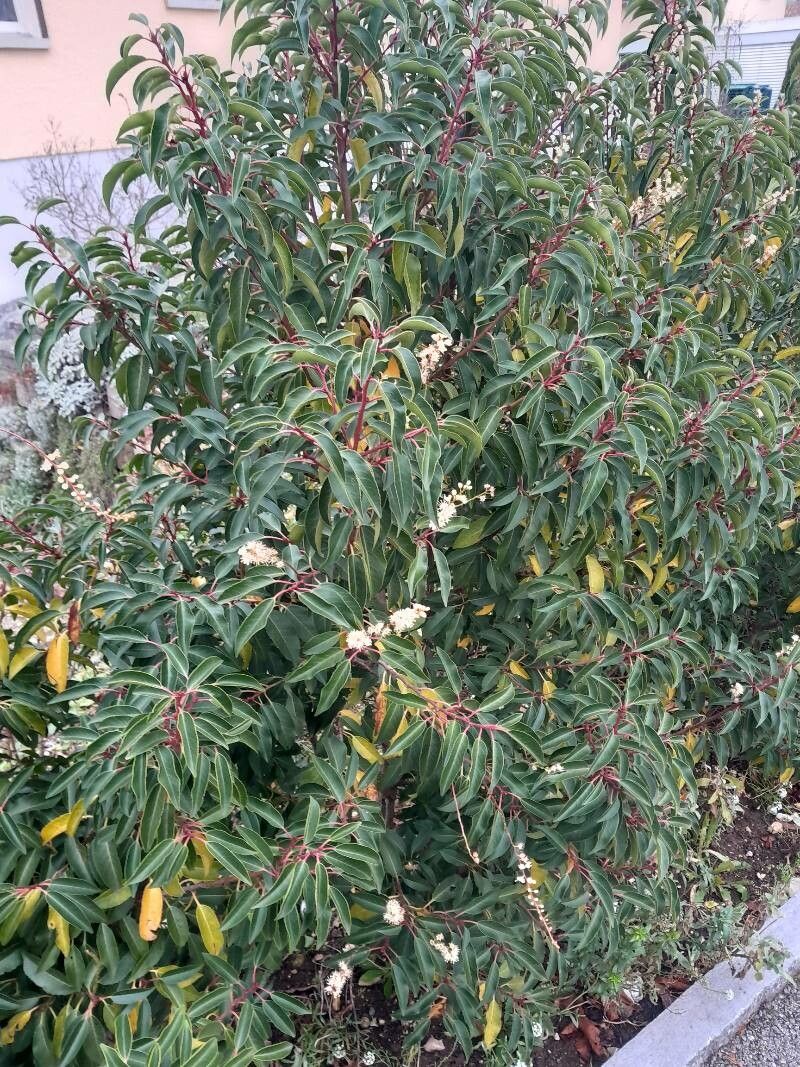
A dense shrub or small tree, Prunus lusitanica commonly reaches 3–8 m (10–26 ft), with exceptional records up to 20 m (66 ft). In British cultivation, RHS records specimens exceeding 12 m (39 ft) tall and 8 m (26 ft) wide after 20–50 years. 2 6
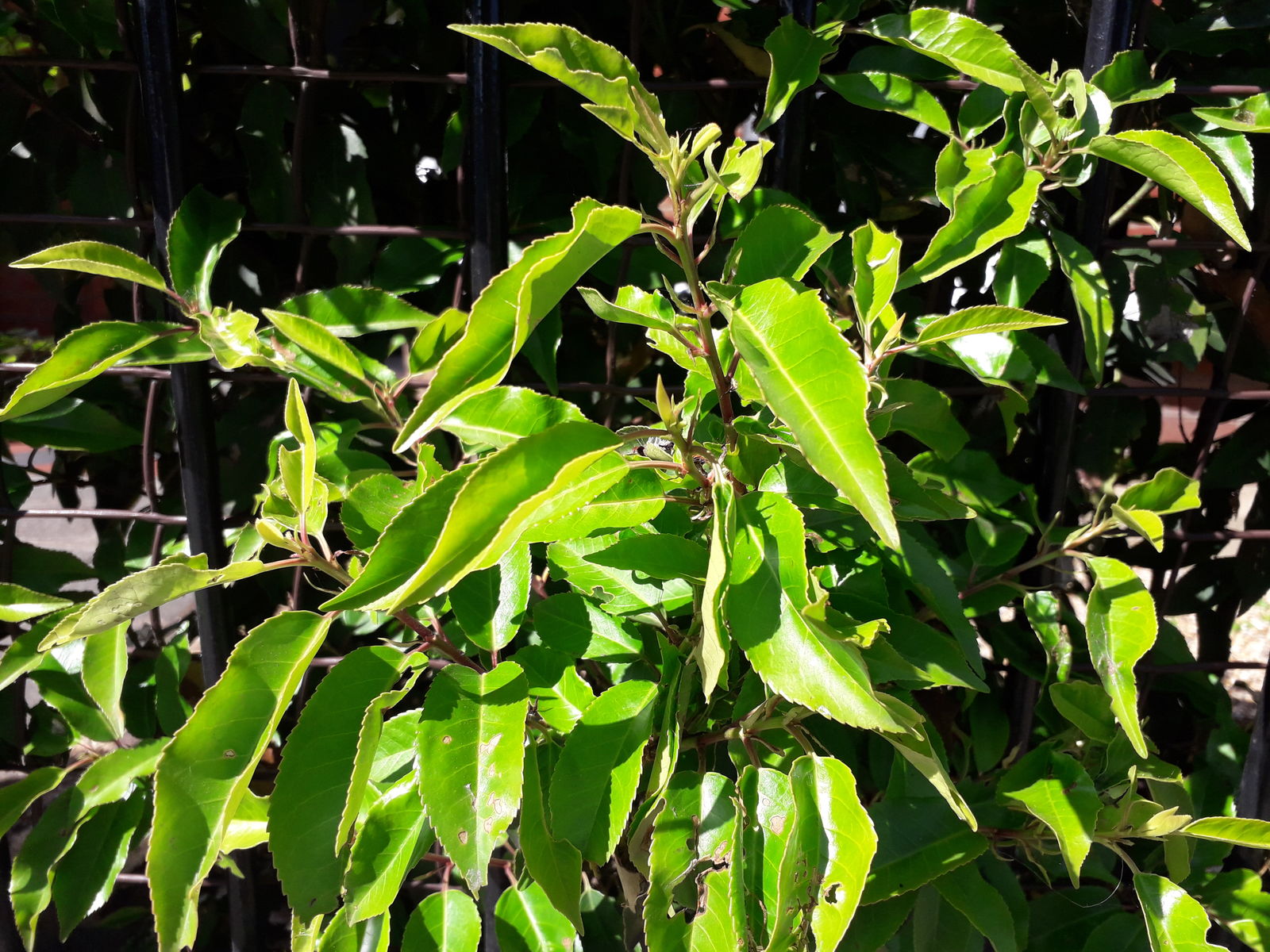
Dark red to purple leaf stalks and young shoots provide a more reliable identification clue than leaf shape. Their color remains visible year-round, while the blade varies with shoot age and exposure. Leaves are oval-lanceolate, leathery and glossy, 6–13 cm (2.4–5.1 in) long, with finely toothed edges. 3 2
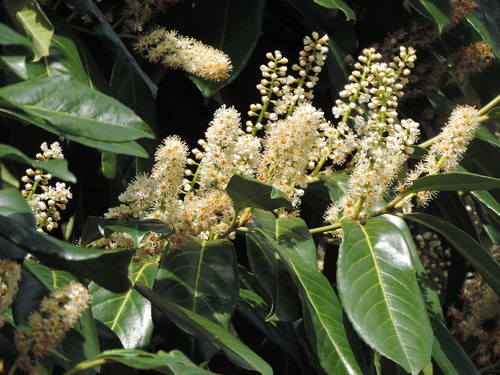
Early summer brings upright racemes 15–28 cm (6–11 in) long, carrying numerous small, fragrant white flowers. These are followed by small, egg-shaped to conical drupes, green at first, then dark red to purplish black when ripe. 2 6
Useful taxonomy
Taxonomically, Prunus lusitanica L. belongs to the Amygdaloideae subfamily of Rosaceae. Three geographically distinct subspecies help establish a specimen's origin:
- Prunus lusitanica subsp. lusitanica occupies the mainland (Portugal, Spain, the French Basque Country and Morocco) and is the nominate subspecies;
- Prunus lusitanica subsp. azorica (Mouill.) Franco is endemic to the Azores and considered threatened in its natural habitat;
- Prunus lusitanica subsp. hixa (Brouss. ex Willd.) Franco grows on Madeira and the Canary Islands and is more widespread than the Azorean subspecies.
These island divisions explain why one species name can encompass very different conservation situations. Giving only Prunus lusitanica without its subspecies conflates a stable population (hixa) with a threatened one (azorica). Including the subspecies avoids that confusion. 1
Habitat and range
Mainland populations occupy cool upland forests and ravines, a niche that makes the plant a relict of Tertiary laurel forest, once much more extensive in Europe. Wild populations are rare there, confined to humid gorges in the southwestern Iberian Peninsula. 4 8
Macaronesian islands present a different picture: the species remains a common component of laurel forest, sustained by mist and supporting endemic plants and animals. Its natural populations remain most abundant in the Azores, Madeira and the Canary Islands. 6 1
Outside the native range, cultivation chiefly supplies ornamental hedges. Long planted in the United Kingdom, the shrub occasionally naturalizes there without crossing into invasive status in the account cited here. 4
Life cycle and reproduction
Summer's fragrant flower racemes attract pollinating insects. Once fertilized, the flowers develop into drupes that ripen from green to dark red, then purplish black, between summer and autumn. 3 2
For propagation in cultivation, semi-ripe cuttings taken in summer from the current year's wood produce plants faster and more faithfully than seed. Seeds need 2–3 months of cold stratification and may take up to 18 months to germinate, so sowing is mainly suited to selection work or conserving wild subspecies. 4
Hedge plants withstand hard pruning and readily reshoot from old wood. This response allows a dense outline to be maintained over several decades without sacrificing vigor. 3
Uses and risks
Clipped hedges, privacy screens and topiary are the principal ornamental uses, supported by ready recovery from pruning and tolerance of poor, calcareous soils. RHS has given the plant its Award of Garden Merit. 2
Toxicity requires care around animals and people. As in other Prunus, leaves, seeds and especially wilted stems contain cyanogenic glycosides. The ASPCA classifies cherries in this genus as toxic to cats, dogs and horses, with typical signs including brick-red mucous membranes, dilated pupils and breathing difficulties after ingestion. 5 3
European plant-health monitoring also treats the shrub as a high-risk host for Xylella fastidiosa, a regulated quarantine bacterium in Europe. Sudden shoot dieback warrants reporting to the relevant plant-health service rather than simply pruning away affected growth. 2
Varieties, look-alikes and related plants
Garden selections include Variegata, with creamy-white leaf margins, and Myrtifolia, with small, narrow leaves resembling myrtle. These remain horticultural names, rather than substitutes for taxonomic identity. For a wild specimen of uncertain geographic origin, the precise subspecies (azorica, hixa or lusitanica) is the useful reference. 2
Three groups cause more confusion than other evergreen hedge plants:
- Prunus laurocerasus, cherry laurel, has larger, broader leaves and, crucially, green leaf stalks rather than dark red ones;
- Laurus nobilis, bay laurel, shares the word “laurel” but belongs to a different family, Lauraceae;
- other evergreen Prunus are sold under similar hedge names without the characteristic red leaf stalks.
Checking the leaf stalk color takes less time than comparing leaf size. It also works on a clipped hedge whose leaves have not reached their full adult size.
Main sources
- Plants of the World Online / Kew, Prunus lusitanica L.
- Royal Horticultural Society, Prunus lusitanica details
- North Carolina Extension Gardener Plant Toolbox, Prunus lusitanica
- Plants For A Future, Prunus lusitanica
- ASPCA, Cherry (Prunus spp.) toxic plant entry
- Wikipedia FR, Portuguese laurel (Prunus lusitanica)
- Wikipedia EN, Prunus lusitanica
- INPN / MNHN, Prunus lusitanica
Frequently asked questions
Is Portuguese laurel toxic to cats and dogs?
Yes. Like other Prunus, its leaves, seeds and wilted stems contain cyanogenic glycosides. The ASPCA classifies Prunus cherries as toxic to cats, dogs and horses, with brick-red mucous membranes and breathing difficulties after ingestion.
How can I tell Portuguese laurel from cherry laurel?
The most reliable clue is the color of leaf stalks and young shoots: dark red to purple in Prunus lusitanica, green in Prunus laurocerasus. Cherry laurel leaves are also generally larger and broader.
What soil and exposure does it need?
Well-drained, neutral to calcareous soil in full sun to partial shade gives the best flowering. It also tolerates poor, shallow soils, making it an undemanding hedge once established.
Is Portuguese laurel invasive?
No documented invasion is reported in metropolitan France, where the species is native in rare populations. In the United Kingdom, where it is introduced and widely planted, occasional naturalization is recorded without a marked invasive status.
Why is it called lusitanica if it grows beyond Portugal?
The epithet refers to Roman Lusitania, an old name for Portuguese territory chosen by Linnaeus in 1753. The actual range also includes Spain, the French Basque Country, Morocco and several Macaronesian archipelagos.
Can Portuguese laurel replace boxwood in a hedge?
This is a common use. Its tolerance of poor, calcareous soil and ready recovery from hard pruning make it a resilient alternative where traditional boxwood suffers from box tree moth and dieback.
Are all its subspecies threatened?
No. The Azorean endemic subspecies azorica is considered threatened in its natural habitat, whereas subspecies hixa of Madeira and the Canary Islands remains more widespread within its range.
Similar plants
If you are unsure about a plant’s toxicity, ask a botanist or veterinarian for advice.