
Firethorn (Pyracantha coccinea, )
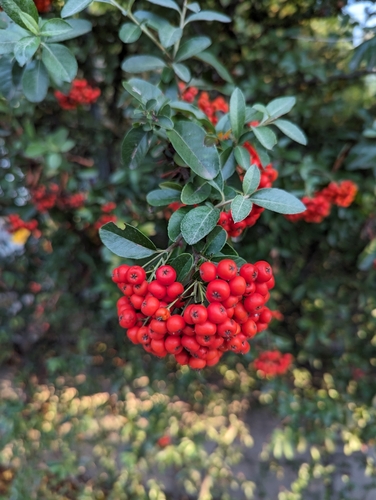
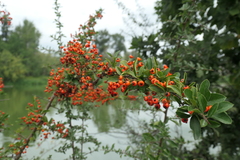
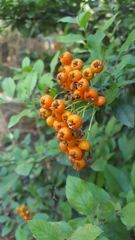
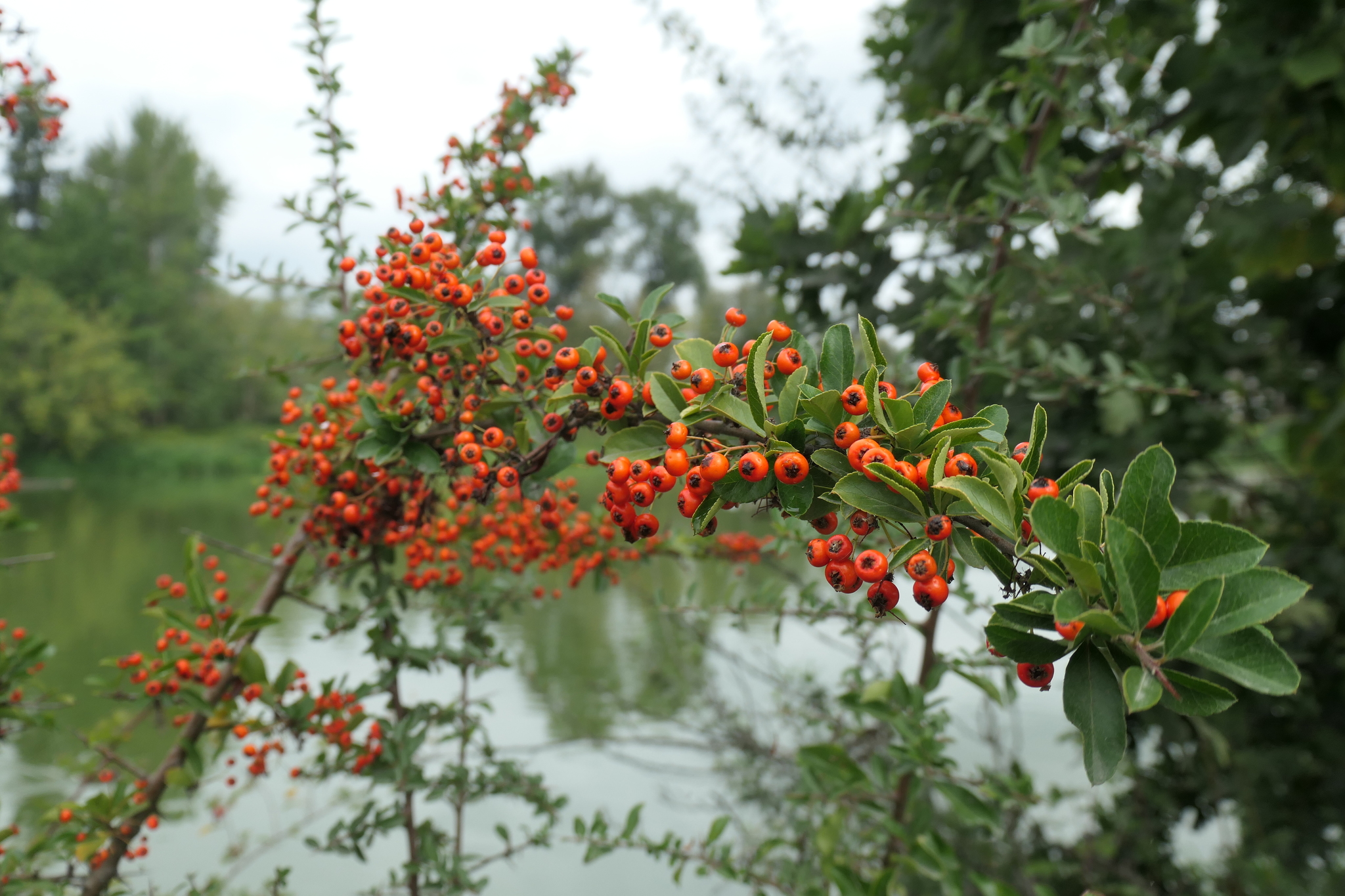
Firethorn (Pyracantha coccinea M.Roem., 1847) is a thorny evergreen shrub in the Rosaceae family, native to southeastern and southern Europe east to Iran. Its white spring flowers and orange to red fruits, which persist through winter, make it ornamental, while long, rigid thorns suit it to defensive hedges.
Read moreFirethorn, Scarlet firethorn, Red firethorn, European firethorn and Pyracantha


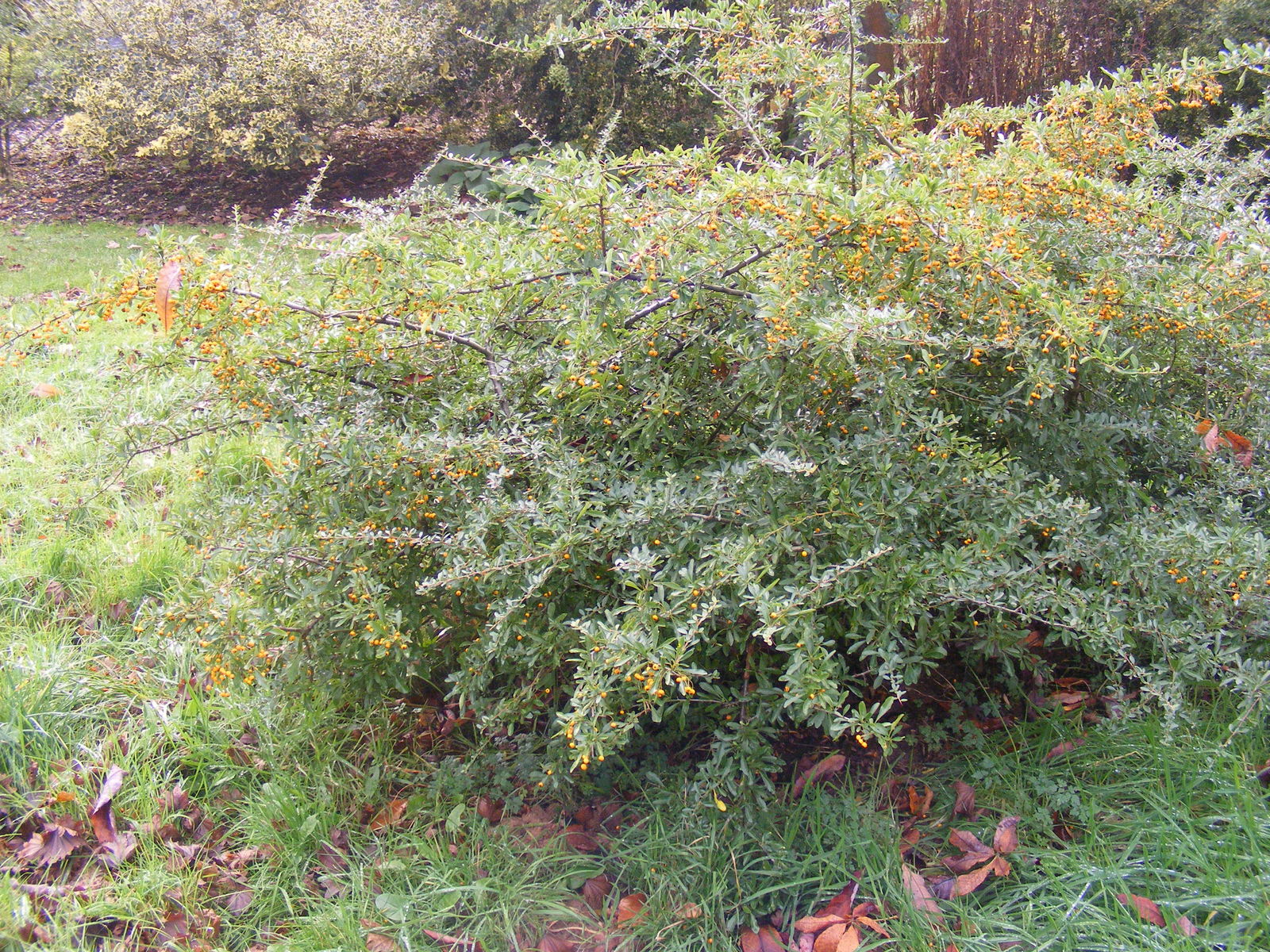
© photo
(c) Johnny Roger Pedersen, some rights reserved (CC BY-NC), uploaded by Johnny Roger Pedersen · cc-by-nc
David Dyck · cc-by
Chelsea Welch · cc-by
Taken Nov 29, 2022 by Jim Knopf (cc-by-sa)
Taken Nov 7, 2021 by Nicolò LC (cc-by-sa)
Taken Oct 12, 2022 by Jim Knopf (cc-by-sa)
Taken Nov 19, 2022 by Caw Vus (cc-by-sa)
Taken May 3, 2021 by Alain Bigou (cc-by-sa)
© copyright of the Board of Trustees of the Royal Botanic Gardens, Kew.




Global distribution
POWO/WCVP places the native range of Pyracantha coccinea from southeastern and southern Europe to Iran, including southern France and Corsica. It is widely cultivated outside this range and naturalizes locally in some temperate regions; no invasive designation is assigned to it in France.
- Native5
- Introduced1
- Southeastern Europe
- Italy
- Southern France and Corsica
- Turkey
- Iran
- Central Europe
Hexagons: regions where the plant occurs. Green dots: native range.1
Identity
Firethorn (Pyracantha coccinea M.Roem., 1847) combines evergreen foliage with rigid thorns, making this Rosaceae shrub suitable for defensive hedges or training against a sunny wall. Its genus name joins the Greek pyr, fire, and akantha, thorn. Both features help explain its identity: unlike the otherwise similar cotoneaster, it has stiff thorns, while orange-red fruits brighten the foliage through winter. 1 2
Established shrubs tolerate cold down to −20 °C (−4 °F), allowing cultivation in northern French gardens as well as the dry summers of southern France. The alternative English name scarlet firethorn emphasizes the same brilliant fruit color. The French name pyracanthe also occurs in horticultural catalogs and botanical literature. 3
Identification
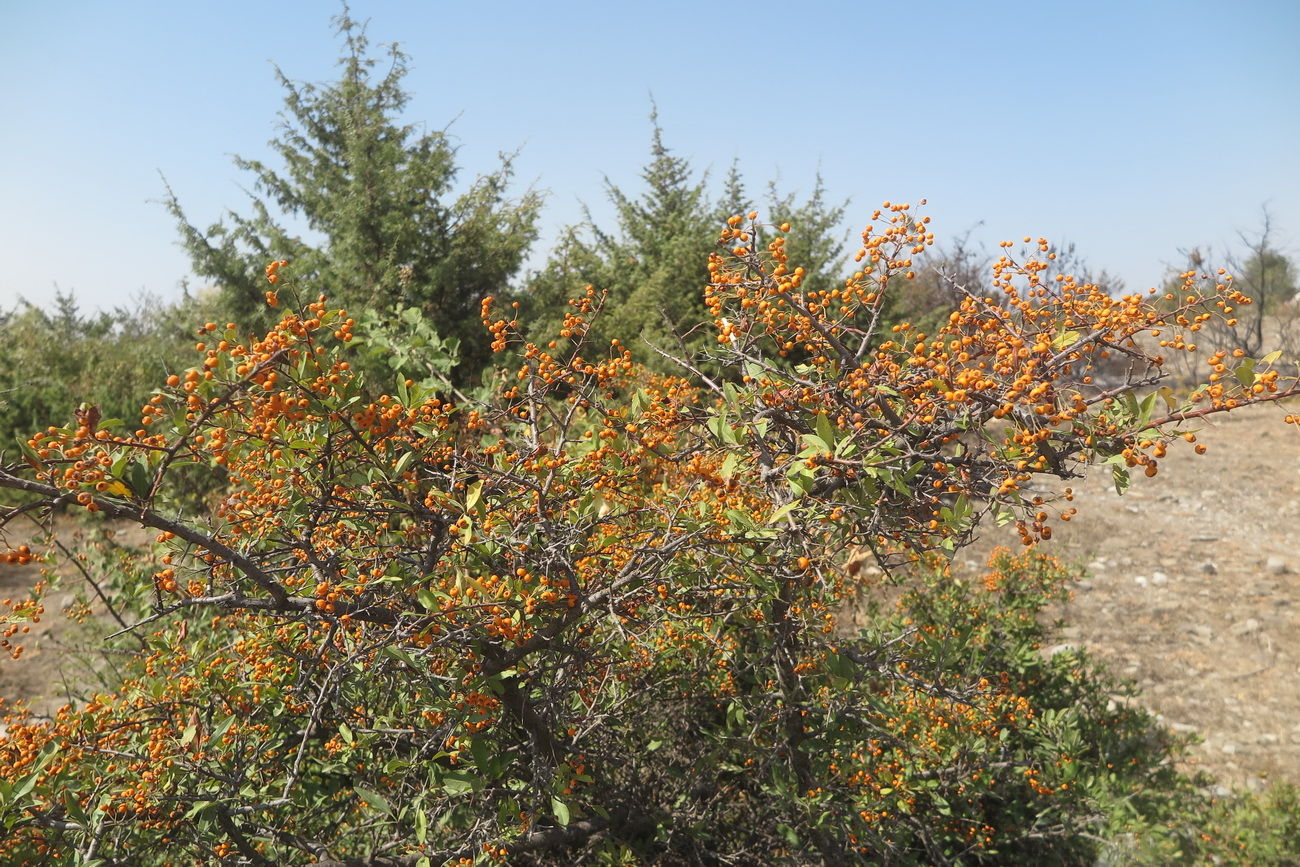
Dense branching creates a shrub 2–4 m (6.5–13 ft) tall and similarly wide, with an upright to spreading outline depending on training. Simple oval to lance-shaped leaves are 2–6 cm (0.8–2.4 in) long and glossy dark green on their upper surface. 2 3
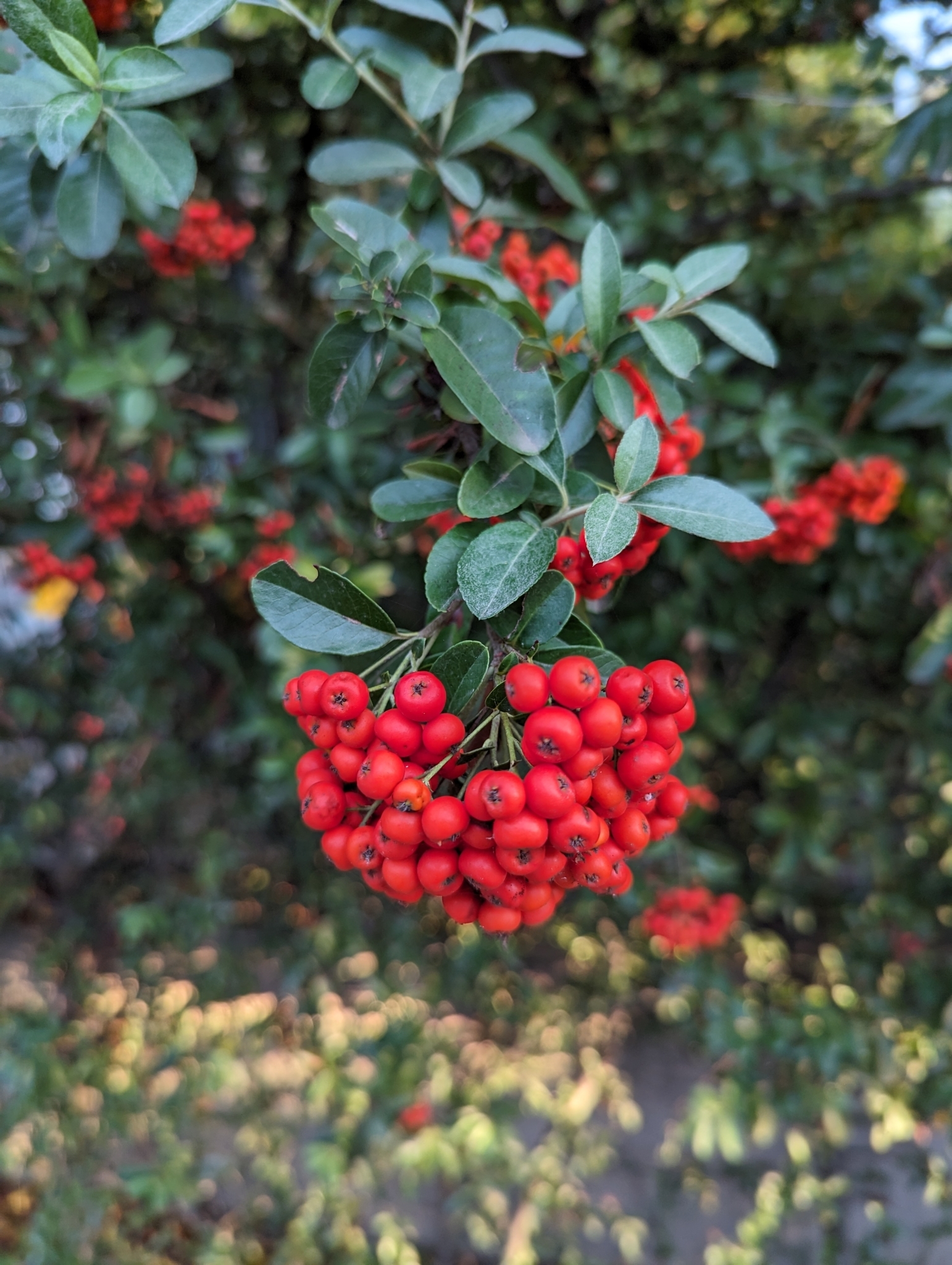
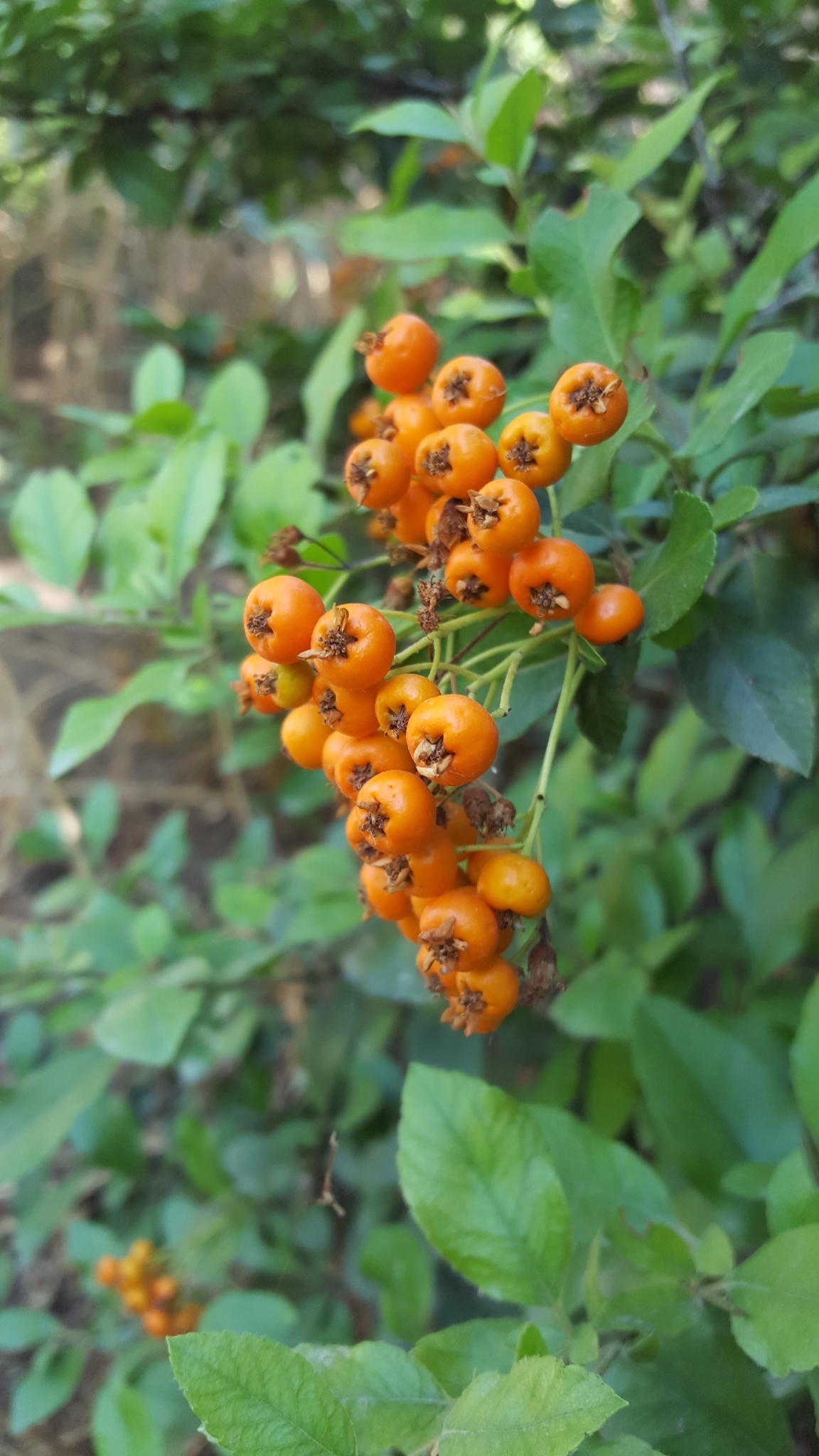
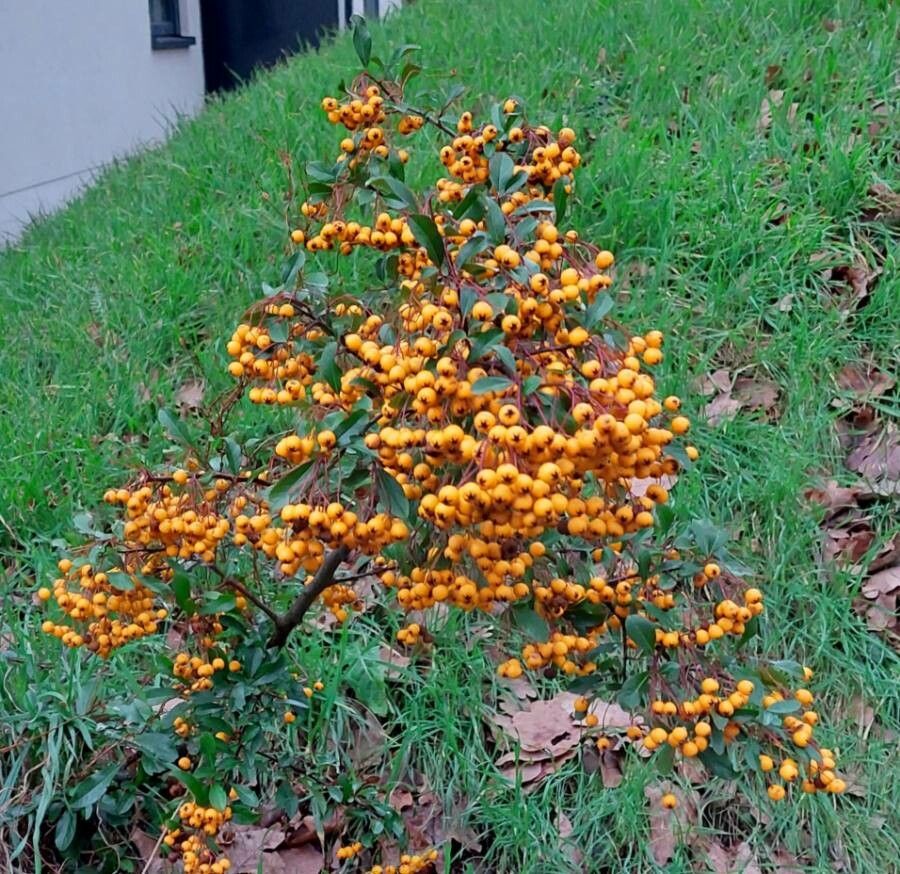
In the northern temperate spring, typically May–June, small white flowers with five petals appear on the previous year's wood. They form dense, drooping corymbs visited by bees. By autumn these become small, round, apple-like fruits, orange to scarlet and closely clustered. The clusters often persist into midwinter and feed birds. 2 3
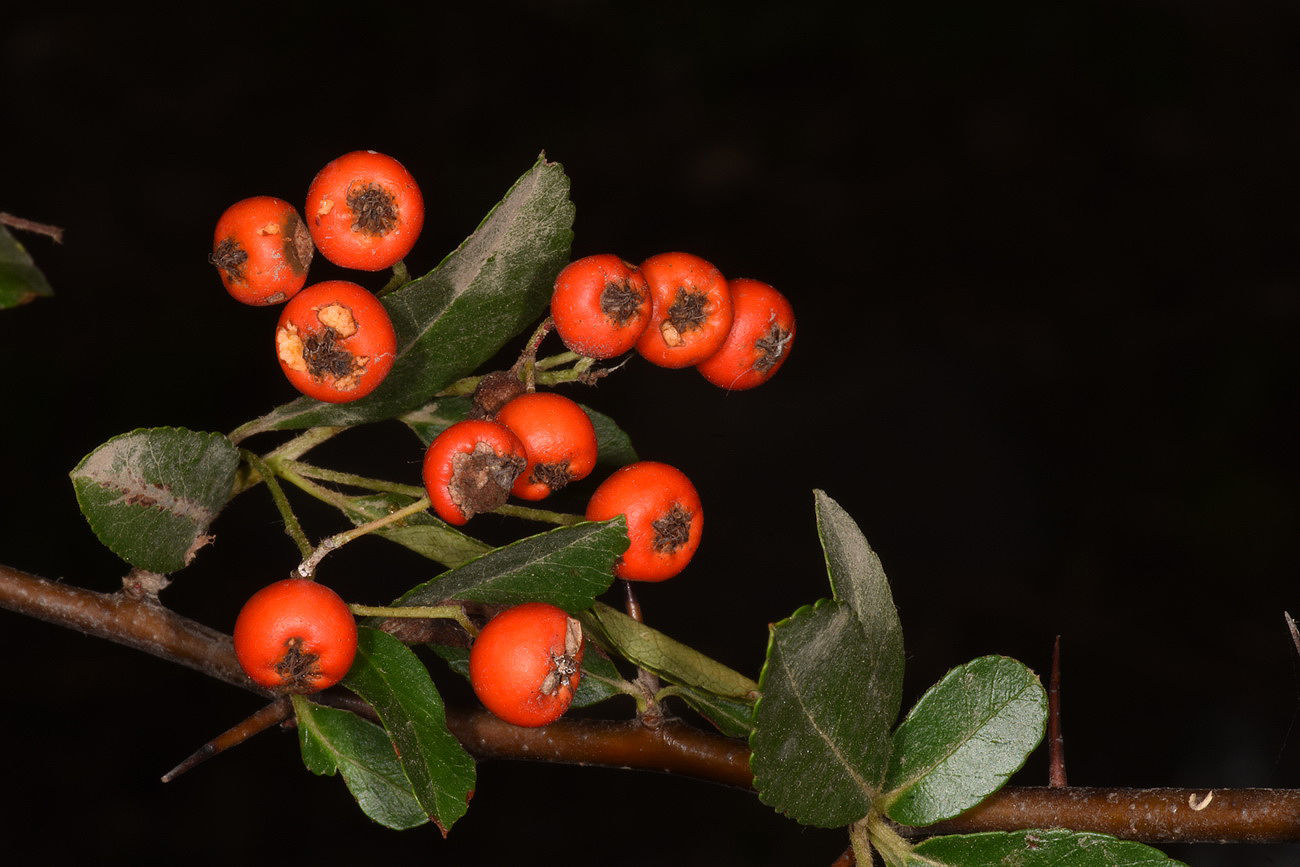
Numerous stiff thorns develop from modified short shoots rather than simple outgrowths of bark. Together with the evergreen foliage, they provide a useful distinction from a similarly shaped cotoneaster, which is entirely unarmed. 4
Useful taxonomy
Its earliest description dates to Linnaeus in 1753 as Mespilus pyracantha L. (basionym), placing it among the medlars. Max Joseph Roemer transferred it in 1847 to the new genus Pyracantha, established for these thorny, pome-bearing Rosaceae. The synonym Crataegus pyracantha (L.) Medik., 1793 also records its historical placement among hawthorn-like plants before its current position. 1
Several closely related Pyracantha species are regularly confused in garden centers. They include the narrower-leaved Pyracantha angustifolia (Franch.) C.K.Schneid., Himalayan Pyracantha crenulata (D.Don) M.Roem. and Taiwanese endemic Pyracantha koidzumii (Hayata) Rehder. Many plants sold under cultivar names are hybrids between these species, making a nursery plant's scientific label less dependable than usual. 1
Habitat and distribution
Southern and southeastern Europe east to Iran form the native range recorded by POWO/WCVP, including natural populations in southern France and Corsica. In these habitats the shrub grows at open woodland edges, in hedges and in scrub, usually on chalky soil, at pH 6–8, in sun. Excess lime can sometimes hinder iron uptake and yellow the leaves; chelated iron can correct that imbalance. 1 7 4
Extensive ornamental planting has carried firethorn beyond its native range. It naturalizes locally in temperate regions where the climate is suitable and birds disperse its seeds. This local establishment should be distinguished from its status in France, where no invasive designation is assigned to the species. 4
Life cycle and reproduction
Bees and other visiting insects pollinate the white flower clusters. The developing pomes then ripen slowly, changing from green to orange and finally red according to the cultivar. They remain attached through winter, providing a late food reserve for blackbirds and thrushes when few other berries remain. 2
Seeds germinate chiefly after passing through birds or after artificial cold stratification. Without prior cold, germination is slow and irregular. Semiripe cuttings taken in late summer avoid this difficulty and reproduce a particular cultivar more reliably than seed, preserving its selected characteristics. 4 5
Uses and risks
For a defensive hedge, plants spaced 60–100 cm (2–3.3 ft) apart can form a dense barrier within three to five years. Their thorns deter intrusion. Alternatively, a shrub can be trained flat against a sunny wall, displaying its white flowers and later its colorful fruit without occupying the same depth as a freestanding hedge. 2 3
Cooked fruits feature in jellies, marmalades and sauces in some regional traditions, although raw fruits are unappealing. Leaves and seeds contain cyanogenic compounds that can release small amounts of hydrogen cyanide, accounting for the bitterness of chewed seeds. The ASPCA lists firethorn as toxic to cats and dogs, with digestive upset the main reported symptom after large quantities of fruit are eaten. 4 4 6
Disease presents the most serious threat to the shrub itself. Fire blight, caused by Erwinia amylovora, blackens flowers and young shoots as if scorched, while scab marks leaves and fruits. These two diseases explain the emphasis on resistant cultivars in nursery selections. 5 3
Cultivars, similar plants and identification
American breeders selected disease-resistant cultivars after older forms suffered from fire blight and scab. Mohave resists both and bears large orange fruits; the more compact Apache bears red fruit. Teton has a narrow, upright habit useful for a close hedge against a wall. Other selections, including Orange Glow and Red Column, lack this enhanced resistance and are chosen chiefly for fruit color or a columnar outline. 5
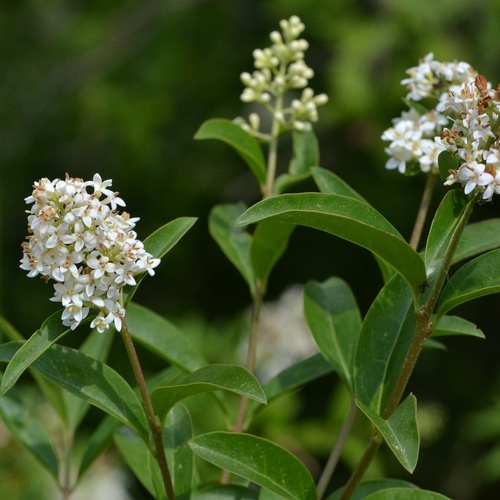
Cotoneaster is the most likely source of confusion because its habit and colorful fruits resemble firethorn's. It never develops thorns, even on old branches. Common hawthorn (Crataegus monogyna) shares white spring flowers but has larger, solitary fruits. Firethorn fruits measure 0.6–1 cm (0.25–0.4 in) across and form compact clusters; hawthorn also sheds its leaves in winter, while firethorn remains green. 4
Main sources
- Plants of the World Online / Kew, Pyracantha coccinea M.Roem.
- Royal Horticultural Society, Pyracantha coccinea - firethorn
- Missouri Botanical Garden Plant Finder, Pyracantha coccinea
- Plants For A Future, Pyracantha coccinea database entry
- NC State Extension Gardener Plant Toolbox, Pyracantha coccinea
- ASPCA, Firethorn toxicity entry
- Tela Botanica / BDTFX, Pyracantha coccinea taxon entry
Frequently asked questions
Is firethorn toxic to cats and dogs?
Yes, mildly. Fruits, seeds and leaves contain cyanogenic glycosides. Eating large amounts chiefly causes digestive upset; its toxicity is not comparable to plants classed as highly toxic.
Can firethorn be confused with hawthorn or cotoneaster?
Yes. Cotoneaster has a similar habit and colorful fruit but no thorns. Common hawthorn (Crataegus monogyna) has larger, solitary fruits and loses its leaves in winter, whereas firethorn is evergreen.
When can I prune firethorn without losing its fruit?
Prune just after flowering in late spring. Late-summer pruning removes flower buds already formed on the previous year's wood and can greatly reduce the next crop.
Is firethorn invasive in France?
No invasive designation is assigned to this species in France, where it occurs naturally in the south and Corsica. Local naturalization is documented in parts of central Europe.
Are firethorn fruits edible?
Cooked fruits are used in jellies, marmalades and sauces in some culinary traditions. Raw fruits are unappealing and mildly irritating; seeds and leaves also contain cyanogenic compounds.
What is fire blight on firethorn?
This serious bacterial disease, caused by Erwinia amylovora, blackens flowers and young shoots as though scorched. Affected growth needs prompt removal with cuts well below the lesion and tools disinfected between cuts.
Similar plants
If you are unsure about a plant’s toxicity, ask a botanist or veterinarian for advice.