
Bladder campion (Silene vulgaris, )
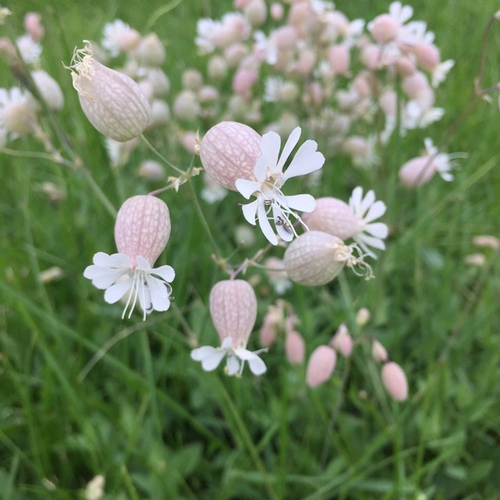
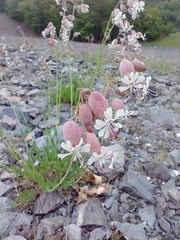
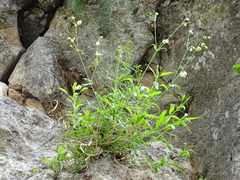
Bladder campion (Silene vulgaris (Moench) Garcke, 1869) is an herbaceous perennial in the Caryophyllaceae family, widespread in meadows, banks and roadsides in temperate Europe, North Africa and western Asia. Its inflated calyx has a network of often purple veins and forms a translucent bladder behind five deeply divided white petals. Populations mix hermaphroditic and female-only individuals, making the species a model in evolutionary biology.
Read moreBladder campion and Maidenstears
Allow a few hours of direct sun per day, preferably morning or evening.
Full sun to light partial shade
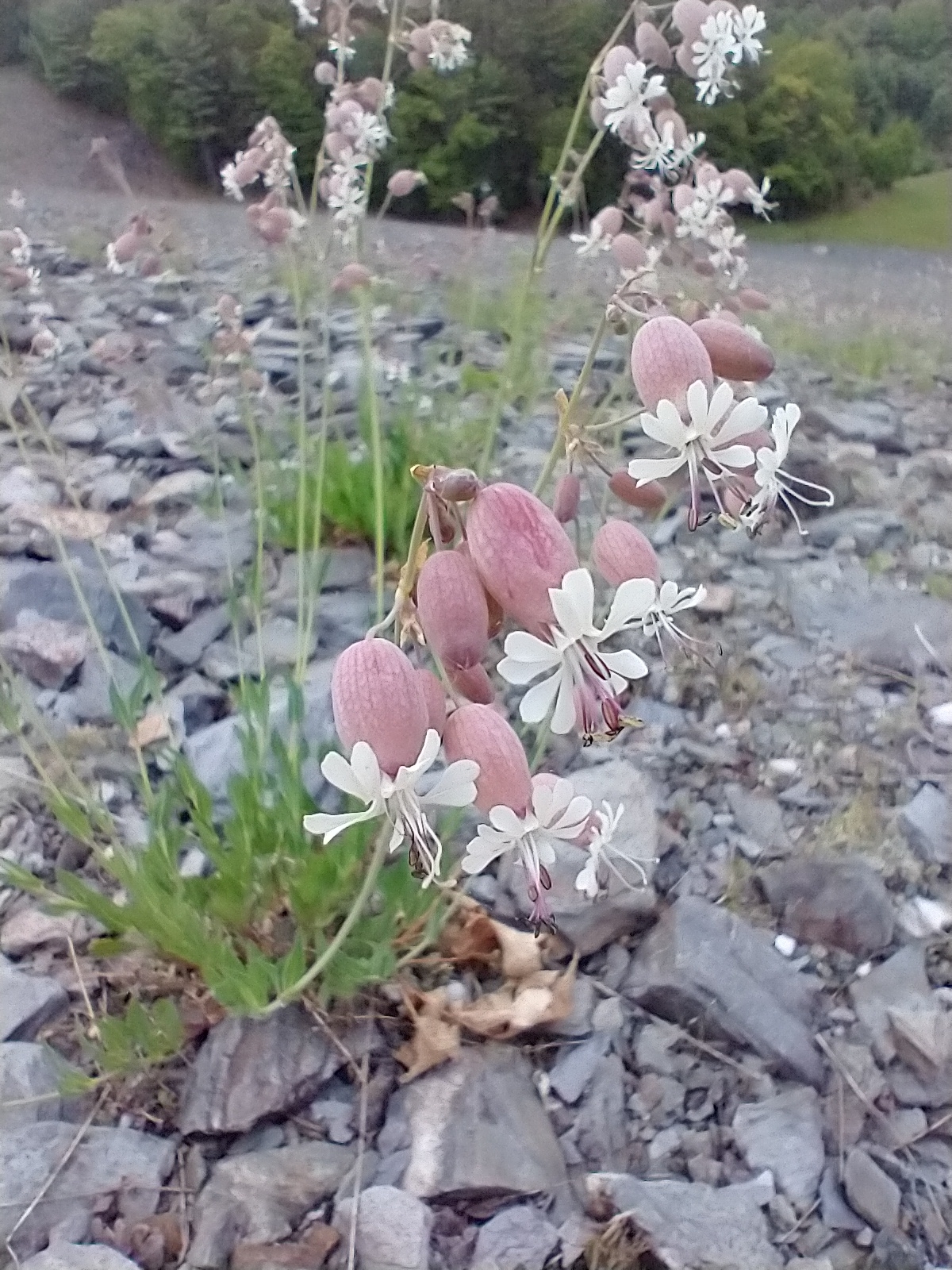
© photo
(c) mayamauri, some rights reserved (CC BY-NC) · cc-by-nc
Tom Norton · cc-by
Grzegorz Grzejszczak · cc-by-sa


Global distribution
POWO places the native range of Silene vulgaris in temperate Europe, southwestern Siberia, Macaronesia and North Africa. It has naturalized widely in North and South America, Australia, New Zealand and Japan, occupying open habitats similar to those in its native range.
- Native4
- Introduced3
- Metropolitan France
- Temperate and Mediterranean Europe
- North Africa
- Southwestern Siberia
- United States
- Australia
- New Zealand
Hexagons: regions where the plant occurs. Green dots: native range.1
Identity
Bladder campion (Silene vulgaris (Moench) Garcke, 1869), also called maidenstears, is an herbaceous perennial of the genus Silene in the Caryophyllaceae family. The epithet vulgaris means common: this is a widespread plant of meadows, banks and roadsides throughout temperate Europe. 1 3
Christian Ehrenfried Moench first described the plant as Behen vulgaris in 1794. German botanist Christian August Friedrich Garcke transferred it to Silene in 1869, producing the accepted combination used today. 2 3
The English name bladder campion describes its defining feature: an inflated calyx, shaped like a small bladder and crossed by a network of often purple veins. Many other Caryophyllaceae have a much less conspicuous tubular calyx. Filled with air and struck against the back of a hand, the bladder pops sharply, inspiring the childhood game behind the regional French name claquet, a practice still documented in the field. 6
Recognition
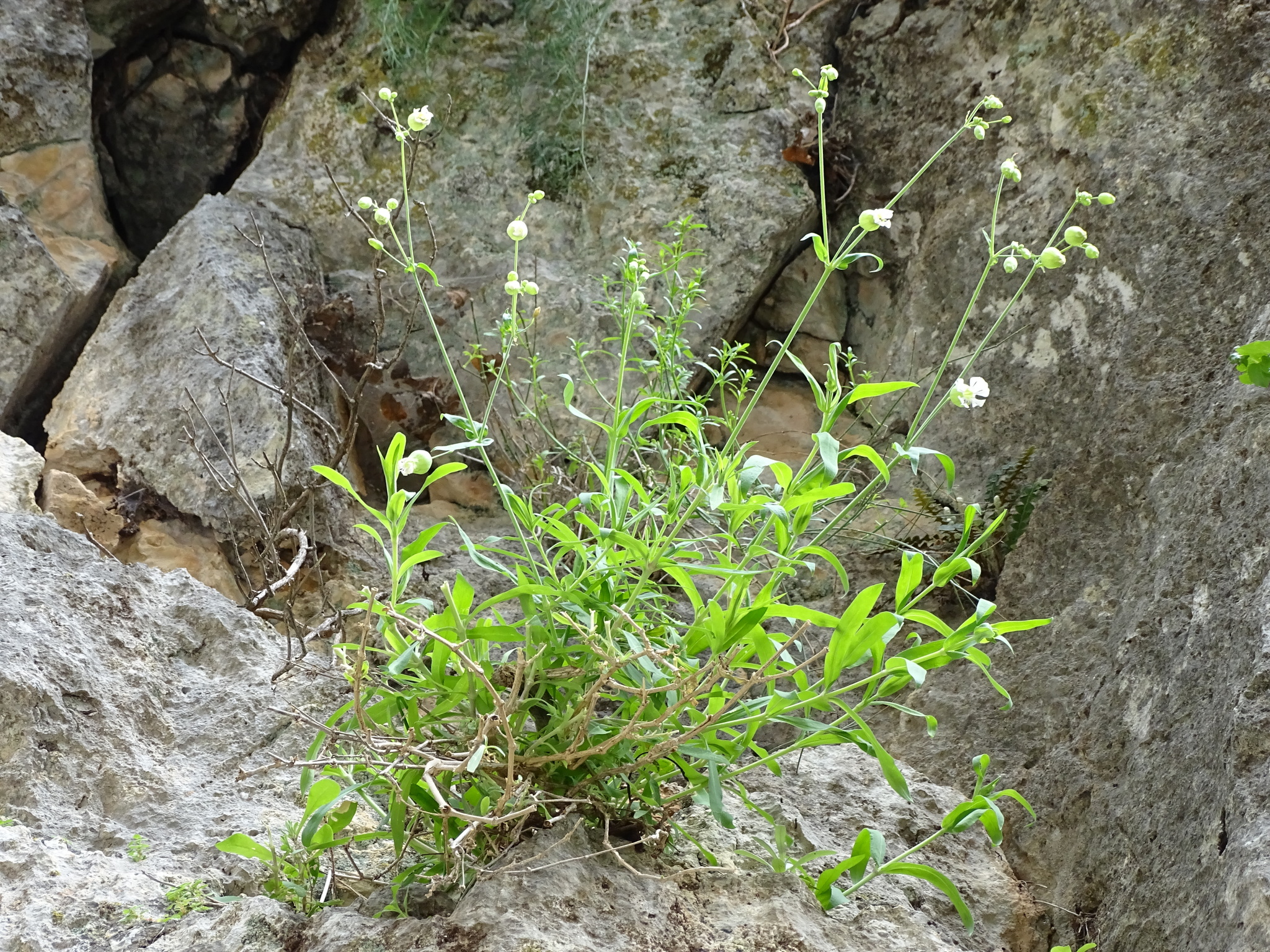
Upright, branching clumps of bladder campion are hairless from base to flower and reach 20–70 cm (8–28 in) tall, depending on growing conditions. Opposite, blue-green, hairless leaves change from oval to lance-shaped near the base to narrower, linear leaves toward the stem tips. 4 5
Five white petals, each deeply divided into two lobes, form a flower 1.2–2.5 cm (0.5–1 in) across. The strongest clue is the calyx: inflated, membranous and visibly net-veined, it persists long after the petals fall. Most other Caryophyllaceae retain a less noticeable tubular calyx. 4
Late in the day, the flowers open most fully and their fragrance becomes noticeable. Moths provide most pollination, with occasional visits by daytime insects, a pattern shared by several other night-flowering Silene species. 5
Useful taxonomy
Within Caryophyllaceae, POWO accepts Silene vulgaris (Moench) Garcke in the subfamily Caryophylloideae and tribe Sileneae. Older literature also uses these scientific synonyms:
- Behen vulgaris Moench
- Cucubalus behen L.
- Silene cucubalus (L.) Wibel
- Silene venosa (Gilib.) Asch. Each listed name belongs to the historical synonymy of bladder campion.
About ten subspecies and varieties recognized by POWO reflect distinct habitats. Subspecies glareosa grows on scree from the Pyrenees to the Carpathians, aetnensis is confined to Mount Etna, and commutata occurs along Mediterranean shores. These coastal and mountain ecotypes are more compact and often fleshier than the typical form, which has long encouraged confusion with related coastal species. 1 3
Habitat and range
Temperate Europe, southwestern Siberia, Macaronesia and North Africa make up the native range recorded by POWO. Bladder campion grows in meadows, on banks and roadsides, and on cultivated or disturbed ground. It favors neutral to alkaline soil and distinctly avoids acidic ground. 1 5
Beyond its native range, bladder campion has naturalized widely in North and South America, Australia, New Zealand and Japan. There it occupies open habitats resembling those of its native range, without documented invasive status to date. 3
Life cycle and reproduction
In temperate northern climates, flowering runs from June to August, with fruiting continuing into September. The upright capsule opens through six curved teeth and releases numerous small, warty seeds, dispersed mainly close to the parent plant. 4
Bladder campion is a model for gynodioecy in evolutionary biology, a reproductive system uncommon among most other Caryophyllaceae. Within one population, hermaphroditic plants coexist with plants bearing only female flowers, which produce no pollen. Mitochondrial genes interrupt pollen development; some individuals counter this effect with nuclear genes that restore fertility. 7 8
Conflict between mitochondrial and nuclear genomes has made bladder campion a model organism in evolutionary genetics for decades, well before its edible shoots became widely known. Researchers now compare mitochondrial transcriptomes from female and hermaphroditic flowers to identify the precise genes responsible for cytoplasmic male sterility. 8
Uses and risks
Mediterranean cuisines use young shoots and leaves gathered before flowering and then cooked. Italian dishes include risotto and shoots fried with garlic; Spanish uses include cold gazpacho and rice with collejas. In Cyprus and Crete, the shoots are sautéed in olive oil. 4
Bladder campion contains saponins, which are poorly absorbed by the body but irritating in large raw amounts and especially toxic to fish. Cooking destroys a substantial proportion of these compounds, explaining the preference for cooked shoots in culinary use. Cats, dogs and humans are not considered at risk at usual consumption levels. 5
Historical uses included emollient baths and fumigations, while the juice was applied to some eye irritations. These practices are now of ethnobotanical interest rather than current medical use. 5
Varieties, look-alikes and related plants
Flore Pleno is the main horticultural form, a double-flowered selection of the coastal ecotype listed by the RHS under Silene vulgaris subsp. maritima. Most other variation reflects ecology rather than ornamental selection. 4
When comparing bladder campion with other plants, check these common look-alikes:
- Silene latifolia, white campion, is truly dioecious and hairy, with a less net-veined and less clearly inflated calyx;
- Silene noctiflora is an annual, sticky to the touch, with an elongated rather than bladder-like calyx;
- coastal ecotypes sometimes treated as Silene uniflora are more prostrate and fleshy, adapted to sea spray;
- Stellaria media, common chickweed, belongs to the same family but forms a creeping mat without an inflated calyx or such large flowers.
A distinctly inflated, net-veined, persistent calyx is the key feature in this comparison. In bladder campion it accompanies hairless stems and mainly evening pollination, unlike hairy white campion or sticky Silene noctiflora.
Main sources
- Plants of the World Online / Kew, Silene vulgaris (Moench) Garcke
- International Plant Names Index, Silene vulgaris (Moench) Garcke
- USDA GRIN Taxonomy for Plants, Silene vulgaris
- Royal Horticultural Society, Silene vulgaris - bladder campion
- Plants For A Future, Silene vulgaris
- Tela Botanica / eFlore, Silene vulgaris ethnobotanical account
- BMC Plant Biology, variation in plastid genomes in the gynodioecious species Silene vulgaris
- PMC, differentially expressed genes shared by two cytoplasmic male sterility types of Silene vulgaris
Frequently asked questions
Is bladder campion toxic?
It is considered non-toxic to cats, dogs and humans. Its saponins can irritate when eaten raw in large amounts and are particularly toxic to fish, but cooking largely neutralizes them.
Can you eat bladder campion?
Yes. Young shoots and leaves gathered before flowering are eaten cooked, including in Italian risotto and several Mediterranean dishes in Spain and Greece.
What is the bladder on bladder campion?
It is the inflated calyx, crossed by net-like veins, surrounding the base of the flower like a small translucent bladder. It persists after the petals fall and is the most reliable identification feature.
Why do geneticists study bladder campion?
Its populations are gynodioecious, mixing hermaphroditic plants with female-only plants. Conflict between mitochondrial and nuclear genes underlies this system, making it a model for the evolution of plant sexual systems.
How can I distinguish bladder campion from white campion?
White campion (Silene latifolia) is truly dioecious and hairy, with a less inflated and less net-veined calyx. Bladder campion is hairless and has a distinctly bladder-like calyx.
Why is bladder campion called claquet in French?
This regional name refers to a childhood game: the inflated calyx is filled with air and struck against the back of the hand to make it pop. Field botanists still document the practice.
Does bladder campion have subspecies?
Yes. POWO recognizes several, including coastal and Mediterranean mountain forms such as glareosa, aetnensis and commutata, which are more compact than the typical form.
Similar plants

If you are unsure about a plant’s toxicity, ask a botanist or veterinarian for advice.