
Canada goldenrod (Solidago canadensis, )
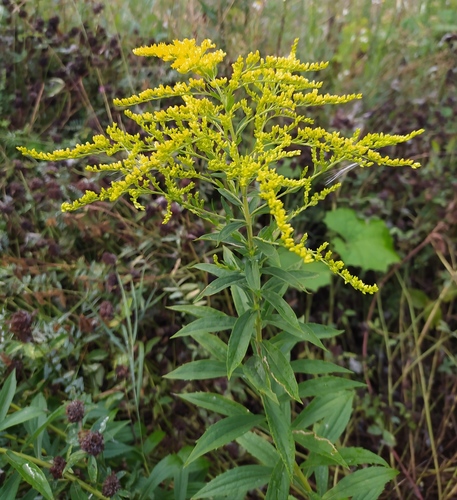
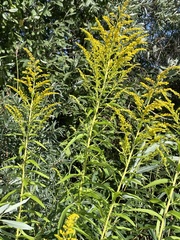
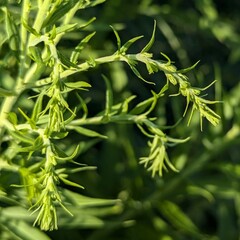
Canada goldenrod (Solidago canadensis L.) is a perennial in the Asteraceae native to North America. Introduced to Europe as an ornamental, it has become widely naturalized. Recognition and management matter where it spreads: its rhizomes form dense colonies that reduce local plant diversity, even though its late flowers still feed many pollinators.
Read moreCanada goldenrod and Canadian goldenrod
Allow a few hours of direct sun per day, preferably morning or evening.
Full sun; tolerates light partial shade
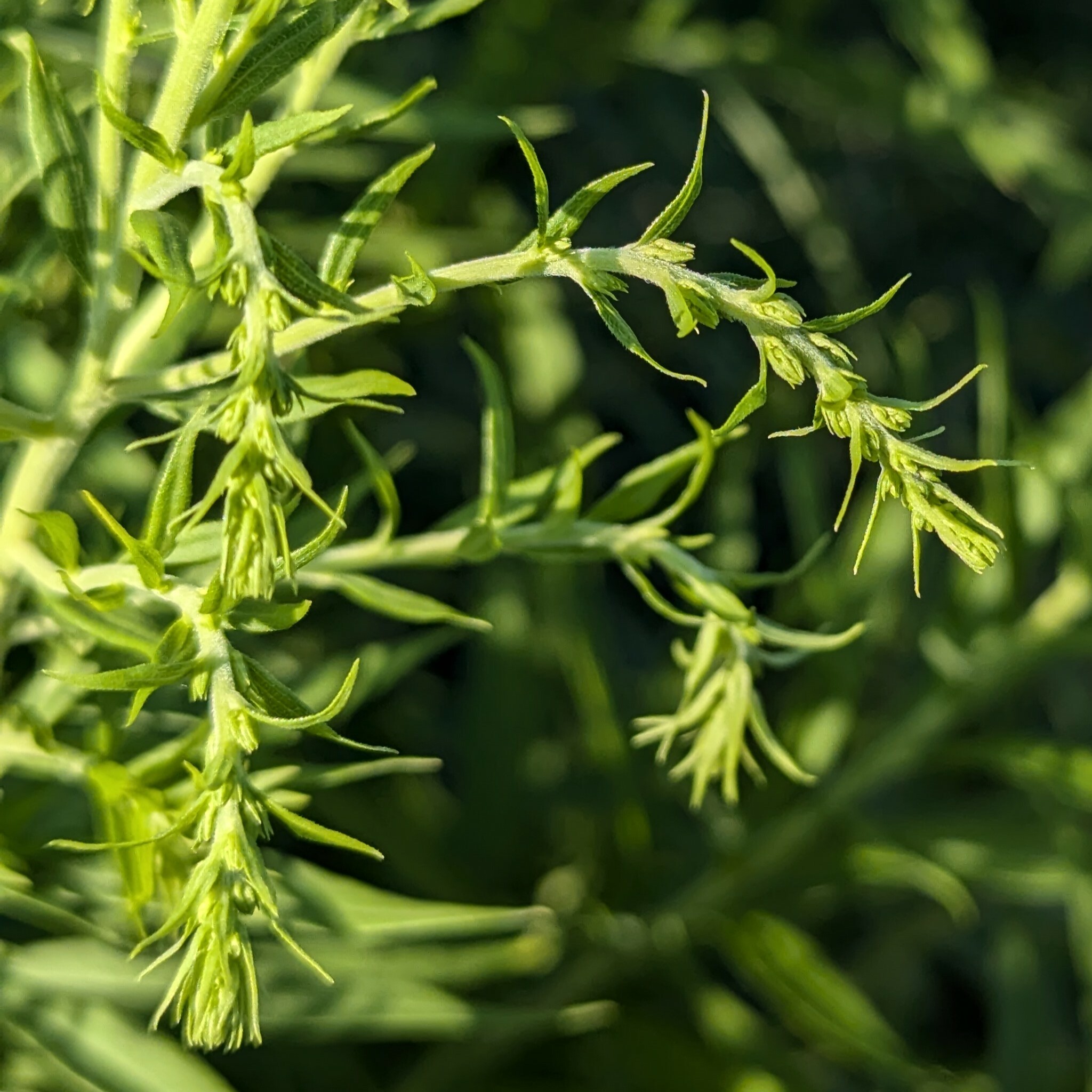


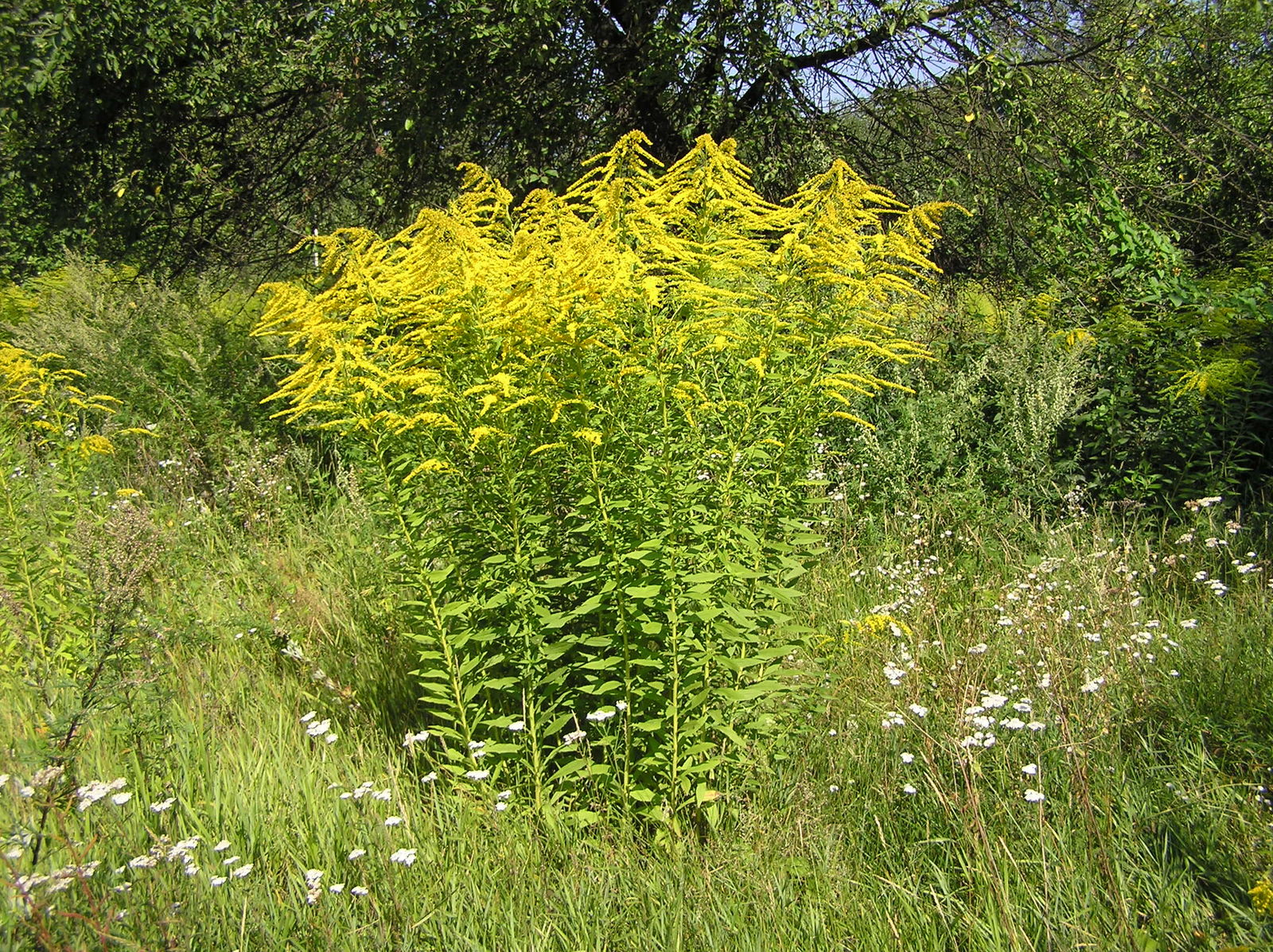
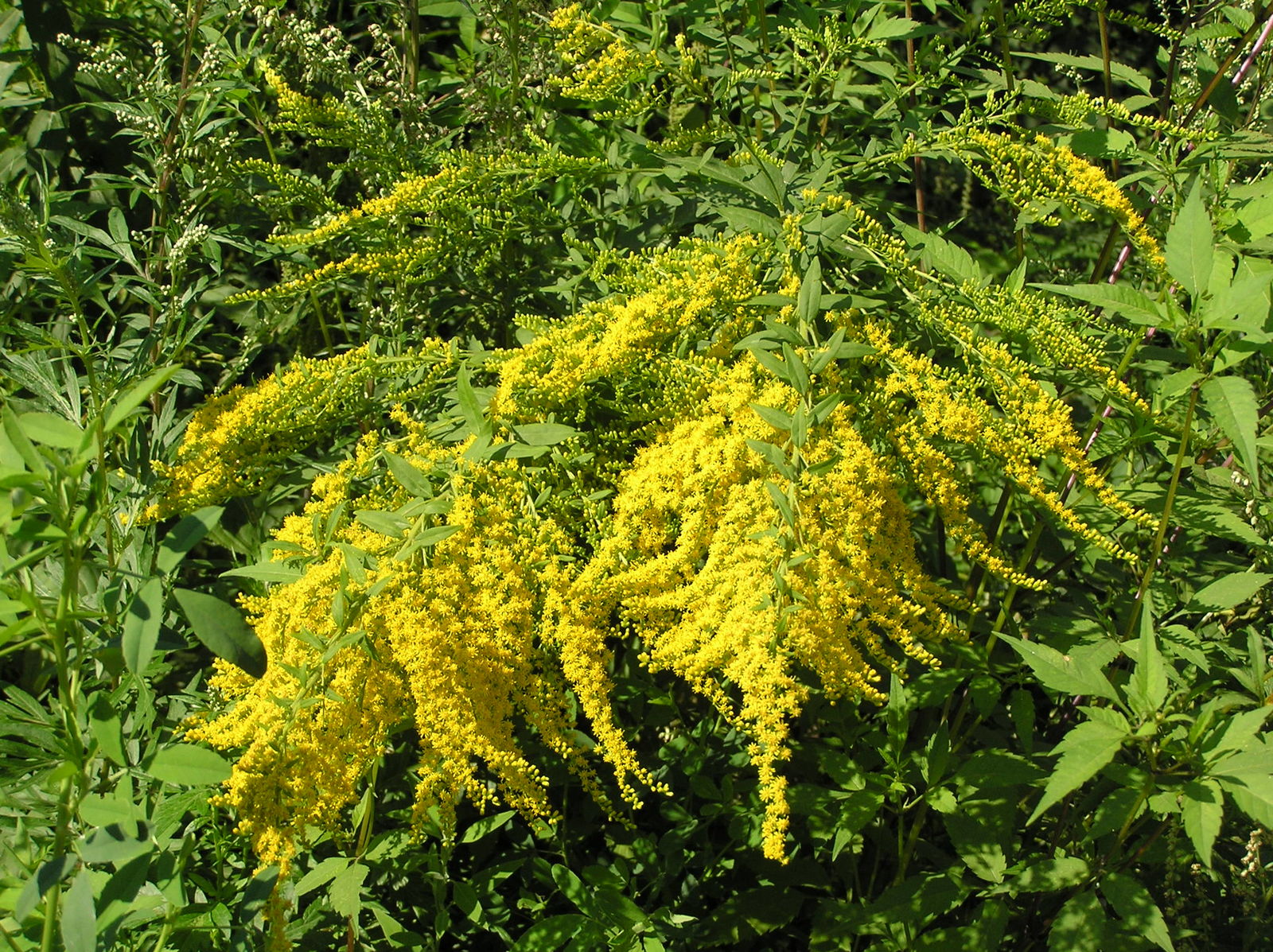
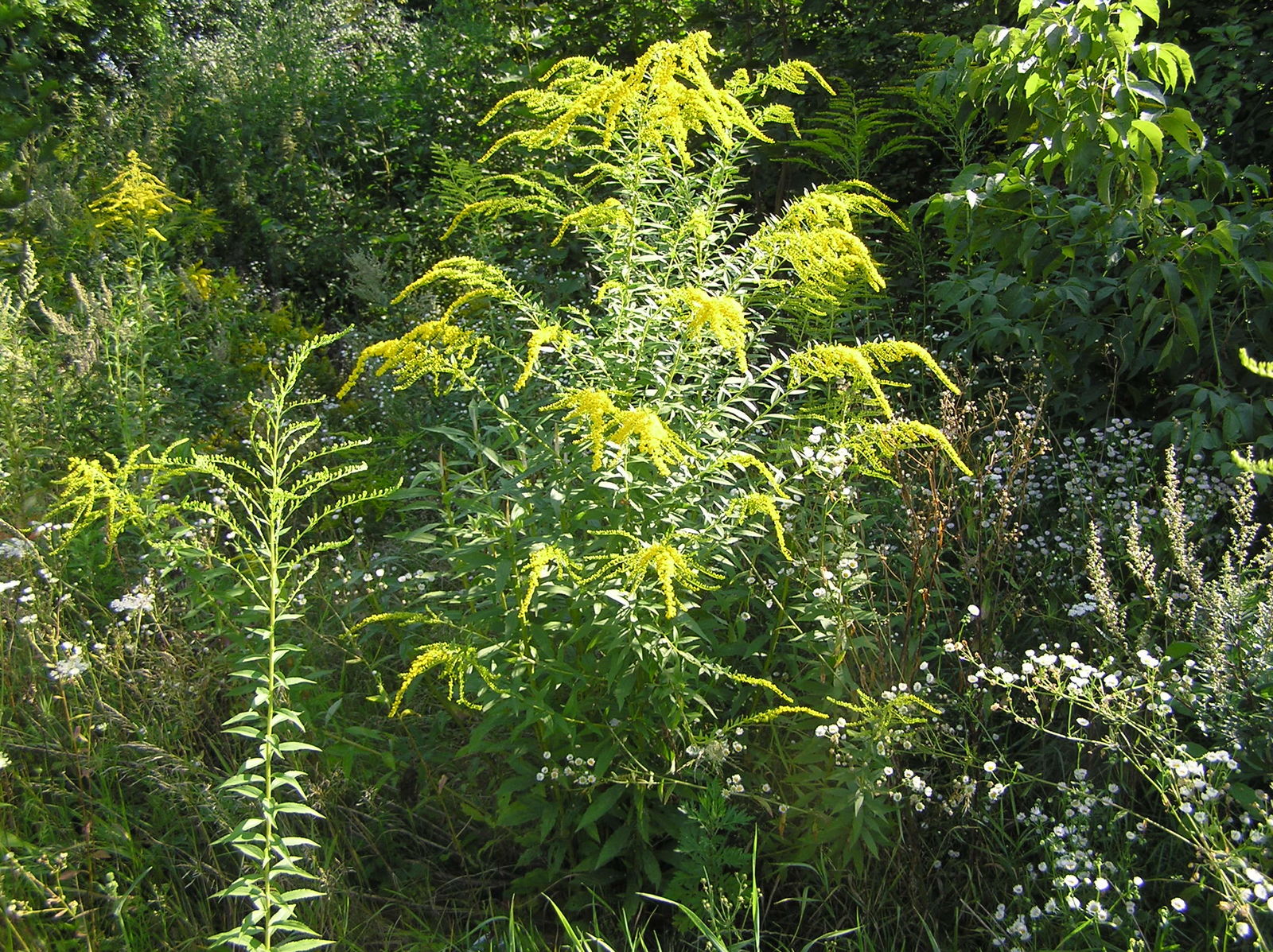
© photo
(c) Lyudmila Ivanova, some rights reserved (CC BY-NC), uploaded by Lyudmila Ivanova · cc-by-nc
Силаева Татьяна Борисовна · cc0
Darius Regnier · cc0
Taken Jul 26, 2021 by Boumlik Messaïli (cc-by-sa)
Taken Sep 2, 2022 by Jim Knopf (cc-by-sa)
Taken Aug 16, 2021 by Valentin Wjst (cc-by-sa)
Taken Jul 26, 2019 by pascal dorchies (cc-by-sa)
Taken Sep 25, 2021 by Pietro Brignoli (cc-by-sa)
© copyright of the Board of Trustees of the Royal Botanic Gardens, Kew.




Global distribution
POWO and INPN treat Solidago canadensis as native to North America. It reached Europe as an ornamental in the 17th and 18th centuries before escaping gardens. French national botanical conservatories classify it as an invasive alien of wetlands and grasslands.
- Native2
- Introduced2
- Invasive3
- Canada
- United States
- Japan
- United Kingdom
- Metropolitan France
- Central and Eastern Europe
- China
Hexagons: regions where the plant occurs. Green dots: native range.1
Identity
Canada goldenrod (Solidago canadensis L., 1753), also called Canadian goldenrod, is an accepted species of Solidago in the Asteraceae. POWO and INPN attribute the name to Linnaeus. Native to Canada and the eastern United States, it was introduced as an ornamental to Europe and Asia, where it subsequently naturalized. 1 2
English-language North American and British sources use both Canada goldenrod and Canadian goldenrod for this species. French names recorded by Tela Botanica include gerbe-d’or, alongside verge d’or du Canada and solidage du Canada. 4 5
Two contrasting traits define its ecological role: late flowers feed pollinators in its native range, while rhizomatous colonies reduce local plant diversity where introduced in France. 3
Recognition
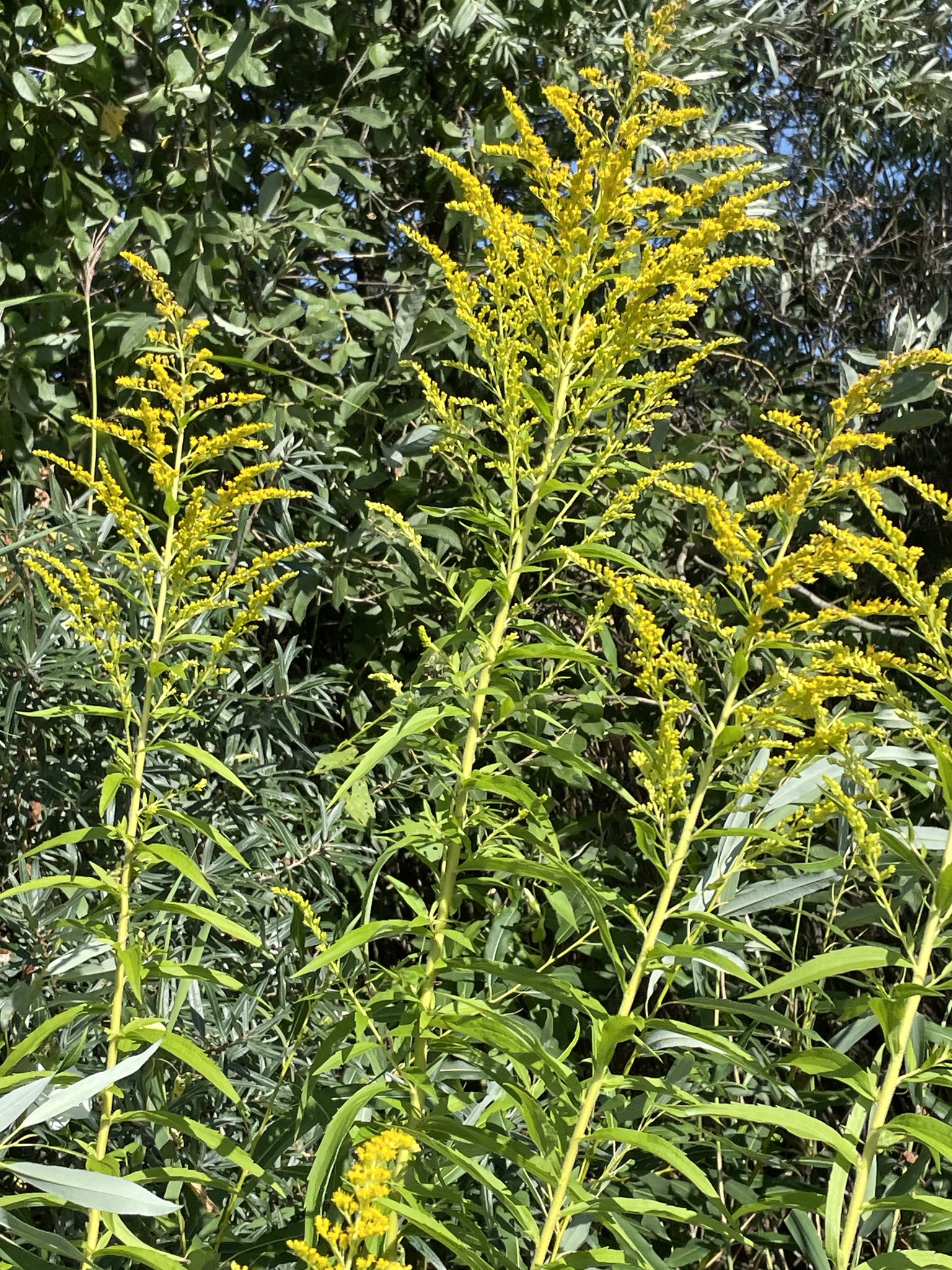
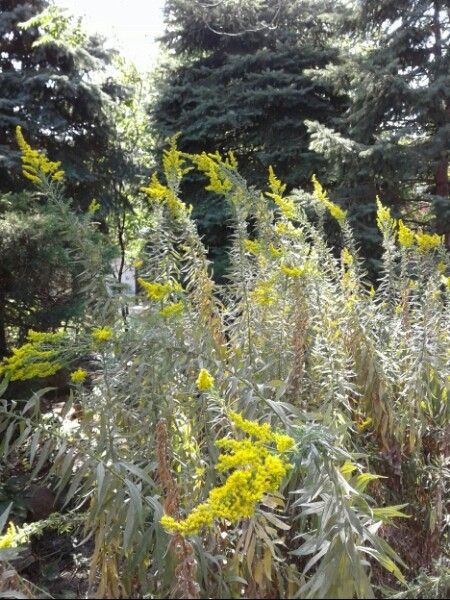
Upright clumps reach 0.6–2.5 m (2–8 ft) tall, with stems often hairy near the top and a spread of 0.5–1.5 m (1.6–5 ft) per plant. Alternate, lance-shaped leaves have fine teeth and three conspicuous main veins. 5 6
Arching, pyramidal flower panicles provide the strongest field clue. Each holds hundreds of tiny yellow heads, mostly arranged along one side of a branch. They flower from late summer into fall, after many other perennials have finished. Timing depends on the local climate. 6 5
Hay fever in late summer is often wrongly attributed to goldenrod. Its heavy, sticky pollen mainly travels on insects; ragweed releases windborne pollen into the air and is the usual culprit. 7
Useful taxonomy
Within Solidago canadensis, POWO recognizes the autonym var. canadensis and a second accepted variety, var. hargeri Fernald, ranging from southern Canada to the east-central United States. Solidago glabra subsp. canadensis (L.) Bonnier is a homotypic synonym of the same taxon. 1
Closely related species require particular attention. POWO now treats Solidago altissima as distinct, although older literature regarded it as a variety or subspecies of Solidago canadensis. European populations called “Solidago canadensis” may therefore belong to this wider complex. 1
Hairiness deserves more weight than yellow flower color alone when identifying these plants. Solidago gigantea has a smooth, bluish-green stem, while the hairier Solidago altissima requires closer comparison within the complex. Field identifications should remain cautious. 9
Habitat and range
Canada and the eastern half of the United States form the native range described here, with plants in moist meadows, abandoned pastures, disturbed ground and roadsides. Ornamental introductions to Europe in the 17th and 18th centuries were followed by escapes into natural habitats. 2 9
China received the species as an ornamental in the early 20th century. It later naturalized widely in eastern and central regions. A recent review reports expansion of about 741 km² (286 sq mi) a year in Central and Eastern Europe, driven by rhizomes and abundant seed production. 9
The French CBNBFC-ORI describes a sun-loving plant whose dense clones spread readily in nutrient-rich, moist, neutral to alkaline soil. It occupies meadows, marshes, riverbanks, woodland edges and disturbed sites. 3
Life cycle and reproduction
Rhizomes and seeds provide complementary routes of reproduction. Underground rhizomes extend each year and send up new shoots in spring, producing clonal colonies that may contain almost no other plant species. 9
A single plant can produce 1,000–20,000 achenes, each light and equipped with a plume. Germination rates of 30–75% favor rapid establishment, depending on soil quality. Wind, water and human activity disperse these fruits over long distances. 9
Roots and rhizomes also release allelopathic compounds: fatty acids, terpenes and flavonoids, including rutin and chlorogenic acid. These inhibit germination and growth in several neighboring plants while suppressing some soil pathogens. Together with the rhizome network, this soil chemistry helps colonies persist and explains why one isolated attempt at pulling is insufficient. 9
Uses and risks
Perenual lists Solidago canadensis as non-toxic to cats and dogs; its horse status remains undocumented in that source. No food-related toxic compound is documented, although pollen contact may cause minor skin irritation in sensitive people. 8
Plants For A Future records historical uses of young leaves, flowering tops and seeds as food, and flowers or leaves as tea. It also reports traditional urinary uses recognized by Germany’s Commission E for urinary infections and kidney stones. This is a record of historical use, not a present-day recommendation to consume the plant. 7
Within its native range, late flowers remain a valued nectar source as fall approaches. In France, this benefit does not offset the reduced plant and pollinator diversity documented in dense colonies. 3
Management in France
CBNBFC-ORI classifies Solidago canadensis as a major invasive alien in natural and semi-natural habitats of Franche-Comté. Its colonies reduce plant diversity in open habitats, lower pasture quality and hinder woodland regeneration. 3
French management differs from the public-health measures applied to ragweed. Canada goldenrod is not subject to a nationwide control duty under the French Public Health Code; management mainly falls to botanical conservatories and natural-area managers rather than prefectural health orders. 3
CBNBFC-ORI recommends repeated cutting or pulling before flowering, twice a year for several consecutive years. This pressure weakens the rhizomes and helps exhaust colonies over several seasons. A geotextile barrier can reduce establishment of young colonies; the guidance calls for cut material to be removed and incinerated to prevent regrowth. 3
Varieties, look-alikes and related plants
When checking a suspected Canada goldenrod, compare these look-alikes:
- Solidago gigantea has smooth, bluish-green stems without conspicuous hairs;
- Solidago altissima, now treated by POWO as a distinct species, is hairier and often taller;
- Ambrosia artemisiifolia has deeply divided leaves and windborne pollen, clearly separating it from goldenrod.
Before intervening, check stem hairiness, leaf shape and flowering time. These features are more reliable than the yellow color of the flower heads alone. 9 7
Main sources
- Plants of the World Online / Kew, Solidago canadensis L.
- INPN, Solidago canadensis L., 1753
- CBNBFC-ORI, Solidago canadensis species profile
- Tela Botanica, BDTFX reference, Solidago canadensis
- Royal Horticultural Society, Solidago canadensis - Canadian goldenrod
- Missouri Botanical Garden, Plant Finder, Solidago canadensis
- Plants For A Future, Solidago canadensis
- Perenual, horticultural and toxicity traits, Solidago canadensis
- PMC, allelopathy and allelochemicals of Solidago canadensis for their naturalization
Frequently asked questions
Is Canada goldenrod poisonous to cats and dogs?
No. Perenual lists Solidago canadensis as non-toxic to cats and dogs. This source does not document its status for horses.
Why is goldenrod often blamed for hay fever?
Solidago canadensis has heavy, sticky pollen carried mainly by insects rather than wind. Ragweed, which releases large amounts of airborne pollen, is more often responsible for late-summer allergies.
Should Canada goldenrod be planted in a French garden?
No, planting it is not recommended in France. National botanical conservatories classify it as an invasive alien in grasslands and wetlands, where its colonies reduce local plant diversity.
How can Canada goldenrod be distinguished from other goldenrods?
Solidago gigantea has a smooth, bluish-green stem without conspicuous hairs. POWO now treats Solidago altissima as a distinct species, although it was formerly considered a variety of Solidago canadensis.
How can an invasive goldenrod colony be managed?
French botanical conservatories recommend repeated cutting or pulling before flowering, twice a year over several years, with removal of residues to prevent regrowth.
Does invasive goldenrod still benefit pollinators?
Yes, to a degree. Its late flowers still feed many insects, but dense colonies reduce overall floral diversity and disadvantage other local pollinator species.
What does the scientific name Solidago canadensis mean?
Solidago comes from the Latin solidare, meaning to make whole or firm, reflecting an old herbal use in wound healing. The epithet canadensis recalls the North American origin described by Linnaeus in 1753.
Similar plants
If you are unsure about a plant’s toxicity, ask a botanist or veterinarian for advice.