
Sea almond (Terminalia catappa, )

Sea almond (Terminalia catappa) is a large tropical tree in the Combretaceae family, widespread on sandy Indo-Pacific shores and naturalized across the tropics. Its distinctive horizontal tiers of branches bear broad leaves that turn red before falling, twice a year. The fruit contains an edible kernel that explains its almond names.
Read moreSea almond, Tropical almond, Indian almond, Beach almond and False kamani
Place in full sun, with intense direct light all day long.



© photo
Darren Obbard · cc0
iNaturalist User · CC BY-NC
Wikimedia Commons · CC BY-SA or Public Domain
Taken Nov 11, 2015 by Tela Botanica − Hugo SANTACREU (cc-by-sa)
Taken Feb 27, 2017 by Tela Botanica − Liliane ROUBAUDI (cc-by-sa)
Taken Mar 2, 2006 by Tela Botanica − Geneviève Botti (cc-by-sa)
Taken Nov 20, 2021 by Theophile Amedjrana (cc-by-sa)
© copyright of the Board of Trustees of the Royal Botanic Gardens, Kew.


Global distribution
The native range of Terminalia catappa remains debated but covers a broad Indo-Pacific area from Madagascar and the Comoros to India, Southeast Asia, northern Australia and the Pacific; New Guinea is often cited as a likely center of origin. Prolonged seed flotation has helped it naturalize on tropical coasts worldwide, including the French Antilles, Réunion and Florida, where it is sometimes classified as invasive.
- Native4
- Introduced4
- Invasive1
- New Guinea
- Madagascar
- India and Southeast Asia
- Northern Australia
- French Antilles
- Réunion
- French Polynesia
- West Africa
- Florida (United States)
Hexagons: regions where the plant occurs. Green dots: native range.1
Identity
Sea almond (Terminalia catappa L., 1767) is an accepted species of Terminalia in the Combretaceae family. Its scientific name combines Latin terminus, meaning an end, for the leaves clustered at shoot tips, with catappa, Linnaeus’s rendering of the Malay tree name ketapang. 1 6
The edible kernel explains the names Tropical almond, Indian almond and Beach almond; False kamani is another English name. The French name badamier derives from the Indian word badām, meaning almond in Hindi and Marathi. These names refer to flavor rather than a botanical relationship with Prunus dulcis. The dried fruit is also called myrobolan, while French Antillean names include amandier pays and amandier des Indes. 6
Its precise geographical origin remains debated. POWO describes a broad range from the Comoros and Madagascar through tropical Asia to the Pacific, while several references identify New Guinea as a likely center of diversification. 1 6
Recognition
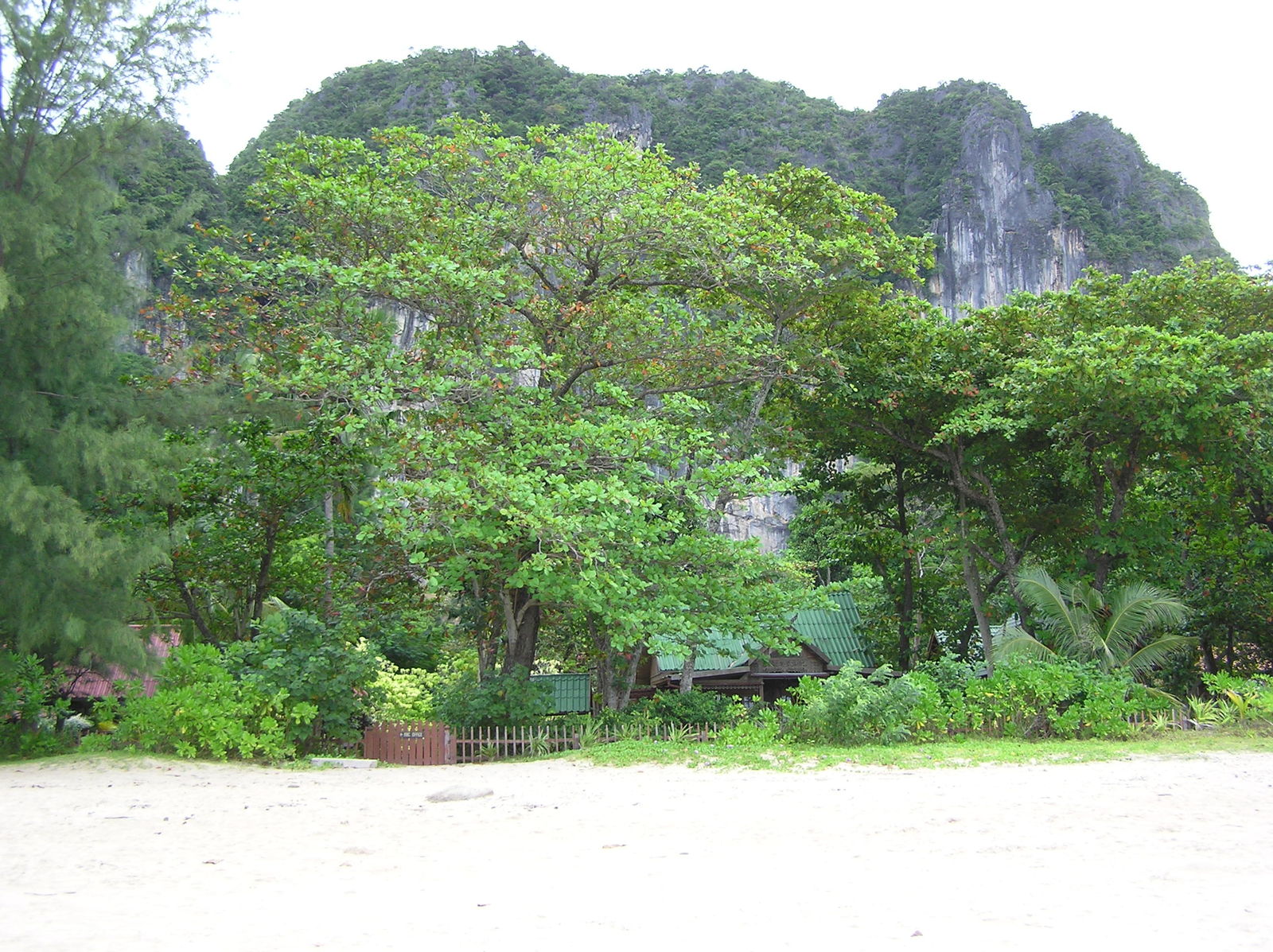
Horizontal tiers of branches give Terminalia catappa its most distinctive outline. Whorled branches form successive levels as the tree grows. Coastal trees planted in the ground commonly reach 15–25 m (49–82 ft); some records report 35–40 m (115–131 ft) in especially favorable situations. 2 3
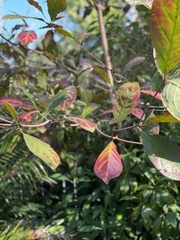
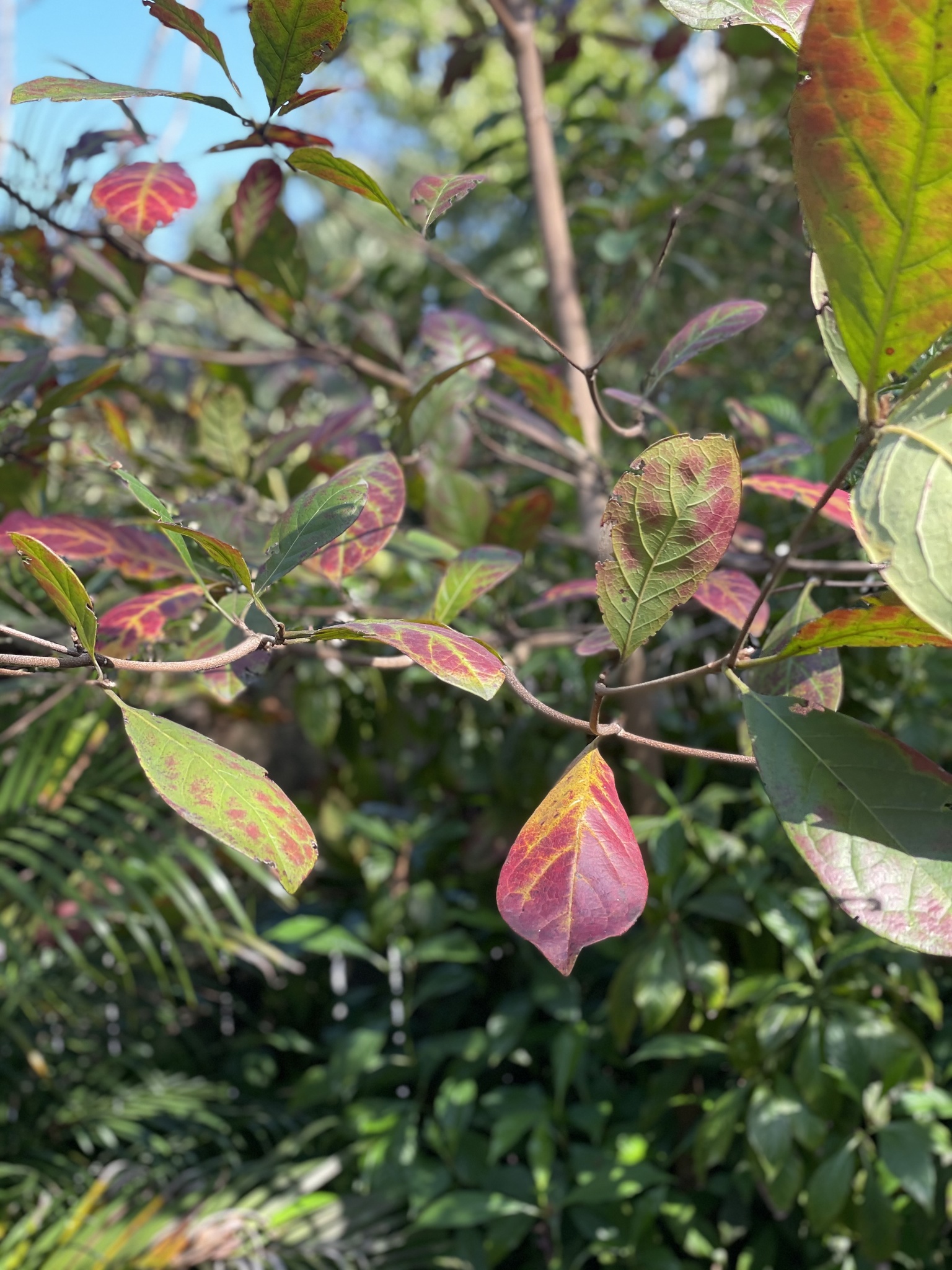
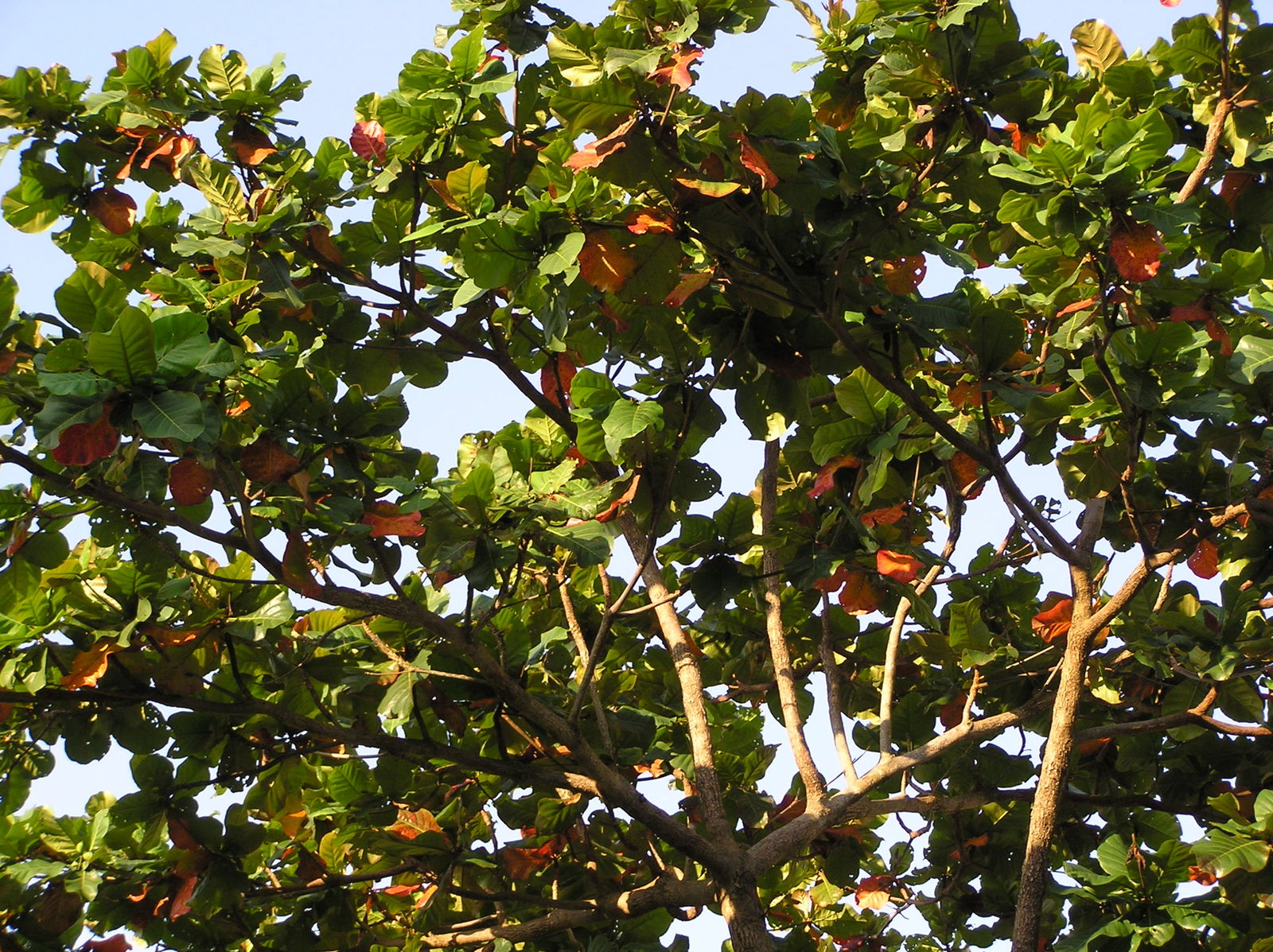
Broad, obovate leaves cluster at Sea almond shoot tips, each 8–36 cm (3–14 in) long and 6–24 cm (2–9 in) wide, on a short stalk. They turn red before falling, a cycle repeated twice a year in stable tropical conditions, without leaving the tree bare for long. 6 2
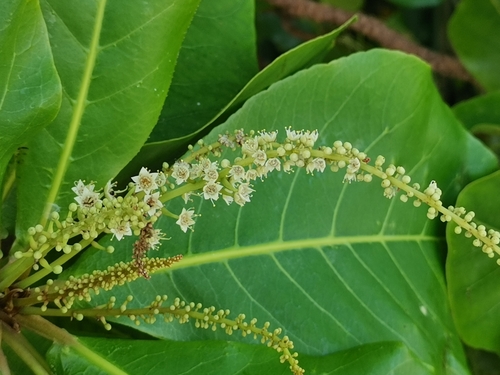
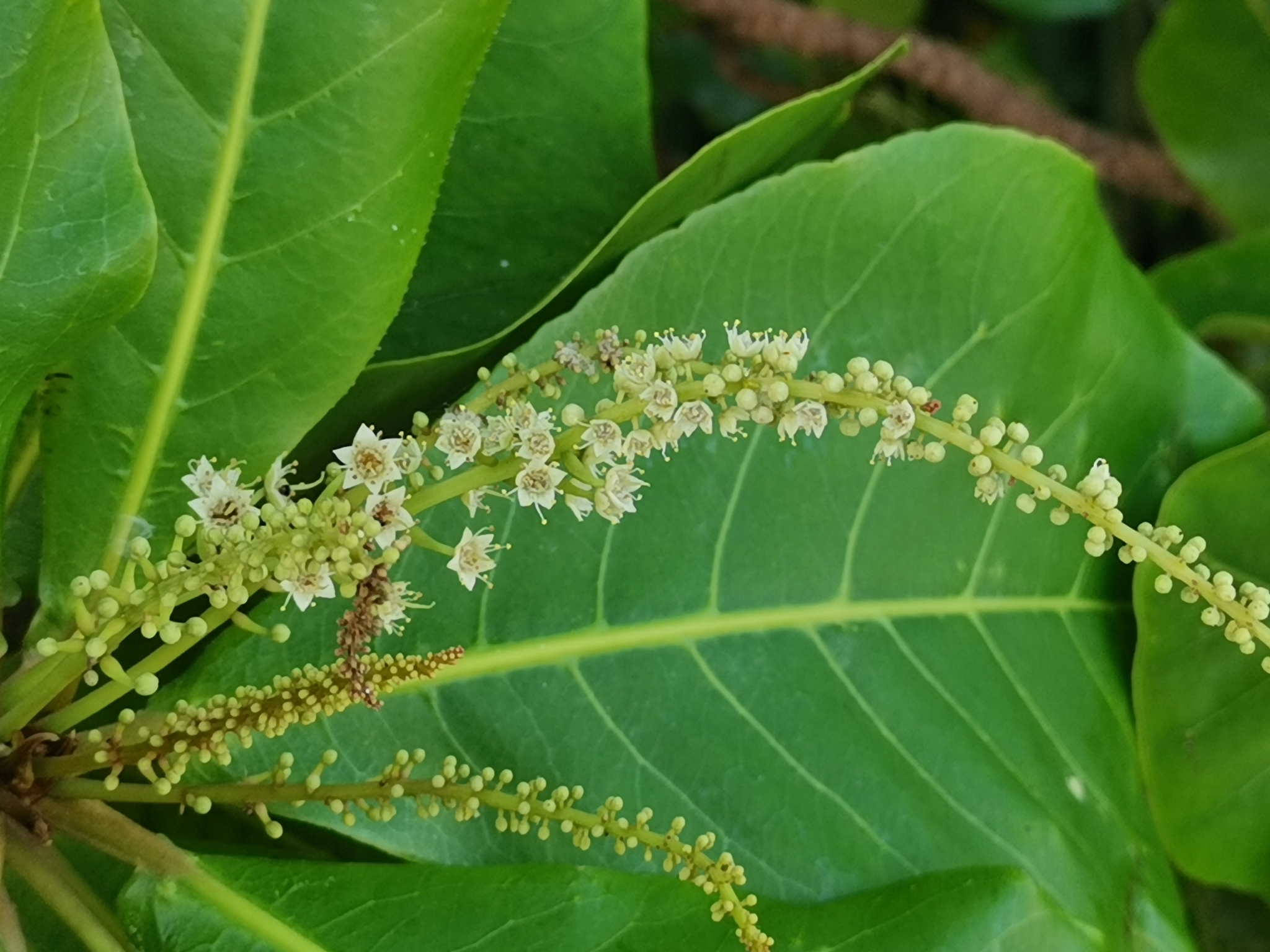
Elongated axillary spikes 5–25 cm (2–10 in) long carry tiny whitish flowers with no petals and ten stamens. The resulting flattened oval drupe measures about 5–7 cm (2–3 in), changing from green to reddish brown when ripe. A very hard stone surrounds the edible kernel. 6 2
Useful taxonomy
Several hundred accepted species belong to Terminalia, helping explain confusion around shared vernacular names such as badamier. The main botanical synonyms of Terminalia catappa are:
- Terminalia catappa var. macrocarpa Hassk., historical synonym
- Terminalia catappa var. rhodocarpa Hassk., historical synonym
- Terminalia catappa var. subcordata (Humb. & Bonpl. ex Willd.) DC., historical synonym
- Myrobalanus catappa (L.) Kuntze, historical synonym
- Juglans catappa (L.) Lour., historical synonym
These historical varieties mainly referred to larger or more strongly colored fruits; they are now treated as synonyms of the accepted type. The complete name, Terminalia catappa L., remains the reliable reference. 1
Habitat and range
Tropical sandy and rocky shores are its principal habitat, including beach edges, foredunes and low coastal ground. Sea almond seeds float for long periods without losing their ability to germinate, explaining their arrival on many tropical shores well before deliberate planting. 6 4
Widely planted for shade, Terminalia catappa has naturalized on numerous tropical coasts, including the French Antilles, Réunion, French Polynesia and parts of West Africa. In Florida it is listed as a Category 2 invasive species, capable of displacing native coastal vegetation. 4 7
The IUCN assesses Sea almond as Least Concern. Its very wide range and strong dispersal ability rule out an immediate global threat, although local populations may require monitoring for invasive behavior. 5
Life cycle and reproduction
In stable tropical climates, Sea almond flowers through much of the year, peaking in spring. Spikes carry male flowers toward the tip and fewer bisexual flowers at the base, an arrangement favoring insect-mediated cross-pollination. 6
Ripening takes several months. Fallen fruits can float at sea for weeks while the kernel remains viable. This effective long-distance ocean dispersal explains Sea almond on shores where people have never planted it. 6 4
Growers propagate Sea almond almost exclusively by seed. Soaking for 24 hours before sowing encourages germination approaching 70% within two to three weeks. 3
Uses and risks
Extracted from its very hard stone, the kernel is eaten raw or roasted and contains about 50% oil. It supports a small local trade in Guadeloupe under the name amandes pays. Unlike the fruit of Prunus dulcis, its sweet, fibrous flesh is also eaten when young. 3 6
Dried fruits known as myrobolans entered European pharmacopoeias in the 13th century through Arabic medical writings. Leaves rich in astringent tannins remain part of traditional treatments for coughs and digestive complaints in several tropical regions. 6
Aquarists have long used dried Sea almond leaves to acidify and soften water in betta and shrimp tanks, through the gradual release of tannins and humic acids. No major veterinary database classifies Terminalia catappa as toxic to cats, dogs or humans. 8
Varieties, look-alikes and related plants
Cream-and-green foliage distinguishes the horticultural form Variegata, sold as a tropical ornamental tree rather than a separate species. 3
Particular care is needed with Barringtonia asiatica, also called badamier in French. It belongs to the Lecythidaceae, produces toxic bishop’s-miter-shaped fruits and lacks the horizontal tiers of Terminalia catappa. A shared common name cannot identify the tree safely. 6
Elsewhere, other Terminalia species share the name badamier, including Terminalia macroptera in West Africa. The full binomial is more reliable than a vernacular name alone when distinguishing edible and toxic species. 1
Main sources
- Plants of the World Online / Kew, Terminalia catappa L.
- Missouri Botanical Garden, Plant Finder — Terminalia catappa
- Plants For A Future, Terminalia catappa — Indian Almond
- University of Florida, Plant Directory — Terminalia catappa
- IUCN Red List, Terminalia catappa assessment 2019
- French Wikipedia, Terminalia catappa
- Espèces Envahissantes Outre-mer, Terminalia catappa
- Au Jardin Info, Catappa leaves, a natural aid for aquarists
Frequently asked questions
Is Sea almond toxic to cats and dogs?
No. No major veterinary database lists Terminalia catappa as toxic to cats, dogs or humans. Its kernel is edible.
Why does Sea almond shed its leaves twice a year?
This is normal behavior rather than a sign of disease. Leaves turn red and fall within a few days before quickly regrowing, generally twice a year in tropical climates.
Can Sea almond grow outdoors in mainland France?
It cannot grow in the ground there. The species needs a frost-free climate, USDA zones 10–12; within France, year-round outdoor cultivation is restricted to overseas departments and territories.
What are catappa leaves used for in aquariums?
Dried leaves gradually release tannins and humic acids when submerged, acidifying and softening the water. Asian aquarists have long used them for bettas and shrimp.
Is Sea almond fruit like a true almond?
Only the kernel inside the stone resembles a common almond in flavor. Botanically, the fruit is a Combretaceae drupe, unrelated to the almond tree Prunus dulcis.
How can I distinguish Sea almond from Barringtonia asiatica?
Both are sometimes called badamier in French, but Barringtonia asiatica belongs to a different family, produces toxic bonnet-shaped fruits and lacks the distinctive horizontal tiers of Terminalia catappa.
Similar plants
If you are unsure about a plant’s toxicity, ask a botanist or veterinarian for advice.