
Tricolor hibiscus (Hibiscus × rosa-sinensis, )
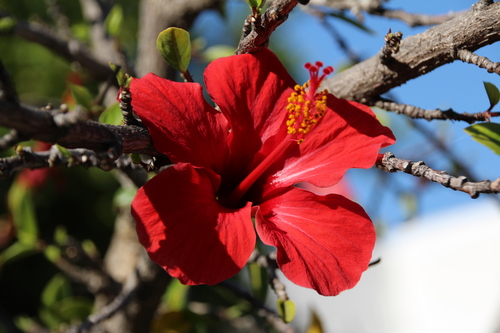
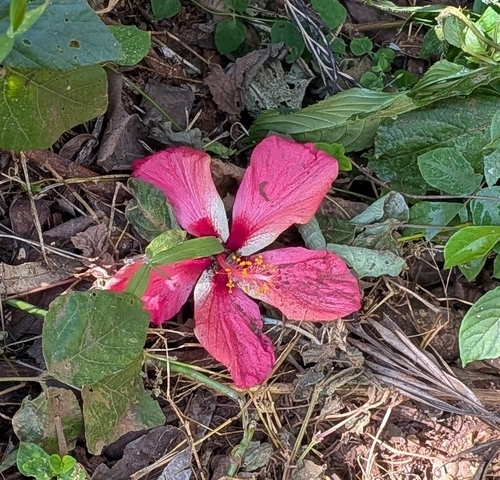
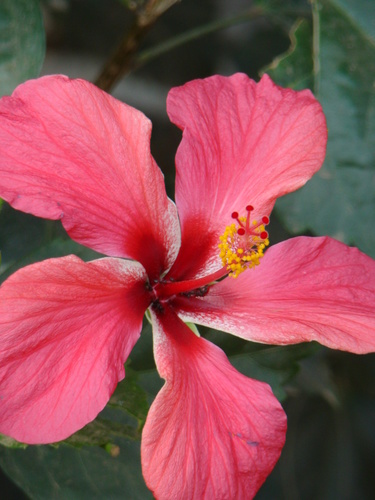
The tricolor hibiscus (Hibiscus × rosa-sinensis L., often written Hibiscus rosa-sinensis) is a tropical evergreen shrub in the mallow family, Malvaceae. It is grown mainly for its large, short-lived flowers, often red, pink, yellow, orange or white, as a hedge in warm climates, a summer container plant or a frost-free conservatory shrub.
Read moreChinese hibiscus, Tropical hibiscus, Shoe flower and China rose
Hibiscus rosa-sinensis
Allow a few hours of direct sun per day, preferably morning or evening.
Global distribution
POWO/WCVP treats Hibiscus × rosa-sinensis as a hybrid cultigen from the South Pacific, while several horticultural sources point to tropical Asia or China. Horticultural origin, cultivated range and introductions therefore need to be kept apart, without assigning any invasive status.
- Native1
- Introduced3
- Vanuatu
- Florida
- California
- Caribbean
Hexagons: sourced regions. Green dots: native range. Statuses according to POWO (Kew).
Identity
The tricolor hibiscus is the tropical hibiscus of summer containers, conservatories and warm-climate gardens. POWO/WCVP accepts the name Hibiscus × rosa-sinensis L., yet the spelling Hibiscus rosa-sinensis is still everywhere in horticultural references, growing databases and the nursery trade. 1 2
It belongs to the mallow family, Malvaceae, in the genus Hibiscus. Names such as Chinese hibiscus, tropical hibiscus, shoe flower and China rose all refer to the same large cultivated group, not to a rose of the genus Rosa. The epithet rosa-sinensis literally means "rose of China," which accounts for part of the naming confusion. 3 4
Calling it a simple wild Asian shrub would be misleading. POWO/WCVP treats it as a hybrid cultigen from the South Pacific; other horticultural sources give an Asian or Chinese origin, because the plant has such a long history of cultivation. 1 5
Recognition
In the horticultural sense, Hibiscus rosa-sinensis forms an evergreen shrub, sometimes trained as a small tree, a hedge, a standard or a large container specimen. Leaves are alternate, simple, dark green and glossy, ovate to elliptic, with a toothed margin; some selections also carry variegated foliage. 6 4
Look first at the flower. It is large, solitary and funnel-shaped, often 8–15 cm (3–6 in) across and sometimes more depending on the cultivar. Petals may be single or double, in red, pink, yellow, orange, salmon or white. At the center, a protruding staminal column carries the stamens and style, a very useful visual signature across hibiscus. 3 6
Individual flowers are short-lived, often lasting a day or two, but an actively growing plant can keep producing buds all through the warm season. When a plant refuses to bloom, the cause is more often low light, cold, badly timed pruning or watering stress than a misidentified species. 7 8
Useful taxonomy
Everyday horticultural usage still favors Hibiscus rosa-sinensis, while the name accepted by POWO/WCVP is Hibiscus × rosa-sinensis L. Both reference points are kept here: the common spelling for recognizing the plant, and the accepted name for taxonomy. 1 2
The hybrid sign is not a cosmetic detail. Flora of North America describes a complex cultivated history, with scattered naturalizations and many hybrids or selections. NTBG agrees: the plant is no longer known with certainty in the wild, and cultivated forms have shifted a great deal through crossing. 9 4
Related names deserve care. Hibiscus syriacus, often called rose of Sharon or althea, is hardier and deciduous; it should not be used as an automatic stand-in when deciding whether the tropical hibiscus is edible or toxic. Cultivars of H. rosa-sinensis also vary widely from one market to another. 5 10
Habitat and range
Taxonomic databases frame its origin more safely as a tropical cultigen than as a single country. POWO/WCVP describes a cultigen derived from artificial hybrids in the South Pacific, a shrub of the seasonally dry tropical biome. Trefle lists Vanuatu as the native range, followed by many regions of introduction. 1 11
Flora of North America describes the species as widely grown in the tropics and subtropics, sparingly naturalized within that cultivated range, with no certain native occurrence. NTBG likewise stresses its unknown historical origin and its long cultivation across tropical regions. 9 4
Wherever winters bring frost, the tricolor hibiscus is a plant for tubs, conservatories, warm greenhouses or summer patios rather than an ordinary hardy shrub for open ground; outdoor planting makes sense only in frost-free climates. None of the references consulted supports an invasive status, and tropical introductions are treated as localized occurrences, not as a general warning. 5 9
Cycle and cultivation
Flowers form on new growth. RHS recommends pruning in late winter or very early spring to keep the plant compact and encourage fresh flowering shoots. UMN applies the same logic to a warm indoor plant: prune in late winter, give plenty of light and avoid temperature swings. 5 7
Container success comes down to balancing heat, light and water. The plant needs very bright light to bloom, a root ball kept evenly moist but never saturated, a rich, free-draining mix, and a gradual transition when it moves outdoors into sun. Buds drop readily if the plant goes abruptly from warm to cold, from dry to soaked, or from strong light to a dim room. 7 8
Cuttings are the reliable way to propagate cultivars. RHS mentions softwood or semi-ripe cuttings in late spring or early summer, with bottom heat and high humidity; UMN also describes cuttings of about 8–13 cm (3–5 in) that root within a few weeks. Seed is possible, but it does not reliably reproduce the flower colors or forms of named selections. 5 7
Uses, edibility and toxicity
Gardeners grow it for ornament: a warm-climate hedge, a specimen shrub, a patio container, a conservatory plant, a flowering screen or a standard. IFAS describes a very free-flowering landscape shrub in USDA zones 9 to 11; RHS treats it instead as a tender plant for a greenhouse or bright room in cold climates. 6 5
Edibility needs context. NC State lists the flower as having edible value, and UMN Extension includes Hibiscus rosa-sinensis among edible flowers for its mild, tart flavor and for coloring teas. That does not turn the whole plant into food: only correctly identified, untreated flowers intended for eating fall within that scope. 3 12
Toxicity to animals is the trickiest point. The ASPCA entry titled "Hibiscus" actually covers Hibiscus syriacus and lists it as nontoxic to dogs, cats and horses, so it cannot on its own establish that H. rosa-sinensis is nontoxic. IVIS, by contrast, covers the genus Hibiscus in a veterinary guide and mainly reports digestive upset in dogs that chew or eat parts of the plant, with no toxin identified. 10 13
The cautious position is therefore: dogs, caution over digestive upset; cats and horses, unresolved for this species; and no ingestion advice for any animal. A small exposure is not described here as a systemic emergency, but drooling, vomiting, diarrhea, lethargy or a large ingestion warrant a call to a veterinarian, with the plant identified. 13 14
Cultivars and look-alikes
RHS warns that the cultivars on offer change a great deal in the houseplant trade. 'Cooperi' is a useful reference because RHS cites it as a compact variegated form with green-and-white marbled foliage, sometimes flushed pink, and red flowers. Other sales names should be checked against the actual plant. 5
Perenual data also mention Hibiscus rosa-sinensis and a cultivar called 'Persimmon', but these horticultural records remain secondary. They help with size, container use, sun and hardiness, without replacing a taxonomic source or an official cultivar register. 14 2
The most important mix-up involves Hibiscus syriacus. The name "althea" is usually applied to H. syriacus, although some horticultural usage also attaches a similar name to the tropical hibiscus. For growing, the difference is clear: H. syriacus handles winter far better, whereas the tricolor hibiscus must stay frost-free. For safety it matters too, because the ASPCA entries consulted do not cover the same taxon. 10 5
Main sources
- Plants of the World Online / Kew, Hibiscus × rosa-sinensis L.
- NC State Extension Gardener Plant Toolbox, Hibiscus rosa-sinensis
- Royal Horticultural Society, Hibiscus rosa-sinensis growing guide
- University of Minnesota Extension, Hibiscus houseplant guide
- University of Minnesota Extension, Edible flowers
- University of Florida IFAS Extension, Hibiscus rosa-sinensis fact sheet
- Flora of North America, Hibiscus rosa-sinensis
- National Tropical Botanical Garden, Hibiscus rosa-sinensis
- ASPCA, Hibiscus entry for Hibiscus syriacus
- IVIS, Guide to Poisonous House and Garden Plants, Hibiscus species
Frequently asked questions
Why is it sometimes written Hibiscus × rosa-sinensis?
POWO/WCVP treats the taxon as an accepted hybrid. The spelling without the hybrid sign remains very common in horticulture, in the trade and in research.
Is the tricolor hibiscus frost hardy?
No. It is hardy outdoors only in roughly USDA zones 9 to 11. Where winters bring frost, grow it in a container, conservatory or greenhouse and keep it frost-free.
Are the flowers edible?
Horticultural sources list Hibiscus rosa-sinensis flowers as edible, notably for herbal teas or color. That applies only to correctly identified, untreated flowers prepared for food use.
Is the whole plant edible?
No. No food use is recommended for the leaves, stems, roots or treated florist flowers.
Is it toxic to dogs and cats?
The picture is muddled across sources and across plants called hibiscus. Dogs call for caution over digestive upset, the question remains open for cats and horses with H. rosa-sinensis, and veterinary advice is recommended if signs appear.
Why do the buds drop?
Common causes are cold, dry air, irregular watering, low light or an abrupt move.
How do you propagate it?
Stem cuttings are the most reliable way to keep a cultivar true, not seed.
Similar plants
Botanical data compiled from reference sources (RHS, Kew Gardens, POWO). This profile is for guidance only and is not a substitute for advice from a botanist or veterinarian if you have concerns about toxicity.