
Painter's-palette (Anthurium andraeanum, )
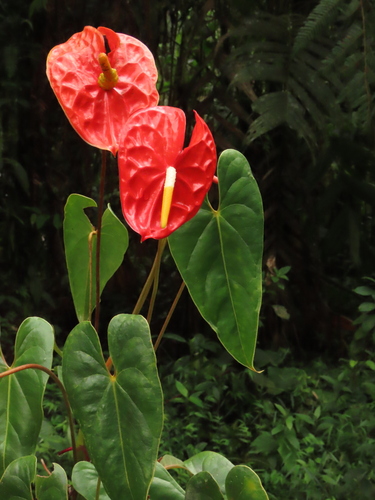
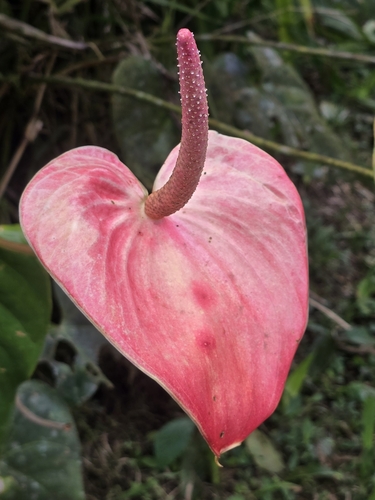
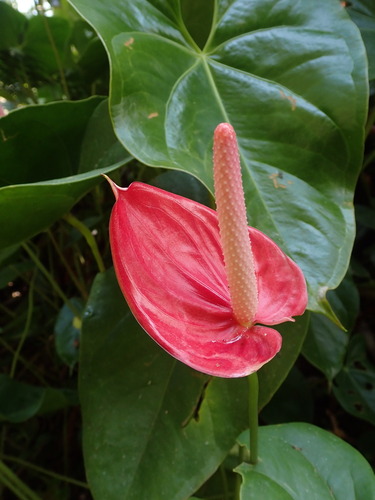
The painter's-palette (Anthurium andraeanum Linden ex André, 1877), the florist's anthurium also sold as flamingo flower or flamingo lily, is a tropical member of the arum family, Araceae, native to Colombia and Ecuador. The red, pink or white part usually taken for a flower is a waxy spathe; the true flowers sit on the central spadix.
Read moreAnthurium, Flamingo flower, Flamingo lily and Laceleaf
Give plenty of ambient light without direct sun on the leaves.
Global distribution
POWO/WCVP and Trefle give Anthurium andraeanum a native range in Colombia and Ecuador. The Venezuelan Antilles, Trinidad and Tobago and the Windward Islands appear as introductions in Trefle; none of the references used supports a general invasive status, in France or elsewhere.
- Native2
- Introduced3
- Colombia
- Ecuador
- Trinidad and Tobago
- Venezuelan Antilles
- Windward Islands
Hexagons: sourced regions. Green dots: native range. Statuses according to POWO (Kew).
Identity
Anthurium andraeanum Linden ex André is an accepted species of the genus Anthurium, in the arum family, Araceae. The taxonomic databases consulted date the name to 1877 and place its native range in Colombia and Ecuador. 1 2
Names such as painter's-palette, anthurium, flamingo flower or laceleaf mostly describe the ornamental plant. They should not hide its botanical structure: the colored piece is not a corolla of petals but a spathe, and the real flowers are tiny ones crowded on the spadix. 3 4
The distinction matters because the species is often sold as a flowering pot plant or a cut flower. In that trade, "flower" means the long-lasting visual effect of the inflorescence, not a single large bloom like a hibiscus or a rose.
Recognition
WCVP describes Anthurium andraeanum as an epiphytic subshrub of the humid tropics. In cultivation it forms a compact clump of evergreen, glossy leaves, heart- to arrow-shaped, held on long petioles. Potted plants usually stay around 30 to 60 cm (12 to 24 in), while some tropical landscape plantings can approach 90 cm (3 ft). 1 3 5
Its inflorescence gives it away first. The spathe is waxy, flat or slightly wavy, often red in the classic forms but also pink, white, orange, green or two-toned depending on the cultivar. The central spadix, straight to slightly curved, carries the small flowers; it may go on to bear berries if pollination succeeds, a minor point for a houseplant. 4 3
A green spathe does not necessarily mean another species. It can belong to a cultivar, an aging inflorescence or a horticultural form. Identification therefore rests on reading several clues together: the heart-shaped blade, the waxy texture of the spathe, the central spadix and the full botanical name.
Useful taxonomy
The stable reference point is Anthurium andraeanum Linden ex André. WCVP treats it as an accepted species, with Anthurium venustum Sodiro and several historical varieties listed as synonyms or attached names: A. andraeanum var. album, var. roseum, var. divergens, var. salmoneus, var. sanguineum, var. amoenum, var. louisae, plus a few names without formal rank. 1 2
None of these should be confused with modern cultivars. A historical name like album or roseum may describe a color in old lists, whereas an anthurium sold today as 'Midori', 'Acropolis' or "Andraeanum Group" belongs to the horticultural vocabulary of selections, hybrids and sales series. 3 4
The costliest confusion involves the common names "flamingo flower" and "flamingo lily," which can also refer to Anthurium scherzerianum. The two plants are close and share a genus, but A. scherzerianum often has a more twisted, spiraled spadix, while A. andraeanum is the classic florist's anthurium with a large flat spathe.
Habitat and range
POWO/WCVP and Trefle agree on a native range in Colombia and Ecuador. Trefle also lists introductions in the Venezuelan Antilles, Trinidad and Tobago and the Windward Islands. The native range, tropical introductions and worldwide cultivation as a pot plant or cut flower are therefore kept apart. 1 2
Its ecology is that of a humid tropical biome. "Epiphytic" does not mean parasitic: the plant uses a support and an airy organic medium, but it draws no food from the host tree. That origin explains its form better than any care recipe: leathery leaves, roots prone to suffocation, a need for steady warmth and filtered light. 1 5
None of the references used supports presenting Anthurium andraeanum as invasive in mainland France, nor as a general invasive. The Caribbean introductions are recorded as a biogeographic status, not as evidence of a general invasive risk. 2 6
Life cycle and reproduction
This is a tropical perennial. Indoors, its visible cycle combines new leaves, new roots and successive inflorescences once the clump is established. Horticultural sources note long-lasting spathes; in commercial production and in favorable climates, that lasting display in the pot or the vase is precisely where its economic value lies. 4 5
The inflorescence follows the arum family pattern of spadix plus spathe. The true flowers are minute and borne on the spadix. After pollination, the spadix can produce berries, but that does not make them food: the references used mark the species as inedible, and the safety sources mainly describe irritation when the plant is chewed. 3 2 6
At home, the propagation methods that fit the plant's architecture are dividing a clump or taking a stem cutting with a node and roots. A single leaf, however healthy and green, does not carry the vegetative unit needed to rebuild a complete anthurium.
Uses and risks
Its main use is ornamental: indoor pot plant, warm greenhouse, frost-free conservatory, shaded tropical bed where the climate allows, or cut flower. The plant's value lies in the color and staying power of its spathes, not in any food use. Neither Trefle nor Perenual supports eating A. andraeanum. 4 5 2
Toxicity deserves precise wording. NC State ranks Anthurium andraeanum among plants of low toxic severity and names calcium oxalate crystals as the irritant. The Queensland Poisons Information Centre likewise describes anthuriums as irritating to the mouth, lips and throat when swallowed. 3 7
For pets, Pet Poison Helpline treats anthurium as toxic to dogs and cats through insoluble oxalates, with possible oral irritation, drooling, vomiting or difficulty swallowing. The ASPCA list consulted names Anthurium scherzerianum specifically under several "flamingo flower" common names, not A. andraeanum; cats and dogs are still classed with caution, while the risk to horses remains unsettled for this species. 8
Cultivars, buying and look-alikes
Anthuriums sold in garden centers are not always pure wild species. The RHS uses the name Andraeanum Group, and NC State lists several cultivars or trade labels, including Acropolis, Baron, Cheers, Florida, Midori and Rosee Choco. These names describe selections for spathe, size or habit, not taxonomic ranks equivalent to a species. 4 3
Before you buy, a few plain questions help. Is the scientific name Anthurium andraeanum, an Andraeanum Group hybrid or another species such as A. scherzerianum? Does the plant have healthy heart-shaped leaves, a firm spathe, an intact spadix and roots free of rot? A color name alone is not enough to pin down the identification.
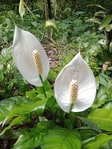
Visual mix-ups mainly involve Spathiphyllum, Zantedeschia, Anthurium scherzerianum and sometimes foliage aroids such as Philodendron or Dieffenbachia. All of them can look tropical, but a flat waxy spathe, a visible spadix, glossy heart-shaped leaves and a complete botanical label together remain the best set of clues.
Main sources
- Plants of the World Online / Kew, Anthurium andraeanum Linden ex André
- Royal Horticultural Society, Anthurium andraeanum
- NC State Extension Gardener Plant Toolbox, Anthurium andraeanum
- University of Florida IFAS Extension, Anthurium andraeanum
- Queensland Poisons Information Centre, Anthurium
- Pet Poison Helpline, Anthurium
- Trefle, species data, Anthurium andraeanum
Frequently asked questions
Is the red part of an anthurium a flower?
No. The red, pink, white or green part is a spathe. The true flowers are small and packed together on the central spadix.
Where does Anthurium andraeanum come from?
The taxonomic sources used give a native range in Colombia and Ecuador. The Caribbean records consulted are treated as introductions.
Is Anthurium andraeanum toxic?
Treat the plant as an irritant because of its calcium oxalate crystals. Caution applies to adults, children, cats and dogs; for horses, the specific sources consulted do not settle the question for this species.
Can you eat anthurium?
No. The references used give no reliable food use, and the tissues are irritating when chewed.
Why is my anthurium sold under a color name?
Many potted and cut-flower anthuriums are horticultural cultivars or hybrids. The color name usually describes the spathe, not a taxonomic rank.
Which mix-up is the most common?
The one worth watching sets Anthurium andraeanum against Anthurium scherzerianum, Spathiphyllum and Zantedeschia. All carry a spathe-type inflorescence, but they differ in appearance and are not always covered by the same safety sources.
Similar plants
Botanical data compiled from reference sources (RHS, Kew Gardens, POWO). This profile is for guidance only and is not a substitute for advice from a botanist or veterinarian if you have concerns about toxicity.