
Heart-leaf philodendron (Philodendron hederaceum, )
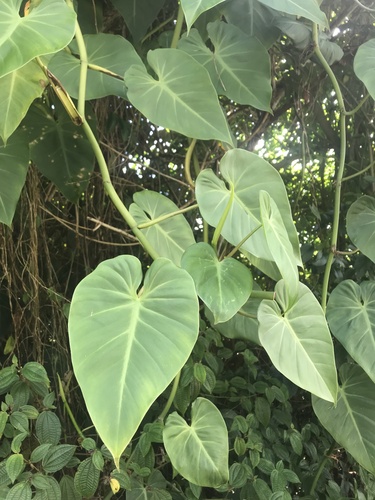
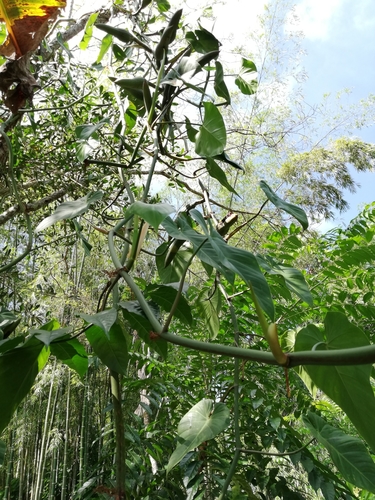
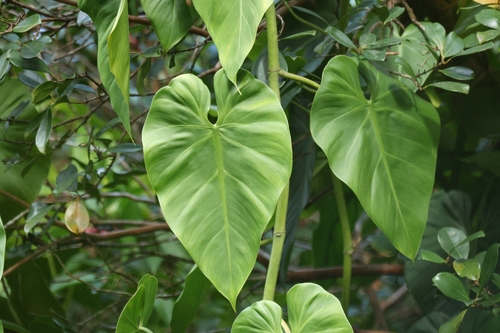
The heart-leaf philodendron (Philodendron hederaceum), also sold as sweetheart plant, is a climbing member of the arum family, Araceae, accepted by Kew as Philodendron hederaceum (Jacq.) Schott. Its heart-shaped leaves, pliant stems and aerial roots explain why it is grown in hanging baskets or on a support, and why it is so often confused with pothos, cordatum and older trade names.
Read moreHeartleaf philodendron, Sweetheart plant, Vilevine and Cordatum
Place in indirect light or in a shaded room.
Global distribution
POWO and the other data consulted assign Philodendron hederaceum a very wide native range, from Mexico to tropical America. Records of introduction in places such as Bangladesh, the Seychelles or Hawaii are not enough to establish that the plant is invasive in general.
- Native6
- Introduced2
- Mexico
- Belize
- Costa Rica
- Colombia
- Brazil
- Caribbean
- Seychelles
- Bangladesh
Hexagons: sourced regions. Green dots: native range. Statuses according to POWO (Kew).
Identity
The heart-leaf philodendron is Philodendron hederaceum (Jacq.) Schott, an aroid published under this combination in 1829. The name rests on an older basionym, Arum hederaceum Jacq., which is why taxonomic lists now attach a relatively recent accepted name to a much longer nomenclatural history. 1 2
In the trade, the plant also goes by heartleaf philodendron, vilevine, cordatum and sweetheart plant. These names mostly describe the leaf shape and its place on the windowsill. None of them should stand in for the binomial, because cordatum can also point to a different Philodendron taxon. 3 4
Recognition
Look first at the habit. Philodendron hederaceum has pliant stems that lengthen, trail when hung and cling as soon as they meet a support. Its nodes can produce aerial roots, which help fix the plant to a moss pole, a trunk or a trellis. 5 6
The leaves are simple, entire and heart-shaped, often dark green and glossy on the common form. A houseplant usually keeps small leaves, while a plant grown in a warm, humid climate can become far more vigorous. Published sizes vary widely with conditions: under roughly 1 m (3 ft) indoors, but several meters when the vine climbs outdoors or in a tropical greenhouse. 5
Flowers rarely help the home grower. As in other aroids, the inflorescence pairs a spadix with a spathe; NC State describes the group as having a whitish to purplish red spathe and white to orange berries, while noting that indoor plants seldom bloom. 5
Useful taxonomy
The stable reference point is the accepted name Philodendron hederaceum. POWO lists it as an accepted species in the genus Philodendron and the family Araceae, with three accepted infraspecific taxa: var. hederaceum, var. kirkbridei and var. oxycardium. 1
Older names still have a job to do, but it is decoding labels, not multiplying species:
- Arum hederaceum Jacq.
- Pothos hederaceus (Jacq.) Aubl.
- Philodendron scandens K.Koch & Sello, treated in the data consulted as a synonym of var. hederaceum
- Philodendron oxycardium Schott, placed under var. oxycardium
- Philodendron micans Klotzsch ex K.Koch, included in the synonymy of var. hederaceum
That synonymy sets two traps. A plant sold as P. scandens may simply carry an old label for P. hederaceum. Conversely, a plant sold as cordatum is not automatically P. hederaceum, since Philodendron cordatum also appears as an accepted species in the Trefle data. 4
Habitat and range
POWO sums up the native range as Mexico to tropical America. The data consulted spell out a very broad area: Mexico, Central America, the Caribbean, Colombia, Ecuador, Peru, Venezuela, Suriname, Trinidad and Tobago and several regions of Brazil. With a range that wide, any serious summary should avoid pinning its origin on a single country. 1 4
In the wild it lives in humid tropical forest, as an epiphyte or understory vine on shaded trunks and supports. That ecology explains how it behaves in cultivation: it tolerates dappled shade, yet fills out more when its nodes find something to climb and the air stays warm and humid. 1 5
Records of introduction should stay tied to specific places. POWO and Trefle report Bangladesh and the Seychelles, and NC State adds other tropical territories in its summary distribution. None of this justifies calling the plant invasive in general; outside frost-free climates, roughly USDA zones 10 to 12, it is essentially a houseplant or conservatory plant. 1 5
Life cycle, uses and risks
Indoors, what you see is mostly vegetative growth: stems lengthen, new nodes form and the evergreen leaves are gradually replaced. Reliable propagation needs a stem node. A single leaf may survive for a while, but without a growing point it will not rebuild a complete plant. 5 6
Its main use is ornamental. In a hanging basket it forms a cascade of stems; on a moss pole it shows more of its climbing nature. No food use is recorded. The data consulted indicate no common edible use, and the general medicinal claims in POWO are not developed here without a more precise clinical or ethnobotanical source. 1 6
The best-documented risk comes from insoluble calcium oxalates. The ASPCA lists heartleaf philodendron as toxic to dogs, cats and horses, with oral irritation, swelling, excessive drooling, vomiting (except in horses) and difficulty swallowing. NC State also reports toxicity to people if eaten and possible skin irritation from the sap. 7 5
Cultivars, look-alikes and buying
The best-documented cultivar in the references used is Brasil, also spelled Brazil, described by NC State as a form of P. hederaceum with a yellow band down the center of each leaf. When buying, the spelling on the tag matters less than three checks: the scientific name, viable nodes on any cuttings and the actual state of the roots. 5
Labels such as micans, scandens and oxycardium call for more caution. Depending on the seller, they may refer to synonyms, accepted varieties or trade names. Rather than treating them as three separate houseplant species, ask which taxon is being claimed and look closely at the leaves: heart shape, smooth or velvety texture, variegation, size and growth habit. 1 4
Frequent mix-ups involve:
- Epipremnum aureum, the pothos, a different aroid genus often sold on the same shelf
- Philodendron cordatum, a similar name sometimes confused with heartleaf philodendron
- Scindapsus pictus, an indoor vine with satiny, silver-marked foliage
- certain hybrid Philodendron plants whose habit or heart-shaped leaves blur the trade name
For an encyclopedic account, these confusions matter more than an exhaustive cultivar list. They explain why the same plant can arrive with several historical labels, and why the binomial Philodendron hederaceum remains the most robust starting point. 3
Main sources
- Plants of the World Online / Kew, Philodendron hederaceum
- International Plant Names Index, Philodendron hederaceum
- GBIF Backbone Taxonomy, Philodendron hederaceum
- NC State Extension, Philodendron
- ASPCA, Heartleaf Philodendron toxicity entry
- Trefle, species data, Philodendron hederaceum
- Perenual data consulted, Philodendron hederaceum
Frequently asked questions
Is Philodendron hederaceum the same plant as Philodendron scandens?
In the taxonomic sources consulted, Philodendron scandens appears as an older name belonging to the P. hederaceum complex. It is still common on nursery labels, but the accepted name to use is Philodendron hederaceum.
Is the heart-leaf philodendron toxic?
Yes for pets, according to the ASPCA: cats, dogs and horses are listed as susceptible. The tissues contain insoluble calcium oxalates, which irritate when the plant is chewed or swallowed.
Can this philodendron be mistaken for a pothos?
Yes. Both are climbing aroids with pliant stems, but pothos is Epipremnum aureum. Leaf texture, variegation and above all the scientific name make it possible to correct the label.
Is the plant invasive?
None of the references consulted supports treating it as a general invasive. Its localized tropical introductions should be kept separate from its role as a houseplant.
Similar plants
Botanical data compiled from reference sources (RHS, Kew Gardens, POWO). This profile is for guidance only and is not a substitute for advice from a botanist or veterinarian if you have concerns about toxicity.