
Swiss cheese plant (Monstera deliciosa, )
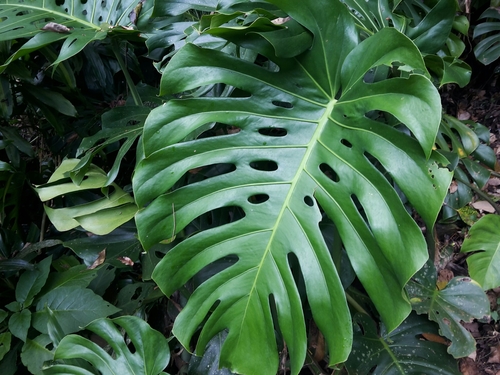
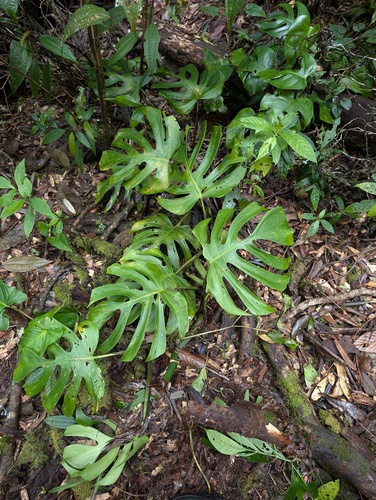
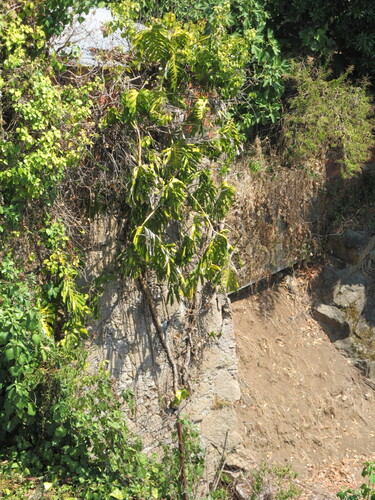
The Swiss cheese plant (Monstera deliciosa), also sold as split-leaf philodendron, is a hemiepiphytic climber in the arum family, Araceae, native to the humid forests of southern Mexico and Guatemala. Young plants often bear entire leaves; mature ones develop large, deeply cut, perforated leaves and long aerial roots.
Read moreSplit-leaf philodendron, Fruit salad plant, Ceriman and Costilla de Adán
Give plenty of ambient light without direct sun on the leaves.
Global distribution
The strict native range of Monstera deliciosa lies in southern Mexico (Veracruz, Oaxaca, Chiapas) and Guatemala. Horticultural accounts often stretch that range from southern Mexico into Central America, so reports of introduction, naturalization or invasion should stay tied to specific places.
- Observations6.1K
- Native range2
- Mexiconative
- Guatemalanative
Yellow-orange dots: concentration of documented observations by country. Green countries: sourced native range. GBIF source · Native range according to POWO (Kew).
Identity
The Swiss cheese plant (Monstera deliciosa Liebm., 1849), long sold as split-leaf philodendron, is a perennial in the genus Monstera, part of the arum family, Araceae. That second name preserves an old horticultural mix-up: the plant was often marketed as a "philodendron," yet it does not belong to the genus Philodendron. 1 2
The name Swiss cheese plant refers to the adult foliage, which is often cut and perforated. The names ceriman and fruit salad plant point instead to the ripe fruit, and the fruit is what earned the epithet deliciosa, not the leaves or stems. 3 4
Recognition
A robust hemiepiphytic climber, Monstera deliciosa sends out numerous brownish aerial roots at the nodes and leaf axils, which anchor it to a trunk or support. In the wild it can reach 20 m (65 ft); indoors it usually stays at 2–3 m (6.5–10 ft), though the long leaf stalks often give it an imposing spread. 4 3
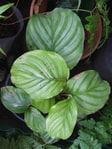
Juvenile leaves are small, entire and barely lobed. As the plant ages, it produces larger, leathery, glossy, heart-shaped leaves that become deeply split and sometimes fenestrated. Adult leaves commonly reach 60–90 cm (24–35 in) long and can approach 1 m (3.3 ft) on very large specimens. A plant without holes may simply be young, short on light or grown without a support. 3 2
The flower is an aroid inflorescence: a central spadix wrapped in a thick, velvety, creamy white spathe. After flowering, the spadix turns into an upright green infructescence made of tightly packed segments covered with polygonal scales. 4
Useful taxonomy
In this species, trade names and botanical names are easily muddled. The main synonyms and historical names worth checking are:
- Monstera borsigiana K.Koch
- Monstera deliciosa var. borsigiana Engl.
- Monstera deliciosa var. sierrana G.S.Bunting
- Monstera lennea K.Koch
- Monstera tacanaensis Matuda
- Philodendron anatomicum Kunth
- Tornelia fragrans Gut. ex Schott
Borsigiana is the trickiest case: the name sits in the synonymy, yet it also circulates in the trade for plants that are more compact or more slender. The stable reference is the accepted scientific name, Monstera deliciosa. 1 2
Habitat and range
The species grows in humid tropical forest, from the lowlands to middle elevations, mainly in southern Mexico and Guatemala. Horticultural accounts often describe its range more broadly as Central American, because the plant is so widely grown and has been introduced across the tropics. 1 5
Seeds germinate on the forest floor. The seedlings creep toward darker areas until they meet a trunk, then fasten onto it with their aerial roots. The plant is no parasite: it uses the tree as a ladder toward brighter light higher up, usually filtered by the canopy. 6 4
Outside its native range, Monstera deliciosa is mostly an ornamental. In some warm, humid climates it can naturalize, blanket trunks or forest edges, and become locally invasive. 5
Life cycle and reproduction
Indoors, flowering is rare, but it is normal on a mature, established plant in a favorable climate. The inflorescence carries a creamy white spathe around a spadix, and the fruit then develops on the central spike. 3 4
Known as ceriman, the fruit often measures 20–25 cm (8–10 in) long and about 5–6 cm (2–2.4 in) across, with reports of up to 30 cm (12 in). It ripens slowly, over roughly 12–14 months. While the scales stay attached it is irritating; once fully ripe, they come away easily to reveal sweet flesh whose flavor is often compared to pineapple, banana or pear. 4 3
In cultivation, propagation is mostly by stem cuttings with a node or by air layering. The node is what matters: a leaf cut without one may look decorative for a while, but it will not grow into a complete plant. 2 3
Uses and risks
Its main use is ornamental. In frost-free tropical or subtropical climates, roughly USDA zones 10 to 12, the plant can climb a tree, a shaded wall or a sturdy trellis; where winters bring frost, it is mostly grown indoors in bright rooms. A vertical support is more than decoration: it brings the plant closer to its natural habit and often encourages larger leaves. 2 4
Ripe fruit is eaten in some tropical regions, but it is rarely sold commercially, since it ripens slowly and keeps poorly. The leaves, stems, sap and unripe fruit contain irritating calcium oxalate crystals. If swallowed, they can cause a burning mouth, drooling, difficulty swallowing or digestive upset, particularly in children, dogs and cats. 7 8
Varieties, look-alikes and related plants
Variegated forms are not separate species. Variegata and Albo-variegata refer to irregular white variegation, Aurea to yellow or golden variegation, and Marmorata to a more marbled pattern. Before buying, check the scientific name, the presence of a viable node, the condition of the roots and how stable the variegation is. 2
Common look-alikes include:
- Monstera adansonii, with smaller, heavily perforated leaves
- Rhaphidophora tetrasperma, often sold as "mini monstera"
- Epipremnum pinnatum, a large climber whose adult foliage can split
- some philodendrons and thaumatophyllums with large, deeply cut leaves
These comparisons explain why a plant sold as a monstera may not be Monstera deliciosa, and why a young M. deliciosa may not yet look like the Swiss cheese plant buyers expect.
Main sources
- Plants of the World Online / Kew, Monstera deliciosa Liebm.
- Royal Horticultural Society, Monstera deliciosa, Swiss cheese plant
- University of Wisconsin Extension, Swiss-Cheese Plant, Monstera deliciosa
- Monaco Nature Encyclopedia, Monstera deliciosa
- ASPCA, Monstera deliciosa toxicity entry
- Merck Veterinary Manual, houseplants with insoluble calcium oxalates
- Environmental Weeds of Australia / Lucidcentral, Monstera deliciosa
- Strong & Ray, 1975, host-tree location by skototropism in Monstera gigantea
Frequently asked questions
Is Monstera deliciosa a philodendron?
No. Monstera deliciosa belongs to the arum family, Araceae, like Philodendron, but it is placed in the genus Monstera. The name split-leaf philodendron comes from an old horticultural mix-up, not from its taxonomy.
Is Monstera deliciosa toxic?
The leaves, stems and unripe fruit contain irritating calcium oxalates. The ASPCA lists Monstera deliciosa as toxic to cats and dogs; the ripe fruit has to be considered separately from the rest of the plant.
Why do some Monstera leaves have no holes?
Monstera deliciosa leaves are often entire at the juvenile stage. The splits and perforations appear mainly on adult leaves, once the plant gains size and starts to climb.
Which plants are mistaken for Monstera deliciosa?
The most frequent mix-ups involve Rhaphidophora tetrasperma, often sold as mini monstera, Epipremnum pinnatum and some philodendrons with deeply cut leaves. The scientific name remains the most reliable reference.
Is Monstera deliciosa fruit edible?
Fully ripe fruit is eaten in some regions, but unripe fruit is irritating. Scales that lift or fall away and a sweet smell are among the described signs of ripeness; they do not replace reliable local food-safety advice.
Where does Monstera deliciosa come from?
Its strict native range runs from southern Mexico to Guatemala. Horticultural sources often widen the story to Central America, so native range, cultivated regions and regions of introduction need to be kept apart.
Are variegated monsteras different species?
No. Variegata, Albo-variegata and Aurea are horticultural labels tied to leaf variegation. They should not be confused with a distinct species, a botanical variety or a taxonomic synonym.
Similar plants
Botanical data compiled from reference sources (RHS, Kew Gardens, POWO). This profile is for guidance only and is not a substitute for advice from a botanist or veterinarian if you have concerns about toxicity.