











01
Identify or search
A photo, or a search by name.

Encyclopedia
For every species, a complete profile: what it needs, where it comes from, what it's used for, how to recognize it, and whether it's dangerous for your pets.
4.8 on the app stores50,000+ gardeners
Monstera deliciosa
Also Known As: Philodendron pertusum, Monstera borsigiana
 +15
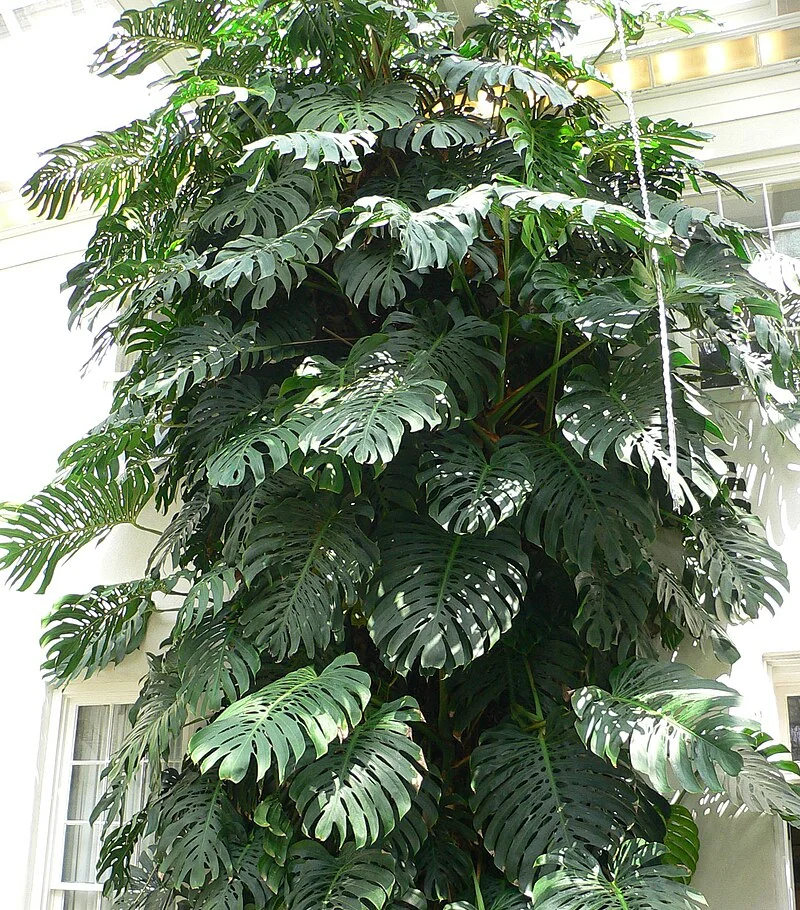
Monstera deliciosa comes from the rainforests of southern Mexico and Central America. Its large leaves split and form holes as it matures, more so the more light it gets.
Monstera deliciosa comes from the rainforests of southern Mexico and Central America. Its large leaves split and form holes as it matures, more so the more light it gets.
The specific epithet deliciosa means "delicious", referring to the edible fruit. The genus Monstera is named from the Latin word for "monstrous" or "abnormal", and refers to the unusual leaves with natural holes that members of the genus have. Its popular name as a houseplant of "Swiss cheese plant", or just "cheese plant", is commonly stated to refer to the "eyes" or holes that develop in its leaves similar to the holes in some Swiss-type cheeses such as Emmental cheese.
Source: Wikipedia
This member of the arum family (Araceae) is a hemiepiphyte with aerial roots. It is able to grow up to 20 m (66 ft) high in the wild, with large, leathery, glossy, pinnate, heart-shaped leaves 25, 90 cm (10, 35.5 in) long by 25, 75 cm (10, 29.5 in) broad. The leaves on young plants are smaller and entire with no lobes or holes, but soon produce lobed and fenestrate leaves as they grow. Although it can grow very tall in nature, it only measures between 2 and 3 m (6.6 and 9.8 ft) when grown indoors.
Source: Wikipedia
Monstera deliciosa is native to humid tropical forests, in lowlands and on lower mountains, in the south of Mexico and also in Costa Rica, Guatemala and Panama. The seeds fall to the ground, then the seedlings crawl (negative phototropism) until they meet a tree on which to attach. The many adjacent roots thus allow the plant to anchor against its new support and reach the canopy light (although it rarely grows in full sun and prefers a light dimmed by the foliage).
Source: Wikipedia
Monstera deliciosa is commonly grown outdoors as an ornamental plant in the tropics and subtropics. The plant requires a lot of space and a rich and loose soil (ideally garden soil and compost in equal parts). If it grows in the ground it is better to plant it near a tree, where it can climb, if not against a trellis. It is a "moderately greedy plant", in that it needs to be watered just to keep the soil slightly moist. Its hardiness is 11 (that is to say the coldest at −1 °C or 30 °F).
Source: Wikipedia
Monstera deliciosa is moderately toxic to both cats and dogs because it contains needle-like insoluble calcium oxalate crystals. These crystals may cause injury to the mouth, tongue, and digestive tract. It also causes dermatitis by direct contact with cat and dog skin.
Source: Wikipedia
In those areas where it grows naturally, M. deliciosa is considered a delicacy due to its sweet and exotic flavor. The fruit may be ripened by cutting it when the first scales begin to lift up and it begins to exude a pungent odor. It is wrapped in a paper bag and set aside until the scales begin popping off. The scales are then brushed off or fall away to reveal the edible flesh underneath. The flesh, which is similar to pineapple in texture, can be cut away from the core and eaten.
Source: Wikipedia
The sheet's tabs, just like in the app: the overview, then the sections of the species' Wikipedia article, in your language.
Difficulty, toxicity, light, watering.
Description, range, cultivation: the sections of its Wikipedia article, in your language.
Move from one section to the next as in the app, without leaving the sheet.
Try it right here: switch tabs
Monstera deliciosa
Also Known As: Philodendron pertusum, Monstera borsigiana
+15Monstera deliciosa comes from the rainforests of southern Mexico and Central America. Its large leaves split and form holes as it matures, more so the more light it gets.
Monstera deliciosa comes from the rainforests of southern Mexico and Central America. Its large leaves split and form holes as it matures, more so the more light it gets.
The specific epithet deliciosa means "delicious", referring to the edible fruit. The genus Monstera is named from the Latin word for "monstrous" or "abnormal", and refers to the unusual leaves with natural holes that members of the genus have. Its popular name as a houseplant of "Swiss cheese plant", or just "cheese plant", is commonly stated to refer to the "eyes" or holes that develop in its leaves similar to the holes in some Swiss-type cheeses such as Emmental cheese.
Source: Wikipedia
This member of the arum family (Araceae) is a hemiepiphyte with aerial roots. It is able to grow up to 20 m (66 ft) high in the wild, with large, leathery, glossy, pinnate, heart-shaped leaves 25, 90 cm (10, 35.5 in) long by 25, 75 cm (10, 29.5 in) broad. The leaves on young plants are smaller and entire with no lobes or holes, but soon produce lobed and fenestrate leaves as they grow. Although it can grow very tall in nature, it only measures between 2 and 3 m (6.6 and 9.8 ft) when grown indoors.
Source: Wikipedia
Monstera deliciosa is native to humid tropical forests, in lowlands and on lower mountains, in the south of Mexico and also in Costa Rica, Guatemala and Panama. The seeds fall to the ground, then the seedlings crawl (negative phototropism) until they meet a tree on which to attach. The many adjacent roots thus allow the plant to anchor against its new support and reach the canopy light (although it rarely grows in full sun and prefers a light dimmed by the foliage).
Source: Wikipedia
Monstera deliciosa is commonly grown outdoors as an ornamental plant in the tropics and subtropics. The plant requires a lot of space and a rich and loose soil (ideally garden soil and compost in equal parts). If it grows in the ground it is better to plant it near a tree, where it can climb, if not against a trellis. It is a "moderately greedy plant", in that it needs to be watered just to keep the soil slightly moist. Its hardiness is 11 (that is to say the coldest at −1 °C or 30 °F).
Source: Wikipedia
Monstera deliciosa is moderately toxic to both cats and dogs because it contains needle-like insoluble calcium oxalate crystals. These crystals may cause injury to the mouth, tongue, and digestive tract. It also causes dermatitis by direct contact with cat and dog skin.
Source: Wikipedia
In those areas where it grows naturally, M. deliciosa is considered a delicacy due to its sweet and exotic flavor. The fruit may be ripened by cutting it when the first scales begin to lift up and it begins to exude a pungent odor. It is wrapped in a paper bag and set aside until the scales begin popping off. The scales are then brushed off or fall away to reveal the edible flesh underneath. The flesh, which is similar to pineapple in texture, can be cut away from the core and eaten.
Source: Wikipedia
01
A photo, or a search by name.
02
Difficulty, toxicity, light and watering, at the top of the profile.
03
The sections of its Wikipedia article, tab by tab, in your language.
After the overview, each tab carries one section of the species' Wikipedia article. The gallery shows leaves, flowers, fruit, growth habit and bark to help you recognize the species.
Monstera deliciosa
Also Known As: Philodendron pertusum, Monstera borsigiana
+15Monstera deliciosa comes from the rainforests of southern Mexico and Central America. Its large leaves split and form holes as it matures, more so the more light it gets.
Monstera deliciosa comes from the rainforests of southern Mexico and Central America. Its large leaves split and form holes as it matures, more so the more light it gets.
The specific epithet deliciosa means "delicious", referring to the edible fruit. The genus Monstera is named from the Latin word for "monstrous" or "abnormal", and refers to the unusual leaves with natural holes that members of the genus have. Its popular name as a houseplant of "Swiss cheese plant", or just "cheese plant", is commonly stated to refer to the "eyes" or holes that develop in its leaves similar to the holes in some Swiss-type cheeses such as Emmental cheese.
Source: Wikipedia
This member of the arum family (Araceae) is a hemiepiphyte with aerial roots. It is able to grow up to 20 m (66 ft) high in the wild, with large, leathery, glossy, pinnate, heart-shaped leaves 25, 90 cm (10, 35.5 in) long by 25, 75 cm (10, 29.5 in) broad. The leaves on young plants are smaller and entire with no lobes or holes, but soon produce lobed and fenestrate leaves as they grow. Although it can grow very tall in nature, it only measures between 2 and 3 m (6.6 and 9.8 ft) when grown indoors.
Source: Wikipedia
Monstera deliciosa is native to humid tropical forests, in lowlands and on lower mountains, in the south of Mexico and also in Costa Rica, Guatemala and Panama. The seeds fall to the ground, then the seedlings crawl (negative phototropism) until they meet a tree on which to attach. The many adjacent roots thus allow the plant to anchor against its new support and reach the canopy light (although it rarely grows in full sun and prefers a light dimmed by the foliage).
Source: Wikipedia
Monstera deliciosa is commonly grown outdoors as an ornamental plant in the tropics and subtropics. The plant requires a lot of space and a rich and loose soil (ideally garden soil and compost in equal parts). If it grows in the ground it is better to plant it near a tree, where it can climb, if not against a trellis. It is a "moderately greedy plant", in that it needs to be watered just to keep the soil slightly moist. Its hardiness is 11 (that is to say the coldest at −1 °C or 30 °F).
Source: Wikipedia
Monstera deliciosa is moderately toxic to both cats and dogs because it contains needle-like insoluble calcium oxalate crystals. These crystals may cause injury to the mouth, tongue, and digestive tract. It also causes dermatitis by direct contact with cat and dog skin.
Source: Wikipedia
In those areas where it grows naturally, M. deliciosa is considered a delicacy due to its sweet and exotic flavor. The fruit may be ripened by cutting it when the first scales begin to lift up and it begins to exude a pungent odor. It is wrapped in a paper bag and set aside until the scales begin popping off. The scales are then brushed off or fall away to reveal the edible flesh underneath. The flesh, which is similar to pineapple in texture, can be cut away from the core and eaten.
Source: Wikipedia
Toxicity is broken down by animal: dogs, cats, horses. The profile explains why the plant is toxic, how to protect your pets and what to do if one eats some, with poison control contacts.
Monstera deliciosa
Also Known As: Philodendron pertusum, Monstera borsigiana
+15Monstera deliciosa comes from the rainforests of southern Mexico and Central America. Its large leaves split and form holes as it matures, more so the more light it gets.
Monstera deliciosa comes from the rainforests of southern Mexico and Central America. Its large leaves split and form holes as it matures, more so the more light it gets.
The specific epithet deliciosa means "delicious", referring to the edible fruit. The genus Monstera is named from the Latin word for "monstrous" or "abnormal", and refers to the unusual leaves with natural holes that members of the genus have. Its popular name as a houseplant of "Swiss cheese plant", or just "cheese plant", is commonly stated to refer to the "eyes" or holes that develop in its leaves similar to the holes in some Swiss-type cheeses such as Emmental cheese.
Source: Wikipedia
This member of the arum family (Araceae) is a hemiepiphyte with aerial roots. It is able to grow up to 20 m (66 ft) high in the wild, with large, leathery, glossy, pinnate, heart-shaped leaves 25, 90 cm (10, 35.5 in) long by 25, 75 cm (10, 29.5 in) broad. The leaves on young plants are smaller and entire with no lobes or holes, but soon produce lobed and fenestrate leaves as they grow. Although it can grow very tall in nature, it only measures between 2 and 3 m (6.6 and 9.8 ft) when grown indoors.
Source: Wikipedia
Monstera deliciosa is native to humid tropical forests, in lowlands and on lower mountains, in the south of Mexico and also in Costa Rica, Guatemala and Panama. The seeds fall to the ground, then the seedlings crawl (negative phototropism) until they meet a tree on which to attach. The many adjacent roots thus allow the plant to anchor against its new support and reach the canopy light (although it rarely grows in full sun and prefers a light dimmed by the foliage).
Source: Wikipedia
Monstera deliciosa is commonly grown outdoors as an ornamental plant in the tropics and subtropics. The plant requires a lot of space and a rich and loose soil (ideally garden soil and compost in equal parts). If it grows in the ground it is better to plant it near a tree, where it can climb, if not against a trellis. It is a "moderately greedy plant", in that it needs to be watered just to keep the soil slightly moist. Its hardiness is 11 (that is to say the coldest at −1 °C or 30 °F).
Source: Wikipedia
Monstera deliciosa is moderately toxic to both cats and dogs because it contains needle-like insoluble calcium oxalate crystals. These crystals may cause injury to the mouth, tongue, and digestive tract. It also causes dermatitis by direct contact with cat and dog skin.
Source: Wikipedia
In those areas where it grows naturally, M. deliciosa is considered a delicacy due to its sweet and exotic flavor. The fruit may be ripened by cutting it when the first scales begin to lift up and it begins to exude a pungent odor. It is wrapped in a paper bag and set aside until the scales begin popping off. The scales are then brushed off or fall away to reveal the edible flesh underneath. The flesh, which is similar to pineapple in texture, can be cut away from the core and eaten.
Source: Wikipedia
The taxon explorer browses the plant library by order, family and genus. Start from a species you know and discover its neighbors.
Monstera deliciosa
Also Known As: Philodendron pertusum, Monstera borsigiana
+15Monstera deliciosa comes from the rainforests of southern Mexico and Central America. Its large leaves split and form holes as it matures, more so the more light it gets.
Monstera deliciosa comes from the rainforests of southern Mexico and Central America. Its large leaves split and form holes as it matures, more so the more light it gets.
The specific epithet deliciosa means "delicious", referring to the edible fruit. The genus Monstera is named from the Latin word for "monstrous" or "abnormal", and refers to the unusual leaves with natural holes that members of the genus have. Its popular name as a houseplant of "Swiss cheese plant", or just "cheese plant", is commonly stated to refer to the "eyes" or holes that develop in its leaves similar to the holes in some Swiss-type cheeses such as Emmental cheese.
Source: Wikipedia
This member of the arum family (Araceae) is a hemiepiphyte with aerial roots. It is able to grow up to 20 m (66 ft) high in the wild, with large, leathery, glossy, pinnate, heart-shaped leaves 25, 90 cm (10, 35.5 in) long by 25, 75 cm (10, 29.5 in) broad. The leaves on young plants are smaller and entire with no lobes or holes, but soon produce lobed and fenestrate leaves as they grow. Although it can grow very tall in nature, it only measures between 2 and 3 m (6.6 and 9.8 ft) when grown indoors.
Source: Wikipedia
Monstera deliciosa is native to humid tropical forests, in lowlands and on lower mountains, in the south of Mexico and also in Costa Rica, Guatemala and Panama. The seeds fall to the ground, then the seedlings crawl (negative phototropism) until they meet a tree on which to attach. The many adjacent roots thus allow the plant to anchor against its new support and reach the canopy light (although it rarely grows in full sun and prefers a light dimmed by the foliage).
Source: Wikipedia
Monstera deliciosa is commonly grown outdoors as an ornamental plant in the tropics and subtropics. The plant requires a lot of space and a rich and loose soil (ideally garden soil and compost in equal parts). If it grows in the ground it is better to plant it near a tree, where it can climb, if not against a trellis. It is a "moderately greedy plant", in that it needs to be watered just to keep the soil slightly moist. Its hardiness is 11 (that is to say the coldest at −1 °C or 30 °F).
Source: Wikipedia
Monstera deliciosa is moderately toxic to both cats and dogs because it contains needle-like insoluble calcium oxalate crystals. These crystals may cause injury to the mouth, tongue, and digestive tract. It also causes dermatitis by direct contact with cat and dog skin.
Source: Wikipedia
In those areas where it grows naturally, M. deliciosa is considered a delicacy due to its sweet and exotic flavor. The fruit may be ripened by cutting it when the first scales begin to lift up and it begins to exude a pungent odor. It is wrapped in a paper bag and set aside until the scales begin popping off. The scales are then brushed off or fall away to reveal the edible flesh underneath. The flesh, which is similar to pineapple in texture, can be cut away from the core and eaten.
Source: Wikipedia
The profile gives general guidance. Care tailored to your pot and your room is on your plant's page, in My garden.
Not every species has documented toxicity or a full gallery yet. The profile shows "Unknown" or "Data not available" rather than guessing.
If a pet eats a plant, call a vet or a poison control center. The profile helps you act fast, it doesn't make a diagnosis.
The key facts (difficulty, toxicity, light, watering), a gallery by plant part and the species' classification, then the sections of its Wikipedia article in tabs, in your language.
Open the species profile and tap toxicity: the risk is broken down for dogs, cats and horses when the data exists.
Remove any remaining pieces from its mouth without forcing, note which part was eaten and call a vet or a poison control center. The species profile gathers these steps and the useful contacts.
The profiles of the plants in your garden stay available offline, even at the far end of the yard.
A way to browse plants by order, family and genus. Each level shows how many species it groups and highlights a featured species.
Some species are less documented than others. Rather than guessing, the profile tells you when a piece of data isn't available.
Yes. The Floralens encyclopedia is also available on the web, without installing the app, in several languages.
The profile describes the species. Your plant's page, in My garden, starts from that profile and adapts it to your pot, your room and your care.
Take a photo of a plant: its profile opens with the result.
One photo, more than 400,000 species, a result in under 5 seconds with its confidence score and alternatives.
See plant identificationOne plan per plant, notifications at the time you pick, and frequencies that follow the seasons.
See care remindersRooms, a page for every plant, growth photos, and each plant's journey.
See My gardenThe botanist who knows your garden by heart. Ask a question, and the answer takes your plants into account.
See FloraThree photos and a few questions, then a likely cause, treatment plans ranked by priority, and a check-in seven days later.
See Dr. FloraPost your plants, ask other gardeners a question and follow the ones who inspire you.
See the community65 badges in 6 families, 8 series of 6 tiers and 17 one-time badges, earned through what you do.
See badges