
Goeppertia orbifolia (Goeppertia orbifolia, )
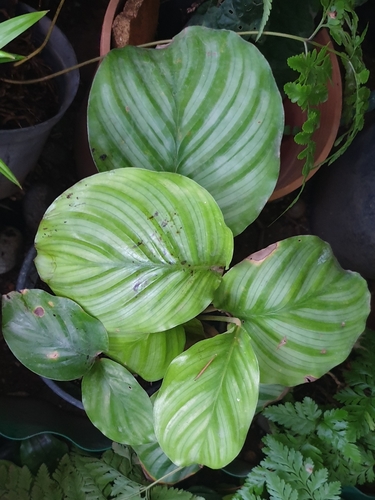
The Calathea orbifolia of garden centers now goes by the accepted botanical name Goeppertia orbifolia (Linden) Borchs. & S.Suárez. A rhizomatous perennial in the Marantaceae, native to eastern Brazil, it is grown for its large, round, dark green leaves banded in silver.
Read moreCalathea orbifolia, Round-leaved calathea and Prayer plant
Give plenty of ambient light without direct sun on the leaves.
Global distribution
POWO and Trefle give eastern Brazil as the native range, with Trefle specifying Northeast and Southeast Brazil. Outside that range, the plant is treated here as a cultivated houseplant or greenhouse plant.
- Native2
- Northeast Brazil
- Southeast Brazil
Hexagons: sourced regions. Green dots: native range. Statuses according to POWO (Kew).
Identity
Sold as a houseplant under the label Calathea orbifolia, this plant is the accepted taxon Goeppertia orbifolia (Linden) Borchs. & S.Suárez. The older name still earns its keep: it is the shelf name, the name people search for and a botanical synonym. It should not, however, hide the accepted genus. 1 2
Goeppertia orbifolia belongs to the Marantaceae, in the order Zingiberales. Linden first published it as Maranta orbifolia in 1861; it was later moved to Calathea, then combined in Goeppertia in 2012. That history is why three names can turn up on labels, in databases or in old catalogs for one and the same plant. 1 3
Recognition
Foliage does most of the work here. Goeppertia orbifolia forms an upright, compact clump with no climbing stem, carrying large, nearly round leaves on long petioles. The leaves are dark green, marked with broad silver to silvery green bands, and paler underneath. 4 2
Published dimensions describe cultivated plants, not an absolute size in the wild. The RHS gives an ultimate height and spread of about 0.5–1 m (1.5–3.3 ft); NC State describes a plant closer to 60–90 cm (2–3 ft) tall and 30–60 cm (1–2 ft) wide, with leaves up to roughly 30 cm (12 in) across. The figures agree on a generous floor or tabletop plant, never a vine. 2 4
Useful taxonomy
POWO treats Goeppertia orbifolia as the accepted name and links six main synonyms to it. The ones most useful for reading an old label or a seller's listing are:
- Calathea orbifolia (Linden) H.Kenn.
- Maranta orbifolia Linden
- Calathea rotundifolia (K.Koch ex Horan.) Körn.
- Maranta rotundifolia Körn.
- Phyllodes rotundifolia (K.Koch ex Horan.) Kuntze
- Thalia rotundifolia K.Koch ex Horan.
The name change was no horticultural whim. Borchsenius, Suárez and Prince confirmed that the old, broad genus Calathea was polyphyletic and revived Goeppertia for a large share of the species previously placed in Calathea. In everyday use, "calathea" is still understood; for taxonomy, Goeppertia orbifolia is the more stable reference. 3 1
Habitat and range
POWO places the native range in eastern Brazil, within the humid tropical biome. Trefle narrows this to Northeast and Southeast Brazil, without extending the species to the rest of South America. 1 5
That origin explains the plant better than any care checklist: it is a perennial of warm understory, where light is filtered and the air stays humid. In a pot it accepts a bright window out of direct sun, but it reacts quickly to dry air, cold and sudden swings. Those reactions are horticultural; they should not be turned into taxonomic characters. 2 4
Life cycle, uses and risks
Growth under household conditions is almost entirely vegetative. The plant spreads by rhizome, adds new shoots within the clump and is propagated by division. It does flower, with small white or inconspicuous blooms, but horticultural sources note that flowering is rare indoors and secondary to the foliage. 2 4
Its main use is ornamental: a tabletop pot, a compact floor plant, a warm greenhouse or a humid conservatory. With zones listed as USDA 11 to 12, it stays outdoors year-round only in frost-free tropical climates; elsewhere it is an indoor or under-glass plant. None of the references used supports a food, medicinal or invasive role; its value is as a foliage plant, not as a useful crop. 2
For pets, the most direct source is the ASPCA: its Calathea spp. entry is listed as non-toxic to dogs, cats and horses. That relative safety does not turn the leaves into food, especially for a child or after a large ingestion; it only means this source records no major veterinary toxicity. 6
Cultivars, trade names and look-alikes
No stable cultivar turns up in the sources used. The names that circulate most are therefore trade names or synonyms: Calathea orbifolia, round-leaved calathea and sometimes Calathea rotundifolia. If a seller presents "rotundifolia" as a distinct variety, ask what actually differs: clone, selection, size, provenance or just an old label. 1 2
Visual mix-ups involve other indoor Marantaceae. Goeppertia makoyana has a more feathery pattern, Goeppertia roseopicta more contrasting colored zones, Ctenanthe usually longer leaves, and Maranta leuconeura a lower, creeping habit. For G. orbifolia, the most reliable clues remain the large orbicular leaf, the broad silver bands, the upright clumping habit and the full botanical name. 4
Main sources
- Plants of the World Online / Kew, Goeppertia orbifolia
- Borchsenius, Suárez & Prince, 2012, Molecular Phylogeny and Redefined Generic Limits of Calathea
- Royal Horticultural Society, Goeppertia orbifolia
- NC State Extension Gardener Plant Toolbox, Goeppertia orbifolia
- ASPCA, Toxic and Non-toxic Plants: Calathea
- GBIF Backbone Taxonomy, Goeppertia orbifolia
Frequently asked questions
Is Calathea orbifolia still the correct name?
It is the most common trade name, but the botanical name accepted by POWO is Goeppertia orbifolia. Both names remain useful for linking taxonomy and horticulture.
Is Goeppertia orbifolia toxic to cats?
The ASPCA lists Calathea spp. as non-toxic to cats, dogs and horses. That listing does not make the plant a human food.
Why do the leaf edges turn brown?
Horticultural sources mostly point to dry air, hard water, uneven watering or direct sun. This symptom is not a botanical identification feature.
Does it flower indoors?
It does produce white flowers, but rarely as a houseplant. The species is grown mainly for its foliage.
Which plants is it confused with?
Mix-ups involve other indoor Marantaceae: Goeppertia makoyana, Goeppertia roseopicta, Ctenanthe and Maranta. The round leaf and the broad silver bands are the most useful clues.
Similar plants

Botanical data compiled from reference sources (RHS, Kew Gardens, POWO). This profile is for guidance only and is not a substitute for advice from a botanist or veterinarian if you have concerns about toxicity.