
Care guide
Monstera care: the complete guide
Monstera deliciosa
Monstera is forgiving, but it dislikes two things: overwatering and direct sun. Water when the top 2 cm (about 0.8 in) of potting mix is dry, keep it within 1.5 m (about 4.9 ft) of an east- or west-facing window, and it will produce perforated leaves for years.
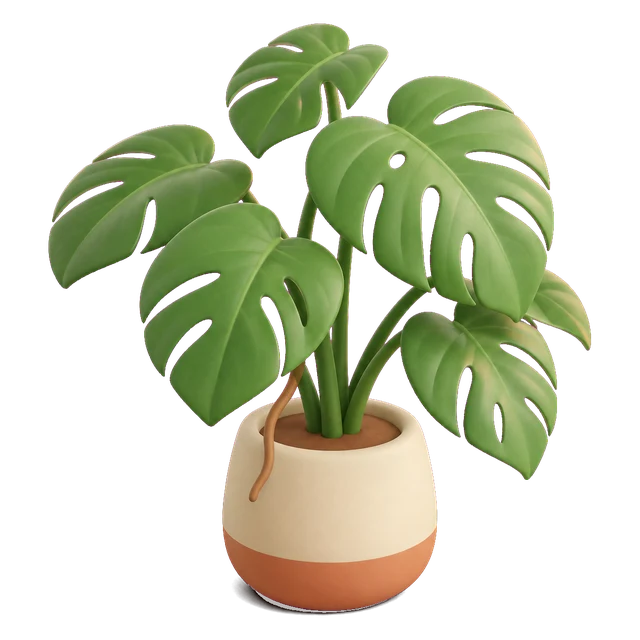
How often should you water a monstera?
Every 7 to 14 days in summer and every 14 to 21 days in winter, where these seasons correspond to active growth and winter slowdown. The real rule is the potting mix rather than the calendar: push a finger 2 cm (about 0.8 in) into it. If it is dry, water. If it is still moist, wait.
17 cL every 11 days
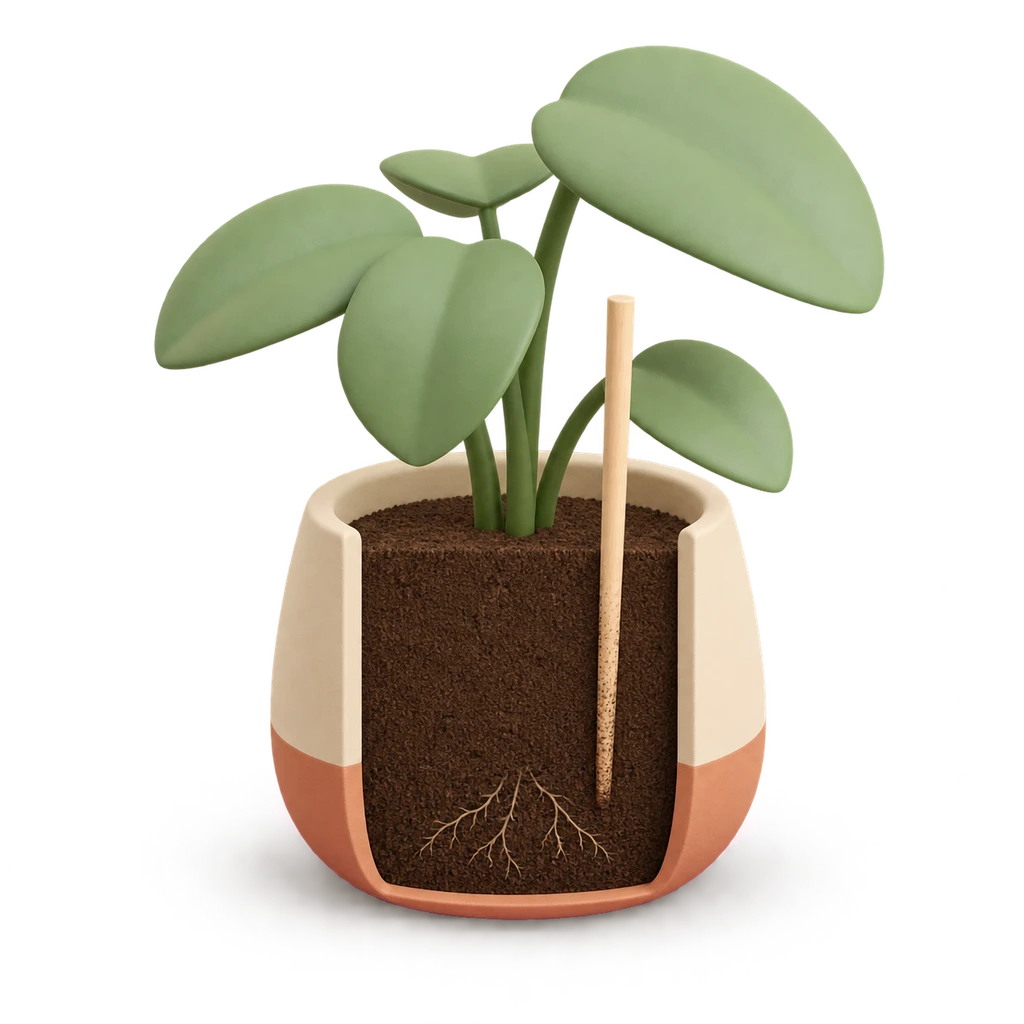
Potting mix dry to 1 cm: still moist
The finger test
Push a finger or wooden skewer 2 cm into the potting mix: if it is dry, water; if it is still moist, wait. The condition of the mix decides, not the calendar.
The number-one monstera mistake is overwatering: roots need oxygen, and saturated growing medium suffocates them within a few weeks. When in doubt, wait two more days.
Three steps are enough: test moisture with a finger to a depth of 2 cm (about 0.8 in), water thoroughly until it drains, and empty the saucer once drainage has finished. A plant standing in water rots.
Know these two signals: limp, drooping leaves with crisp brown edges indicate too little water; yellowing leaves starting with the oldest, a soft stem and a moldy smell indicate too much, the most frequent and most serious problem.
The exact amount depends on pot diameter and exposure: watering a monstera is something to calculate rather than guess.
How much light does a monstera need?
Bright indirect light: within 1.5 m (about 4.9 ft) of an east- or west-facing window, with no direct rays on the leaves. This means a room filled with natural light where sunlight never touches the foliage.
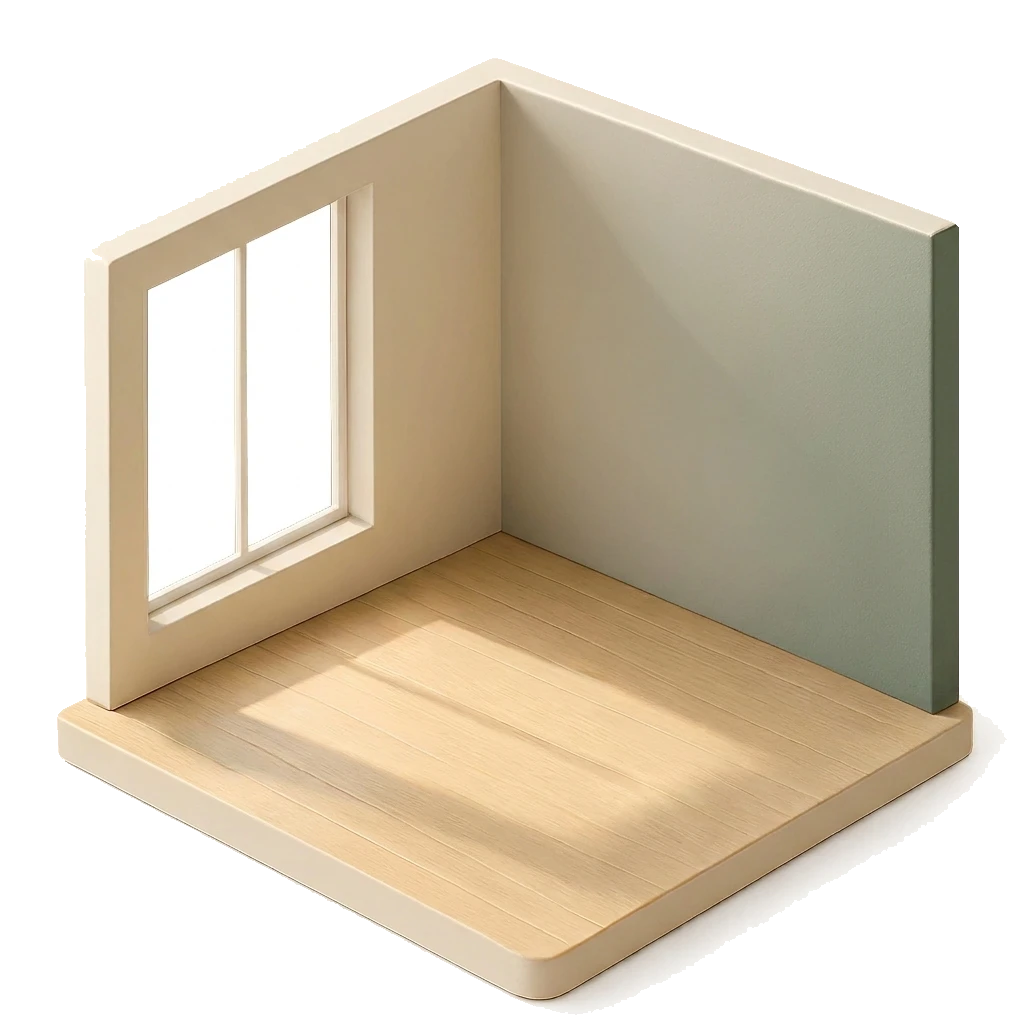
At 1 m from the window: bright light
Distance from the window
Move the plant around the room: for swiss cheese plant, the recommended zone is 0 to 1,5 m from the glass. Light levels fall very quickly with distance.
The compass directions below describe northern-hemisphere conditions; reverse north and south in the southern hemisphere and judge the actual sunlight reaching the leaves.
| Exposure | Suitability for monstera |
|---|---|
| Due south | Avoid without a sheer curtain: it scorches leaves |
| East or west | Ideal, with gentle morning or evening sun |
| North | Tolerable, but growth is slower with few fenestrations |
| Dark room | Avoid: leggy growth is inevitable |
Fenestrations, the characteristic leaf openings, develop mainly in bright light and on mature leaves. If your monstera lives in a dark corner, expect unsplit leaves. A quarter-turn of the pot weekly keeps growth balanced, as the plant grows towards the light.
Which growing medium, and when should you repot a monstera?
Repot every 2 to 3 years, during local spring growth, into a pot 2 to 4 cm (about 0.8–1.6 in) wider, using rich, free-draining, slightly acidic growing medium (pH 5.5 to 7). No wider: excess fresh growing medium stays waterlogged and rots the roots.
- Repot
- Every 2 to 3 yearsSource: Floralens guide
- When to repot
- In springonly if the plant shows one of the signsSource: Floralens guide
- The new pot
- 2 to 4 cm widerSource: Floralens guide
A balanced homemade mix:
- 60% houseplant potting mix
- 20% perlite (drainage)
- 10% pine bark (aeration)
- 10% coir or sphagnum moss (moderate water retention)
Signs it is time: roots emerging from drainage holes, water passing through the pot without being retained, and growth stopping during the growing season. Between repottings, replacing the top layer of potting mix is enough.
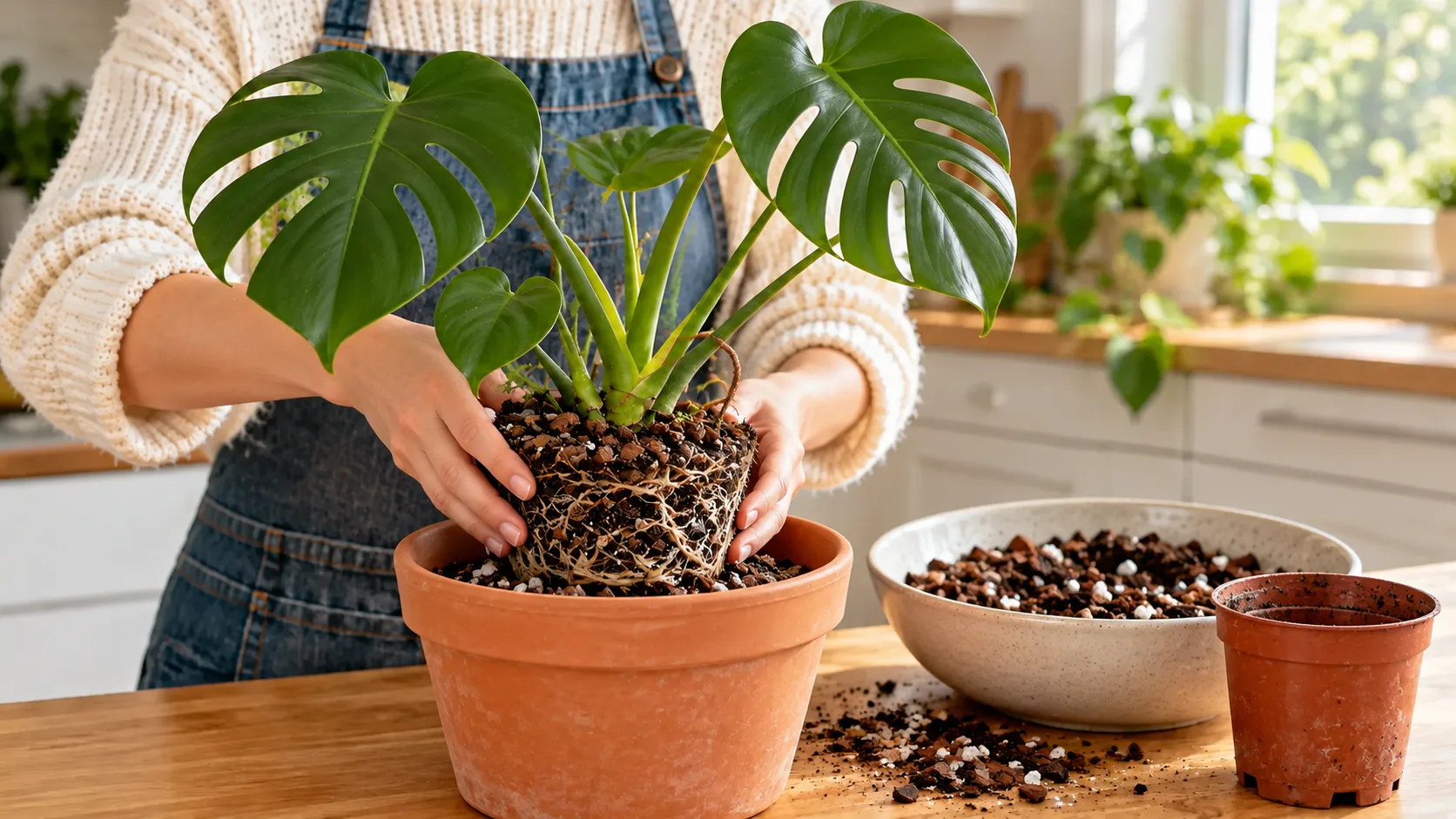
Choosing the container matters as much as choosing the mix, and the wrong diameter can lead to rot: repotting a monstera requires a few precautions.
Which fertilizer, and how much?
Only from March to October in the northern-hemisphere growing calendar described here, use liquid houseplant fertilizer diluted to 50% of the manufacturer's dose every 3 to 4 weeks. Match this to your local active-growth season. Do not feed during winter rest.
- Type: all-purpose liquid houseplant fertilizer, applied after watering
- Dose: half the dose stated on the bottle
- Frequency: every 3 to 4 weeks during the growing period
Signs of overfeeding: brown leaf tips, a whitish deposit on the potting mix and distorted growth. The remedy: flush the growing medium thoroughly with water for 5 minutes and stop feeding for two months.
Month-by-month care calendar
The monstera routine follows the seasons: regular watering and feeding from April to September, almost complete rest from November to February, and repotting in spring in the northern-hemisphere calendar used here. Adapt those months to your local growing and resting seasons.
| Task | January | February | March | April | May | June | July | August | September | October | November | December |
|---|---|---|---|---|---|---|---|---|---|---|---|---|
| Watering | reduced | reduced | reduced | moderate | moderate | high | high | high | moderate | reduced | reduced | reduced |
| Growth | resting | resting | active | active | strong | strong | strong | strong | active | active | resting | resting |
| Feeding | no | no | yes | yes | yes | yes | yes | yes | yes | no | no | no |
| Repotting | no | no | favorable window | favorable window | favorable window | no | no | no | favorable window | no | no | no |
How do you prune and propagate a monstera?
Monstera needs no structural pruning. Three steps are enough:
- Cut off damaged leaves at the base of their petiole with clean pruning shears
- Clean the leaves monthly with a damp cloth: dust blocks photosynthesis
- Train it up a support: a moist sphagnum pole encourages fenestrations and stabilizes a plant taller than one meter (about 3.3 ft)
A cut in the wrong place will not regrow: pruning a monstera follows two rules about position.
Propagation essentials
Monstera is propagated from stem cuttings, provided you keep a node, the swelling from which the petiole and aerial root emerge. Cut 2 cm (about 0.8 in) below it, place the node in water and allow 4 to 8 weeks for the first roots. A leaf alone, without a node, will never produce new growth.
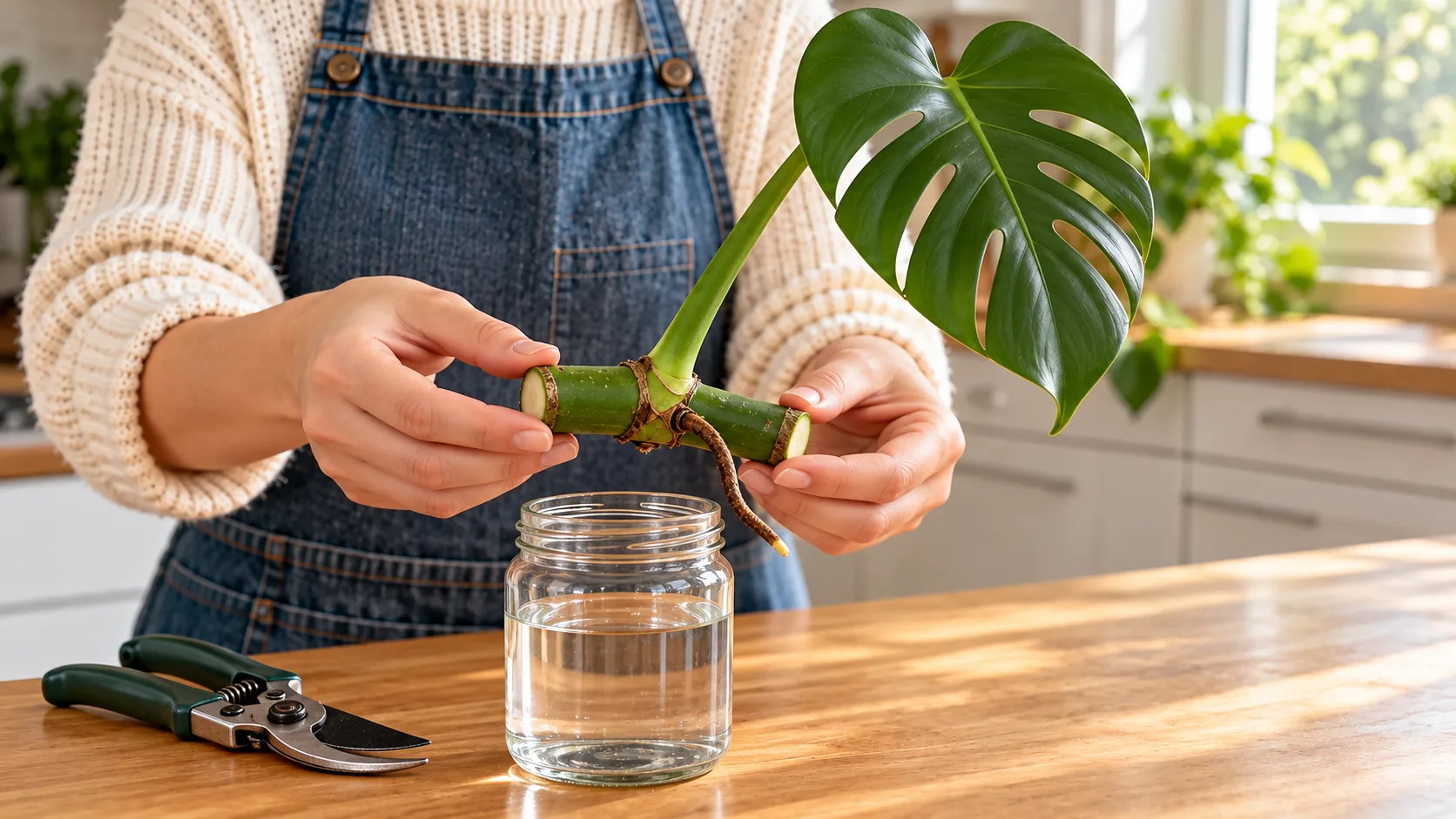
The remaining choice is water or soil, which differ in rooting time and establishment: propagating a monstera depends on that decision.
Common problems: diagnosis
| Symptom | Most likely cause | Solution |
|---|---|---|
| Yellow leaves (older ones) | Overwatering | Water less often and check drainage |
| Brown leaf tips | Air too dry, hard water | Humidify the air; use rainwater or filtered water |
| No fenestrations | Insufficient light, plant too young | Move closer to an east- or west-facing window |
| Soft stem, moldy smell | Root rot | Repot urgently and cut off black roots |
| Small white cottony clusters | Mealybugs | Use a cotton bud dipped in 70% alcohol; repeat weekly |
| Fine webs beneath leaves | Spider mites | Shower the foliage; use diluted soft soap |

Each row of this table can have several possible causes: monstera diseases are distinguished mainly by the part of the plant affected.
Unsure about a symptom? The Floralens app diagnoses it from a photo of the leaf and guides you through each action.
| What you see | Likely cause | What to do |
|---|---|---|
| Soil stays soggy, suffocating roots and causing rot. | OverwateringExternal Factors | Treating Waterlogged Soil |
| The plant wilts and yellows while the soil stays wet. | Root RotDiseases | Treating Waterlogged Soil |
| The soil is dry and leaves are soft and drooping. | UnderwateringExternal Factors | Rescue by Soaking |
| Tiny insects leaving silver streaks and black dots on leaves. | ThripsPests | Eradicate Thrips |
| Tiny arachnids that spin fine webs under leaves. | Spider MitesPests | Eliminate Spider Mites |
| Small black insects flying around the pot and soil. | Fungus Gnats (Sciarids)Pests | Eliminate Fungus Gnats |
| White cottony clumps in leaf axils and on stems. | MealybugsPests | Eliminate Armored Scale Insects |
| Small, immobile waxy shells (1–3 mm) on stems and leaves. | Armored ScalePests | Eliminate Armored Scale Insects |
Is monstera toxic to cats and dogs?
Yes, to both. All monstera tissues contain calcium oxalates, crystals that irritate mucous membranes.
- Cats and dogs: mouth irritation, excessive drooling and vomiting if chewed. Moderately toxic, rarely serious, but always unpleasant.
- Children: the same effects, generally mild. If ingestion causes a burning mouth, rinse with cold water and give cold milk.
- What to do after substantial ingestion: contact your regional poison center or veterinarian, describing the plant and the amount swallowed.

If your pet chews the leaves, place the plant up high or choose a safe species: Calathea, Chlorophytum or Pilea peperomioides.
Monstera varieties and cultivars
Variegated cultivars of Monstera deliciosa need the same care as the typical species, with one extra requirement: white or yellow areas do not photosynthesize, so a variegated plant needs more light and grows more slowly.

Stable cultivar
Cream variegation in fine, star-like speckles; propagated through tissue culture. Described as stable in the trade, without a botanical source.
Variegated
A horticultural label for leaves with irregular white variegation.

Albo-Variegata
Variegated
A trade name referring to white variegation.
Mint
Very rare
Diffuse mint-green variegation. A recent collector label, with high prices and identification to check with the seller.
Borsigiana
Uncertain status
A name found both in botanical synonymy and in the horticultural trade.
Aurea
Variegated
A horticultural label for yellow or golden variegation.
2 more varieties documented in the botanical profile.
Do not confuse these cultivars with Monstera adansonii, a separate species with smaller, fully perforated leaves, commonly sold in garden centers.
Frequently asked questions
How often should I water a monstera?
Every 7 to 14 days in summer depending on pot size, and every 14 to 21 days in winter, where these seasons match active growth and rest. The care-summary calculator refines this for your pot, exposure and season. Always test moisture with a finger before watering: dry to 2 cm (about 0.8 in), water; still moist, wait.
My monstera has no holes in its leaves. Is that normal?
Yes, for a young plant. Fenestrations appear after 2 to 3 years, only on mature leaves. Bright indirect light and a support encourage them to appear sooner; in a dark corner, leaves remain unsplit.
Is monstera toxic to cats and dogs?
Yes. Its tissues contain calcium oxalates that cause mouth irritation, excessive drooling and vomiting if chewed. Toxicity is moderate and rarely serious, but keep the plant out of reach or choose a safe species such as spider plant (Chlorophytum).
How much light does a monstera need?
Bright indirect light: a room filled with natural light, without sunlight touching the leaves. In practice, place it within 1.5 m (about 4.9 ft) of an east- or west-facing window, or behind a sheer curtain on the south side in the northern hemisphere (north in the southern hemisphere). Dim light slows growth and prevents fenestrations.
When should I repot a monstera?
Every 2 to 3 years, during local spring growth, when roots emerge from the drainage holes. Choose a pot only 2 cm (about 0.8 in) wider than the old one: too much fresh growing medium stays waterlogged and encourages root rot.
Should I mist a monstera?
It is not essential. Monstera tolerates the dry air of a heated home, but humidity of 60% or more produces larger leaves. More effective than daily misting: group plants together or place the pot on a bed of damp clay pebbles, without direct contact with water.