
Variegated
Monstera variegata at a glance
Monstera deliciosa
Care for a monstera variegata as you would a green monstera, with three adjustments: brighter light without direct sun, slower growth that needs less water and feeding, and a watch for stems reverting to green, which should be cut back before they take over.
What changes
More bright, indirect light
Give it more bright, indirect light than the green form: the white areas lack chlorophyll, so the plant produces energy only through its green leaf area.
Slower growth
Growth is a little slower than in the green form: repot less often and reduce feeding slightly.
No direct sun
Keep it out of full, direct sun, just like the green form: direct sun marks the foliage.
Prune stems that revert to green
If a stem reverts to solid green, cut above a variegated bud; otherwise the variegation will be lost.
Monstera variegata at a glance
Monstera variegata is a variegated form of monstera (Monstera deliciosa): its leaves have large white to cream patches. Like most variegated plants, it comes from a sport, a mutation in a green plant, propagated by cuttings to preserve its appearance.1 University extension sources list two variegated cultivars, 'Variegata' and 'Albovariegata', with slightly smaller leaves than the typical form.23

| Feature | Monstera variegata |
|---|---|
| Botanical name | Monstera deliciosa 'Variegata', closely related to 'Albovariegata' 2 |
| Variegation | White to cream, in irregular sectors and marbling, different on every leaf |
| Stability | Unstable: stems can turn green or entirely white 14 |
| Origin | A mutation in a green plant, propagated by cuttings 1 |
| Growth | Slower than the green form: pale areas lack the chlorophyll that supplies energy 5 |
| Rarity | Rare and expensive 6, difficult to find in nurseries 3 |
| Toxicity | Toxic to cats and dogs (calcium oxalates) 7 |
Variegata, Albo or Thai Constellation
Variegata's coloring is a chimera: not all the cell layers in the bud can produce chlorophyll. When the mutation occupies only a portion of those layers, in sectors, the chimera is unstable and the bud often eventually becomes entirely green or entirely white.4 Thai Constellation, by contrast, has regular cream speckles; sellers describe it as a product of tissue culture and more stable, but we have found no botanical source documenting this. Compare the two on the Monstera Thai Constellation page; the trade name “albo” has its own Monstera Albo Variegata page.
Its price reflects its rarity: in late , a variegated monstera sold for NZ$6,551 at auction on Trade Me.8
How much light does a monstera variegata need?
More light than a green monstera, but never direct sun on its leaves. Variegated varieties need more light than dark green forms,6 because the pale areas lack the chlorophyll needed for growth: the plant relies only on its green surface area.5 The RHS recommends bright indirect light for the species.9
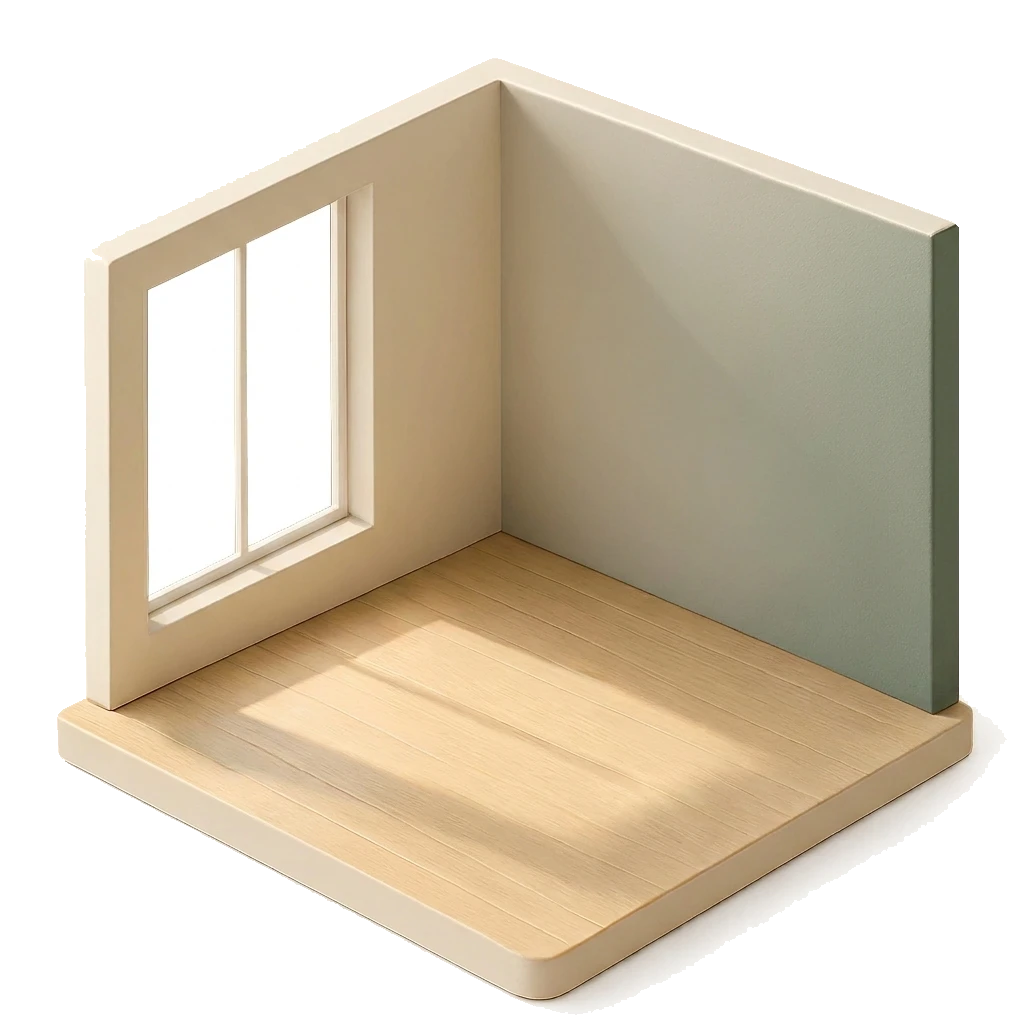
At 1 m from the window: bright light
Distance from the window
Move the plant around the room: for swiss cheese plant, the recommended zone is 0 to 1,5 m from the glass. Light levels fall very quickly with distance.
Direct sun is the other pitfall. Strong sunlight destroys chlorophyll: the leaf becomes pale and discolored, then the area turns brown and brittle.10 A leaf that is already half white has little margin to spare. If you move the plant outdoors for your local summer, acclimate it gradually or it will scorch.2 The University of Maryland recommends starting with 2 hours of sun a day, then increasing the exposure.10
Conversely, a plant that persistently loses its variegation is most often short of light.11
Watering a monstera variegata without drowning its roots
Water thoroughly, then let the upper quarter or third of the pot dry before watering again.6 Wet the moss pole too, as the aerial roots draw water from it, and water less during winter slow growth.2 The RHS keeps the growing medium just moist during that season.9
17 cL every 11 days
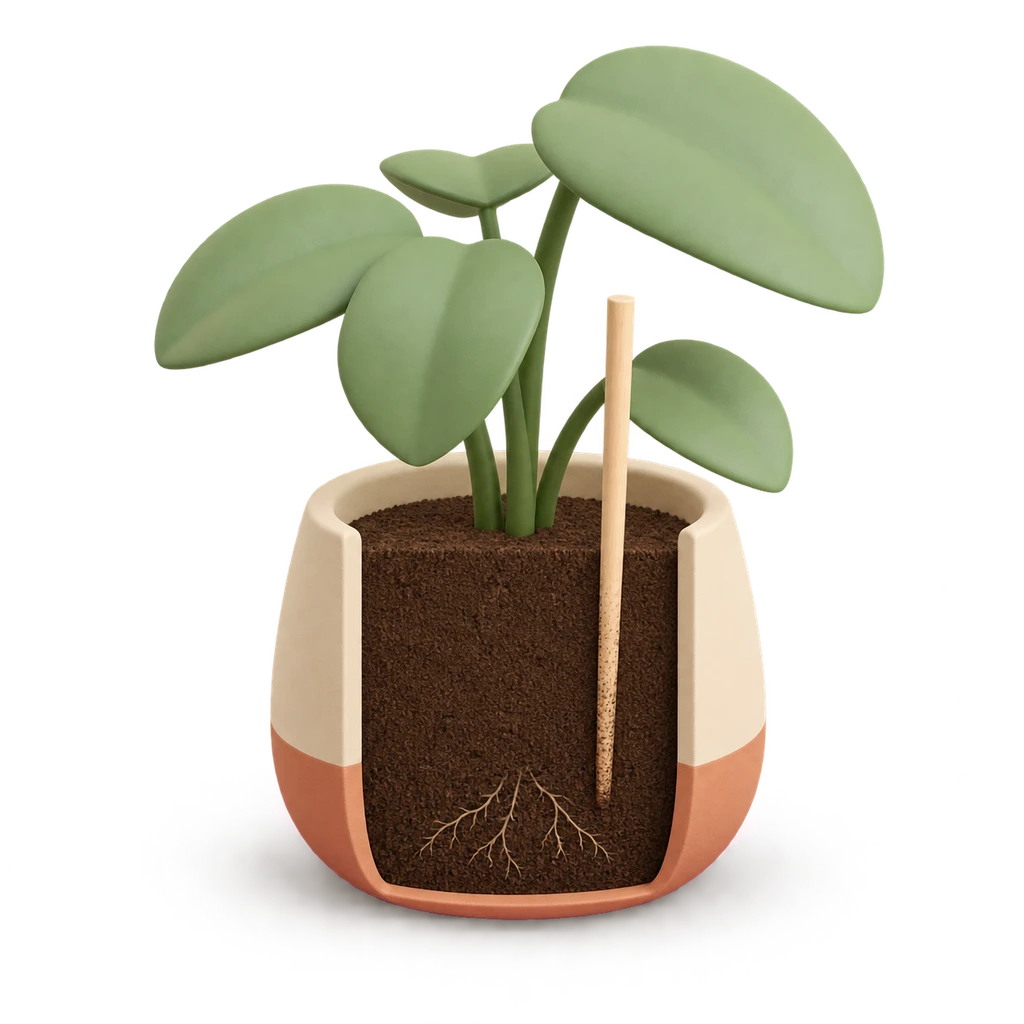
Potting mix dry to 1 cm: still moist
The finger test
Push a finger or wooden skewer 2 cm into the potting mix: if it is dry, water; if it is still moist, wait. The condition of the mix decides, not the calendar.
A slower-growing plant also uses less water: feel the growing medium before every watering rather than following a calendar. Overwatering is costly with variegata: waterlogged soil can cause loss of variegation and brown areas in the centers of leaves.11
Humidity and temperature
Between 16 and 29 °C (60.8–84.2 °F), with high humidity.6 The plant stops growing below 10 °C (50 °F),2 and its leaves are damaged or killed between -1 and 0 °C (30.2–32 °F).3 The RHS rates it H1B and moves it outside only above 18 °C (64.4 °F).9
Dry air shows at the edges: leaf margins turn brown when humidity is too low.2 A humidifier or a tray of damp clay pebbles beneath the pot raises humidity in a heated room.6
Growing medium and repotting
A rich, free-draining, peat-free potting mix in a pot with room for the roots. The RHS recommends a peat-free, loam-based mix that is moist but well drained.9 Monstera cannot tolerate waterlogged soil.3 A sturdy moss-covered pole, inserted into the pot, supports its aerial roots.2
Variegata fills its pot more slowly than the green form. Repot when roots emerge from the drainage holes or circle against the pot wall, rather than on a fixed date, and during spring growth rather than winter slow growth in climates with that seasonal pattern.
Propagating monstera variegata: choose a variegated node
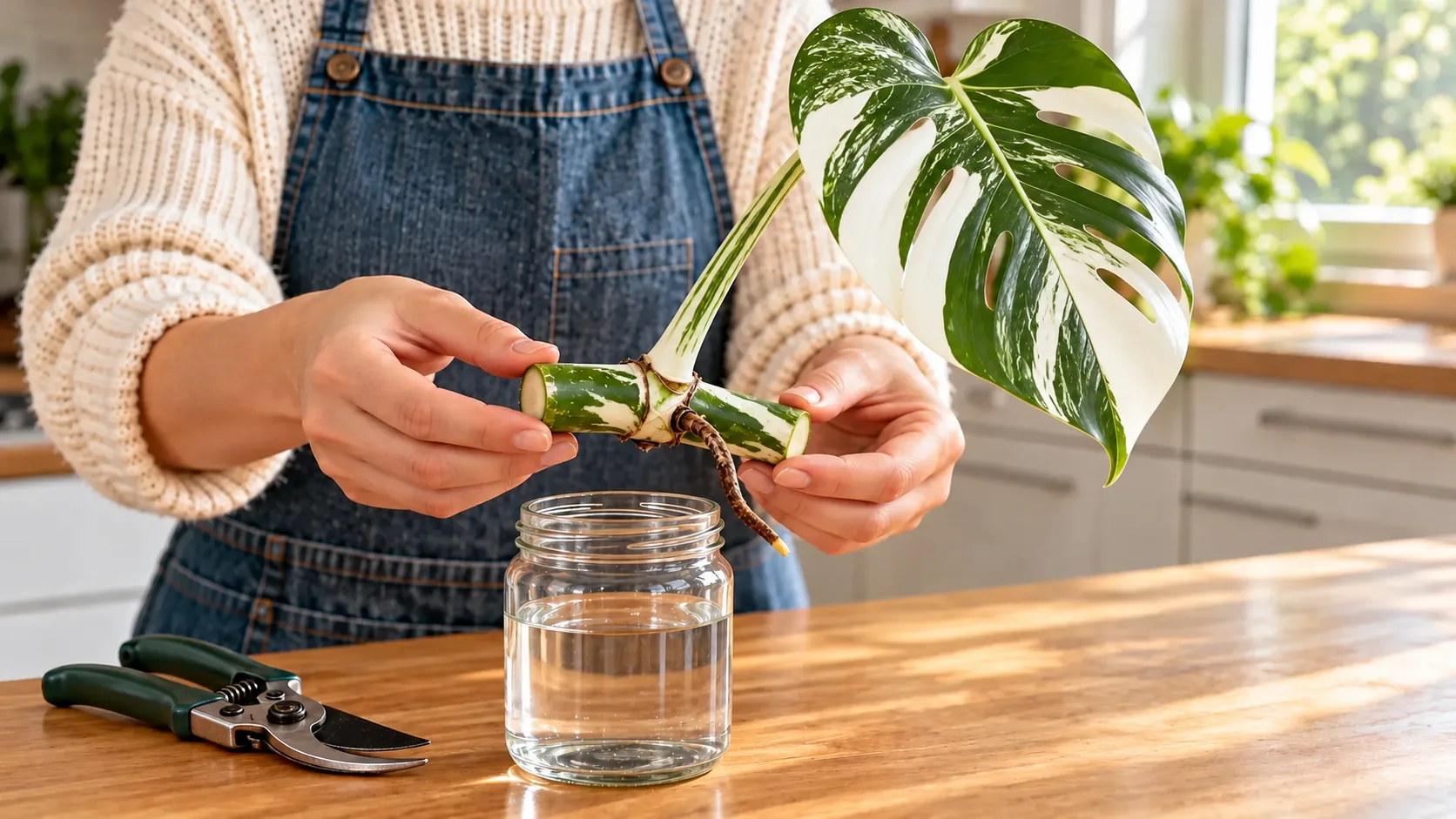
Stem cuttings are the usual way to propagate a monstera.3 Cut the end of a stem just below an aerial root, then pot up the cutting.2 For variegata, cuttings are also the only way to retain the variegation: very few variegated plants come true from seed, as variegation is generally not inherited.1
The choice of node determines what follows. Variegation depends on the cell layers in the meristem,4 and a cutting reproduces the stem it came from exactly.1 A node from an entirely green stem therefore produces a green plant; a node with a variegated leaf and stem has every chance of retaining the white.
Feeding, pruning and green reversions
A balanced liquid fertilizer once a month during growth,9 from spring to autumn where these are the growing seasons.2 With a slower-growing plant, never increase the dose to speed it up: fertilizer cannot replace the chlorophyll missing from the white areas.
The main reason to prune variegata is reversion. A stem that has turned green contains more chlorophyll, grows faster and eventually takes over.1 Cut it out entirely or cut back to a section that still bears variegated leaves.1 Reversion can also signal insufficient light.5 Entirely white shoots, meanwhile, are weak and do not dominate the plant.1
Monstera variegata problems
Most problems specific to variegata show in its white areas. The table links each sign to its most likely cause and the action to take.

| Symptom | Likely cause | What to do |
|---|---|---|
| White areas becoming pale, then brown and brittle | Excessively strong sun 10 | Move away from the glass, filter the sun, acclimate gradually |
| Brown leaf edges | Air too dry 211 | Use a humidifier or a tray of damp pebbles |
| Brown areas in leaf centers, soft roots | Overwatering 11 | Let the upper third dry and check drainage |
| An entire stem reverting to green | Reversion 1 | Cut the stem back to a variegated section |
| Variegation fading throughout the plant | Insufficient light or waterlogged soil 11 | Move closer to the window and water less often |
| An entirely white new leaf | A bud that has become entirely white 4 | Monitor it: an entirely white shoot remains weak 1 |
| Leaves without splits | Insufficient light 2 | Provide more bright indirect light |
A browned leaf will not turn green again. Cut it off at the base of the petiole if it is in the way, remembering that every leaf matters on a plant that produces few of them.
Monstera variegata care calendar
In climates with seasonal indoor growth, variegata follows the green monstera's rhythm: growth from spring to autumn and rest in winter. Two details are specific to it. Reversions appear mainly in spring and summer, often after temperature fluctuations,1 and variegation is often less pronounced in late summer, without the plant being ill.11 Apply the following to your local seasons and the plant's growth.
| Task | January | February | March | April | May | June | July | August | September | October | November | December |
|---|---|---|---|---|---|---|---|---|---|---|---|---|
| Watering | reduced | reduced | reduced | moderate | moderate | high | high | high | moderate | reduced | reduced | reduced |
| Growth | resting | resting | active | active | strong | strong | strong | strong | active | active | resting | resting |
| Feeding | no | no | yes | yes | yes | yes | yes | yes | yes | no | no | no |
| Repotting | no | no | favorable window | favorable window | favorable window | no | no | no | favorable window | no | no | no |
- Spring: repot if roots are outgrowing the pot, take cuttings, resume feeding and inspect for green stems.
- Summer: feed once a month, water when the upper third is dry and keep midday sun off the foliage.
- Autumn: gradually stop feeding and bring the plant indoors before nights fall below 18 °C (64.4 °F).
- Winter: space out waterings, humidify the air and keep the plant away from radiators.
Frequently asked questions
Why is my monstera variegata turning green?
Should I cut off white leaves that are turning brown?
Will a monstera variegata seed produce a variegated plant?
Almost never. Very few variegated plants come true from seed, as variegation is generally not inherited 1. Only a cutting from a variegated stem reproduces the parent plant exactly.
Why is monstera variegata so expensive?
Is monstera variegata toxic to cats?
Yes, like green monstera. It contains insoluble calcium oxalates, which are toxic to cats and dogs: mouth irritation and burning, drooling, vomiting and difficulty swallowing 7.
For watering quantities, step-by-step repotting and the other shared care needs, see the complete monstera guide.
Other varieties

Stable cultivar
Cream variegation in fine, star-like speckles; propagated through tissue culture. Described as stable in the trade, without a botanical source.