
Stable cultivar
Monstera Thai Constellation: plant profile
Monstera deliciosa ‘Thai Constellation’
Care for a monstera Thai Constellation like a green monstera, with three differences: more bright light but no direct sun on its cream speckles, slightly slower growth that uses less water and feed, and a watchful eye for stems reverting to all green.

What changes
More bright, indirect light
Give it more bright, indirect light than the green form: the white areas lack chlorophyll, so the plant produces energy only through its green leaf area.
Slower growth
Growth is a little slower than in the green form: repot less often and reduce feeding slightly.
No direct sun
Keep it out of full, direct sun, just like the green form: direct sun marks the foliage.
Prune stems that revert to green
If a stem reverts to solid green, cut above a variegated bud; otherwise the variegation will be lost.
Monstera Thai Constellation: plant profile
Thai Constellation is a cultivar of monstera (Monstera deliciosa) with speckled variegation: cream dots and marbling scattered across the green leaf blade. NC State describes this marbled, speckled pattern as resembling a constellation and lists the plant among rare cultivars.1 The RHS describes growth as slightly slower than the species, with leaves closer together along the stem.2

| Feature | Monstera Thai Constellation |
|---|---|
| Botanical name | Monstera deliciosa 'Thai Constellation', Araceae family 2 |
| Variegation | Cream to pale-yellow dots, patches and marbling on medium to dark green 13 |
| Leaf stalk | Green, or variegated green and white 3 |
| Leaf shape | Broadly heart-shaped, almost as wide as long 3 |
| Mature size | 2.5 to 4 m (about 8.2 to 13.1 ft) tall and 1.5 to 2.5 m (about 4.9 to 8.2 ft) wide, reached in 10 to 20 years 2 |
| Growth | Slightly slower than the species, with more closely spaced leaves 2 |
| Commercial propagation | Tissue culture 4 |
| Hardiness | H1B: under cover, outdoors only in summer under suitable conditions 2 |
| Toxicity | Toxic to cats and dogs (calcium oxalates) 5 |
Origin and stability: what the sources say
Two US plant patents mention Thai Constellation, one as a parent and the other as a comparison variety, and both describe it as unpatented.63 The first, granted on , describes a commercial tissue-culture laboratory in Pathum Thani province, Thailand, taking material from a Thai Constellation. Treated to induce mutations, this material produced a smaller plant than its parent in , patented as 'Sumi1'.6 In , a team at the University of Florida published a Thai Constellation micropropagation protocol, noting that growers struggle to propagate it on a large scale.4
Sellers describe it as stable, arguing that every laboratory-produced plant has the same pattern. None of the botanical sources consulted documents this stability: neither the RHS, NC State nor the two patents. The RHS notes that mutations in variegated plants are not always stable.7 In comparison with Monstera Albo Variegata, the 'Sumi1' patent describes albo as having, alongside speckles, large areas of entirely cream leaf blade.6 Monstera variegata, another variegated form, also has its own page.
What light does a monstera Thai Constellation need?
Bright, filtered light near an east-, west- or south-facing window, without direct sun on the foliage during the hottest hours. These are northern-hemisphere window directions. The RHS grows it in bright indirect light, in partial shade, facing east, south or west.2 Variegated cultivars need more light than dark-green forms,1 because cream areas lack the chlorophyll that supplies energy for growth: the plant relies only on its green surface.8
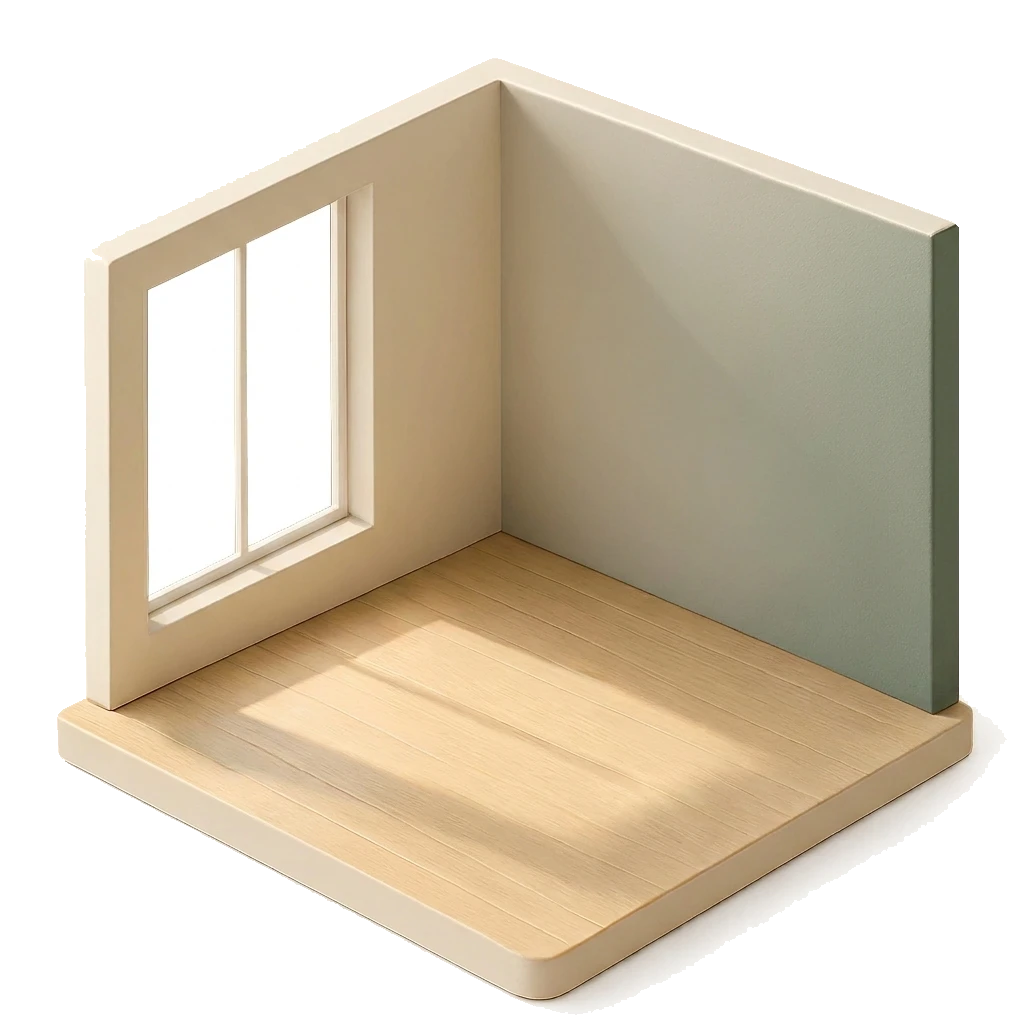
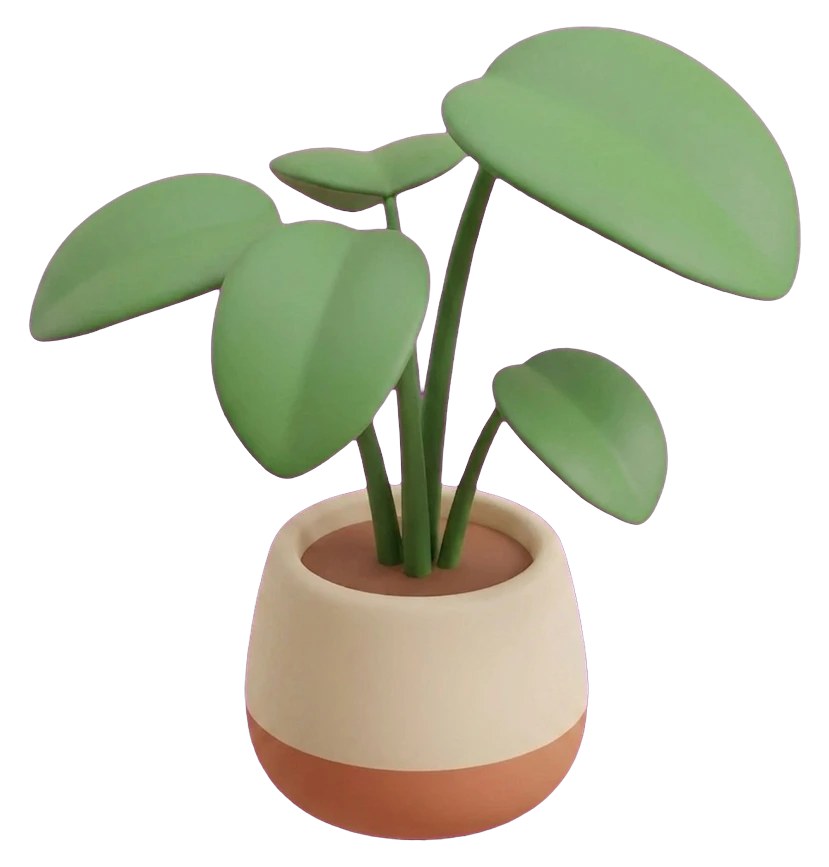
At 1 m from the window: bright light
Distance from the window
Move the plant around the room: for swiss cheese plant, the recommended zone is 0 to 1,5 m from the glass. Light levels fall very quickly with distance.
Strong sun destroys chlorophyll: the area fades, loses color, then turns brown and brittle, with worse damage if the soil is dry at the same time.9 When moving the plant outside for summer, acclimate it gradually,10 starting with 2 hours of sun a day.9
Conversely, a plant kept too dark produces leaves without splits10 and can lose its variegation permanently.11
Watering a monstera Thai Constellation
Water thoroughly, then let the top quarter or third of the pot dry before watering again.1 Also wet the moss pole, where aerial roots take up water, and water less during winter slowdown.10 The RHS then keeps the potting mix just moist.2
17 cL every 11 days
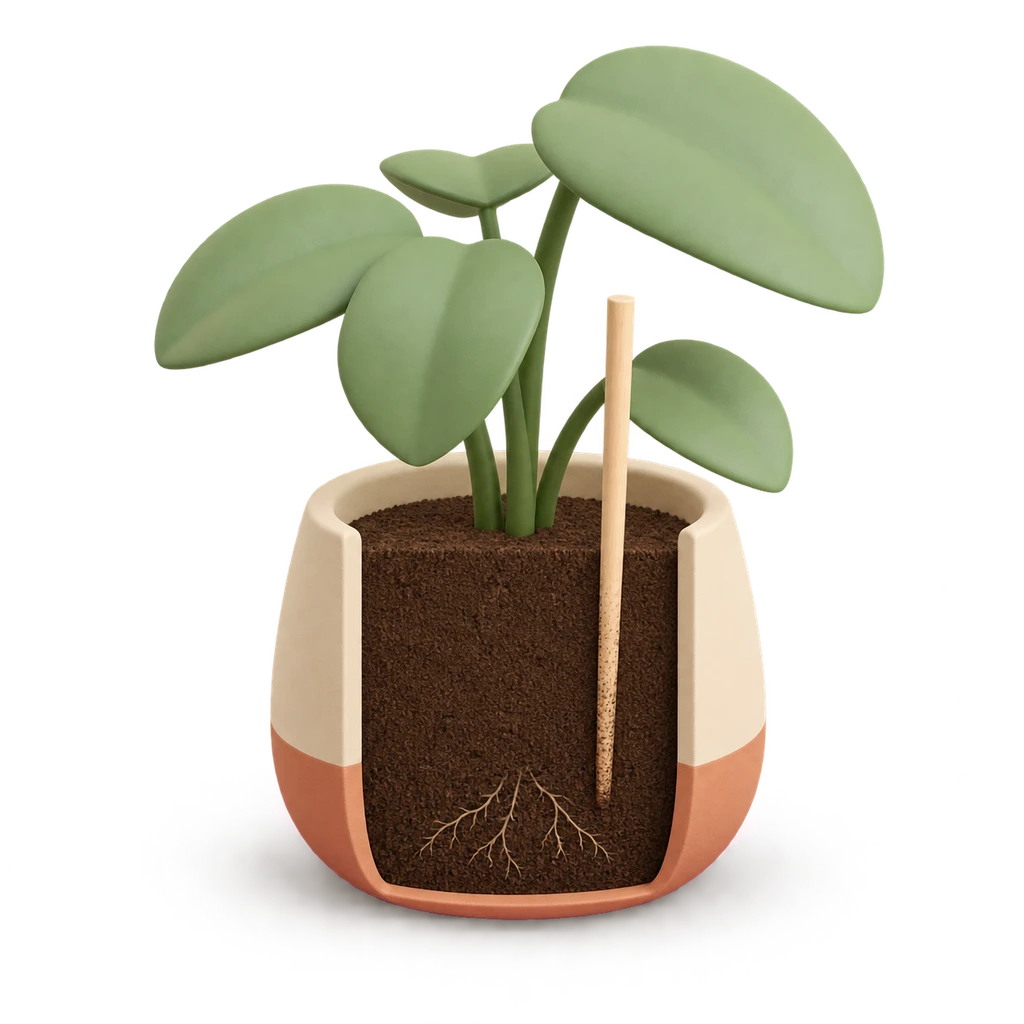
Potting mix dry to 1 cm: still moist
The finger test
Push a finger or wooden skewer 2 cm into the potting mix: if it is dry, water; if it is still moist, wait. The condition of the mix decides, not the calendar.
A slower-growing plant uses less water: feel the potting mix before every watering instead of choosing a fixed day. Leaves that “sweat” indicate overly wet mix; space out watering before the roots rot.10 Waterlogged soil can also erase variegation.11
Humidity and temperature
Between 16 and 29 °C (60.8 and 84.2 °F), with humid air.1 The RHS recommends moderate to high humidity2 and rates it H1B: it goes outside only above 18 °C (64.4 °F).2 Growth stops below 10 °C (50 °F)10 and leaves die between -1 and 0 °C (30.2 and 32 °F).12
Dry air shows at the edges: leaf margins turn brown when humidity is too low.10 A humidifier or tray of wet clay pebbles beneath the pot raises humidity in a heated room.1
Potting mix and repotting
Rich, peat-free, loam-based potting mix, moist but well drained.2 Monstera cannot tolerate waterlogged soil.12 Give the roots space for larger leaves,10 and install a sturdy support to keep stems from breaking.1 A moss-covered pole supports the aerial roots.10
Thai Constellation fills its pot more slowly than the green form. Repot when roots emerge through the drainage holes or circle the sides, preferably as spring growth resumes rather than during winter slowdown in your conditions.
Taking a monstera Thai Constellation cutting
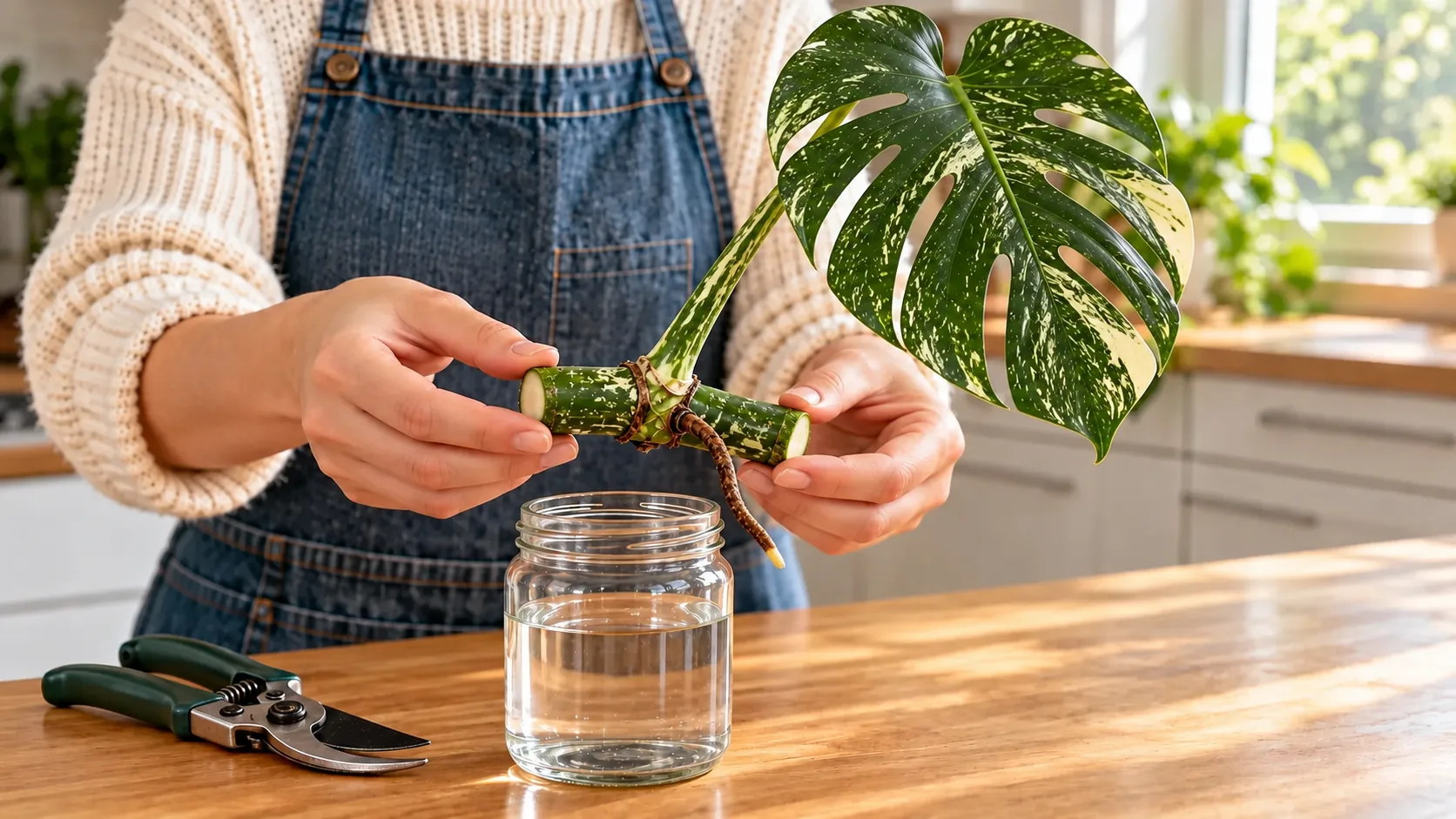
Cut the end of a stem just below an aerial root, then pot up the cutting.10 Stem cuttings are the most common propagation method for monstera.12 Sowing is unsuitable: very few variegated plants reproduce true from seed.7
A cutting is identical to the stem it comes from.7 Variegation depends on cell layers in the meristem,13 so choose a node whose leaf and stem carry cream speckles. A node from an all-green stem would produce a green plant.
Growth, feeding and pruning
A balanced liquid fertilizer once a month during active growth,2 from spring to autumn in the source growing conditions.10 Thai Constellation grows a little more slowly than the species2: do not increase the dose to hurry it along; fertilizer cannot replace the chlorophyll missing from the cream areas. Wipe dust off the leaves occasionally.10
Pruning mainly addresses reversion. A stem that becomes entirely green contains more chlorophyll, grows faster and eventually takes over.7 Remove it entirely, or cut back to a part that still carries variegated leaves.7 Reversion can also indicate too little light.8 Entirely cream shoots, in contrast, remain weak and do not dominate the plant.7
Problems with monstera Thai Constellation
Cream areas react first: sun, dry air and too much water show there before elsewhere. The RHS also lists susceptibility to scale insects and spider mites.2

| Symptom | Likely cause | What to do |
|---|---|---|
| Speckles fade, then brown and become brittle | Sun too strong, especially in dry soil 9 | Move away from the glass, filter the sun and acclimate gradually |
| Brown leaf edges | Air too dry 10 | Humidifier or tray of wet pebbles |
| “Sweating” leaves, soft roots | Potting mix too wet 10 | Let the top third dry and check drainage |
| A whole stem has reverted to green | Reversion 7 | Cut the stem back to a variegated part |
| Variegation fading across the whole plant | Too little light or waterlogged soil 11 | Move closer to the window and water less often |
| Leaves without splits | Insufficient light 10 | More bright indirect light |
| Small shells or cottony clusters on stems | Scale insects or mealybugs 210 | Isolate the plant and remove insects by hand |
| Dull, finely stippled foliage | Spider mites 2 | Isolate, shower the foliage and raise humidity |
A brown area will not turn green again. Remove the leaf at the base of its stalk only if it is mostly dry: on a plant that produces few leaves, every green leaf matters.
Monstera Thai Constellation care calendar
Thai Constellation follows the green monstera's rhythm: growth from spring to autumn and rest in winter under the source growing conditions. Follow your local growing and resting seasons. Two points are specific to it. Reversions appear mainly in spring and summer, often after temperature fluctuations,7 and variegation is often less marked at the end of summer without the plant being ill.11
| Task | January | February | March | April | May | June | July | August | September | October | November | December |
|---|---|---|---|---|---|---|---|---|---|---|---|---|
| Watering | reduced | reduced | reduced | moderate | moderate | high | high | high | moderate | reduced | reduced | reduced |
| Growth | resting | resting | active | active | strong | strong | strong | strong | active | active | resting | resting |
| Feeding | no | no | yes | yes | yes | yes | yes | yes | yes | no | no | no |
| Repotting | no | no | favorable window | favorable window | favorable window | no | no | no | favorable window | no | no | no |
- Spring: repot if roots overflow, take cuttings or air layers, resume feeding and inspect stems as growth restarts.
- Summer: feed once a month, water when the upper third is dry and keep midday sun off the leaves.
- Autumn: gradually stop feeding as growth slows; bring it inside before nights fall below 18 °C (64.4 °F).
- Winter: space out watering during slower growth, humidify the air and keep the pot away from radiators.
Frequently asked questions
Can a monstera Thai Constellation turn green again?
What is the difference between Thai Constellation and monstera albo?
Why is Thai Constellation rare?
Is Thai Constellation patented?
Will a Thai Constellation cutting stay variegated?
Does Thai Constellation grow more slowly than a green monstera?
How big does a monstera Thai Constellation grow?
Can Thai Constellation go outside in summer?
Is monstera Thai Constellation toxic to cats?
Yes, like green monstera. It contains insoluble calcium oxalates, toxic to cats and dogs: mouth irritation, drooling, vomiting and difficulty swallowing 5.
For watering quantities, step-by-step repotting and other shared care, see the complete monstera guide.
Other varieties
Variegated
A horticultural label for leaves with irregular white variegation.