
Care guide
Orchid care
Phalaenopsis
A moth orchid can live for years in a living room with three essentials: a ten-minute soak when roots fade toward silver-gray, an east- or west-facing window without direct sun, and a room above 15 °C (59 °F). Repotting, feeding, and reblooming build on those three conditions.
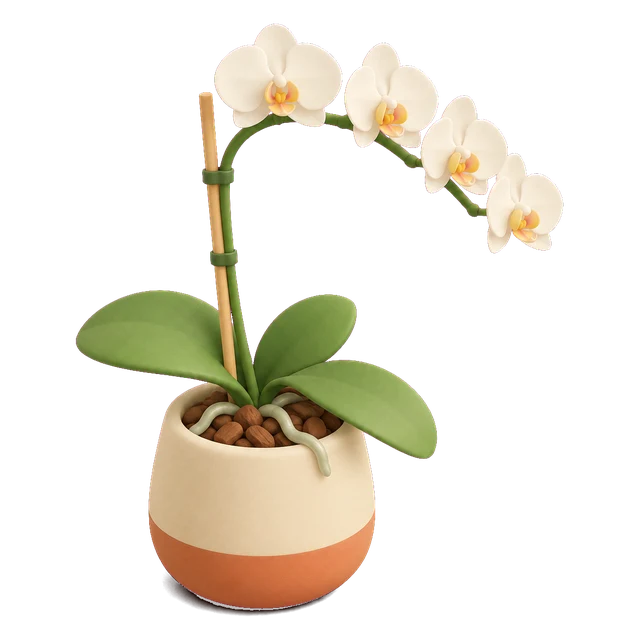
How often should you water an orchid?
About once a week during growth, from spring to fall, slightly less in winter, adjusted to local light, temperature, and growth.1 The Muséum averages one soak every ten days.2 These intervals are only a starting point: root color decides, rather than the calendar.
17 cL every 11 days
About every 7 days
A little less often than in summer
About every 10 days
Hiver, eau calcaire, écorce ou sphaigne, pot de verre : watering an orchid se règle différemment dans chaque cas.
A moth orchid (Phalaenopsis) is an epiphyte: in tropical Asian forests, it attaches to branches, with roots growing in the air. It has no pseudobulb to store water, only fleshy leaves, so it must never dry out completely.3
The ten-minute soak
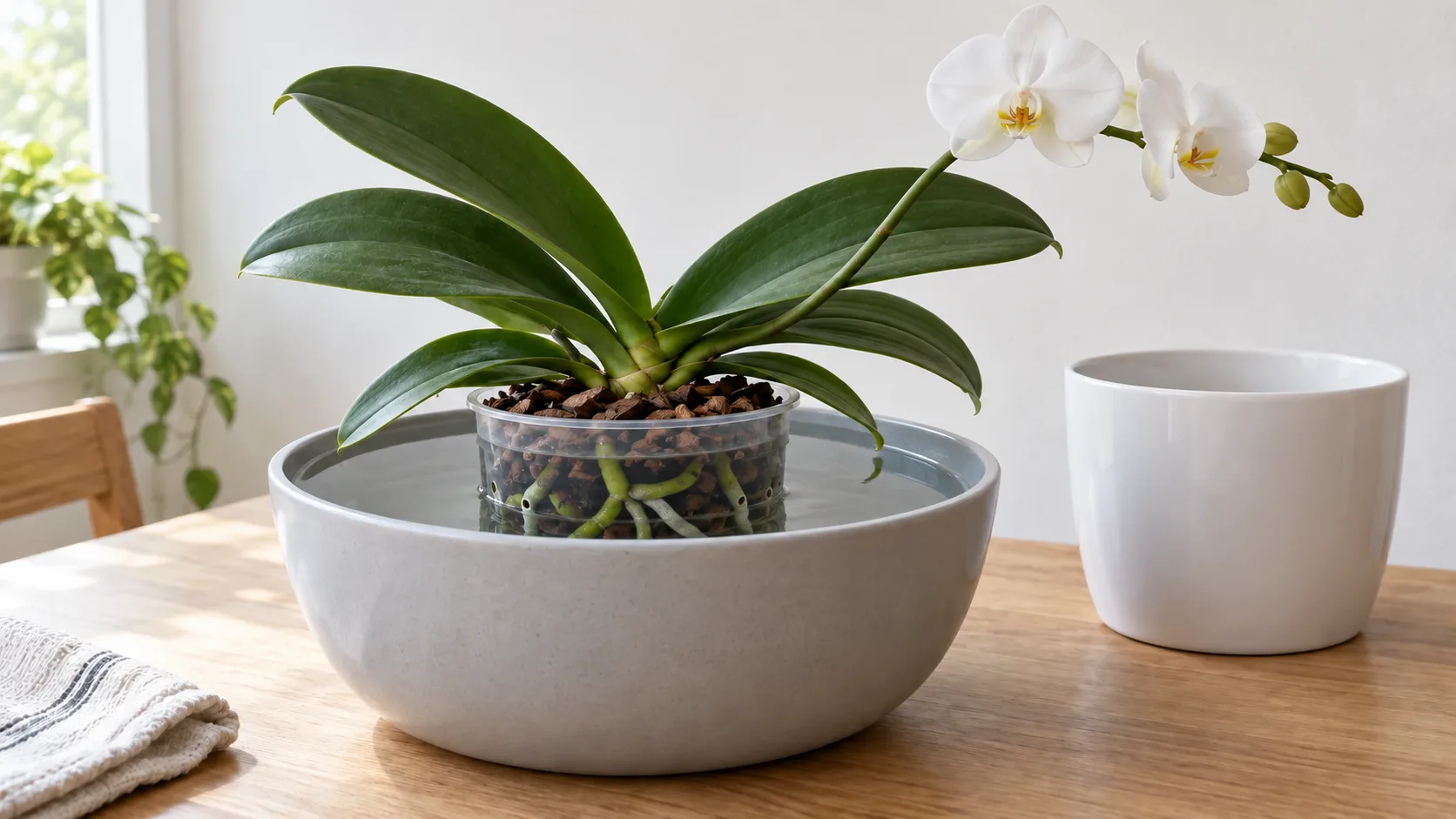
The Muséum's gardeners use bassinage, or soaking from below: set the pot in a basin, with water at pot height, for ten minutes, then drain completely before returning it to its decorative pot. Soaking also avoids wetting the crown.2
Bottom watering
A water bath, or soak, is what the Muséum calls bassinage: water rises from below without wetting the crown of the plant.
- Take the nursery pot out of its decorative outer pot.
- Place it in a basin with water up to the height of the pot.
- Leave it to soak for 10 minutes.
- Let it drain thoroughly before putting the pot back.
- Lukewarm water, preferably rainwater: cold water damages tissues.14
- In the morning: leaves dry before night.3
- Never leave water in the crown of the rosette: a drop lingering between leaves can start rot.4
- Never leave the pot standing in a full saucer.1
How can you tell an orchid needs water?
Look at its roots through the clear pot. They are covered with velamen: clear green means hydrated; fading toward silver-gray means thirsty. Aerial roots turn from silver-gray to pale green as soon as they have taken up enough water.5 The more cautious Muséum waters when roots inside the pot begin losing their green color, without waiting for white or gray.2

The trap: soft, wrinkled leaves can result from overwatering, because rotten roots no longer absorb water. Before adding water to a wilting plant, take it out of the pot and inspect the roots.4
Brown, hollow roots, dark, compacted bark, and a pot still heavy several days after soaking point to excess water. Gray, firm roots and a light pot indicate thirst. See underwatering and overwatering for both cases.
Where should you place an orchid?
About 1 m (3.3 ft) from an east- or west-facing window, in bright light without direct summer sun. The RHS considers these orientations ideal in its UK setting; the American Orchid Society prefers an east-facing window.13 Against the glass, overheating is a risk.2 Judge your own position by local light and leaf temperature.
At 1 m from the window: bright light
Distance from the window
Move the plant around the room: for phalaenopsis, the recommended zone is 0,5 to 1,5 m from the glass. Light levels fall very quickly with distance.
The season changes conditions. In winter, short days justify moving closer to the glass, even to a south-facing window in the sources' Northern Hemisphere setting; in summer, direct sun burns leaves.51 Adjust to actual local light. Keep it away from radiators and drafts too: it dislikes temperature swings.1
| Leaves | Diagnosis | Action |
|---|---|---|
| Light green and firm | Suitable light | Keep conditions unchanged |
| Dark green and very stiff | Too little light | Move closer to the window |
| Yellow-green with reddish edges | Too much light | Move back or filter light with a sheer curtain |
These benchmarks come from Maryland Extension.5 A windowless room can work with a grow light placed 30–60 cm (12–24 in) above the leaves3: see low light for diagnosis and supplemental lighting for equipment.
Humidity: a bright bathroom
Air matters as much as light: orchids prefer 50–70% relative humidity, making a bright bathroom a good location; see our bathroom plants. Elsewhere, a damp pebble tray beneath the pot helps more than misting, considered insufficient indoors, provided the pot does not touch the water.5 See raising ambient humidity for other measures.
What growing medium should you use, and when should you repot?
About every two years, in pine-bark medium, never potting soil.12 Bark decomposes over time: it compacts, holds water too long, and eventually roots rot.1
- Repot
- Every 1 to 2 yearsSource: University of Maryland Extension
- Repot
- Every 1 to 2 yearsEvery year, at most every two yearsSource: Jardins de France (SNHF)
- Repot
- Every 2 yearsSource: Royal Horticultural Society
- Repot
- Every 2 yearsApproximatelySource: Clemson Cooperative Extension
- Repot
- Every 1 to 3 yearsSource: American Orchid Society
- Repot
- Every 2 to 3 yearsSource: Muséum national d'Histoire naturelle
- Repot
- Every 2 to 3 yearsSource: Vacherot & Lecoufle
- When to repot
- March to May, Septemberwhen new growth beginsSource: University of Maryland Extension
- When to repot
- After floweringin spring, as soon as new root tips appearSource: American Orchid Society
- Avoid
- November to FebruarySource: Vacherot & Lecoufle
- The new pot
- 2 cm widerSource: Vacherot & Lecoufle
- Pot diameter
- 15 to 20 cmMature plantSource: American Orchid Society
Choix de l'écorce, taille du pot, racines à couper ou à garder : repotting an orchid se prépare avant de dépoter.
General-purpose potting soil kills an orchid: its roots need air as much as water.1 Commercial mixes combine pine bark and sometimes a little sphagnum moss, as long as the mix stays airy.2 Aim for slightly acidic pH, 5.5–6.5.
The right time is when new growth starts: spring, March–May, or September in the French source calendar.5 Use actual local root activity as your cue. The RHS says repotting is possible in any season with active roots showing green tips.1
There are three steps: remove all old bark, cut off brown or hollow roots with a clean tool, and replant in a clear pot barely larger than the old one.1
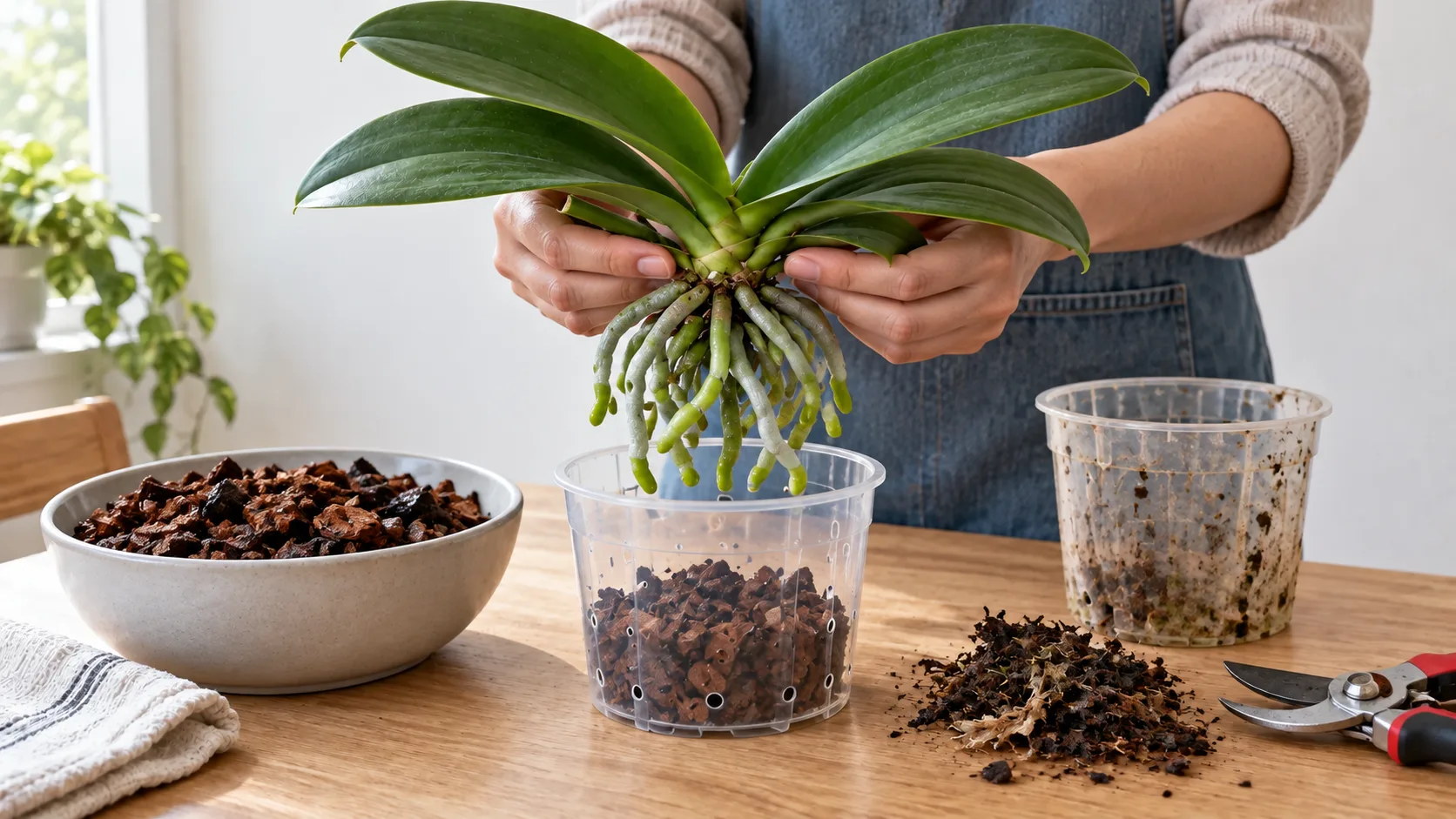
The repotting trap is an oversized pot: excess medium stays wet and sustains rot.1 Roots sitting in sodden bark cannot wait for spring: see emergency repotting for drainage.
What fertilizer do orchids need, and how often?
Dilute orchid fertilizer every two weeks during growth, with plain water every fourth watering. Plain water flushes salts that burn roots.13 In winter, feeding becomes infrequent or stops.1 Follow local growth rather than the month.
- Fertilizer
- For orchids, dilutedSource: Royal Horticultural Society
- Feeding
- During active growthSource: Royal Horticultural Society
- Feeding
- In winterAt a reduced dose · while the plant continues to growSource: American Orchid Society
- No fertilizer
- In winterfeed rarely, if at allSource: Royal Horticultural Society
- Frequency
- Twice a month, at a low dosein cool or cloudy weatherSource: American Orchid Society
- Frequency
- At quarter strength with every wateringin warm, humid weatherSource: American Orchid Society
- Frequency
- Every 7 daysHalf strengthSource: American Orchid Society
- Frequency
- Every third or fourth wateringLabel doseSource: University of Maryland Extension
- Avoid
- Exceeding the dose on the labelSource: University of Maryland Extension
Add liquid orchid fertilizer to the soaking water at the manufacturer's dose, never exceeding it; some growers use one-quarter strength at every watering.3
Too much fertilizer produces leaves rather than flowers: Maryland Extension notes that overfed plants grow at the expense of flowering.5 Damaged roots despite appropriate watering suggest excess salts: a prolonged plain-water soak can flush salts from the medium.
Formules, dose, rinçage et l'hiver qui divise les sources : choosing orchid fertilizer se règlent selon la saison.
What temperatures can an orchid tolerate?
Above 15 °C (59 °F), comfortable at 18–28 °C (64–82 °F), never below 10 °C (50 °F): the French source treats moth orchids as houseplants in France. The RHS calls for above 16 °C (61 °F), with nights at 16–19 °C (61–66 °F).1 They have no frost hardiness: below 10 °C (50 °F), a few hours can leave sunken yellow, water-soaked spots on leaves.6 The slightest frost kills them, and even a cold draft marks leaves.4
Temperatures for phalaenopsis
In °C, thresholds given by the sources.
- Cold damage10 °C
- Recommended minimum (RHS)16 °C
- Maximum daytime temperature for triggering a spike25 °C
- No spike if above this temperature for 12 hours a day28 °C
- Upper limit (AOS)35 °C
- Ideal: 18 to 28 °C
- Tolerated: 15 to 32 °C
Above 28 °C (82 °F), warm days promote leaf growth, provided humidity and ventilation increase; the American Orchid Society places the upper limit around 32–35 °C (90–95 °F).3 Cold can also arrive in water: ice-cold watering or ice cubes on the medium are listed by the source as causing sunken leaf lesions.4
The French source's outdoor-summer example: an orchid can spend summer outdoors once nights stay above 15 °C (59 °F), on a balcony or beneath a covered patio, in shade and sheltered from rain that could collect in the crown.4 Apply these temperature and shelter conditions locally.
For fall, the American Orchid Society allows the first cool nights, provided they stay above 10–13 °C (50–55 °F), to trigger flowering. In this source advice, bring it back inside after two or three weeks, or as soon as nights fall below 10 °C (50 °F).4 These cooler thresholds differ from the general growing temperatures above.
How large does an orchid grow?
20–70 cm (8–28 in) tall and 20–40 cm (8–16 in) across. Growth is slow to moderate, most active in warm conditions. The RHS also lists 15–20 cm (6–8 in) miniatures and plants 50 cm (20 in) or taller.1
- Mature height
- 20 to 70 cm
- Spread
- 20 to 40 cm
- Growth
- Slow to moderate, more active in the warm season
Its habit is monopodial: the plant grows from one central stem, producing a new leaf at the top as the oldest eventually yellows below.45 The rosette stays roughly the same size each year; aerial roots spill beyond it. Do not bury them or cut them if firm: this is natural behavior.15
When do orchids flower?
Once or twice a year, with blooms that can last several months.2 Moth orchids most often open flowers in winter and spring in the source setting, after four to five weeks of days no warmer than 25 °C (77 °F).6 Local temperature and growth determine the timing.
- What triggers flowering
- Cooler daysDays below 25 °C, for 4 to 5 weeksSource: American Orchid Society
- Flowering
- In winterSource: American Orchid Society
- Flowering
- In springSource: American Orchid Society

Entre la chute des dernières fleurs et la hampe suivante, chaque semaine compte : getting an orchid to bloom again suit un calendrier précis, du triage des causes à la première fleur.
Cooler conditions trigger flowering, rather than day length.7 The RHS summarizes the change as about 5 °C (9 °F) cooler for one month.1
Conversely, above 28 °C (82 °F) for more than twelve hours a day, near a radiator or behind a south-facing window in the sources' Northern Hemisphere summer setting, the plant grows without flowering.7 If it does not rebloom, first suspect too little light5, then overly warm days6 and too much fertilizer.5 Use actual local conditions to assess the site.
After flowers fall, cut the flower spike just above the second node below the faded flowers: a green spike can flower again from a node.1 Cut a brown, dry spike at its base.5
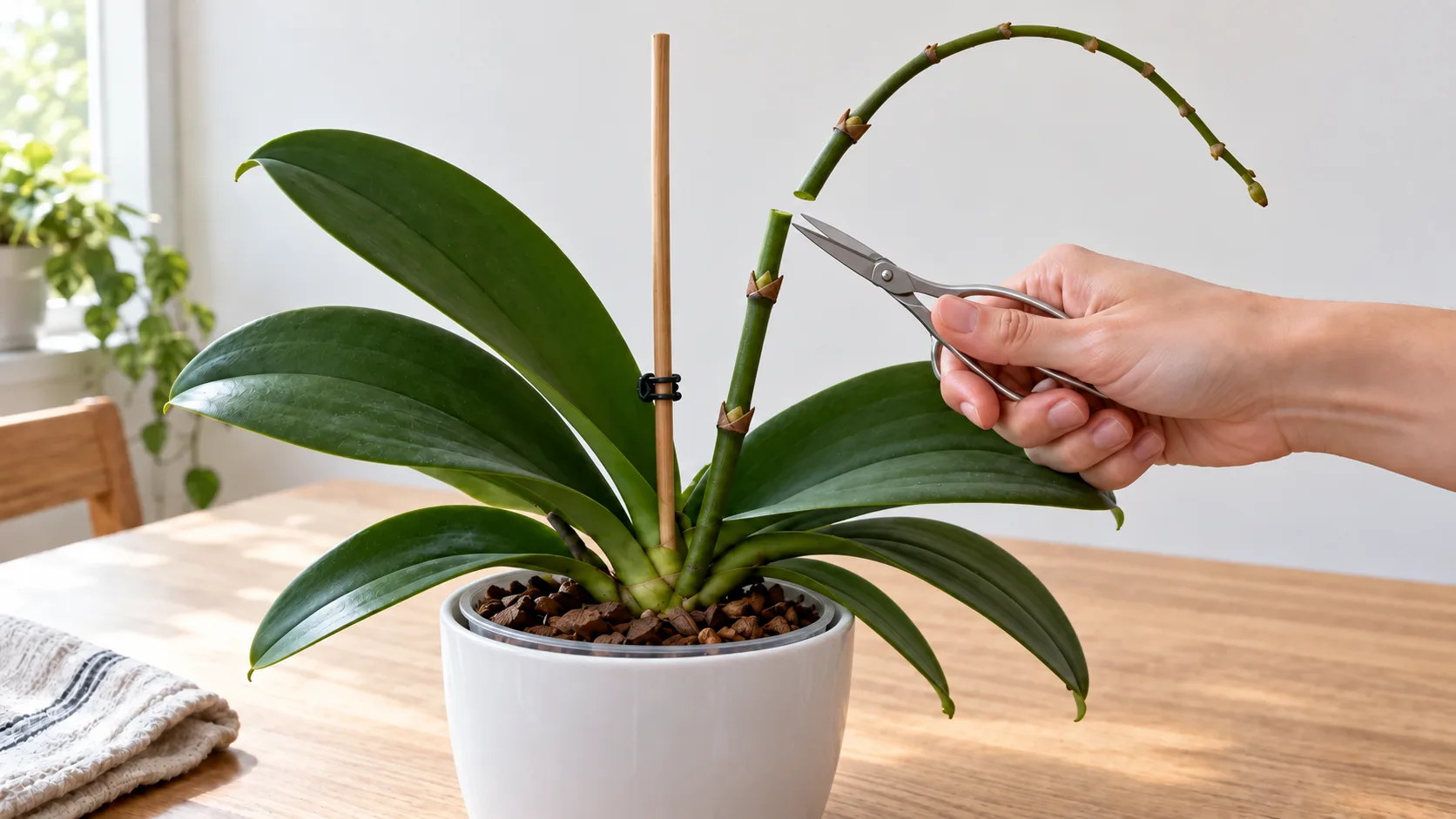
Couper au deuxième nœud, au ras des feuilles ou pas du tout : pruning an orchid compare les trois choix, avec les feuilles fanées et les racines mortes.
A month-by-month orchid care calendar
The French source calendar calls for more frequent soaks in June–August, repotting in March–May or September, reduced feeding in October–February, and a flower spike after a few cooler weeks in fall. Treat these months as source-climate examples; time your care by local light, temperature, active roots, and growth. Winter fertilizer remains optional: at most a light feeding, or none.15
| Task | January | February | March | April | May | June | July | August | September | October | November | December |
|---|---|---|---|---|---|---|---|---|---|---|---|---|
| Watering | reduced | reduced | moderate | moderate | high | high | high | high | moderate | moderate | reduced | reduced |
| Growth | resting | active | active | strong | strong | strong | strong | strong | active | active | active | resting |
| Feeding | yes | yes | yes | yes | yes | yes | yes | yes | yes | no | no | yes |
| Repotting | no | no | favorable window | favorable window | favorable window | no | no | no | favorable window | no | no | no |
How do you propagate an orchid?
Through a keiki: a plantlet growing from a flower-spike node, detached once it has several roots.1 Keiki is a Hawaiian word.
- Keiki
- After floweringKeiki paste on a spent flower spike · a plantlet may form in 6–8 weeksSource: Royal Horticultural Society
- Division
- When repottingTop of a plant that has grown too tall · the top section keeps its rootsSource: Stephen R. Batchelor
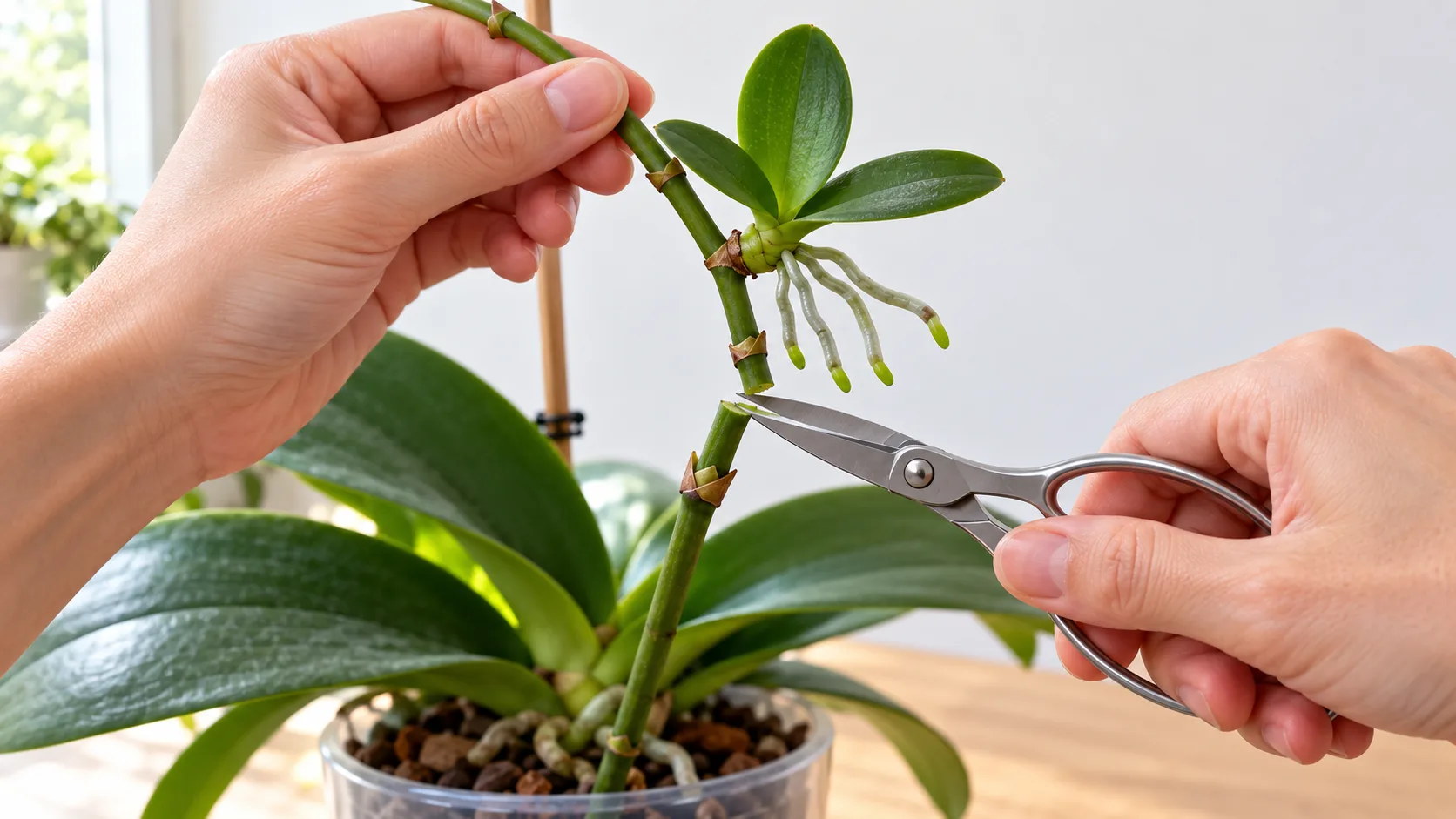
A keiki rarely appears spontaneously. Hobbyists induce one with keiki paste, a hormone preparation applied to a node after splitting its covering scale with a scalpel: a plantlet sometimes forms in six to eight weeks. Ordinary rooting hormone does not work for this purpose.1 This describes the source's method, without a guarantee of success.
Once detached, plant the keiki in fine bark, water sparingly, and mist daily for the first few weeks.13 Division is uncommon in a monopodial plant, and seed growing needs a sterile laboratory, making it a professional production method.
Détacher un keiki, en provoquer un ou diviser une plante trop haute : propagating an orchid détaille ce qui reprend et ce qui ne reprend pas.
Common problems: diagnosis
A declining orchid is more likely to have a watering problem than pests. The American Orchid Society notes that growing mistakes probably cause more damage than pests and diseases.4
Une feuille qui jaunit n'annonce pas forcément une maladie : yellow orchid leaves ont chacune leur cause, de la vieille feuille qui s'en va à l'excès de soleil.
| Symptom | Most likely cause | Action |
|---|---|---|
| Soft, thin leaves and brown roots | Root rot, decomposed bark | Repot in fresh bark and cut off dead roots |
| Blackened crown; central leaf comes loose | Crown rot: water left in the rosette | Tilt the pot to drain the crown; water in the morning |
| Watery spots with yellow halos, odor, and spread within two or three days | Bacterial soft rot | Cut away affected tissue with a disinfected tool; isolate the plant |
| Greenish blister that browns and becomes sunken | Bacterial brown spot (Pseudomonas) | Remove the affected part if the spot spreads |
| Brown or black spots on flowers | Botrytis (Botrytis cinerea) | Remove affected flowers and ventilate the room |
| White cottony clusters in leaf axils or on roots | Mealybugs | The source suggests an alcohol-soaked cotton swab; check weekly |
| Small brown shields and sticky deposits | Scale insects | The source suggests dislodging them with a soft brush dipped in alcohol |
| Pale stippling on leaves, fine webs underneath | Spider mites | Rinse leaf undersides and raise humidity |
The American Orchid Society lists bacterial brown spot among the genus's most common diseases and notes that soft rot can destroy a plant in two to three days.4 Soft rot is caused by bacteria in the group formerly called Erwinia, some now assigned to Dickeya.8 For scale insects and mealybugs, identification and removal details orchid-specific treatment. The alcohol methods in the table are source suggestions, without a concentration specified here or a guarantee of safety or effectiveness.


Two kinds of damage mimic disease. Black spots on the highest part of a leaf, just after a move, indicate sunburn. Buds dropping before opening almost always follow a sudden temperature change.43
Pourritures, botrytis, cochenilles, tétranyques, thrips et virus : orchid diseases se reconnaissent symptôme par symptôme.
A spotted or yellowing leaf? Photograph it: Floralens identifies the problem and the action to take.
| What you see | Likely cause | What to do |
|---|---|---|
| Soil stays soggy, suffocating roots and causing rot. | OverwateringExternal Factors | Treating Waterlogged Soil |
| The plant wilts and yellows while the soil stays wet. | Root RotDiseases | Treating Waterlogged Soil |
| The soil is dry and leaves are soft and drooping. | UnderwateringExternal Factors | Rescue by Soaking |
| Stems become soft, translucent, and collapse at the base. | Bacterial Soft RotDiseases | Treating Waterlogged Soil |
| Tiny arachnids that spin fine webs under leaves. | Spider MitesPests | Eliminate Spider Mites |
| White cottony clumps in leaf axils and on stems. | MealybugsPests | Eliminate Armored Scale Insects |
| A soft gray rot covering flowers and fruit. | Gray Mold (Botrytis)Diseases | Treating Botrytis (Gray Mold) |
| A black, soot-like deposit covering leaves. | Sooty MoldDiseases | Cleaning Honeydew and Its Source |
Are orchids toxic to cats and dogs?
No. The ASPCA lists moth orchids as nontoxic to cats, dogs, and horses.9 The source describes a large mouthful as causing at most mild digestive upset; if fertilizer is swallowed, contact a veterinarian or poison control center. See the moth orchid's origins and botany and nontoxic plants for cats and dogs.

Which moth orchid should you choose?
Start with a commercially sold large standard hybrid or multiflora: they are easier and more floriferous than botanical species. The Muséum places the genus among the easiest orchids.2 Modern hybrids, even unnamed ones, generally rebloom more often.1

Espèce botanique
A botanical species with large white flowers, from which most commercially sold white hybrids descend.

Espèce botanique
A Philippine species with grey-mottled foliage and long, branched spikes of pink flowers with a light rose scent.

Groupe d'hybrides
Grexes with large, rounded white, pink or striped flowers, sold at garden centres.

Groupe d'hybrides
Compact hybrids 15–20 cm (about 6–8 in) tall in small pots, or multiflora hybrids with very numerous medium-sized flowers on branched spikes.

Groupe d'hybrides
Lightly scented species and hybrids, descended mainly from P. violacea and P. bellina, with brightly coloured, waxy flowers.
Varieties documented in the botanical profile.
Most hybrids need the same care; only flower size and spike branching differ. A few species and groups are exceptions: Phalaenopsis schilleriana needs slightly brighter light and cooler fall nights, around 13 °C (55 °F), to flower10; fragrant orchids bloom with warmth and light, without the cooler fall spell used for large hybrids.11 Follow those temperature and growth conditions locally. A grex is the offspring of a registered cross, explaining labels without a variety name.
Take care with other orchids sold alongside them: bamboo orchids (Dendrobium), with upright canelike stems, need the cool, dry winter rest described in bamboo orchid care; cymbidiums (Cymbidium) tolerate much colder nights, as their encyclopedia profile explains.
Frequently asked questions
Should you put ice cubes on an orchid?
No, according to this overview's source advice. It describes ice on bark as causing cold injury to a tropical plant's roots and leaves; the American Orchid Society lists ice cubes among causes of chilling damage. A ten-minute soak in lukewarm water remains the safest method in that guidance.
How do you care for an orchid indoors?
Three essentials: a ten-minute soak when roots pale, about once a week; an east- or west-facing window without direct summer sun; and a room above 15 °C (59 °F). Adjust to local light and temperature. Add dilute orchid fertilizer during growth, repot in bark every two years, and provide a few cooler weeks during the local fall growth cycle for reblooming.
How much water should you give an orchid?
No need to measure: soak the pot for ten minutes in a basin with water at pot height, then drain completely before returning it to its decorative pot.2 The bark holds what the roots need and excess water drains away.
How do you care for an orchid in summer?
Shorten soaking intervals, more frequent from June to August in the source calendar1, and keep it away from direct sun, which burns leaves.5 Follow local warmth and drying. Avoid temperatures above 28 °C (82 °F) for more than twelve hours a day: the plant grows without flowering there.7 Once nights stay above 15 °C (59 °F), it can spend summer outdoors in shade, sheltered from rain.4
Should you cut roots that grow out of the pot?
No, as long as they are firm and green or silvery. Aerial roots are natural in an epiphyte and capture moisture from the air. Cut only dry, hollow, or rotten roots when repotting.
Should you mist an orchid?
Light misting helps in warm summer conditions if you avoid the rosette's crown, but it cannot raise a heated room's humidity sufficiently. A damp pebble tray beneath the pot, without contact with water, works better.
Why does my orchid drop buds before they open?
Usually after a sudden temperature change: the journey from the store, a window opened in winter, or a nearby radiator switched on. Once buds form, keep the plant in the same place at a stable temperature.