
Espèce botanique
Phalaenopsis amabilis: at a glance
Phalaenopsis amabilis, Indonesia’s moon orchid, grows like the large white hybrids descended from it: filtered light, soaking when roots turn silver, never below 15 °C (59 °F). Flowering depends on a few weeks of cooler nights, in fall in the sources’ seasonal growing example. Time this by actual light and temperature. In a home, it does better in a bark-filled pot than mounted on cork.
- Nights 8–11 °C (about 14–20 °F) cooler
- What changes

What changes
Nights 8–11 °C (about 14–20 °F) cooler
Flowering depends on temperature, as it does in the large white hybrids descended from this species: in your local autumn, days below 28 °C (82 °F) and nights 8–11 °C (about 14–20 °F) cooler trigger a flower spike.9
White flowers 7.5–10 cm (about 3–4 in) across
White flowers 7.5–10 cm (about 3–4 in) across on an arching spike, either unbranched or branched. Almost all modern white hybrids descend from selected forms of this species or its close relatives.2
Mainly from specialist growers
It is mainly available from specialist orchid growers: an unnamed white orchid sold at a garden centre is usually a hybrid.10
Phalaenopsis amabilis: at a glance
Phalaenopsis amabilis is an epiphytic orchid of humid lowland tropical forests from Malesia to north-eastern Australia.1 It grows on trunks, branches and rocks, from Sumatra and Java to the Philippines, New Guinea and Queensland.1 In Indonesia it is called anggrek bulan
, the moon orchid, and recognized as one of the national flowers.1

| Feature | Phalaenopsis amabilis |
|---|---|
| Status | Botanical species described by Blume in , three accepted subspecies 1 |
| Native range | Sumatra to Queensland, humid lowland tropical forest 1 |
| Leaves | 3 to 5, thick, glossy dark green, up to 50 cm by 10 cm (20 by 4 in) 12 |
| Flowers | White, 7.5 to 10 cm (3 to 4 in), yellow and red lip with two tendrils 23 |
| Flower spike | Arching, often branched, up to 1 m (3.3 ft) 1 |
| Flowering | Fall to early spring in the RHS’s UK seasonal example, flowers lasting several weeks 31 |
| Fragrance | Flowers described as fragrant by the RHS 3 |
| Trade | Orchid listed in Appendix II of CITES 1 |
| Toxicity | Non-toxic to cats, dogs and horses 4 |
The ancestor of white orchids
Most Phalaenopsis hybrids have P. amabilis in their ancestry.2 Cultivated for more than 250 years, it was first described by Rumphius in Ambon around , then named Epidendrum amabile by Linnaeus in .1 A garden-center white orchid is therefore its descendant: care is similar, with differences explained under large standard hybrids. Its full botanical identity is in the Phalaenopsis amabilis encyclopedia profile. The RHS has awarded it an AGM.3
What light does Phalaenopsis amabilis need?
Bright filtered light, without direct sun during hot hours. An east-facing window is the American Orchid Society’s source-setting example; judge by the actual light. The American Orchid Society considers an east window ideal in a home; south or west works behind a sheer curtain.5 The RHS specifies partial shade, facing north, east or west, sheltered.3

At 1 m from the window: bright light
Distance from the window
Move the plant around the room: for phalaenopsis, the recommended zone is 0,5 to 1,5 m from the glass. Light levels fall very quickly with distance.
As winter days shorten, move it closer to the glass.6 Foliage is naturally glossy dark green2: do not mistake this for insufficient light. Judge by flowering instead: a healthy plant producing no spike often lacks light.6
Watering Phalaenopsis amabilis: soak when roots turn silver
Water thoroughly, then wait until the medium is nearly dry.5 The home method is soaking: immerse the pot for ten minutes in a basin, with water up to pot height, then drain completely.7
17 cL every 11 days
About every 7 days
A little less often than in summer
About every 10 days
Roots give the signal. Covered in velamen, they change from green to silvery gray when thirsty and turn green after soaking.6 Water in the morning so leaves dry before night, and never leave water standing in the rosette center: this admits crown rot.5
Mounted on cork, it retains far less water than in a pot and needs much more frequent watering.8
Humidity and temperature: lowland forest warmth
Around 18 °C (64 °F) at night and 27 °C (81 °F) by day, with 50 to 80% humidity. The American Orchid Society recommends moderately warm cultivation2 and gives this 50 to 80% humidity range.5 The RHS rates it H1A: never below 15 °C (59 °F).3
Fall cooling induces flowering. Its flowering depends entirely on temperature, like its large white hybrid descendants: days below 28 to 29 °C (82 to 84 °F) and nights 8 to 11 °C (14 to 20 °F) cooler initiate a spike. Above 23 to 24 °C (73 to 75 °F) at night, it does not start.9
Dry air is the other pitfall in a heated living room. A tray of damp gravel beneath the pot, without contact with water, or misting on hot days raises humidity around leaves.10
Repotting in bark or growing on cork
In a home, use a clear pot with fine bark; reserve cork mounting for a greenhouse or terrarium. The American Orchid Society asks for a porous mix, fine bark indoors and repotting every one to three years.5 A pot barely larger than the rootball avoids surplus bark staying wet.10
In nature, its stem is often pendant, with fleshy roots clinging to bark.1 Mounting imitates this on cork, a standard support because it resists rot and has neutral pH, with a little sphagnum against roots.8 But the American Orchid Society discourages mounting indoors: a mount holds little water and demands constant humidity, easily maintained in greenhouses or terrariums, difficult in homes.8

Propagating Phalaenopsis amabilis with a keiki
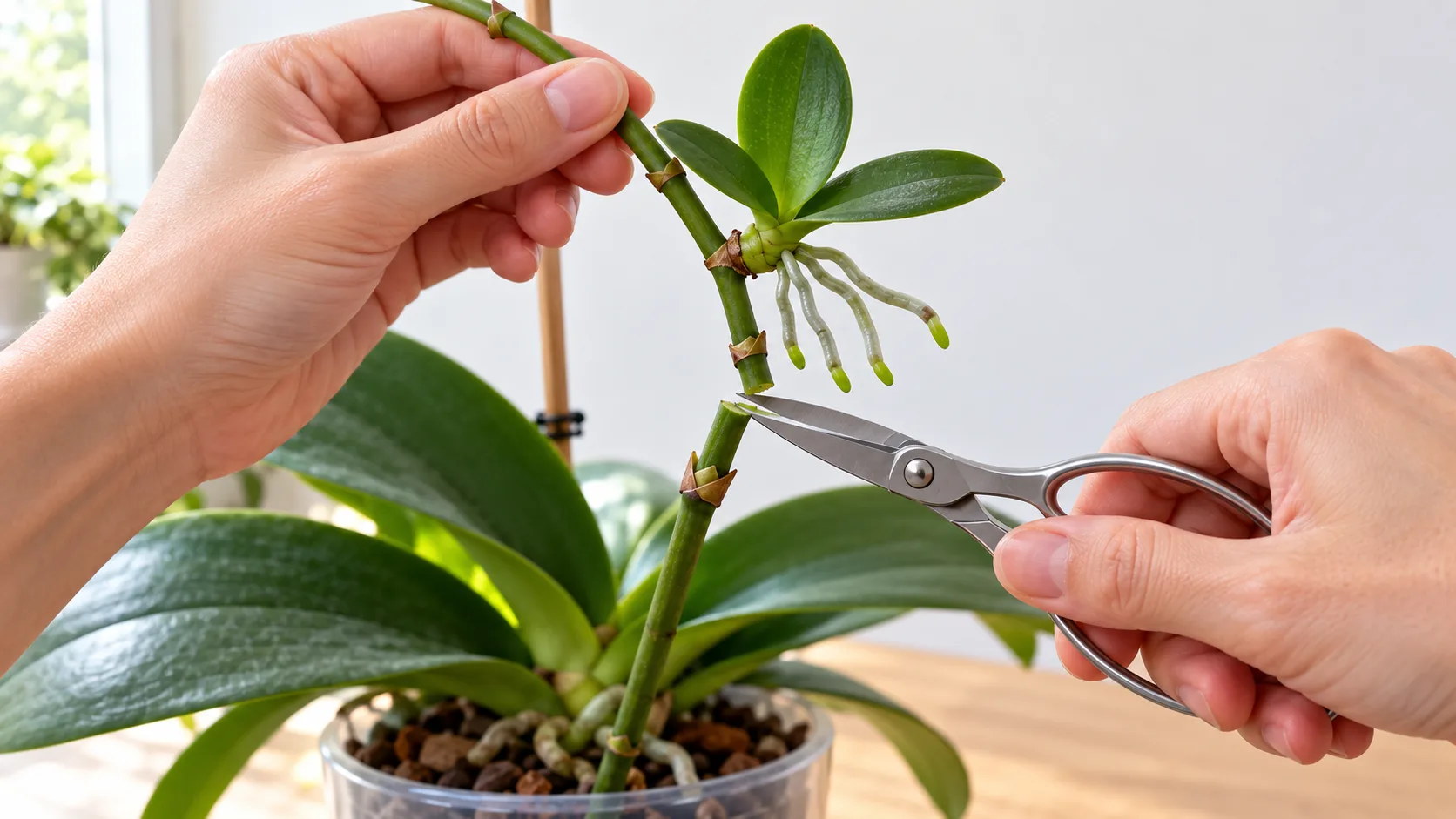
A keiki is the simplest home method for obtaining a second P. amabilis identical to the first. It sometimes appears at a spike node.10 Like all vegetative propagation, it produces a plant identical to its parent.11
Detach it once it has 2 or 3 leaves and 2.5 to 5 cm (1 to 2 in) roots, then pot separately.11 Hormone paste on a node may induce one; ordinary rooting hormone does not.10
Feeding, growth and pruning spikes
Diluted orchid fertilizer twice monthly during growth, with plain water every fourth watering.510 The RHS allows one to two years for a young plant to reach mature size, 50 cm to 1 m (20 to 39 in) tall.3
Each flower lasts several weeks, or until pollinated.1 Once the last falls, cut the flower spike above the second node below faded flowers: a side shoot may grow.10 Cut a brown, dry spike at its base.6
Phalaenopsis amabilis problems: diagnosis
In moth orchids, cultivation mistakes cause more damage than pests.12 The table matches signs, likely causes and actions.
| Symptom | Likely cause | What to do |
|---|---|---|
| No spike in late fall on a healthy plant in the source’s seasonal growing example | Nights too warm, above 23 °C (73 °F) 9 | Provide several weeks of nights 8 to 11 °C (14 to 20 °F) cooler |
| Spike stops growing | Days above 28 °C (82 °F) 9 | Move away from radiators and south-facing glass |
| Blackened crown, central leaf comes loose | Water left in the rosette 5 | Water in the morning; tilt to empty the crown |
| Soft, wrinkled leaves, brown roots | Roots rotted by excess water 12 | Unpot, cut dead roots, use fresh bark |
| Black spots on upper leaf surface | Sunburn after moving 12 | Move back from glass or use a sheer curtain |
| Buds fall before opening | Sudden temperature change 12 | Keep the plant in one place until flowering |
| Mounted plant wrinkles | Mount too dry between waterings 8 | Return it to a bark-filled pot |
A damaged leaf cannot repair itself. On a plant with only three to five leaves,1 keep it while partly green.

Phalaenopsis amabilis care calendar
Flowers after several weeks of cooler nights, from fall to early spring in the RHS’s UK seasonal example.39
| Task | January | February | March | April | May | June | July | August | September | October | November | December |
|---|---|---|---|---|---|---|---|---|---|---|---|---|
| Watering | reduced | reduced | moderate | moderate | high | high | high | high | moderate | moderate | reduced | reduced |
| Growth | resting | active | active | strong | strong | strong | strong | strong | active | active | active | resting |
| Feeding | yes | yes | yes | yes | yes | yes | yes | yes | yes | no | no | yes |
| Repotting | no | no | favorable window | favorable window | favorable window | no | no | no | favorable window | no | no | no |
- Spring: repot if bark compacts, resume feeding, trim spent spikes.
- Summer: soak when roots turn silver, feed twice monthly, no midday sun.
- Fall: several weeks of cooler nights, never below 15 °C (59 °F), then stop moving it once buds form.
- Winter: flowering, close to glass, less frequent watering and reduced feed.
Frequently asked questions
How does Phalaenopsis amabilis differ from a shop-bought white orchid?
Is Phalaenopsis amabilis fragrant?
The RHS describes its flowers as fragrant 3. For an orchid chosen primarily for scent, see fragrant orchids.
Why is my Phalaenopsis amabilis not reblooming?
Can you mount Phalaenopsis amabilis on cork?
Yes, in a greenhouse or terrarium, on cork with some sphagnum. In homes, the American Orchid Society recommends pots: mounts dry quickly and need far more frequent watering 8.
How long do its flowers last?
How cool can it get in winter?
Can you buy a wild-collected Phalaenopsis amabilis?
Is Phalaenopsis amabilis poisonous to cats?
No. The ASPCA lists moth orchids as non-toxic to cats, dogs and horses 4.
When should you detach a keiki?
Once it has 2 or 3 leaves and roots 2.5 to 5 cm (1 to 2 in) long 11. It produces a P. amabilis identical to its parent.
Shared moth-orchid care is explained step by step in the complete orchid guide. For a mottled-leaved species, see Phalaenopsis schilleriana.
For the species' identity, natural range and taxonomy, see the View botanical profile profile.
Other varieties

Groupe d'hybrides
Compact hybrids 15–20 cm (about 6–8 in) tall in small pots, or multiflora hybrids with very numerous medium-sized flowers on branched spikes.

Groupe d'hybrides
Lightly scented species and hybrids, descended mainly from P. violacea and P. bellina, with brightly coloured, waxy flowers.

Espèce botanique
A Philippine species with grey-mottled foliage and long, branched spikes of pink flowers with a light rose scent.

Groupe d'hybrides
Grexes with large, rounded white, pink or striped flowers, sold at garden centres.