
Groupe d'hybrides
Large standard hybrids: at a glance
Phalaenopsis
The large standard hybrid is the flowering moth orchid sold in supermarkets, garden centers and florists. It is the reference for other pages: soak when roots turn silver, use an east or west window and nights at 16 to 19 °C (61 to 66 °F). Two times need more attention: the days after purchase and the cooling period, in fall in the sources’ seasonal growing example, which decides the next flowering. Follow actual temperatures and light.
- Up to 20 flowers, 10–13 cm (about 4–5 in) across
- What changes

What changes
Up to 20 flowers, 10–13 cm (about 4–5 in) across
They account for more than half of commercially produced orchids, with long spikes carrying up to around 20 flowers, 10–13 cm (about 4–5 in) across, in white or pink, or with stripes or spots.1
16–19 °C (61–66 °F) at night
Steady warmth year-round: 19–30 °C (66–86 °F) by day and 16–19 °C (61–66 °F) at night, away from radiators and draughts.3
Day–night difference of at least 8 °C (about 14 °F)
Flowering is triggered by temperature: in your local autumn, a difference of at least 8 °C (about 14 °F) between day and night triggers flower spikes, while nights above 23 °C (73 °F) can prevent flowering.4
5 °C (9 °F) cooler for a month
If a healthy plant has stopped reblooming, a room about 5 °C (9 °F) cooler for a month is generally enough to trigger a new flower spike.3
Newer hybrids are easier to grow
Newer hybrids, even those sold without a name, are easier to grow and rebloom more often than older ones.3
Large standard hybrids: at a glance
The large standard hybrid is the supermarket moth orchid (Phalaenopsis): large rounded white, pink or striped flowers on a long arching spike. Large-flowered hybrids represent more than half of commercially produced orchids, propagated from seed or tissue culture.1 Mass-produced and moderately priced,2 they are sold by garden centers, supermarkets, DIY stores and florists, and most have no hybrid name on sale.3

| Feature | Large standard hybrid |
|---|---|
| Botanical name | Phalaenopsis hybrids, usually sold unnamed 3 |
| Parent species | P. amabilis, P. aphrodite, P. schilleriana 4 |
| Flowers | Up to 20 flowers measuring 10 to 13 cm (4 to 5 in) per spike 1 |
| Colors | White, pink, white with red lip, striped, spotted 1 |
| Height | Up to 50 cm (20 in) or more 3 |
| Flowering | Several months; forced year-round by growers 34 |
| Lifespan | Many years, repotted every two years 3 |
| Toxicity | Non-toxic to cats and dogs 5 |
What the label tells you
A complete hybrid orchid name has two parts: genus, then the cross name registered with the Royal Horticultural Society, the grex. Every seedling from that cross shares the name despite variation. A name in single quotes identifies one individual reproduced exactly in laboratories.6 Phalaenopsis Taisuco Kochdian, the white hybrid in the header photo, is among large whites cited by Brooklyn Botanic Garden.1
A “Doritaenopsis” label means a cross with former genus Doritis, so closely related that its species Doritis pulcherrima is now Phalaenopsis pulcherrima.1 Care is unchanged.
What light for a shop-bought orchid?
An east or west window, bright light, no direct summer sun. RHS considers these orientations ideal and asks for the brightest position in winter to support flowering; summer sun scorches leaves.3 A windowless room works beneath a grow light, 30 to 60 cm (12 to 24 in) above leaves.7
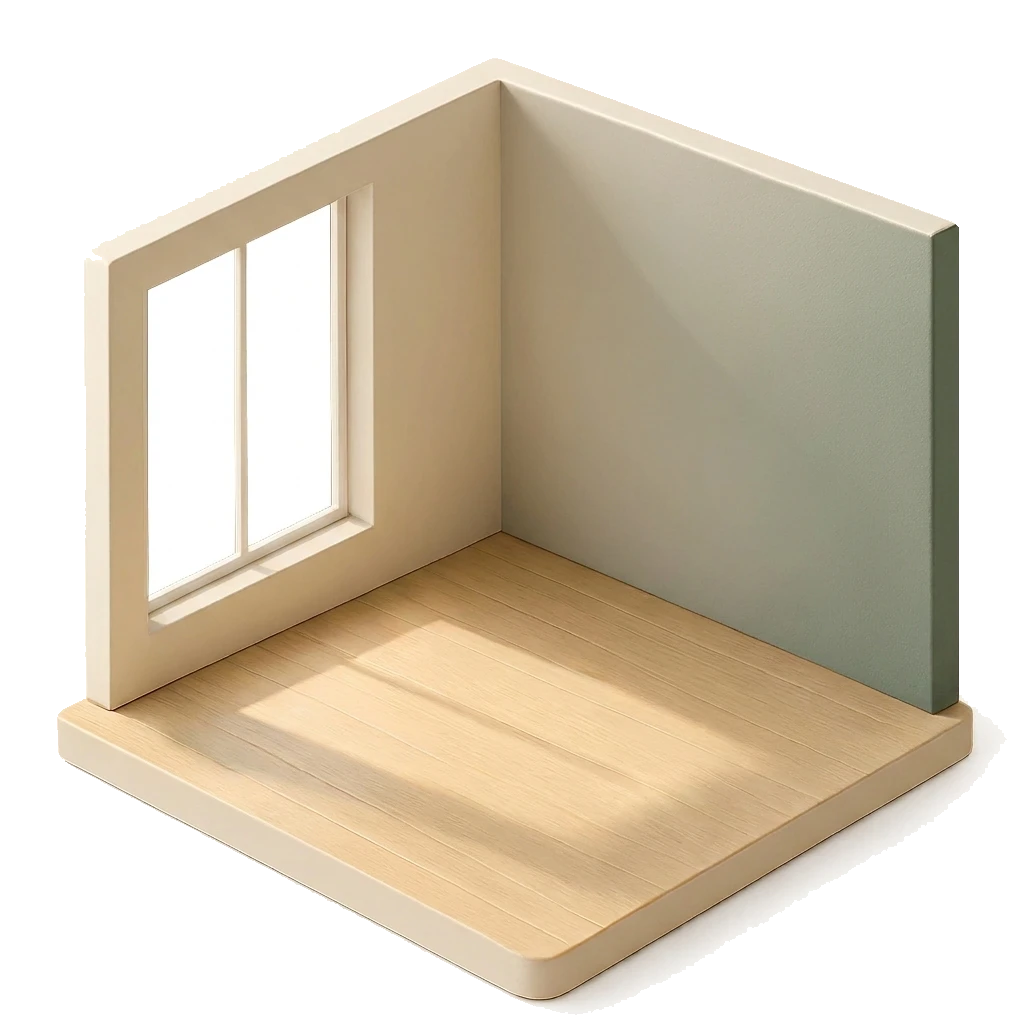
At 1 m from the window: bright light
Distance from the window
Move the plant around the room: for phalaenopsis, the recommended zone is 0,5 to 1,5 m from the glass. Light levels fall very quickly with distance.
Leaves show whether the position suits: light green means suitable light; dark green and stiff means too little; yellow-green with reddish edges means too much.2 Position matters more than expected: insufficient light is the leading cause of failure to rebloom.2
Watering an orchid bought in flower
A ten-minute soak roughly weekly during growth, slightly less in winter.3 Use the Museum's soaking method: pot in a basin with water to pot height for ten minutes, then full drainage before replacing the outer pot.8 Aerial roots turn from silver-gray to pale green when sufficiently hydrated.2
17 cL every 11 days
About every 7 days
A little less often than in summer
About every 10 days
Check pot contents at purchase. Bark dries fairly quickly; sphagnum holds water long and repels it once dry.9 In the latter case, space out soaking and judge pot weight, much lighter when dry.10
During flowering, consistency matters: a plant too dry, or with rotten roots, withdraws water from buds, which fall.11 Empty the outer pot after every soak: never leave the plant standing in water.3
Humidity and temperature: first days at home
19 to 30 °C (66 to 86 °F) by day, 16 to 19 °C (61 to 66 °F) at night, away from radiators and drafts.3 Ideal humidity is 50 to 80%; damp gravel beneath the pot, without touching water, helps heated rooms.7 Misting does not supply enough humidity indoors.2
The journey home is the riskiest moment. Moving from car to home in hot or cold weather, a draft by a window or heating vent can drop buds.11 Ethylene from ripening fruit, smoke from cigarettes or a fireplace has the same effect.11
Medium and repotting after flowering
Roughly every two years, in spring just after flowering, into orchid bark.73 Multipurpose potting mix kills moth orchids.3 Two signs cannot wait for spring: outgrowing the pot and bark resembling mulch, draining poorly and holding water.2 Brown coffee-ground-like particles washing out during soaking mean the same.10
Remove all old bark, cut brown, soft or hollow roots, shorten healthy roots to around 12 cm (4.7 in) and replant in a clear pot.3 Reuse the old one if roots fit: oversized pots hold wet bark and rot roots.3
Propagating a large hybrid: the keiki
Use a keiki, a plantlet at a spike node, detached once it has several roots.3 Each node contains cells capable of producing a leaf, root, spike or keiki; once it has produced something, it produces nothing more.12
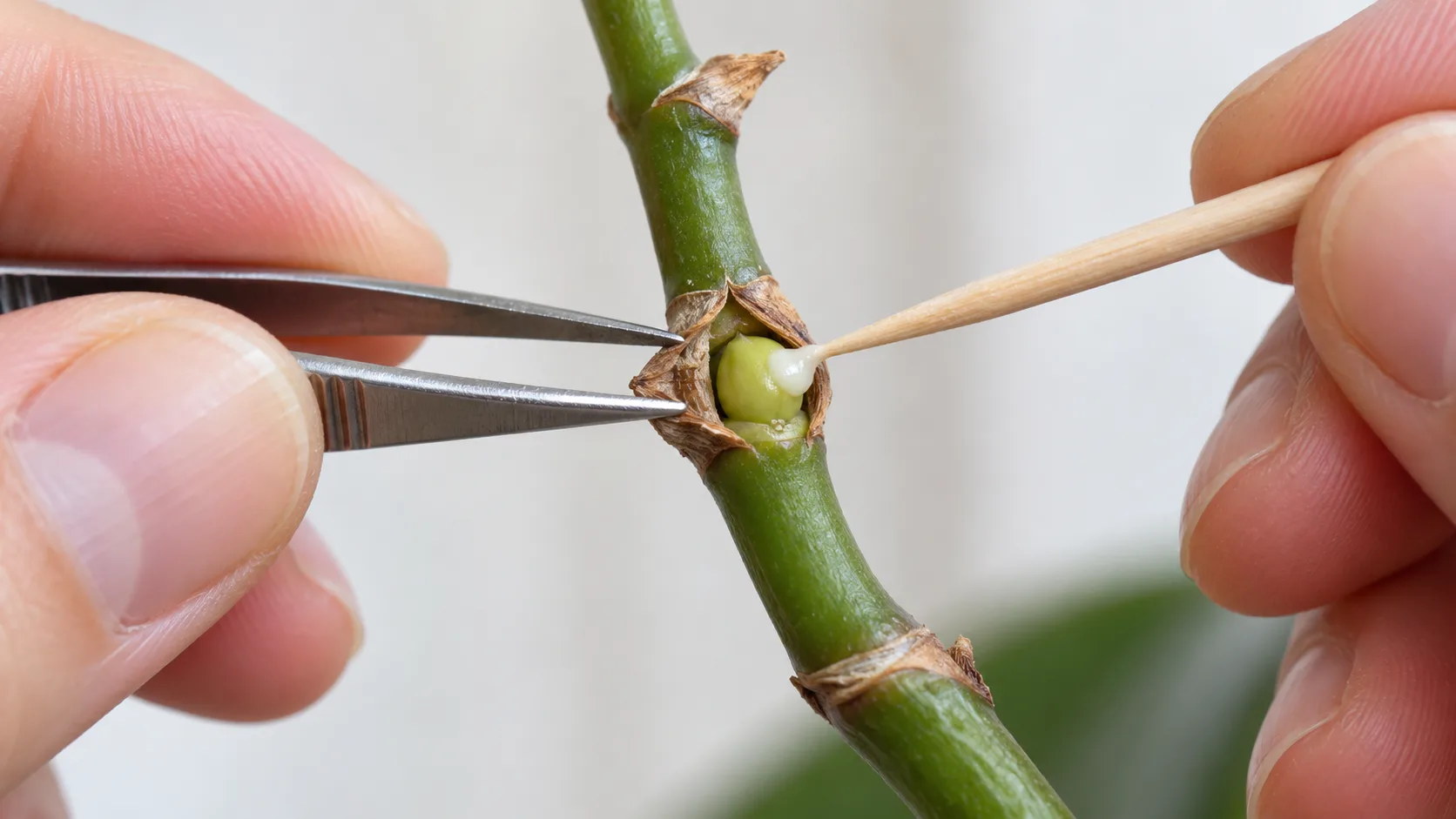
Keikis rarely appear spontaneously. Keiki paste on a node with its scale opened may induce one in six to eight weeks; ordinary rooting hormone does not work.3 Once detached, plant in a small pot, water little and mist daily at first.3
Feeding, spike pruning and reblooming
Diluted orchid feed twice monthly during growth, little or none in winter.73 RHS flushes with plain water every fourth watering to prevent salt buildup.3 Overfed plants make leaves at the expense of flowers.2
After the last flower falls, cut above the second node below spent flowers: a flowering side shoot may emerge.3 This second flowering is smaller and tires the plant; AOS often prefers cutting at the base and allowing recovery for the next flowering.12
Reblooming depends on temperature, not season. Parent species flower after days below 28 °C (82 °F) and nights 8 to 11 °C (14 to 20 °F) cooler; above 23 °C (73 °F) at night, a spike may never start.4 Growers know this: they force flowers like poinsettias, hence flowering orchids in shops year-round.4 At home, a room around 5 °C (9 °F) cooler for a month generally restarts a healthy plant.3
Large hybrid problems: diagnosis
Most issues arise at two times: arrival home and the year after first flowering. The table matches signs, likeliest causes and actions.

| Symptom | Likely cause | What to do |
|---|---|---|
| Buds yellow and fall during purchase week | Travel temperature shock, draft 11 | Stable final position away from doors and radiators |
| Buds fall near fruit bowl | Ethylene from ripe fruit 11 | Keep away from fruit and smoke |
| Small brown flower spots | Botrytis (Botrytis cinerea) 13 | Remove affected flowers, ventilate, nights above 17 °C (63 °F) |
| Healthy leaves but no spike for a year | Insufficient light or no fall day-night difference 24 | Brighter window, then a month 5 °C (9 °F) cooler |
| Spike stops growing | Days above 27 to 28 °C (81 to 82 °F) 4 | Move away from radiator and south-facing glass |
| Soft leaves, compacted bark, white mold | Decomposed medium, rotten roots 13 | Repot in fresh bark, water little during recovery |
| Poor second flowering on old spike | Plant exhausted by reblooming 12 | Cut spike at base, allow recovery |
| Gray roots outside the pot | Aerial roots, normal for an epiphyte 3 | Neither cut nor bury them |
For crown rot, scale insects, bacterial spots and other cases, the moth orchid guide gives full diagnosis.
Large hybrid care calendar
In the AOS’s seasonal growing example, spikes appear around Christmas and flowers around Valentine’s Day, if fall was cool. This cycle describes a plant spending summer outdoors and receiving fall cooling; use actual temperatures and light rather than those holiday dates.13
| Task | January | February | March | April | May | June | July | August | September | October | November | December |
|---|---|---|---|---|---|---|---|---|---|---|---|---|
| Watering | reduced | reduced | moderate | moderate | high | high | high | high | moderate | moderate | reduced | reduced |
| Growth | resting | active | active | strong | strong | strong | strong | strong | active | active | active | resting |
| Feeding | yes | yes | yes | yes | yes | yes | yes | yes | yes | no | no | yes |
| Repotting | no | no | favorable window | favorable window | favorable window | no | no | no | favorable window | no | no | no |
- Spring: once nights stay above 15 °C (59 °F), it may go outdoors in shade, sheltered from rain; repot after flowering.
- Summer: leaf and root growth, regular soaking, diluted feed; spent spike cut.
- Fall: two or three weeks of cool nights, never below 10 °C (50 °F), then return indoors.
- Winter: brightest window, slightly less soaking, reduced or suspended feed, staked spikes.
Frequently asked questions
What does “Phalaenopsis hybrid” mean on a label?
Why is my orchid losing buds just after purchase?
Usually temperature change during transport or a draft at its new position. Fruit-bowl ethylene and irregular watering also drop buds 11.
Should you repot a newly bought orchid?
How long do shop-bought orchid flowers last?
Why are orchids in flower year-round in shops?
Growers control flowering-trigger temperatures, as with poinsettias, even scheduling flower opening 4. In the sources’ seasonal home-growing example, they flower mainly in winter and spring; local light and temperatures set the timing.
Should you cut a spike above a node or at its base?
Why is my orchid not reblooming?
Can a supermarket orchid live for years?
Yes. Warm, well-lit, regularly watered and repotted every two years, it keeps growing and flowering for many years 3.
Is a large hybrid poisonous to cats?
No. ASPCA lists moth orchids as non-toxic to cats, dogs and horses 5.
Other groups differ: mini orchids need water more often, while fragrant orchids flower without a cold spell.
Other varieties

Groupe d'hybrides
Compact hybrids 15–20 cm (about 6–8 in) tall in small pots, or multiflora hybrids with very numerous medium-sized flowers on branched spikes.

Groupe d'hybrides
Lightly scented species and hybrids, descended mainly from P. violacea and P. bellina, with brightly coloured, waxy flowers.

Espèce botanique
A botanical species with large white flowers, from which most commercially sold white hybrids descend.

Espèce botanique
A Philippine species with grey-mottled foliage and long, branched spikes of pink flowers with a light rose scent.