
Care guide
Rose care
Rosa hybrida
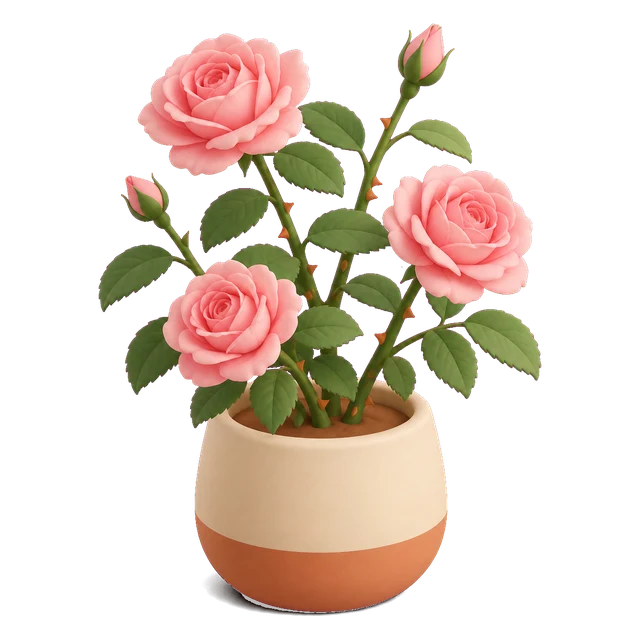
A rose needs little, but timing matters: at least 4 hours of sun, a deep watering every 10–15 days during a dry summer rather than a daily trickle, two feedings a year, and late-winter pruning. Its type, whether a bush, climber, or old garden rose, determines the rest.
How often should you water a rose?
An established rose (Rosa) in the ground needs a deep watering every 10–15 days during prolonged heat and drought, using 20–30 liters per square meter (0.49–0.74 US gal/sq ft). The Société Française des Roses (SFR) notes that its roots reach deep into the soil, down to 1 meter (3.3 ft), making it fairly drought tolerant. 1 2
10 L every 30 days
20 to 30 L per m² every 10 to 15 days
5 to 10 L per plant Weekly maximum: one
Every day
The Royal Horticultural Society (RHS) gives a per-plant amount: 5–10 liters (1.3–2.6 US gal), or a large watering can, no more than once a week at the height of a dry summer. It explains the interval: deep, infrequent watering encourages roots downward, while a daily trickle keeps them near the surface. 3
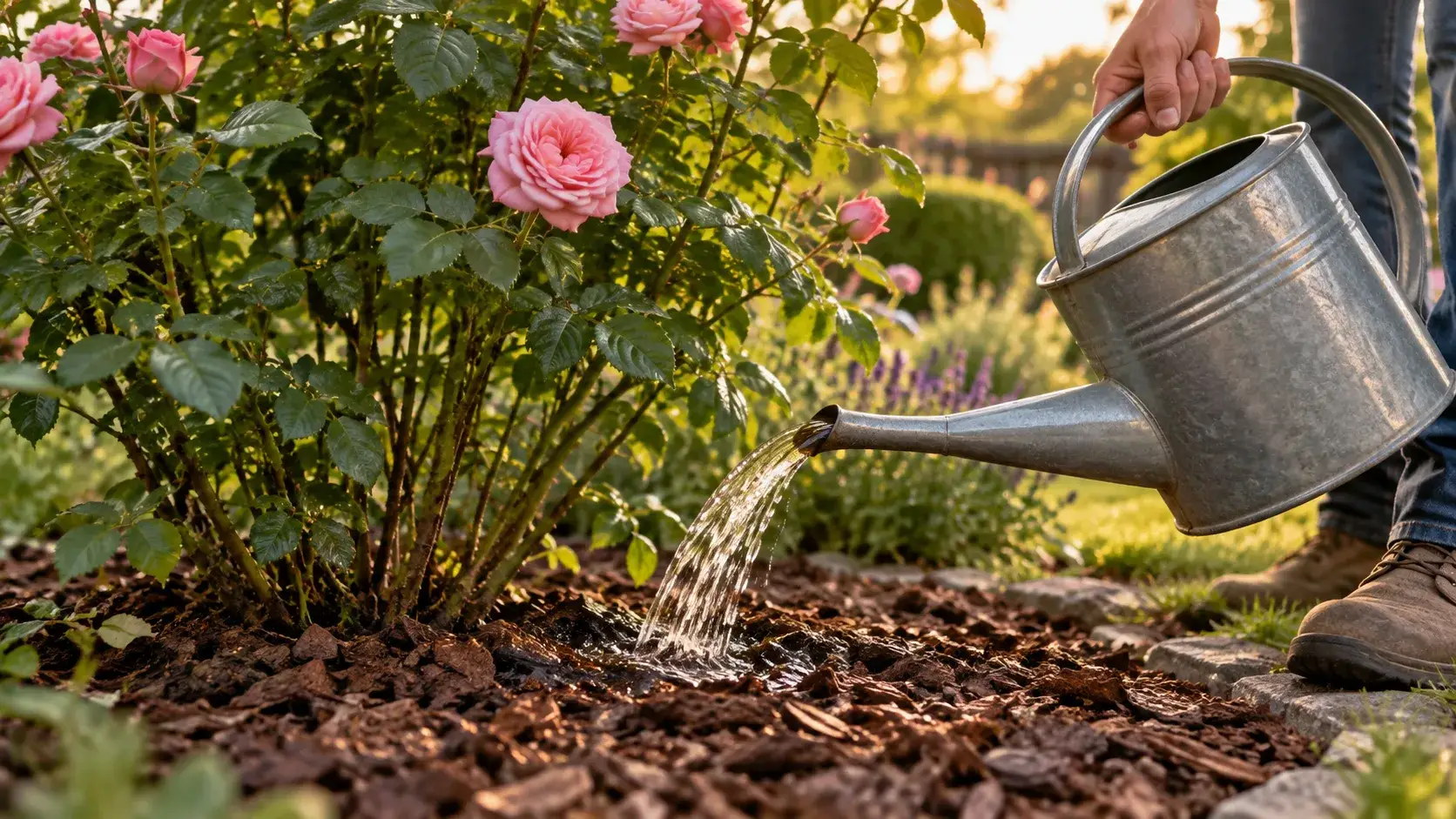
Water at the base, never over the leaves: wet foliage encourages fungal diseases. 1 In a pot, the situation changes: a patio rose may need water every day in hot weather. 3
Quantité, heure, goutte-à-goutte : watering roses se règle sur le sol et la saison.
Where should you plant a rose?
Choose full sun, at least 4 hours a day, with airflow but no strong exposure to wind, more than 6 meters (20 ft) from trees. The RHS sets the minimum sunlight and advises against very exposed sites; the SFR recommends staying outside both tree shade and the area occupied by tree roots. 3 2
4 h of direct sun per day: minimum reached
Sources: Royal Horticultural Society; NC State Extension Gardener Plant Toolbox
Garden exposure
Choose the side of the house where rosa hybrida will grow, then count the hours of direct sun on a clear day.
| Location | Suitability for roses |
|---|---|
| Due south or west, with sun for most of the day in the source setting | Ideal: roses enjoy sun 4 |
| East-facing, with 4–5 hours of sun in the source setting | Suitable: meets the RHS minimum 3 |
| North-facing wall in the source setting | Only for a few tolerant climbers, such as 'New Dawn' 5 |
| Under a tree or among its roots | Avoid: shade and competition for water 2 |
| Corner with no airflow | Watch carefully: powdery mildew thrives here 6 |
| Beside a swimming pool | Avoid: petals in the water and prickly stems 2 |
Rose stems bear prickles, rather than true thorns, and their density varies widely between roses. 7
Prepare fertile, well-drained soil at least 60 cm (24 in) deep: ordinary soil that is slightly clayey or sandy is sufficient. 2 Roses prefer slightly acidic to neutral soil 7, with a pH of 6–7.
Soleil du matin ou du soir, mi-ombre, mur nord : light for roses se choisit selon la variété.
When and how should you plant a rose in a pot or in the garden?
Plant from November to early April in the SFR's French calendar, when the soil is neither frozen nor waterlogged: preferably fall for bare-root roses, spring for container-grown roses. 2 Time your own planting by local dormancy and soil conditions. A container-grown rose can be planted year-round, avoiding frost and drought. 3
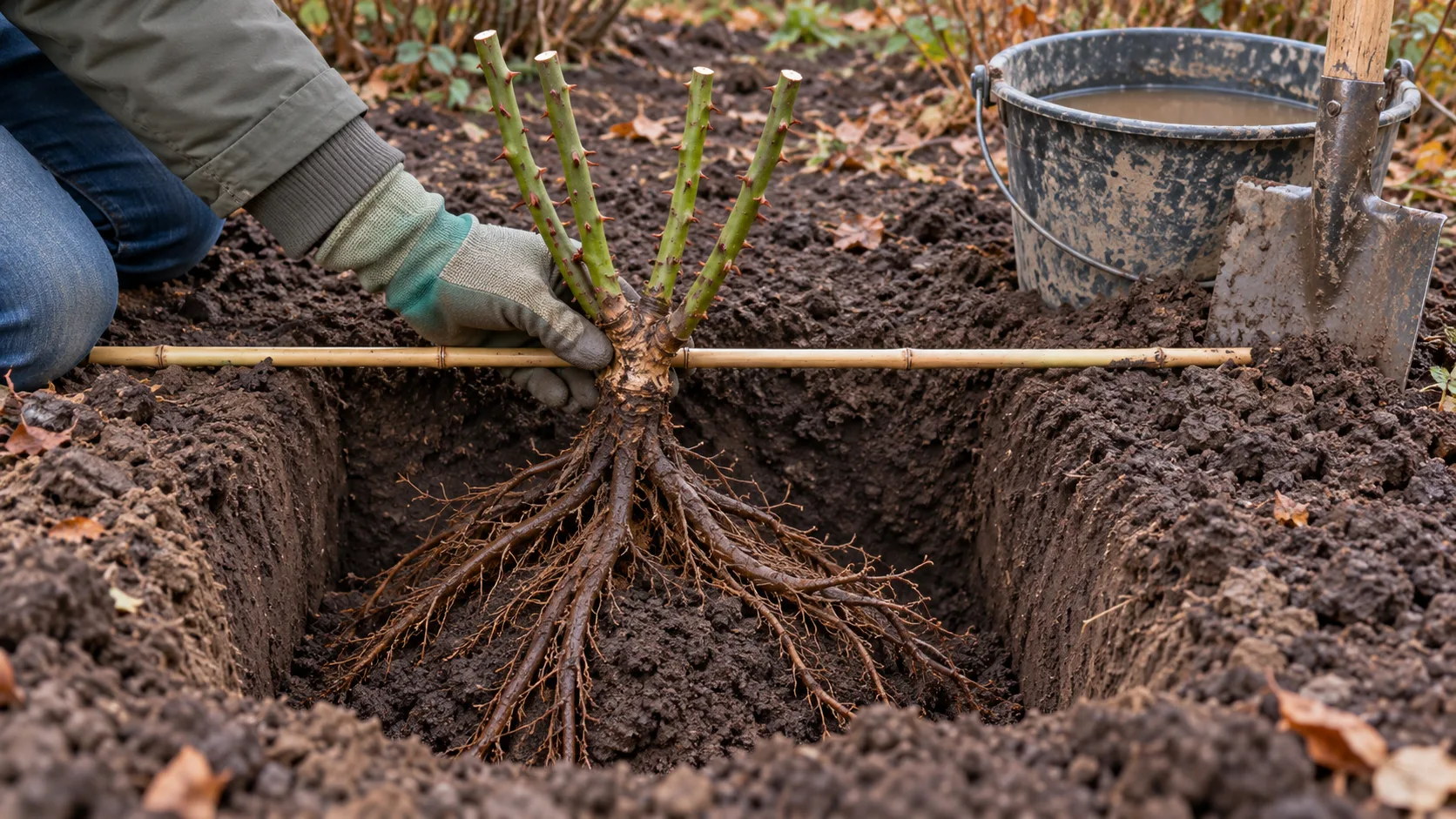
At least two weeks ahead, loosen the soil to 60 cm (24 in) deep, about two spade depths, removing dead tree roots: they can harbor root rot. 2 On planting day:
- Trim the plant: shorten stems to about 30 cm (12 in), except on climbers, and trim overly long or damaged roots. 2
- Dip the roots: immerse the roots and crown in a slurry of soil and water to help establishment. 2
- Dig a hole 30–40 cm (12–16 in) in every direction. 2
- Set the crown 3 cm (1.2 in) below soil level, spreading the roots without letting them touch manure or fertilizer granules. 2
- Backfill and firm with your heel, then water with 2–3 liters (2.1–3.2 US qt): this settles soil against the roots rather than simply moistening it. 2
- If planting before late February in the SFR's French calendar, mound soil around the base against hard frosts until growth starts. Locally, use the risk of hard frost and the start of growth to time this protection. 2
The SFR's spacings are 40–50 cm (16–20 in) between bush roses in a bed, 1.50 m (4.9 ft) between shrub roses, and 3–6 m (10–20 ft) between climbers. 2 November is the main bare-root planting month in that French calendar, as discussed in what to plant in November.
Replacing an old rose brings a risk: a rose planted where another rose grew often struggles. This is replant disease. The SFR considers the site unsuitable for 7–8 years and advises replacing soil to 50 cm (20 in) deep; the RHS recommends a hole 60 cm wide and 30 cm deep (24 × 12 in) filled with soil from elsewhere. 1 8
In pots, depth matters more than width: 23–35 cm (9–14 in) for a miniature or patio rose, at least 30–45 cm (12–18 in) for a groundcover or small climber, using a peat-free, loam-based potting mix. 4
Choix du rosier, terreau, arrosage d'été et hiver : roses in pots demande un contenant profond et un suivi plus serré.
Quand les racines sortent par les trous du pot : repotting roses se fait au repos, dans un pot à peine plus grand.
What fertilizer do roses need, and when?
Two feedings a year are enough in the garden: before flowering, in March–April in the source calendar, then in midsummer after the first flush, using 70 g of rose fertilizer per square meter (2.1 oz/sq yd). Follow your local growth and flowering stages for timing. The RHS emphasizes the second feeding for repeat-flowering varieties. 3 The SFR schedules it for late June or early July in France, using the same NPK fertilizer as in late winter. 1
- Feeding
- March and AprilFirst application · before flowering · in the groundSource: Royal Horticultural Society
- Feeding
- June and JulySecond application · late June or early July in the source’s temperate Northern Hemisphere calendar · in the groundSource: Société Française des Roses
- Feeding
- During active growthLiquid fertiliser · from mid-spring to late summer · in a potSource: Royal Horticultural Society
- No fertilizer
- In autumnfrom late August in the source’s temperate Northern Hemisphere calendar, to avoid soft new growth · in a potSource: Royal Horticultural Society
- Frequency
- Two applications a yearin the groundSource: Royal Horticultural Society
- Frequency
- Every 15 daysin a potSource: Royal Horticultural Society
- Avoid
- Excess nitrogen, applying fertilizer to a dry root ball, exceeding the dose on the labelSources: Royal Horticultural Society; Washington State University
In pots, apply liquid fertilizer every fifteen days from midspring to late summer, following local active growth. 3 A rose with very green leaves but few flowers has often received too much nitrogen. 9
Organique, minéral, spécial rosiers : feeding roses se choisit selon le sol et l'âge du pied.
When and how should you prune a rose?
Do the main pruning in late winter, as hard frosts end: late February to early March in the SFR's French regional examples. Prune once-flowering roses just after flowering, in July in that calendar. 1 A repeat-flowering rose blooms again on the season's shoots, from June to October in the source setting: late-winter pruning does not sacrifice its flowers. 10 7
- Vigorous bush rose: keep the 5 or 6 best stems, cut to 35–40 cm (14–16 in) above ground; use 15–20 cm (6–8 in) for a less vigorous plant. 1
- Repeat-flowering climber: tie young shoots to their support and shorten flowered side shoots to 4 or 5 cm (1.6 or 2 in) from the main stem; on an old plant, replace 1 or 2 of the oldest main stems with young shoots. 1
- The cut: make a sloping cut no more than 5 mm (0.2 in) above an outward-facing bud to open up the center. 11
- Faded flowers: remove them weekly during the flowering season, taking a few centimeters (roughly an inch or two) of stem and cutting just above the first complete leaf. 1
- In November–December in the SFR's French calendar, a cleanup prune removes one-third of the stem length and diseased leaves. Time this light cleanup by your local fall conditions. 1
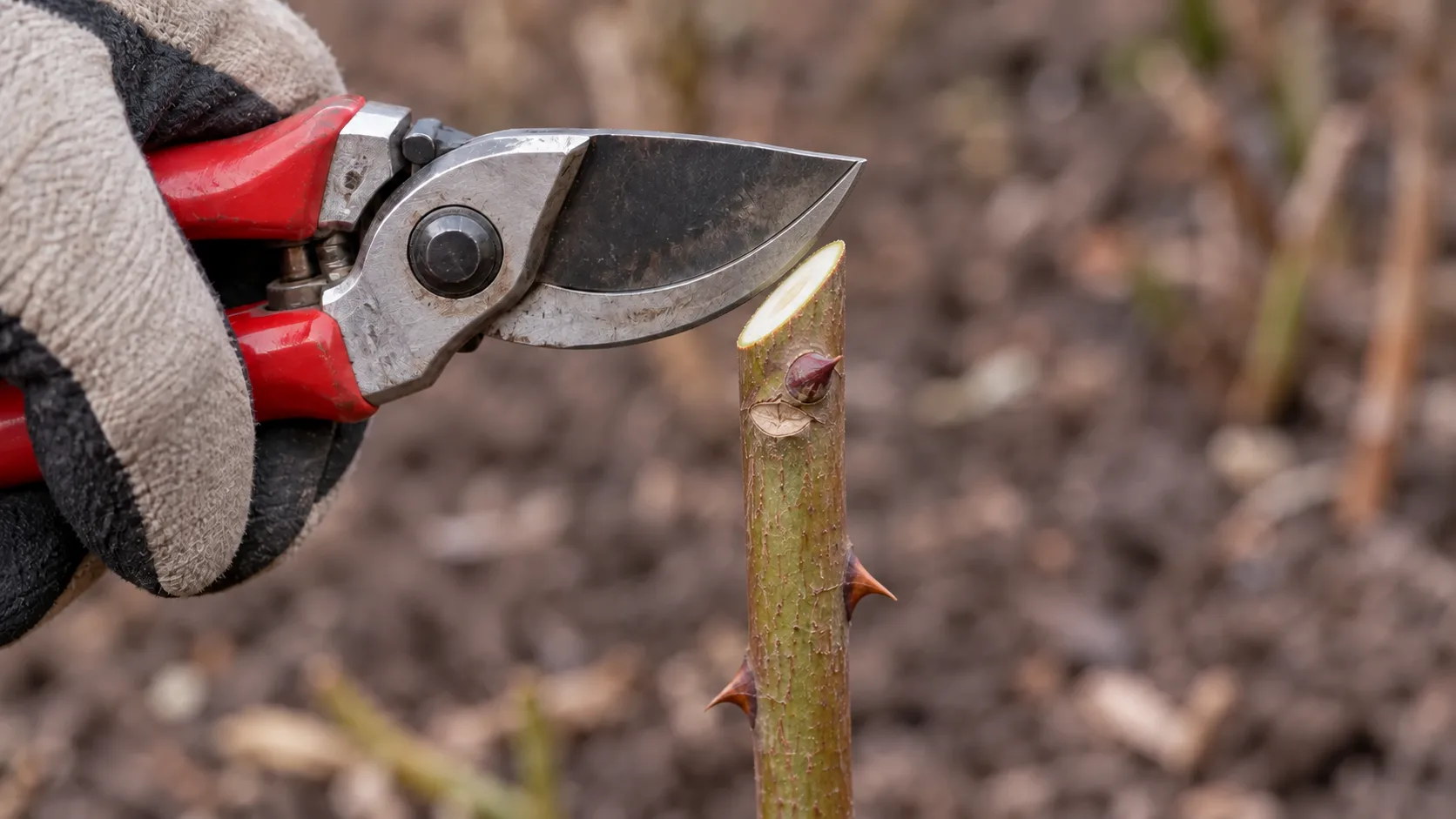
Keep this fall pruning light. Hard fall pruning wakes buds during the first mild spell, then frost destroys them, leaving the rose without those buds for spring regrowth. 1
Buisson, grimpant, liane ou rosier ancien : pruning roses se fait à une date et une hauteur propres à chaque type.
How much cold can a rose tolerate?
Most garden roses tolerate −15 to −20 °C (5 to −4 °F): the RHS rates 'Peace', 'Iceberg', and 'Gertrude Jekyll' H6, and the climber 'New Dawn' H7, below −20 °C (−4 °F). Tea roses and China roses, from milder regions, reach their limits much sooner. 12 13 5
Temperatures for rosa hybrida
In °C, thresholds given by the sources.
- 'Peace' (H6)-20 °C
- 'Mutabilis', China rose (H5)-15 °C
- Earthing up recommended (SFR)-15 °C
- Tea rose (H4)-10 °C
- Ideal: 15 to 25 °C
- Tolerated: -20 to 35 °C
- Potted rose: an unheated room: -1 to 7 °C
- Bring indoors
- Novemberpot sunk into the garden soil or stored somewhere frost-free · in a potSource: Iowa State University Extension
- Move back outside
- Marchmid-March in the source’s temperate Northern Hemisphere calendar, before bud break · in a potSource: Iowa State University Extension
The RHS hardiness rating gives a minimum-temperature range, rather than a single cutoff. The chart uses the bottom of each range.
| Variety | Type | RHS rating | Minimum temperature |
|---|---|---|---|
| 'New Dawn' | Repeat-flowering climber | H7 | Below −20 °C (−4 °F) 5 |
| 'Peace' ('Madame A. Meilland') | Large-flowered bush rose | H6 | −20 to −15 °C (−4 to 5 °F) 12 |
| 'Iceberg' ('Korbin') | Cluster-flowered bush rose | H6 | −20 to −15 °C (−4 to 5 °F) 13 |
| 'Gertrude Jekyll' | English shrub rose | H6 | −20 to −15 °C (−4 to 5 °F) 14 |
| 'The Fairy' | Polyantha, groundcover rose | H6 | −20 to −15 °C (−4 to 5 °F) 15 |
| Rosa rugosa 'Hansa' | Rugosa rose | H6 | −20 to −15 °C (−4 to 5 °F) 16 |
| 'Mutabilis' | China rose | H5 | −15 to −10 °C (5 to 14 °F) 17 |
| Tea rose (Rosa × odorata) | Species rose | H4 | −10 to −5 °C (14 to 23 °F) 18 |
For a variety missing from the table, such as Knock Out or 'Pierre de Ronsard', use the hardiness stated on its label. Hybrid teas and floribundas are more vulnerable to cold than shrub, species, and old garden roses, which Iowa State University considers hardy without protection in its guidance. 19
The SFR gives this benchmark for continental or mountain conditions where winter temperatures commonly fall below −15 °C (5 °F): mound soil around bush roses from mid-November, covering the bases of the stems, and remove it in March in its French calendar. Use local hard-frost timing for your own protection. 1 Iowa State University recommends a mound 25–30 cm (10–12 in) high. 19 To help wood harden, stop deadheading in late summer. 7 A potted rose, whose roots have only the pot wall for protection, spends severe cold in an unheated space kept between −1 and 7 °C (30–45 °F). 19
How large does a mature rose grow?
From 30 cm (12 in) tall for a miniature to 3 m (10 ft) for a large climber, with a spread of 30 cm to 2 m (12 in to 6.6 ft): size depends much more on type than on the botanical name. An established framework takes 2–3 years to develop.
- Mature height
- 0,3 to 3 m
- Spread
- 0,3 to 2 m
- Growth
- Moderate to fast, depending on the cultivar
RHS profiles give variety-specific benchmarks: 'Peace' reaches about 1.2 m (4 ft) 12, 'Gertrude Jekyll' 1.2 m (4 ft) as a shrub and 2.4 m (8 ft) when trained 14, and 'New Dawn' about 3 m (10 ft) 5. At the other extreme, some ramblers climb into tree branches. 3 A shrub rose planted as a hedge eventually spreads 1–2 m (3.3–6.6 ft) wide, even when pruned twice a year. 2
Longevity follows: in suitable soil, a rose lives at least around fifteen years, sometimes 30 or 50 years. 2 To keep a plant compact, choose a low-growing type when buying rather than cutting a climber back every year: pruning controls shape, not its natural size.
When do roses bloom?
Roses start flowering in May–June in the source calendar; repeat-flowering varieties bloom in waves until the first frosts, while others flower only once. Follow local growth and temperature rather than those months. The RHS places the main flowering period in summer, with many roses continuing into fall. 3 'Gertrude Jekyll', for example, flowers almost continuously from early summer to the first fall frosts. 14
- Flowering
- In summerMain flowering periodSource: Royal Horticultural Society
- Repeat flowering
- June to OctoberRepeat-flowering rosesSource: Société Nationale d'Horticulture de France
| Conditions | January | February | March | April | May | June | July | August | September | October | November | December |
|---|---|---|---|---|---|---|---|---|---|---|---|---|
| Repeat-flowering roses | no flowers | no flowers | no flowers | no flowers | no flowers | Repeat flowering | Repeat flowering | Repeat flowering | Repeat flowering | Repeat flowering | no flowers | no flowers |

Deadheading once a week extends the season. Without it, many roses form rose hips and stop flowering. 3
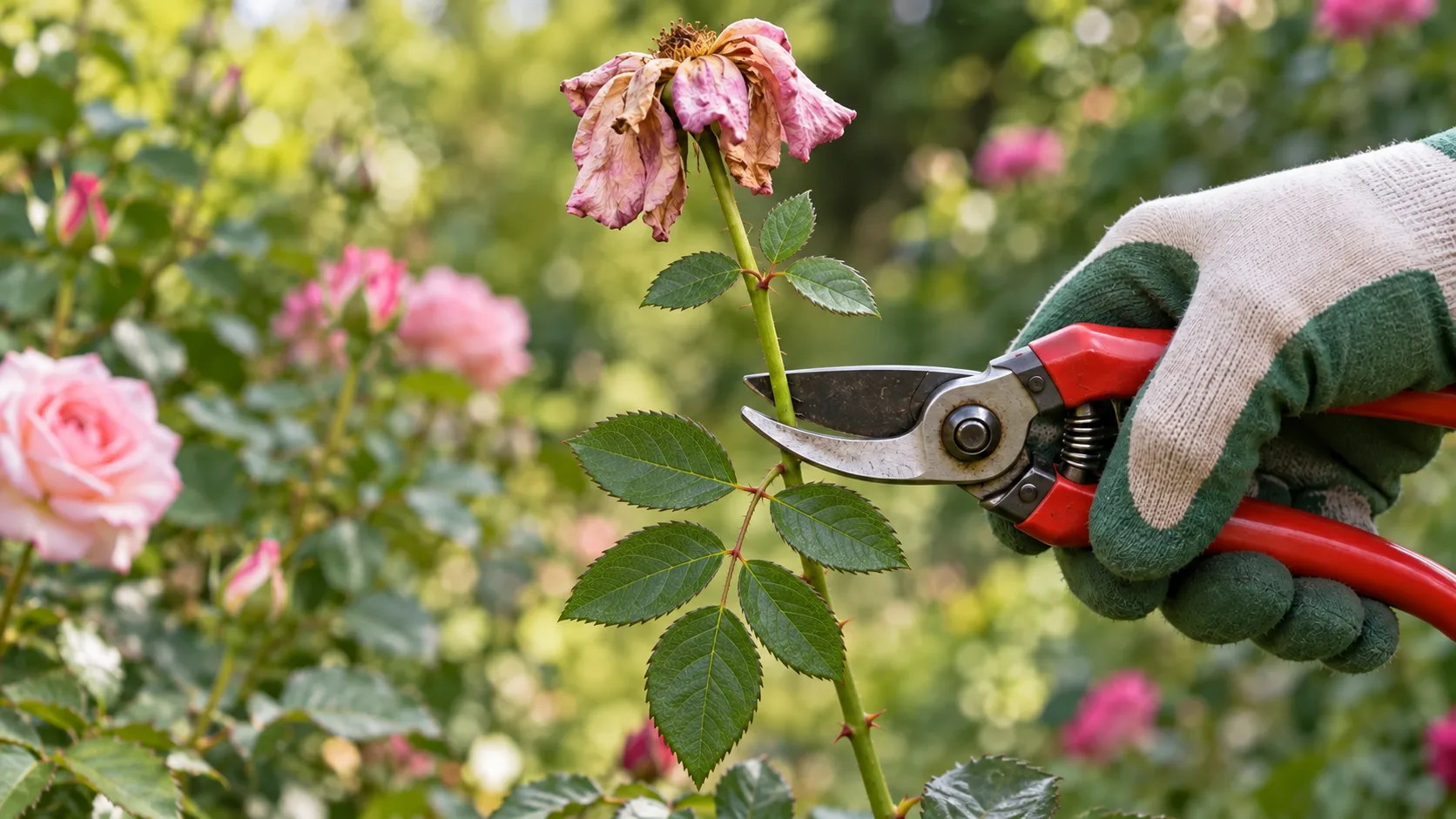
For varieties with attractive hips, stop in midsummer: thrushes and blackbirds feed on them in winter in the source's garden setting. 3
Why isn't my rose flowering? Causes, from most to least common:
- Less than 4 hours of sun, the RHS minimum. 3
- Pruning at the wrong time: pruning a once-flowering rose in March in the source calendar removes that year's buds, carried on last year's wood. Time pruning by your rose's flowering cycle locally. 10 7
- Too much nitrogen: fertilizer encourages leaves at the expense of flowers. 9
- Rootstock suckers left in place, diverting sap from the grafted variety. 1
A month-by-month rose care calendar
The French source calendar divides the rose's year into four phases: rest in December–January, pruning and the first feeding in February–March, checking water needs and deadheading from May to September, and bare-root planting in fall. Feeding runs from March to July; potted roses are repotted from February to April, then in October–November, and garden planting runs from November to early April. These are source-climate examples: time actual care by local dormancy, frost, temperature, light, and active growth.
| Task | January | February | March | April | May | June | July | August | September | October | November | December |
|---|---|---|---|---|---|---|---|---|---|---|---|---|
| Watering | reduced | reduced | reduced | moderate | moderate | high | high | high | moderate | moderate | reduced | reduced |
| Growth | resting | resting | active | active | strong | strong | strong | strong | active | active | resting | resting |
| Feeding | no | no | yes | yes | yes | yes | yes | no | no | no | no | no |
| Repotting | no | favorable window | favorable window | favorable window | no | no | no | no | no | favorable window | favorable window | no |
How do you propagate a rose?
A softwood cutting taken in spring from a current-year shoot roots in about two months; a hardwood cutting taken from midfall to late winter is slower but needs almost no care. Follow those local growth stages. Allow two to three years before the first flowers from a spring cutting. 3
- Softwood cutting
- April to Junerepot before midsummerSource: Royal Horticultural Society
- Semi-ripe cutting
- July to SeptemberSource: Royal Horticultural Society
- Hardwood cutting
- In winterfrom mid-autumn to late winterSource: Royal Horticultural Society
- Layering
- In springClimbers with flexible stems · or in autumn; roots within 12 monthsSource: Royal Horticultural Society
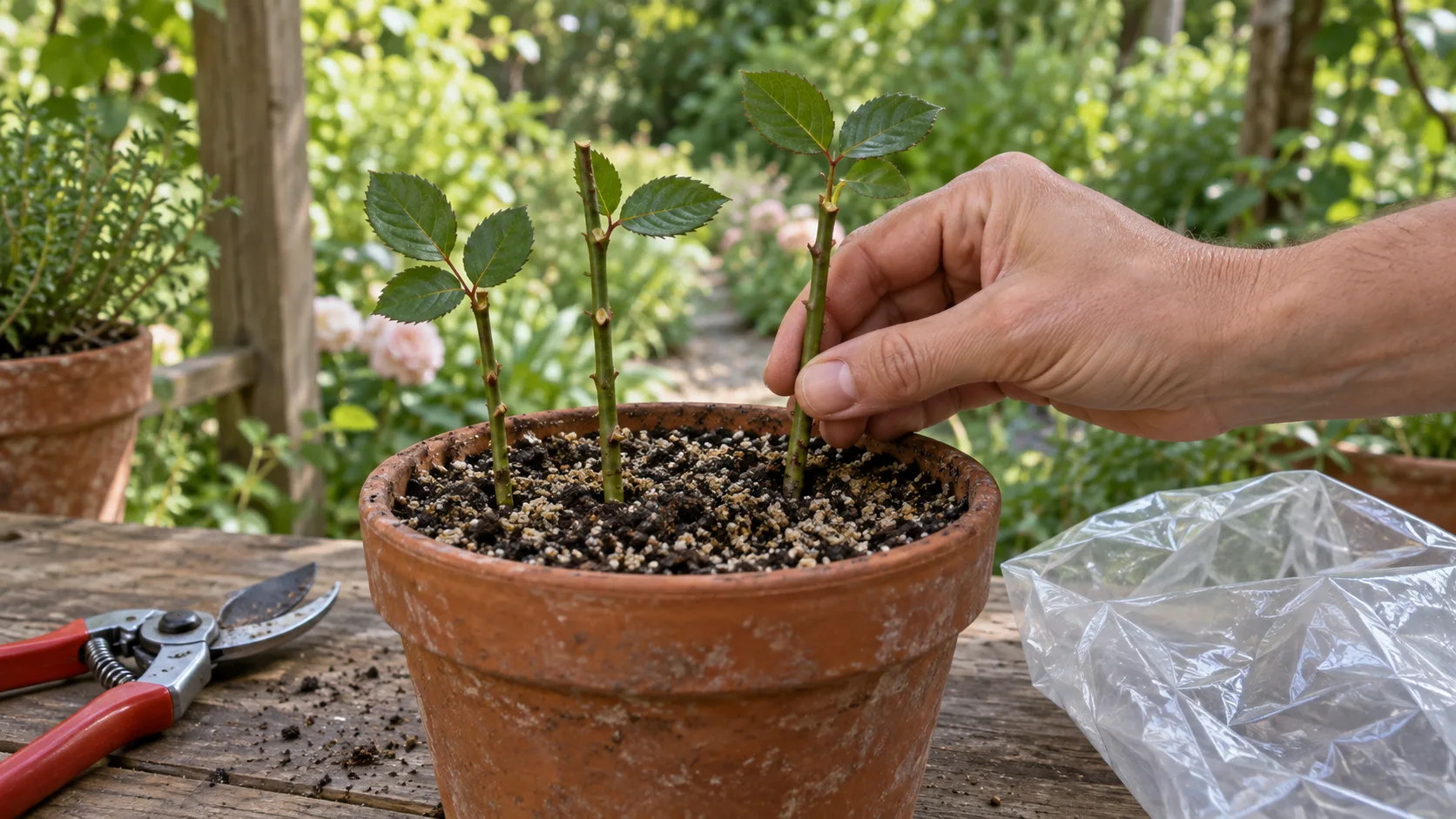
A cutting produces an own-root rose. Most commercially sold roses, however, are grafted onto a selection of dog rose (Rosa canina), a rootstock the SFR considers a safeguard for longevity and adaptation to all soils. 2 Your cutting therefore will not always behave like its parent plant. Another limit in the source guidance: some varieties are protected by plant breeders' rights that prohibit propagating them for sale. 3
Date de prélèvement, longueur, substrat : growing roses from cuttings réussit surtout quand on choisit le bon mois.
Common problems: diagnosis
Three fungi and a few insects account for most rose problems. Start with what you see in the table.
| Symptom | Most likely cause | Action |
|---|---|---|
| Black or purplish spots with radiating edges; leaves yellow and fall | Black spot (Diplocarpon rosae) | Collect fallen leaves in fall; cut out stem lesions in spring, following local seasons 20 |
| White powdery coating; buds fail to open | Powdery mildew (Podosphaera pannosa) | Improve airflow around the plant and water the soil in dry weather 6 |
| Orange pustules under leaves, turning black in late summer | Rust (Phragmidium tuberculatum) | Remove affected growth from spring onward; collect fallen leaves in fall, following local seasons 21 |
| Green or pink colonies on buds; sticky leaves | Aphids (Macrosiphum rosae) | Tolerate small colonies, crush clusters between your fingers, and let lady beetles and hoverflies feed 22 |
| Leaflets rolled into tubes from April to June in the UK source calendar | Rose leaf-rolling sawfly (Blennocampa phyllocolpa) | Tolerate it: the rose recovers; monitor from late April to early June in that source setting, adjusting to local growth 23 |
| Vigorous shoot from the base, with smaller leaves | Rootstock sucker | Wearing gloves, pull it off at its point of origin 1 |
| Weak young rose with rotting fine roots | Replant disease | Move it elsewhere or replace the soil 8 |
| Stem tips turn brown and dry out | Dieback | Remove dead wood as soon as it appears, cutting cleanly above a bud 24 |
The RHS considers black spot the most serious rose disease: a badly affected plant loses almost all its leaves, and the advertised resistance of new varieties rarely lasts more than a few years. 20 Rust, by contrast, is the least serious of the three. 21


Cycle, période à risque et prévention, maladie par maladie : rose diseases se préviennent surtout avant le printemps.
Quand le feuillage jaunit sans tache : yellow leaves on roses ont d'autres causes que les champignons.
A spotted or yellowing leaf? Photograph it: Floralens identifies the problem and the action to take.
| What you see | Likely cause | What to do |
|---|---|---|
| Soil stays soggy, suffocating roots and causing rot. | OverwateringExternal Factors | Treating Waterlogged Soil |
| The soil is dry and leaves are soft and drooping. | UnderwateringExternal Factors | Rescue by Soaking |
| Tiny arachnids that spin fine webs under leaves. | Spider MitesPests | Eliminate Spider Mites |
| Small pear-shaped insects, often clustered on new growth. | AphidsPests | Eliminate Aphids |
| Small jumping insects that leave fine white stippling on leaves. | LeafhoppersPests | Leafhopper Action Plan |
| A white, powdery coating covering leaves and stems. | Powdery MildewDiseases | Eliminating Powdery Mildew |
| A soft gray rot covering flowers and fruit. | Gray Mold (Botrytis)Diseases | Treating Botrytis (Gray Mold) |
| False caterpillars that eat scallop shapes into leaf edges. | Sawfly LarvaePests | Eliminate Sawfly Larvae |
Are roses toxic?
No: the ASPCA lists roses as nontoxic to dogs, cats, and horses. 25 Other hazards remain: injurious prickles and treatment residues on leaves. If a treatment product is swallowed, contact a poison control center or your veterinarian. See rose toxicity and uses of rose hips for details.

Which type of rose should you choose?
Choose the type before the variety: a bush rose for a bed, a shrub or groundcover rose for less maintenance, a climber for a wall. Each type has its own spacing, pruning, and use. 2
Peace
Stable cultivar
A famous hybrid tea rose with pale yellow and pink flowers, according to RHS descriptions.
Iceberg
Stable cultivar
A widely grown white rose, listed in horticultural references.
Knock Out
Horticultural name
A commercial group of shrub roses reputed to have good resistance.
The Fairy
Stable cultivar
A low-growing rose with small, double pink flowers, often used as ground cover.
New Dawn
Stable cultivar
A pale pink climbing rose, cited for its resistance in horticultural lists.
Pierre de Ronsard
Horticultural name
A very well-known trade name; check the exact cultivar name on the label.
2 more varieties documented in the botanical profile.
| Type | Habit and flowers | Spacing | Use |
|---|---|---|---|
| Large-flowered bush rose | Upright, with large flowers singly or in threes | 40–50 cm (16–20 in) | Beds, cut flowers |
| Cluster-flowered bush rose | Rounded, with flowers in clusters | 40–50 cm (16–20 in) | Single-variety beds |
| Shrub rose | Broad, often repeat-flowering | 1.50 m (4.9 ft) | Specimen in a lawn, flowering hedge |
| Climber | Long stems needing training | 3–6 m (10–20 ft) | Walls, pergolas, trellises |
| Groundcover | Trailing or spreading | Depends on variety | Slopes, reduced maintenance |
| Miniature | Small, needs little soil | Depends on variety | Pots, balconies, rock gardens |
The SFR recommends one variety per bed, or groups of 3 or 5 plants per variety in a small garden. 2 For plant health, 'New Dawn' is noted for good disease resistance 7; compare cold tolerance in the RHS rating table above. At purchase, look for at least three strong stems with smooth, unwrinkled bark. 2
Frequently asked questions
Should you put coffee grounds around roses?
Only in small amounts. Oregon State University notes that used grounds contain only 1–2% nitrogen and do not acidify soil: their pH is around 6.5–6.8. Spread alone on the surface, they dry out and repel water; cover them with leaves or bark. Mixed into compost, they should make up no more than 20% by volume 26. See using coffee grounds in the garden for more.
When should you deadhead roses?
What is the best natural fertilizer for roses?
Compost and well-rotted manure. The SFR applies compost with rose fertilizer in late winter, just after pruning 1; the RHS mulches with well-rotted manure, leaving 10 cm (4 in) clear around the stems 3. Go lightly with poultry manure: too much nitrogen encourages leaves at the expense of flowers 9. Coffee grounds contain only 1–2% nitrogen 26.
Can you plant a rose where another rose grew?
Take precautions: replant disease can leave the new plant struggling. Replace soil to 50 cm (20 in) deep, or choose a site where no rose has grown for at least 7 years 1. In a lawn, shifting the bed a few meters (several feet) is often enough.
Can a potted rose stay outside over winter?
Not in a cold region: potting mix on a patio freezes much harder than soil in the ground, and the roots may die. Bury the pot in a sheltered spot in late November in the cited Iowa calendar, or move it into an unheated garage or shed kept between −1 and 7 °C (30–45 °F); bring it back out in mid-March in that source setting 19. Locally, time these moves by severe cold and the return of suitable growing conditions.
Can you keep a miniature rose indoors?
In winter, yes: bring a potted miniature rose in before hard frosts and keep it as a houseplant. Place it at a sunny window or under a grow light, away from cold drafts and radiators. Water when the mix feels dry at the surface and apply diluted fertilizer every 2–4 weeks 19. The rest of the year, it belongs outdoors with at least 4 hours of sun 3.
How do you grow healthy roses?
Four measures cover the essentials: a site with at least 4 hours of sun 3, deep watering at the base rather than frequent watering, fertilizer in late winter and again after the first flush of flowers 1, and pruning suited to your rose's type. Collecting diseased leaves in fall prevents much of the following year's black spot 20.