
Where to plant a rose bush: sunlight and partial shade
How much sun does a rose need?
A rose starts flowering with 4 hours of direct sun daily and performs best with more than 6. In the sources' Northern Hemisphere setting, an open south- or west-facing site, or an east-facing one if necessary, suits it, away from trees and strong winds. Only some climbers and shrubs perform well in partial shade or against a north wall. Elsewhere, judge the actual light and temperature rather than compass direction alone.
How many hours of sun does a rose need?
Four hours of direct sun daily is the minimum; six hours or more produces the most generous flowering. The Royal Horticultural Society (RHS) gives the lower threshold: a sunny spot with at least four hours of sun each day 1. US extension services set a higher target: 6 hours or more for NC State 2, at least six hours for best flowering according to the University of Florida 3.
4 h of direct sun per day: minimum reached
Sources: Royal Horticultural Society; NC State Extension Gardener Plant Toolbox
Garden exposure
Choose the side of the house where rosa hybrida will grow, then count the hours of direct sun on a clear day.
These benchmarks do not conflict. One describes where a rose will flower; the other, where it flowers freely. Our encyclopedia's rose profile uses the same lower threshold: full sun, at least 4 hours.
Count the right light. Only direct sun counts. Measure the hours on a clear late-spring day, when trees are in leaf: a sunny spot in March can be shaded by foliage in May in the source's Northern Hemisphere calendar, just as the rose prepares buds. Use the equivalent local stage of leaf growth elsewhere.
Which garden orientation should you choose?
In the sources' Northern Hemisphere setting, open south- or west-facing sites give the longest flowering; east works with 4 hours of sun, while north suits only a few varieties. Actual sunlight hours remain the guide in other settings. The Société française des roses (SFR) sums up the need as a sunny, airy position 4.
| Orientation | Sun received | Assessment for roses |
|---|---|---|
| Open, due south | Longest daily exposure, 6 hours or more | Ideal: longest flowering 2; near a wall, watch for dry soil 5 |
| Open west or southwest | Afternoon and evening sun, 6 hours or more | Also ideal for the same reason 2 |
| East or southeast | Morning sun, afternoon shade | Suitable if it receives at least 4 hours 1; leaves dry early |
| North | Little or no direct sun | Only the tolerant climbers and shrubs listed by the RHS 6 |
Morning sun has a disease-prevention advantage. Clemson University Extension recommends full sun to dry foliage quickly and advises against late-afternoon watering 7. A rose lit from sunrise dries overnight dew and rain earlier in the day, making an eastern exposure acceptable despite fewer sun hours. The SFR also recommends watering at the base without wetting foliage to avoid encouraging fungal disease 8.
A sunny south-facing site has a limit in this source setting: heat. Our profile places ideal rose growth between 15 and 25 °C (59 and 77 °F), with tolerance up to 35 °C (95 °F). Against a sun-facing wall, stone adds heat and soil dries quickly. For other plants by orientation, see plants for different exposures.
Roses for shade or partial shade: tolerant varieties
No rose flowers in total shade; around thirty varieties still perform well in partial shade. The RHS is clear: roses like sun, and a few tolerate light shade 1. Its lists include 35: 15 climbers and ramblers for a north-facing or shaded wall, 5 English shrub roses that can flower against a north wall, and 15 shrubs for partial shade 6. The north-wall examples refer to the RHS's UK setting.
Partial shade is different from full shade: an open north wall receiving early-morning or late-evening summer sun in the source climate can work. Woodland shade or the base of a dense hedge cannot.
| Variety | Type | Flowering | Height |
|---|---|---|---|
| 'New Dawn' | Climber | Repeat-flowering, early summer to late fall | About 3 m (10 ft) 9 |
| 'Madame Alfred Carrière' | Noisette climber | Almost continuous, summer and fall | 4 to 8 m (13 to 26 ft) 10 |
| 'Albéric Barbier' | Rambler | Once, in summer | 5 m (16 ft), up to 8 m (26 ft) 11 |
| 'Danse du Feu' | Climber | Repeat-flowering, brick red | 4 m (13 ft) 6 |
| 'Phyllis Bide' | Rambler | Repeat-flowering | 3 m (10 ft) 6 |
| Gertrude Jekyll ('Ausbord'), Graham Thomas ('Ausmas') | English shrub roses | Repeat-flowering | 1.2 m (4 ft) as shrubs, 3 m (10 ft) when trained 6 |
| 'Cornelia', 'Penelope' | Hybrid musks | Continuous | 1.5 m (5 ft) 6 |
| Apothecary's rose (Rosa gallica var. officinalis) | Gallica | Once, in summer | 1.2 m (4 ft) 6 |
| 'Madame Hardy' | Damask rose | Once, in summer | 1.5 m (5 ft) 6 |
| Wild Edric ('Aushedge') | Rugosa hybrid | Repeat-flowering | 1.2 m (4 ft) 6 |

Two points stand out. First, no hybrid teas or floribundas appear among the partial-shade shrubs: the list includes hybrid musks, gallicas, a Damask rose, and English shrubs 6. Second, eight of the fifteen climbers selected for a north wall have white, cream, lemon-yellow, or pale pink flowers 6, colors that remain visible in dim light.
For botanical background, see the apothecary's rose in the French rose profile, 'Madame Hardy' in the Damask rose profile, and Wild Edric's ancestor, the rugosa rose. For companions along a shaded wall, see plants for north-facing exposures, with the source's Northern Hemisphere framing in mind.
Even a tolerant rose flowers less in partial shade than in sun. For climbers, train stems as horizontally as possible: the RHS recommends this for the best flowering 5.
Trees, walls, and wind: more than compass direction
The right orientation is not enough when trees, walls, or wind interfere. Horticultural societies give three useful checks:
- Trees: plant the rose more than 6 m (20 ft) away, beyond their shade and root zone 4. A tree takes light above and water below.
- Neighboring plants: leave about 60 cm (24 in) clear around the base so the rose need not compete for water or light 1.
- Wind: avoid very exposed, windy sites 1. Our profile rates wind resistance as only moderate.
The base of a wall needs special attention. A wall intercepts some rainfall, creating a rain shadow. The RHS warns that a climber planted close to a wall finds soil that dries out in summer, reducing late-season flowering and encouraging disease 5.
Air circulation is poor there too. The RHS notes that climbers and ramblers trained against walls and fences often suffer severe powdery mildew, while those on an arch or pergola in open air suffer less 12. See the symptoms on the powdery mildew page.
Au pied d'un mur ou en pot, l'eau manque plus vite : watering roses se règle sur le sol et la saison.
Signs a rose needs more sun
Four signs suggest an overly shaded spot, often in this order:
- Leaves but few buds. The site receives less than the RHS minimum of 4 hours of sun 1.
- Long, thin stems leaning toward the light. This is etiolation, covered under leggy plants and leaning plants.
- Powdery mildew every year. Shade and mild temperatures from 16 to 27 °C (61 to 81 °F) favor it; the University of California IPM program first recommends growing in sun 13. See treating powdery mildew for treatments.
- Persistent black spot. Foliage that dries slowly retains the moisture fungi need 7. See black spots on leaves.

The same California program identifies another trap: too much nitrogen produces dense foliage that shades itself and sustains powdery mildew 13. Feeding a shaded rose to make it flower therefore worsens the problem. See insufficient light for general diagnosis.
Taches noires, oïdium, rouille : rose diseases se préviennent d'abord par l'emplacement.
Spotted or whitened leaf? Take a photo: Floralens identifies the problem and the action to take.
Excess heat: the limits of a sunny south-facing site
Full sun suits roses; the accompanying drought causes trouble. The RHS finds that roses exposed to repeated water shortages are more susceptible to powdery mildew, and recommends regular watering in dry weather and mulching 12.
- Mulch from May in the SFR's French calendar, 5 cm (2 in) deep, to keep the base cool 8. Elsewhere, time this to local drying and warmth. See mulching for the method.
- Water at the base, never on leaves 8, preferably before noon 7.
- Near a wall, water regularly in dry summer conditions: soil in the rain shadow dries quickly 5.
Wilting flowers or leaves signal too little water; the RHS recommends watering without delay 1. Water stress helps distinguish the problem. In the source's Northern Hemisphere setting, plants for south-facing exposures face the same conditions.
In pots, on balconies, or indoors
A potted rose wants sun for at least half the day, but its pot benefits from shade. The RHS suggests positioning the container so it is shaded for part of the day while the plant stays in sun 14. Cool roots dry out more slowly, and repeated water shortages make roses susceptible to powdery mildew 12.
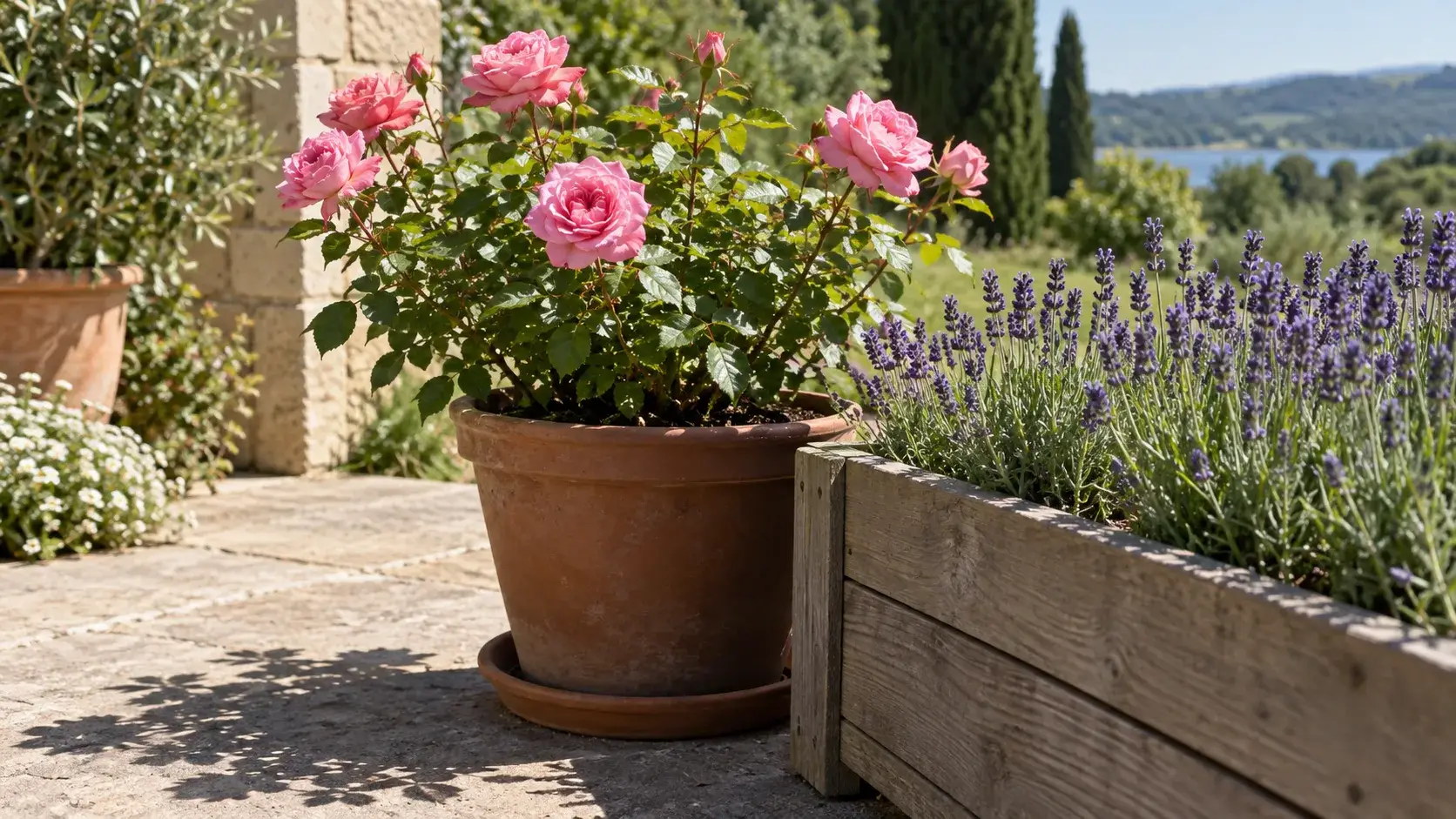
- Suitable types: patio and miniature roses in pots 23 to 35 cm (9 to 14 in) deep 14.
- Balconies: use the same light test as in the garden. The source favors south, east, or west in its Northern Hemisphere setting; a north balcony without direct sun will not make a rose flower. Actual sunlight matters elsewhere. See balcony planters for ideas by orientation.
- Indoors: miniature roses sold in flower, 20 to 60 cm (8 to 24 in) tall, need plenty of light; the University of Florida considers them better suited to outdoors 3. After flowering, move them to a sunny windowsill or balcony once frost has passed.
Contenant, substrat, rempotage : growing roses in pots demande un suivi plus serré qu'en pleine terre.
Moving a poorly placed rose
A rose struggling for lack of sun benefits more from moving than feeding. Move it during dormancy, within the SFR's French bare-root planting window of November to early April, with soil neither frozen nor waterlogged 4. Elsewhere, follow local dormancy and soil conditions.
Choose the new site by the same checks: at least 4 hours of sun, 6 m (20 ft) from trees, and air around it. And never reuse a former rose site without changing the soil: the SFR considers such sites unsuitable for 7 to 8 years, recommending replacement at least 50 cm (20 in) deep because of replant disease 8. See the complete rose care guide for planting steps.
Après un déménagement ou un hiver à l'ombre : pruning a rose se fait à une date propre à chaque type.
Frequently asked questions
What is the best exposure for a rose?
An open south- or west-facing site in the source's Northern Hemisphere setting, providing 6 hours or more of direct sun 2. East works if it provides at least the RHS's 4 hours 1; only a few tolerant varieties flower on the shaded north side. Elsewhere, use actual sunlight rather than direction alone.
Do roses like full sun?
Can I plant a rose in shade?
Which climbing rose suits a north-facing wall?
Can I plant a rose under a tree?
Can a rose live indoors?
Not long-term. Even miniature roses sold in flower need plenty of light and live better outside 3. Keep one at your brightest window while it flowers, then place it on a sunny balcony or windowsill.