
Growing roses in pots
How to grow a rose in a pot
A rose can thrive in a pot if you choose a suitable type, such as a patio, miniature, groundcover, or small climbing rose, and a deep container: 23 to 35 cm (9 to 14 in) for small types, at least 30 to 45 cm (12 to 18 in) for others. Pots dry out quickly and freeze quickly: they may need daily summer watering, feeding every fifteen days in the growing season, and root-ball protection in cold winters.
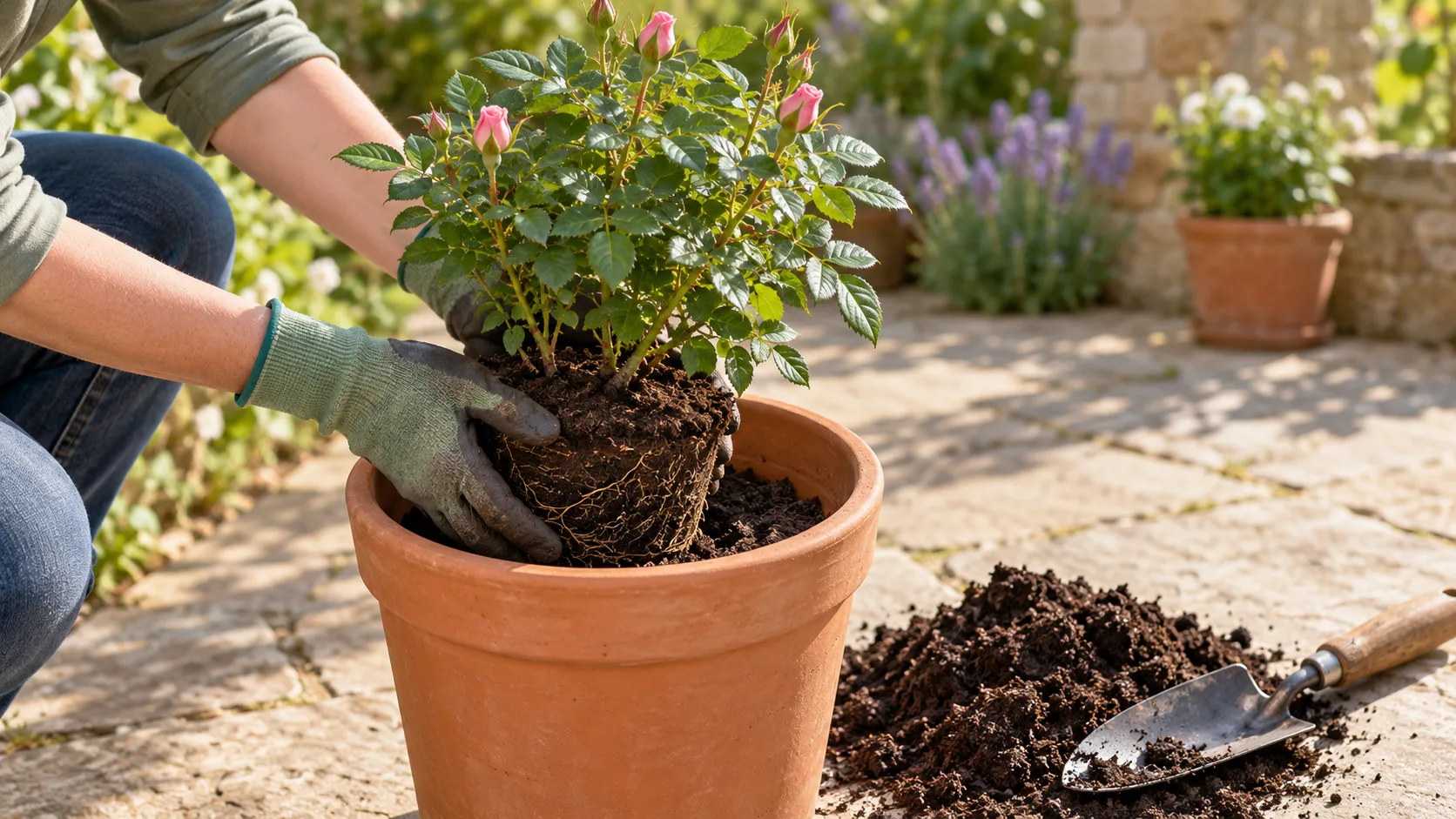
Yes, a rose (Rosa) can grow in a pot for years, provided you choose a suitable type. The Royal Horticultural Society (RHS) makes this clear from the outset: not every rose thrives in a container1. A pot makes the plant movable and gives you control over its soil, but removes the water reserve and protection from cold that the ground would provide.
Can a rose stay in a pot for life?
Patio and miniature roses are bred for container growing. The RHS also includes less vigorous groundcover roses, some climbers, and half-standard roses around 1.50 m (5 ft) tall for a more formal balcony. Some miniature patio climbers reach 2 m (6.5 ft)1.
It lists varieties proven in containers: 'Anna Ford', 'Regensberg', 'Sweet Dream', 'Queen Mother', 'Laura Ford', 'Nice Day', and the groundcover 'Magic Carpet'1. A large bush rose or vigorous rambler will stay cramped and need constant attention.
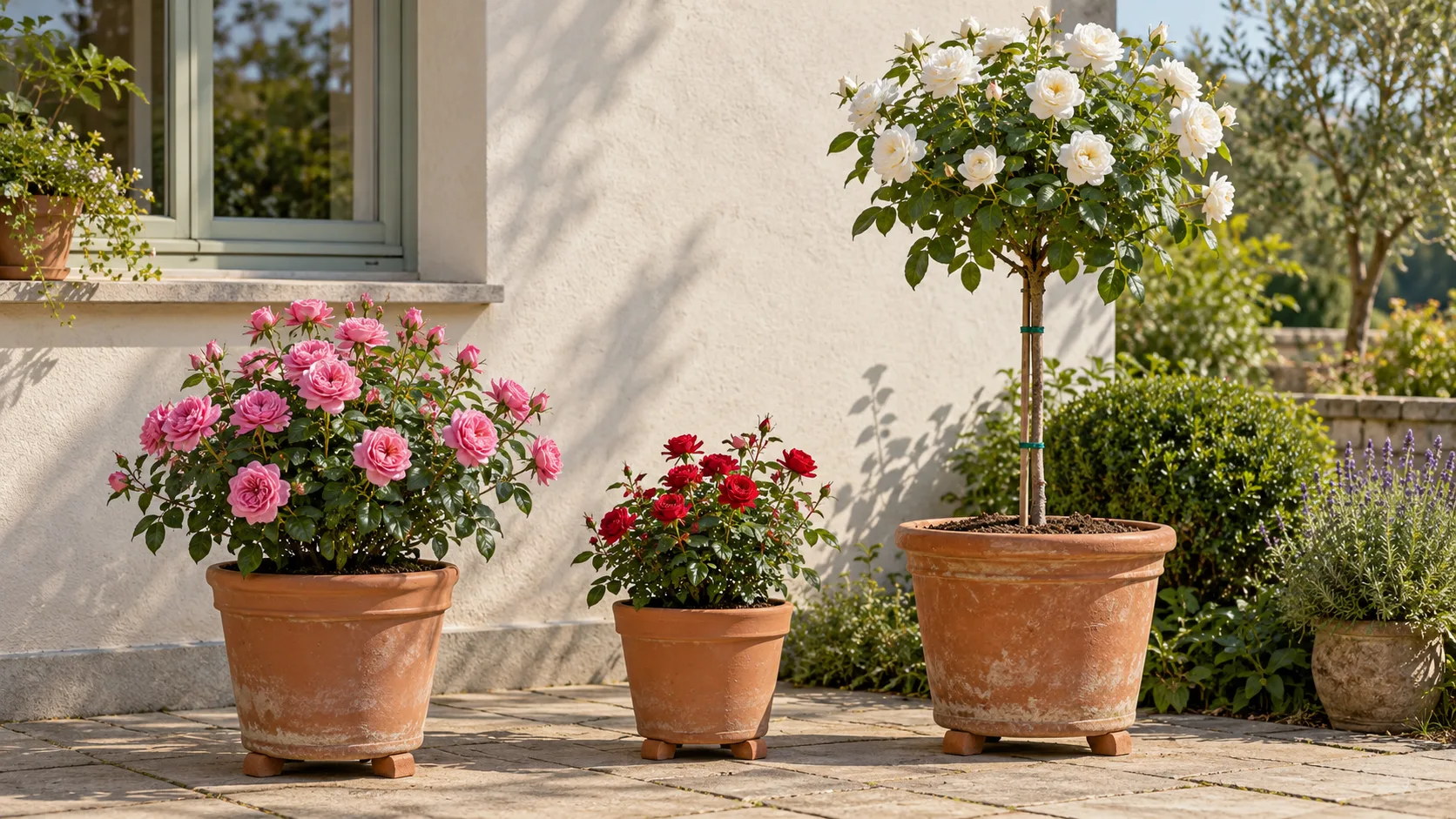
| Rose type | Size and habit |
|---|---|
| Patio or miniature rose | Small, compact1 |
| Less vigorous groundcover rose | Spreading1 |
| Miniature or less vigorous climber | Up to about 2 m (6.5 ft)1 |
| Half-standard | About 1.50 m (5 ft)1 |
What kind of pot does a rose need?
Depth matters more than width: roses send their roots downward. Allow 23 to 35 cm (9 to 14 in) of depth for a patio or miniature rose and at least 30 to 45 cm (12 to 18 in) for a groundcover rose or climber1.
Position the pot before filling it: once planted, it quickly becomes too heavy to move1. Choose a spot with sun for at least half the day and, if possible, shade the pot while keeping the plant in sun to cool the roots1.
Drainage comes first. If water stops draining freely, check for blocked holes or old, compacted mix2. A saucer helps during summer droughts, but remove it for a cold, dormant winter2.
What potting mix should I use for roses?
Use a peat-free, loam-based potting mix, such as John Innes No. 3, which the RHS recommends for plants that will remain in place for several years1. Look for loam-based potting mix: it lets a rose stay for years without the root ball collapsing.
Potting mix still ages: as it decomposes, it becomes dense and waterlogged, and drainage stops2. This is why replacing the top layer every two years matters, as explained below.
Watering a potted rose through the seasons
In summer, a potted rose may need water every day. The RHS waters as needed, sometimes daily in hot weather, without letting the root ball dry out or stay waterlogged3. It checks moisture daily in hot or windy weather and twice daily during a heat wave2.
68 cL every 7 days
Every day
Use this cue: water when the mix is dry 2 or 3 cm (about 1 in) below the surface4. Pour at the base, keeping leaves and flowers dry to reduce foliage diseases3. Repeated dry spells also make a container rose vulnerable to powdery mildew15.
A dormant rose needs very little water in winter, and you should never water when frost is forecast2.
Quantité, moment de la journée et signes de soif : watering roses se règle sur la saison et sur le pot.
Feeding a potted rose
A pot's nutrients run out quickly: feed every fifteen days from midspring to late summer where these are the active growing months. The RHS starts with a balanced liquid fertilizer, then changes to a high-potassium fertilizer, such as tomato feed, when the first buds appear3. Each spring, it also applies granular rose fertilizer to the surface1.
- Feeding
- During active growthLiquid fertiliser · from mid-spring to late summer · in a potSource: Royal Horticultural Society
- No fertilizer
- In autumnfrom late August in the source’s temperate Northern Hemisphere calendar, to avoid soft new growth · in a potSource: Royal Horticultural Society
- Frequency
- Every 15 daysin a potSource: Royal Horticultural Society
- Avoid
- Excess nitrogen, applying fertilizer to a dry root ball, exceeding the dose on the labelSources: Royal Horticultural Society; Washington State University
Stop after August in the RHS's UK calendar: tender growth from late feeding is vulnerable to cold1. In your climate, let the end of active growth and approaching cold set the cutoff.
Formule, dose et engrais maison : fertilizing roses se choisit selon le pot ou le jardin.
Protecting a potted rose in winter
In a pot, roots freeze first: the container wall protects them much less than the ground. Where winters are harsh, Iowa State University offers two options6:
- Bring indoors
- Novemberpot sunk into the garden soil or stored somewhere frost-free · in a potSource: Iowa State University Extension
- Move back outside
- Marchmid-March in the source’s temperate Northern Hemisphere calendar, before bud break · in a potSource: Iowa State University Extension
- Bury the pot in a sheltered garden spot once the rose is dormant, in mid- to late November in Iowa's calendar. Mound soil over the bottom 15 to 20 cm (6 to 8 in) of stems, then surround the base with 30 to 60 cm (12 to 24 in) of straw held by wire mesh6.
- Store it in an unheated garage or shed that stays between −1 and 7 °C (30 and 45 °F)6.
In either case, bring the pot back out in mid-March in Iowa's calendar, after severe cold but before buds begin growing6. Elsewhere, use those local temperature and growth conditions to time the move.
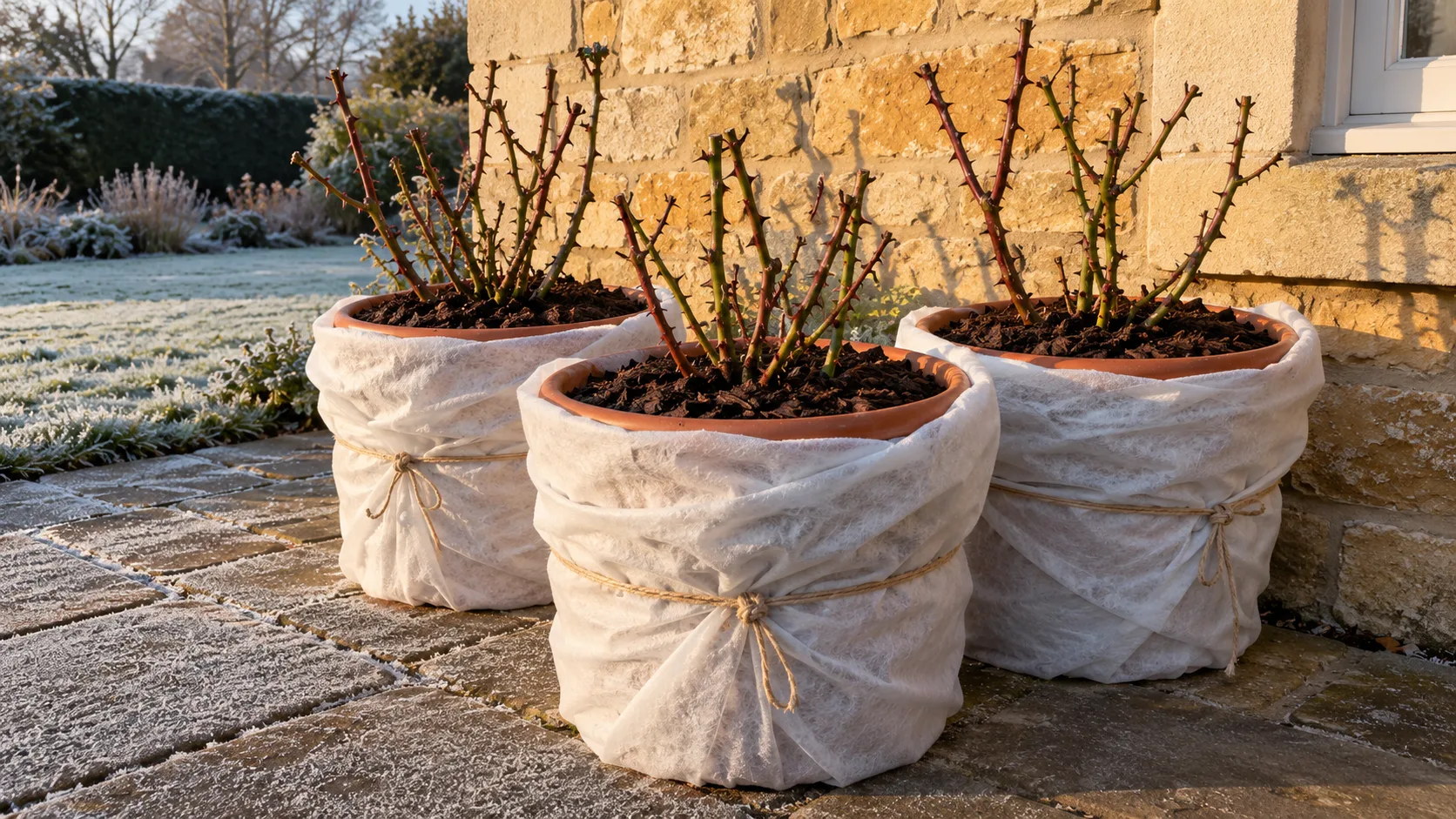
In a milder climate, grouping pots against a house wall to shelter the roots and wrapping them in horticultural fleece is often enough: thick fleece provides about 2 °C (3.6 °F) of extra protection2. Add 5 cm (2 in) of compost mulch between late fall and late winter where those are the dormant seasons1.
Repotting or top-dressing a container rose
Every two years, replace the top 5 cm (2 in) of mix with fresh mix1. This top-dressing nourishes the rose without disturbing it.
- Repot
- Every 3 to 5 yearsGeneral guideline for potted plants · in a potSource: Royal Horticultural Society
- Repot
- Every 2 yearsTop-dress with 5 cm (about 2 in) of fresh potting mix · in a potSource: Royal Horticultural Society
- When to repot
- October to AprilContainer-grown rose · in a potSource: Royal Horticultural Society
- When to repot
- NovemberBare-root rose · in a potSource: Royal Horticultural Society
- The new pot
- 2,5 to 5 cm widerfor a pot less than 25 cm (about 10 in) in diameterSource: Royal Horticultural Society
- Pot depth
- 23 to 35 cmPatio or miniature roseSource: Royal Horticultural Society
- Pot depth
- 30 to 45 cmGround-cover rose or small climberSource: Royal Horticultural Society
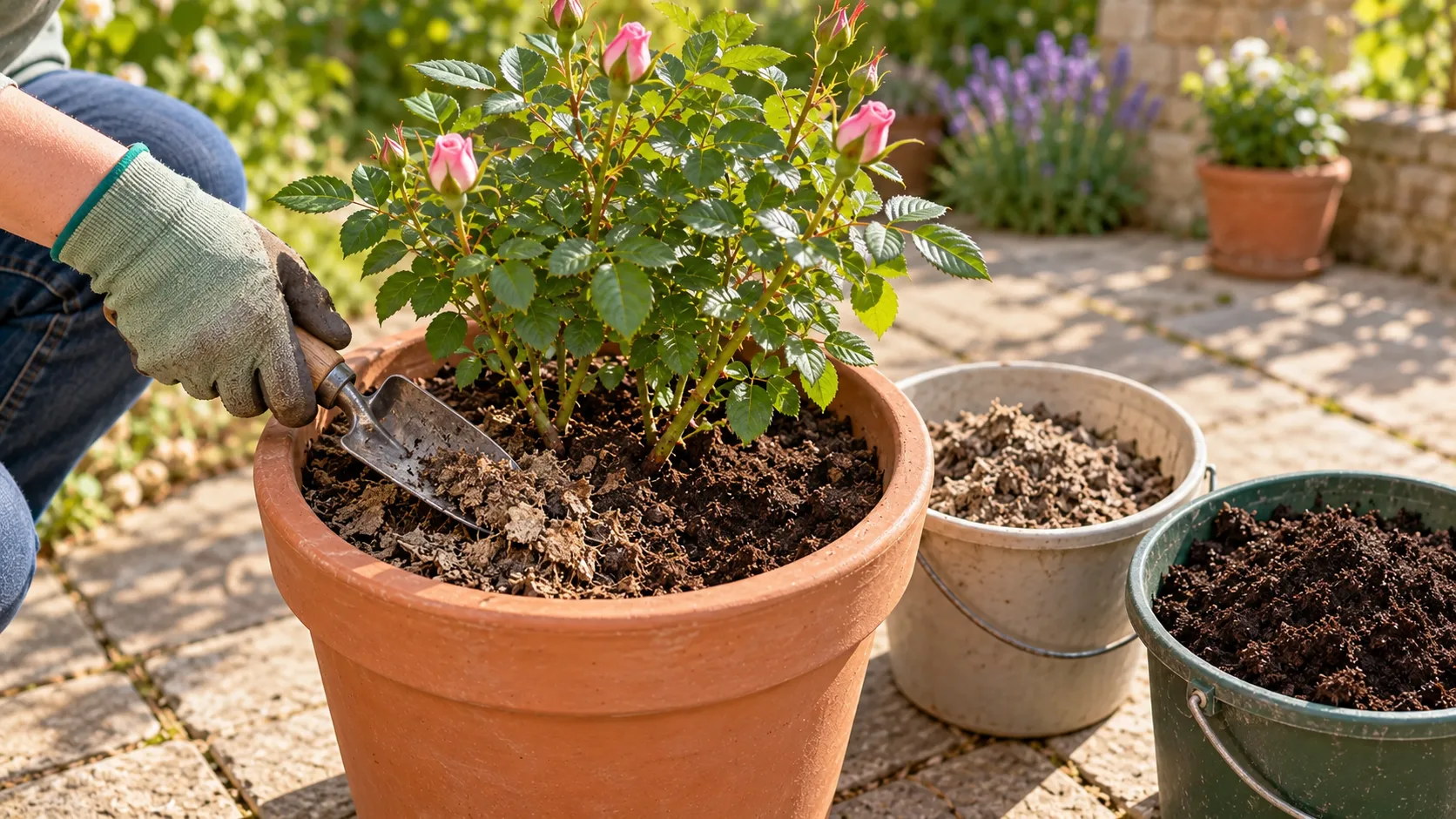
Repot when roots circle the walls or grow through drainage holes: the RHS recommends lifting out the root ball to check7. The new pot should be no more than one-third larger; below 25 cm (10 in) in diameter, add 2.5 to 5 cm (1 to 2 in) in width and depth7. In the RHS's UK calendar, container-grown roses are potted from October to April, preferably in November for bare-root roses1. Elsewhere, follow local dormancy and suitable unfrozen soil conditions.
Dépoter, tailler les racines et choisir le bon pot : repotting a rose se fait au repos, entre l'automne et le printemps.
Add your balcony rose: Floralens reminds you to water and fertilize, season by season (Pro mode). Get reminders
Frequently asked questions
How do I grow a rose in a pot?
Choose a patio, miniature, groundcover, or small climbing rose. Use a pot 23 to 35 cm (9 to 14 in) deep for small types and at least 30 to 45 cm (12 to 18 in) for others, filled with peat-free, loam-based mix1. Give it sun for at least half the day, water when the mix dries, and feed every fifteen days during active growth3.
What soil does a potted rose need?
A peat-free, loam-based potting mix, such as John Innes No. 3, made for plants that will stay in place for several years1. It compacts less quickly than a light all-purpose mix.
Should I bring a potted rose inside for winter?
In a region with harsh winters, yes: Iowa State recommends burying the pot in the garden in mid- to late November or storing it in an unheated shelter at −1 to 7 °C (30 to 45 °F), then bringing it back out in mid-March6. These are Iowa's calendar examples; follow local dormancy, cold, and bud growth elsewhere. In a mild climate, grouping pots against a wall and wrapping them in fleece is often enough2.
Does a potted rose need a lot of water?
Which roses are best for pots?
A patio or miniature rose bred for containers, or a less vigorous groundcover rose or climber. The RHS lists 'Anna Ford', 'Sweet Dream', 'Laura Ford', and 'Magic Carpet'1.